

Writing an acceptance speech means finding the right words for a moment when everyone’s waiting to hear what you’ll say.
Where do you start? How do you thank the leader, the endless people and the organization who got you there without turning your speech into a roll call? How do you make a few minutes at the microphone mean something?
After years of interviewing experts and hearing their stories, I’ve come to appreciate how much thought goes into communicating a message that leaves an impact and inspires everyone present.
The best acceptance speeches make the audience feel something while giving the speaker room to be genuine regardless if it’s for the Hall of Fame, an Academy Award, or a unique token of appreciation on behalf of former staff.
I’ll show you how to plan, structure, write, and practice your great acceptance speech, so you can express genuine gratitude, share a story worth hearing, keep your timing under control, and leave the audience with a message they’ll remember long after you leave the stage no matter the circumstance.
What Is an Acceptance Speech?
An acceptance speech is a short speech you give after receiving an award, recognition, or professional honor. It gives you a chance to thank the people who helped you reach that moment, share what the recognition means to you, and say something the audience can take away.
You might deliver one at an industry awards night, a company ceremony, a film festival, or an international event like the Nobel Prize ceremony.
The Elements of Good Acceptance Speeches
What makes an acceptance speech worth listening to? Think about the last awards ceremony you watched: the speeches you remember probably gave you a reason to care about the person holding the trophy.
Aim to include these six elements when writing your own acceptance speech:
- A strong opening: Open with a surprising reaction, like admitting you rehearsed your speech in the car three times but still can’t believe you’re standing onstage at the Webby Awards.
- Sincere gratitude: Thank the people who helped you reach this moment, from the mentor who reviewed your first book proposal to the partner who kept your coaching business running during launch week.
- Acknowledgment of contributors: Recognize the people behind the achievement by naming the research team, event producers, editors, or colleagues who helped bring your project to life.
- A meaningful story: Share a specific turning point, like the first client who booked your $3,000 coaching program after attending a free workshop you almost canceled.
- Natural humor: Thank your business partner for surviving three years of late-night Zoom calls or joke that your kids finally have proof those weekends spent building your coaching business paid off.
- A memorable closing: Leave the audience with a meaningful thought, like dedicating your award to the first-generation entrepreneurs who are still building their businesses from kitchen tables and spare bedrooms.
For toasts, tributes, and other moments like it, see these special occasion speech examples.
How to Write Acceptance Speeches (Checklist)
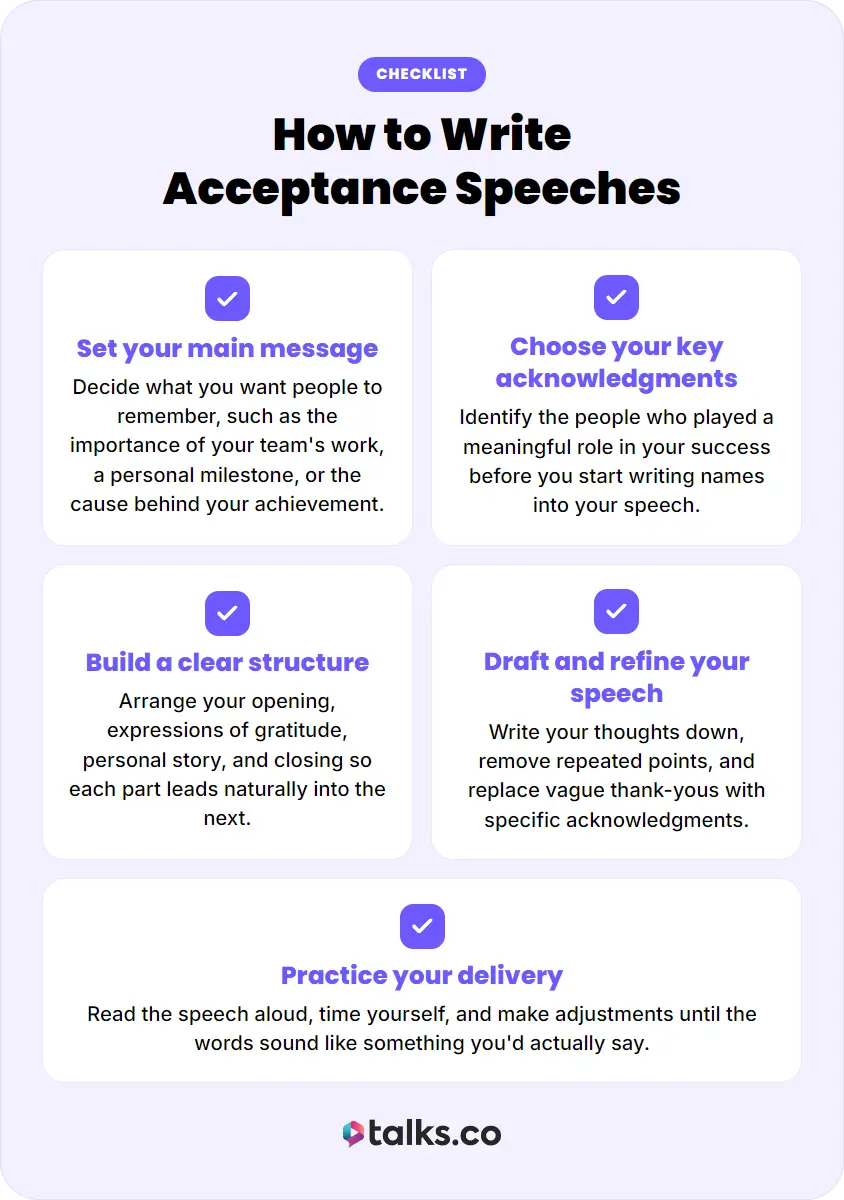
Writing a good acceptance speech takes a bit of planning, especially when you’ve got years of work and several people to thank in just a few minutes.
Work through these steps to decide what to say, organize your message, and prepare a speech that feels natural when you deliver it:
☐ Set your main message: Decide what you want people to remember, such as the importance of your team’s work, a personal milestone, or the cause behind your achievement.
☐ Choose your key acknowledgments: Identify the people who played a meaningful role in your success before you start writing names into your speech.
☐ Build a clear structure: Arrange your opening, expressions of gratitude, personal story, and closing so each part leads naturally into the next, and sketch it as a speech outline first.
☐ Draft and refine your speech: Write your thoughts down, remove repeated points, and replace vague thank-yous with specific acknowledgments.
☐ Practice your delivery: Read the speech aloud, time yourself, and make adjustments until the words sound like something you’d actually say.
How long should an acceptance speech be?
Most acceptance speeches work best between one and three minutes, although the event organizer’s instructions should determine your actual limit.
Before writing, check how much time you’ve been given so you can decide how much gratitude, storytelling, and reflection will fit your type of speech.
- Under 1 minute: Keep it to a brief thank-you, such as recognizing your team at a local business awards ceremony and dedicating the recognition to their work.
- 1-2 minutes: Thank your closest supporters, share one personal detail, and explain what the award means to you.
- 2-3 minutes: Add a short story about a defining moment, such as the night you almost declined your first podcast invitation and said yes at the last minute.
- 3-5 minutes: Use the extra time for broader acknowledgments, a meaningful reflection, and a message connected to your industry or community, provided the event allows it.
- Word count: Aim for about 130 words per minute, so a two-minute speech runs close to 260 words.
How to write an acceptance speech
Once you’ve settled on your time limit, start drafting the actual speech. Give your audience a reason to listen from the opening line, make your gratitude personal, and connect your achievement to a story or experience that explains why the recognition matters.
☐ Write the opening last: Draft your story and thank-yous in a Google Doc first, then write line one once you know what the speech is about.
☐ Rank your thank-yous: Write every name that comes to mind on a sticky note, star the ones you’d regret leaving out, and give them the first 30 seconds.
☐ Group the rest: Thank everyone else in one sentence, like “the producers, editors, and designers who stayed through the final week,” so 15 names don’t eat your minute.
☐ Pick one scene: Choose a moment with a time and a detail, like the 6 a.m. flight to your first keynote in Singapore, so listeners can see where you were standing.
☐ Test your joke on one friend: Read it to someone before the ceremony, and if they don’t smile, cut it and keep the thank-you.
☐ Connect the award to a bigger purpose: Explain how the recognition relates to the people you serve, the work you care about, or the change you hope to make in your industry.
☐ Write a quotable last sentence: Keep it around 12 words, short enough to post as a LinkedIn caption.
For the general process behind any talk, see how to write a speech.
How to make acceptance speech practice effective
With your first draft in place, give it the same attention you’d give a presentation to a room full of potential clients. Read it aloud, check how each sentence sounds, and make sure your delivery feels comfortable rather than overly rehearsed.
Read it out loud: Practice in front of a mirror or record yourself on your phone to catch awkward phrases and sentences that sound stiff, then compare your pacing with an episode from one of the most popular podcasts.
Test it on one listener: Read the draft to a friend over Zoom and ask which line they’d repeat tomorrow, then keep that line and trim whatever they forgot.
Mark your pauses: Add breathing room after an emotional story, a funny remark, or an important acknowledgment so the audience has time to react.
Practice with a timer: Run through the speech three times using your phone’s stopwatch and aim to finish comfortably within the event’s limit.
Prepare for the microphone: Practice speaking into a handheld microphone at a comfortable distance and projecting your voice across a room, the way an emcee does at a live event.
Keep a printed backup: Bring a large-font copy of your speech in case the teleprompter fails, your phone battery runs low, or nerves make it harder to remember your next line.
Rehearse your final sentence: Practice delivering your closing slowly and clearly so you can finish your speech without rushing off the stage.
Examples of Acceptance Speeches
Acceptance speeches follow a few repeatable moves, and these eight examples break each one down so you can study the structure here, then rehearse it with your own thank-you list.
Every breakdown ends with a drill you can run in five minutes, whether you’re accepting an award, giving a toast, or closing out a podcast guest appearance with a thank-you.
Examples of award acceptance speeches
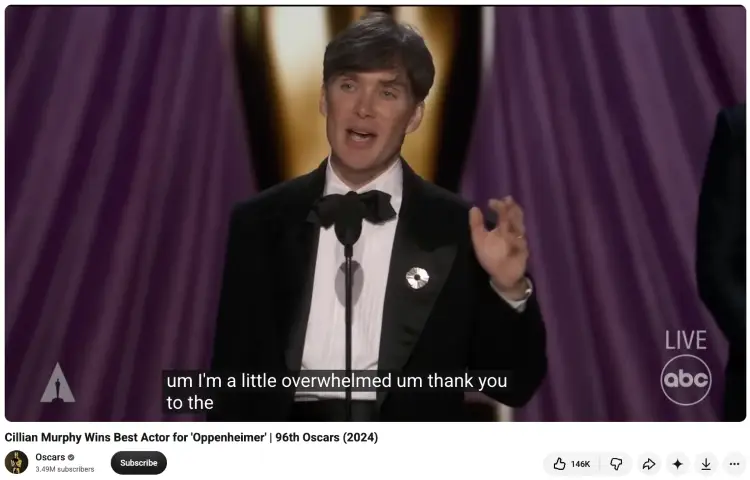
Cillian Murphy’s Best Actor speech at the 2024 Oscars is a compact example of an award acceptance speech: about a minute of thank-yous, one personal line, and one dedication.
- Thank the people who shaped the work: He credits the Academy, director Christopher Nolan, producer Emma Thomas, and every cast and crew member on Oppenheimer.
- Add one personal line: He thanks his team, his partner, and his two sons, then calls himself a proud Irishman in a single sentence.
- Close with a dedication: He ties the film’s subject to a wider hope and dedicates the award to peacemakers everywhere.
Talks Tip: I still get nervous before I speak, and I feel better when I’ve prepared and practiced, so write your thank-you list a day early and add anyone you remembered overnight, since nerves make names disappear.
Acceptance speech example
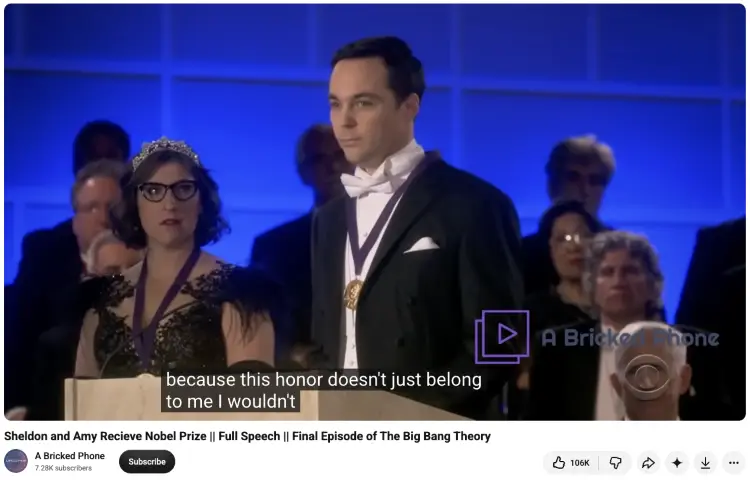
Sheldon and Amy’s Nobel Prize scene in the 2019 finale of The Big Bang Theory (fictional, from the TV show) is a clean acceptance speech example, because it runs in under four minutes and follows a five-step template.
- Thank the committee, then speak to someone: Amy thanks the Nobel Committee, then tells young girls who dream about science to go for it.
- Set the script aside: Sheldon puts down his “very long and somewhat self-centered speech” and says the honor belongs to the people around him.
- Thank by name: He asks his friends to stand and names each one, so every thank-you has a face.
- Close in one personal line: He apologizes for not always being the friend they deserved and ends by telling them he loves them.
Talks Tip: Name three people out loud, give each one a reason in one sentence, and notice how it sounds less like a roll call.
Best acceptance speeches
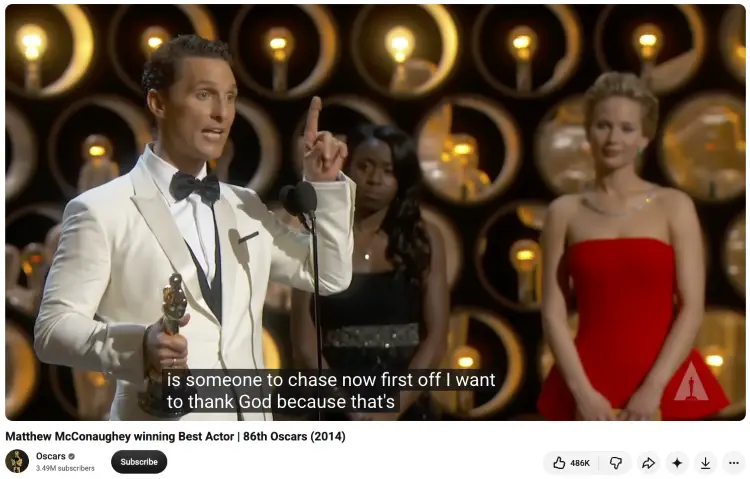
Matthew McConaughey’s 2014 Best Actor speech is often named among the best acceptance speeches because it hands the audience one idea they can carry out of the room.
- Open with three things: He says he needs something to look up to, something to look forward to, and someone to chase, then builds the whole speech around them.
- Map each thank-you to one of the three: God is who he looks up to, his family is what he looks forward to, and his hero is who he chases.
- Tell one story: At 15 he told a mentor his hero was himself in 10 years, and at 25 he gave the same answer, because his hero is always 10 years away.
- End on your signature: He closes with the catchphrase fans know him for.
Talks Tip: Choose your own three things before you write a word, then match each person on your thank-you list to one of them.
Famous acceptance speeches
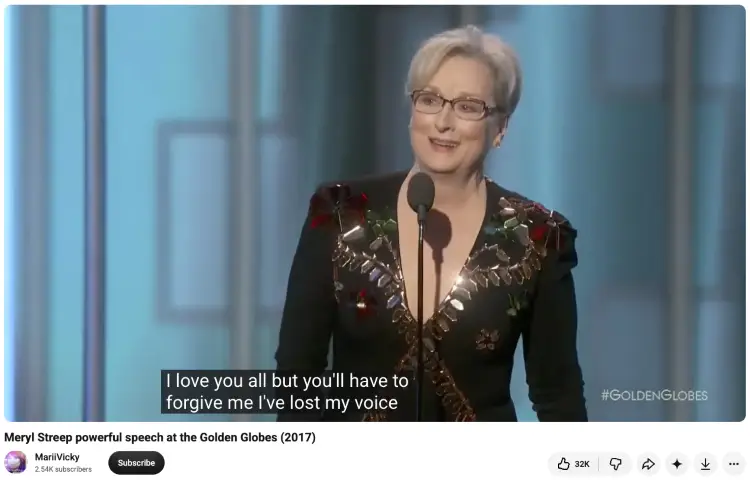
Meryl Streep’s Cecil B. DeMille Award speech at the Golden Globes is one of the most famous acceptance speeches of the last decade, and it moves from a joke to a call to action in about five minutes.
- Open with a shared truth: She says the people in the room belong to groups many Americans love to criticize: Hollywood, foreigners, and the press.
- Name specific people: She walks through birthplaces, from Viola Davis in a sharecropper’s cabin in South Carolina to Amy Adams in Italy, Natalie Portman in Jerusalem, and Dev Patel in Kenya.
- Use one joke to turn: She says that if you removed every outsider, you’d have nothing to watch but football and mixed martial arts.
- Make your point and your ask: She describes a moment when someone seeking the country’s highest office imitated a disabled reporter, explains how that behavior spreads, and asks the room to support the Committee to Protect Journalists.
- Close with borrowed words: She ends with advice from her late friend Carrie Fisher, “take your broken heart, make it into art.”
- Practice it: Write your own opening as a sentence about “people like us,” add three specific names or places, then finish with one ask you’d make of the room.
Grammy acceptance speeches
Bad Bunny’s 2026 Grammys speech for Best Musica Urbana Album shows how a Grammy acceptance speech can put the message first and the thank-yous last.
- Say the headline first: Before he thanks God, he opens with a pointed line that gets the room cheering.
- Use short, plain sentences: He says what people are not, then says they’re humans and Americans, in a run of short sentences.
- Give the room one line to repeat: “The only thing that is more powerful than hate is love.”
- Tell them what to do: He asks that anyone who fights do it with love.
- Thank people last: Thanks to God and the Academy arrive in the final seconds.
- Practice it: Write a two-minute speech with your single message in the first sentence, then move your thank-yous to the last 15 seconds.
Acceptance speech Nobel Prize
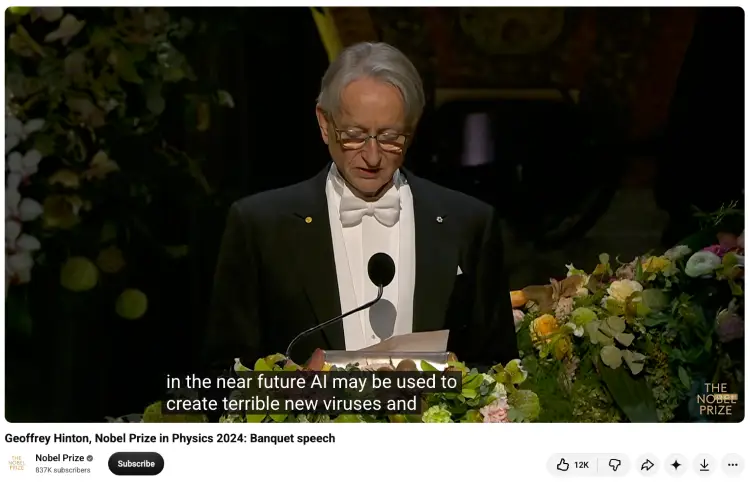
A Nobel Prize acceptance speech is usually a short banquet address in Stockholm, and Geoffrey Hinton used his 2024 Physics banquet speech at Stockholm City Hall to share a hope and a warning.
- Open with the good news: He credits the Nobel committees for recognizing neural networks and says the technology could raise productivity in almost every industry.
- Separate short-term from long-term: He lists near-term risks like echo chambers, surveillance, phishing, and automated weapons, then turns to a longer-term threat from digital beings smarter than we are.
- Ask for one thing: He calls for research on keeping those systems from wanting control and ends on “They are no longer science fiction.”
- Practice it: Take any topic you know well and fill in three sentences, one for the benefit, one for the risk, and one for the ask, then say them in under two minutes.
Funny acceptance speeches
Adam Sandler’s 2023 Mark Twain Prize speech is a funny acceptance speech because the jokes carry the thank-yous, and the sincere stretch in the middle makes the ending hit harder.
- Open with a joke at your own expense: He thanks his friends for coming because Nicholson, Hoffman, and Pacino had dinner reservations they couldn’t cancel.
- Tease your family, then apologize: He jokes about his mother and the pistachios, then tells her he’s sorry for years of jokes about her.
- Turn sincere in the middle: He tells the story of his parents, sisters, and brother making him feel like the star of the family, including his first standup set at 17 at Stitches in Boston, where a heckler yelled about his retainer.
- Close with a callback: He thanks the room for building his confidence, then lists talents his friends have talked him into believing he has, including “best cheek smell.”
- Practice it: Pick one running joke for your opening, write one sincere minute for the middle, and bring the joke back in your last line.
Award acceptance speeches
An award acceptance speech works best when it tells one personal story, and Ke Huy Quan’s 2023 Best Supporting Actor speech for Everything Everywhere All at Once does it in about two and a half minutes.
- Start with someone at home: He speaks straight to his 84-year-old mother, who’s watching at home.
- Compress your journey: In four sentences, “my journey started on a boat” and ends on Hollywood’s biggest stage, with a year in a refugee camp in between.
- Link your story to a bigger idea: He says stories like this only happen in the movies, then calls his path the American dream.
- Credit the person who believed: His wife Echo told him for 20 years that his time would come.
- Hand the audience the lesson: He says he almost gave up on his own dream and asks everyone to keep theirs alive.
- Practice it: Write the sentence your first believer would say to you, then say your whole journey in four sentences.
Now’s Your Time to Shine
The best acceptance speeches give people a reason to remember the person behind the award. Give yours a strong opening, genuine thank-yous, a story worth sharing, and a closing line that stays with the audience.
And if you’re building a name as a coach, author, consultant, or speaker, why wait for an awards ceremony to get your voice heard?
Talks helps you connect with podcast hosts in your niche, find relevant interview opportunities, and get your expertise in front of audiences already interested in what you have to say. You can even automate matching and outreach.
Create your free Talks Creator Profile and start getting booked in as quick as 5 minutes!


