
Did you say yes to moderate a panel and five seconds later your brain went: “Oh no… what am I actually supposed to do?”
Maybe you’re stressing about good moderator questions in advance? Or keeping one panelist from dominating? Pulling the others out of hiding?
Relax.
You don’t need to be loud, funny, or extroverted. You need the playbook for every moderating rookie. One that keeps the conversation flowing, the panelists in check, and the audience awake and listening actively.
Follow these steps on how to moderate a panel discussion, and suddenly, public speaking and being the moderator don’t feel terrifying.
It feels… possible.
What Is a Panel Discussion?
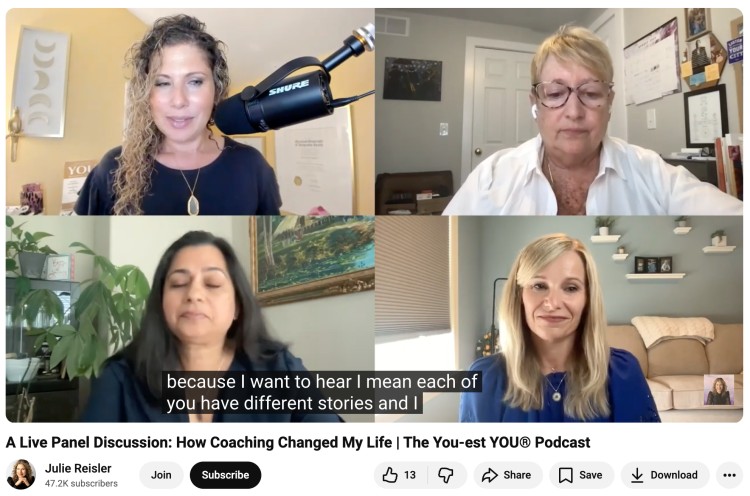
A panel discussion is a structured conversation where experts share insights and answer questions from the audience, all guided by a moderator.
But what is the role of the moderator?
A really good moderator asks sharp questions while staying neutral, engages both the speakers and the audience, and maintains the energy and rapport in real time effectively.
Live, virtual, or hybrid, panels and deliver multiple impactful perspectives fast, focused, and more dynamic than a lecture.
Why panel discussion is important for visibility
Panels put you onstage with experts and multiply your visibility fast. You’re seen, quoted, and remembered.
- Credibility boost: Prove you’re quick on your feet.
- Moderator spotlight: Run the room without shouting.
- Audience engagement: Keep energy high and people involved.
- Repurposable content: Clips, quotes, posts for days.
- Authority growth: Stand beside leaders and get taken seriously.
What makes a good panel discussion?
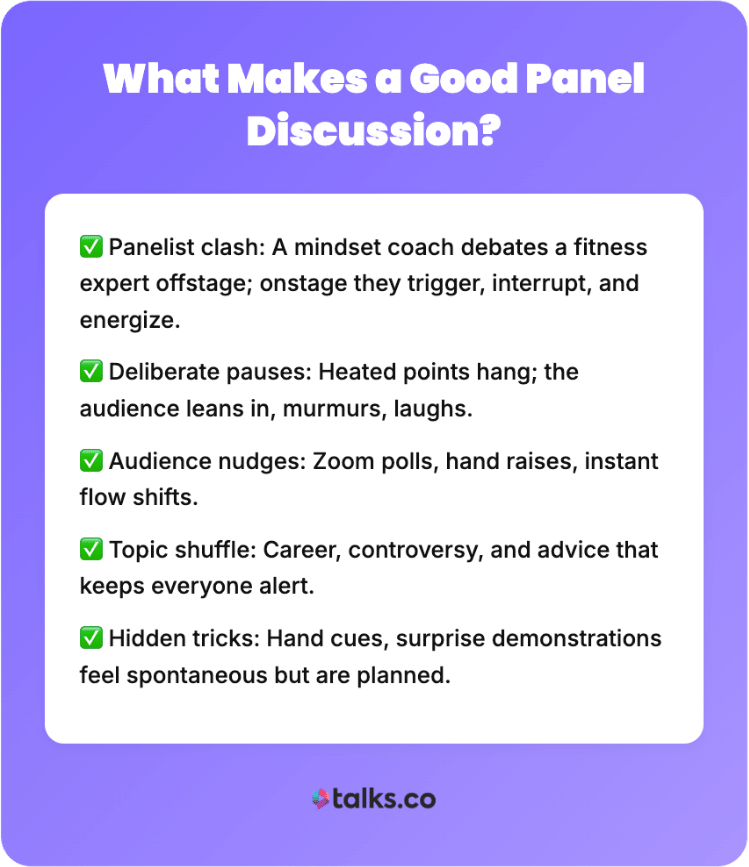
Good panels stick. They have tension, quirks, and surprises you can’t script.
- Panelist clash: A mindset coach debates a fitness expert offstage; onstage they trigger, interrupt, and energize.
- Deliberate pauses: Heated points hang; the audience leans in, murmurs, laughs.
- Audience nudges: Zoom polls, hand raises, instant flow shifts.
- Topic shuffle: Career, controversy, and advice that keeps everyone alert.
- Hidden tricks: Hand cues, surprise demonstrations feel spontaneous but are planned.
What Is a Panel Discussion Format?
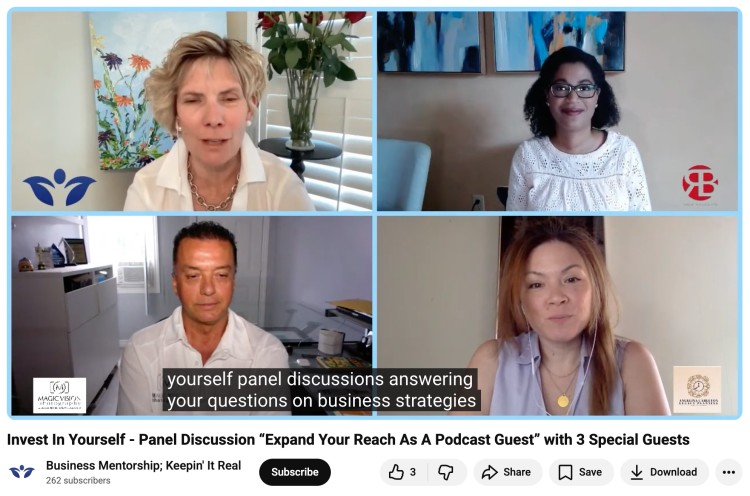
Panel discussion formats vary, but the most common setups include:
- Traditional panel: One moderator, 3-5 panelists, audience Q&A. Most common for conferences and webinars.
- Roundtable: Smaller, more intimate group than a 4-person setup. Conversation is less formal, more collaborative. Ideal for masterminds or focused discussions.
- Fireside chat: Moderator + one expert. More conversational, less structured. Good for storytelling and deep dives.
- Virtual/hybrid panels: Online platforms require extra planning, e.g., clear cues, muting/unmuting, managing tech issues, and keeping virtual attendees engaged.
How many panelists are there in a discussion?
There’s no set rule on how many panelists should be in a discussion. It’s about how much energy, variety, and control you, as the moderator, can handle.
- Fewer than 3: Easier to manage, but risks the discussion feeling narrow or predictable.
- 3 to 4: Balances variety with manageability; gives quieter panelists room to contribute.
- 5 to 6: Easily starts up lively debates, but you need to actively draw out quieter voices.
- 7 or more: High risk of chaos; requires pre-planned roles and laser focus on timing.
How long should panel discussions be?
Panel discussion length depends on attention, panelist count, and content depth.
- 20-30 min: Fireside chats or one-on-one deep dives.
- 30-40 min: Small roundtables or masterminds.
- 45-60 min: Standard conference panels with 3-5 panelists plus Q&A.
- 60-75 min: Multi-topic panels that break into 15-20-min segments.
- 30-45 min (virtual): Shorter attention spans; include buffer for tech glitches.
How Do You Prepare for a Panel Discussion? (Checklist)
Here’s how you make the panel discussion look effortless, even if you’re sweating behind the scenes.
☐ Map panelist personalities: Spot talkers, quiet thinkers, and likely clash points.
☐Know your audience: Who’s in the room or on Zoom? Shape tone and questions.
☐ Line up your openings: Decide who starts, who follows, and your pivot lines.
☐ Script the flow: Time topics, transitions, and key points to repeat.
☐ Audience engagement hacks: Polls, reactions, fast hand checks.
☐ Run a rehearsal: Test tech, names, slides, and handoff cues.
☐ Create a content plan: Mark quotable moments for post-event sharing.
☐ Plan for curveballs: Backup questions for no-shows, rants, or tech issues.
☐ Personal prep: Review notes, hydrate, walk the session mentally.
How to Moderate a Panel Discussion
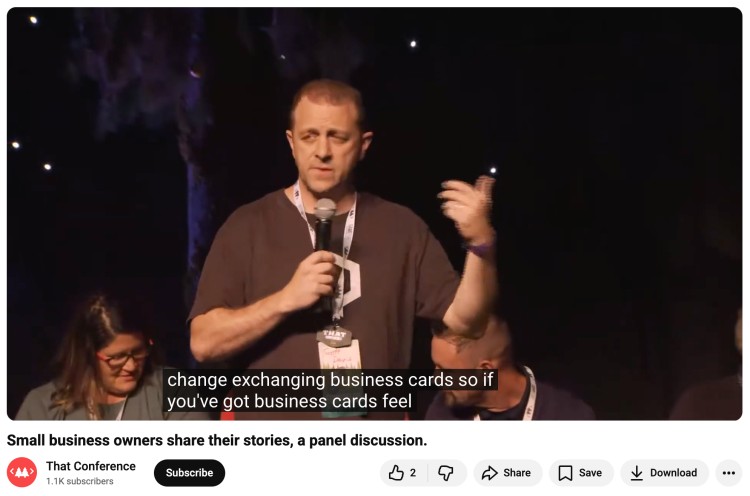
Here’s how to structure a panel discussion to keep the conversation moving and stop panels from turning into TED Talks with extra people onstage.
- 0-5 minutes (welcome & expectations): Ground rules: short answers, no pitches, no hijacking questions. Explain Q&A format.
- 5-10 minutes (panelist intros): Name, role, and why they’re relevant today. No life stories.
- 10-20 minutes (initial framing): One stat, story, or current event to anchor the topic.
- 20-45 minutes (curated questions): Call by name. “Alex, you cut 40% of staff 2 years ago. What shifted?” Avoid “who wants this?”
- 45-55 minutes (audience Q&A): Take written/live questions; interrupt speeches; keep answers tight.
- 55-60 minutes (takeaways & wrap): One concrete action per panelist.
- 60 minutes (close & logistics): Thank-yous, replay/slides, next steps, networking links.
How to moderate a panel discussion script template
Treat this as your plug-and-play run of show. Adjust timing based on how long the panel runs.
Welcome:
“Hi everyone, I’m [Your Name]. Today we’re talking about [Topic]. I’ll keep the conversation moving and make it useful for you.”
Ground rules:
“Short answers, no mini speeches, jump in if you disagree, and keep self-promotion minimal.”
Panelist intros:
“In one sentence, tell us your name, role, and why this topic matters to you right now.”
Set context:
“Here’s what’s happening in [Industry/Topic] that makes this conversation important…”
Questions + follow-ups:
- “[Start with a specific question].”
- “Can you give an example?”
- “What did you do next?”
- “What would you do differently now?”
Audience Q&A:
“Short questions, short answers. If it turns into a speech, I will cut you off with love.”
Takeaways:
“One concrete action in under ten seconds from each of you.”
Close:
“Thank you for being here. If you want to keep the conversation going, find the panelists after the session.”
How to start a panel discussion as a moderator
The first 60 seconds decide if people lean in or mentally leave. Here’s how to effectively moderate a panel discussion:
- Name the real problem in the room: “You’re here because this issue is messy, political, and affects your money.”
- State the promise: “By the end of this panel, you’ll know what to try, what to avoid, and what actually works.”
- Make it human: Share a quick story. “Five minutes before walking in, one panelist told me…”
- Set guardrails: “No 10-minute answers. If you go long, I will jump in. Deal?”
- Give permission to be honest: Look at the panelists when you say, “We’re not here to be safe.” They’ll rise to the challenge and so will the room.
- Warm up panelists: Start with something easy and specific. “What’s an unpopular opinion you hold about this topic?”
How to moderate a roundtable discussion
Roundtables are riskier. There’s nowhere to hide. Everyone sees everyone. Your job is to keep it from becoming polite small talk.
- Set purpose: “This is a conversation, not a presentation. Everyone will talk at some point.”
- Define airtime: “If you’ve spoken twice already, hold back and invite someone else in.”
- Go around the table: Start with short prompts. “Complete this sentence: The hardest part of being an online life coach is…”
- Call people in by name: “I’d love to hear from you on this, Maria.”
- Shut down dominance kindly: “Let’s pause you there so others can weigh in.”
- Surface disagreement safely: “Who sees this completely differently?” Then protect them while they answer.
- Summarize out loud: “So far I’m hearing three themes…”
- Capture ideas: Ask someone to type shared notes or take photos of whiteboard stickies.
How to close a panel discussion
The end is what people remember. Don’t let it trail off awkwardly with “Uh, I guess that’s it.” Here’s how to end a panel discussion tightly every time:
- Circle back to your opening promise: “At the beginning, I said you would leave with 3 steps to becoming a highly-paid coach. You now have it.”
- Translate to action: “If you do nothing else after this session, try this first step.”
- Thank the audience intentionally: “Thanks for showing up, asking questions, and staying engaged.”
- Next step pointer: “Slides, replay, or follow-up resources will be shared by the event team.”
- Final line: Short, confident, done. “Thank you. We’re officially closed.”
How to Moderate a Group Discussion
Whether it’s inside a paid program, a free workshop, or a research session, your job as a panel moderator is simple: move people forward, uncover truth, and create momentum.
Here’s how it looks in practice.
How to facilitate a group discussion inside group coaching programs
Think weekly Zoom calls, mastermind hot seats, cohort programs, and membership communities. People are paying, so the discussion has to keep moving them forward.
- Call the room into the goal: “By the end of this call, your first draft offer is priced and written.”
- Name the elephant: “Some didn’t do the homework. You’re still welcome to share.”
- Hot seat rotation with rules: One talks, two reflect, everyone else listens.
- Interrupt kindly but firmly: “Pause. Give us the decision you made.”
- Shift from therapy to action: “Say your next physical step out loud.”
- Catch emotional moments: “Breathe. Say it again, slower.”
- Close loops: “We’re finishing the three open threads before we log off.”
- Assign micro-commitments: “Type your one action in chat. We’ll check next week.”
How to conduct a group discussion effectively to convert warm leads
Free workshops, challenges, webinars, and pop-up Zoom roundtables where they already know you. Your job is movement toward a decision, not a hard sell.
- Segment the room out loud: “Who’s undercharging right now? Hands up. Great, you’re who this call is for.”
- Let wins speak instead of you: “Two clients from last week’s cohort are here. Tell everyone exactly what changed.”
- Use short breakout rooms strategically: “Five minutes. One question: What are you avoiding? Come back with one sentence.”
- Mirror back the cost of staying stuck: “You’ve delayed this for 18 months. Say what that’s cost you in money or sleep.”
- Invite decision language, not interest language: “Say ‘yes, I’m ready’ or ‘no, not now’ in chat. Both are fine. Pick.”
- Handle objections in the open: “Say it bluntly: what would stop you from joining?” Then address it calmly, without pushiness.
- Make the next step super easy: “Drop ‘CALL’ in chat. My team will message you. No forms or scammy links.”
- End with momentum: “Before we leave, write the one action you’ll do in the next 24 hours. Then go do it.”
How to conduct a focus group discussion for qualitative research
This is where you listen more than you talk. You’re shaping a program, pricing, messaging, or content based on how real humans think and speak.
- State the real purpose clearly: “I’m not here to sell you. I’m here to understand what you actually struggle with.”
- Use messy, real-life questions: “Tell me about the last time this problem embarrassed you in public.”
- Ban perfect answers: “Avoid the polished version. Say the one you’d never post on LinkedIn.”
- Ask for exact language: “What did you literally type into Google the night this happened?”
- Drill down to the wallet moment: “When would you actually pay to solve this? Be specific: amount, timing, trigger.”
- Surface emotional stakes: “If nothing changes in 12 months, what happens? Say it plainly.”
- Listen for patterns, not volume: One quiet person saying something raw often matters more than three confident talkers.
- Close by reflecting back truths, not conclusions: “Here’s what I heard: pricing fear, time guilt, distrust of coaches, and craving structure.”
How to Facilitate a Panel Discussion Online
Online panels live or die by tools. Get the tech right and everything feels smooth.
- Choose the platform: Zoom for breakout rooms, Airmeet for virtual stages, StreamYard for multicasting, Riverside for high-quality recording.
- Run a real tech rehearsal: Internet, audio, lighting, screen-share permissions, backups ready.
- Use engagement software: Slido or Mentimeter for polls and Q&A; chat overlays for reactions.
- Keep timing visible: Big Timer or timer overlays panelists can actually see.
- Backchannel privately: Discord or Slack for moderator coordination.
- Close cleanly: Pin links, drop Calendly, trigger instant follow-up emails via Kit.
How to conduct a panel discussion online with two moderators
With two moderators, one runs content and flow, the other owns tech and engagement. Together, you control the room.
- Lead moderator guides content: Ask questions, call on panelists, summarize takeaways, and control pacing.
- Co-moderator monitors activity: Watch chat, hands, breakout rooms, and fix audio/video issues fast.
- Pre-assign roles per segment: Lead drives discussion; co-moderator launches polls, visuals, and audience questions.
- Coordinate handoffs: Lead asks; co-moderator reframes and routes questions cleanly.
- Use shared dashboards: Timing, attendance, and poll results visible to both.
- Build engagement: Co-moderator spotlights reactions and questions without stopping flow.
- Plan backups: Extra prompts ready if answers run short.
- Close together: Lead wraps; co-moderator posts links, replay, and next steps in chat.
Examples of How to Conduct a Successful Panel Discussion
Seeing real panels in action shows you the do’s and don’ts for moderating a panel discussion, how moderators control flow, keep energy up, and pull out honest insights.
Here are three strong panel discussion examples:
- Life Designer Coach Panel: Julie Riesler guides Kathy, Pretty, and Chrissy through career pivots, coaching transformations, and helping clients rediscover purpose and self-trust.
- Evolution and Changes In Coaching Panel: Rajat Garj moderates Dr. Janet Adu, Pankaj, and Todd, spotlighting trends, blind spots, and practical coaching strategies.
- Invest In Yourself Panel Discussion: Trish Tonaj leads Angelina Carleton, Renee Besson, and Mauricio Jimenez, sharing concrete ways to grow reach as a podcast guest.
Panel discussion with moderator example
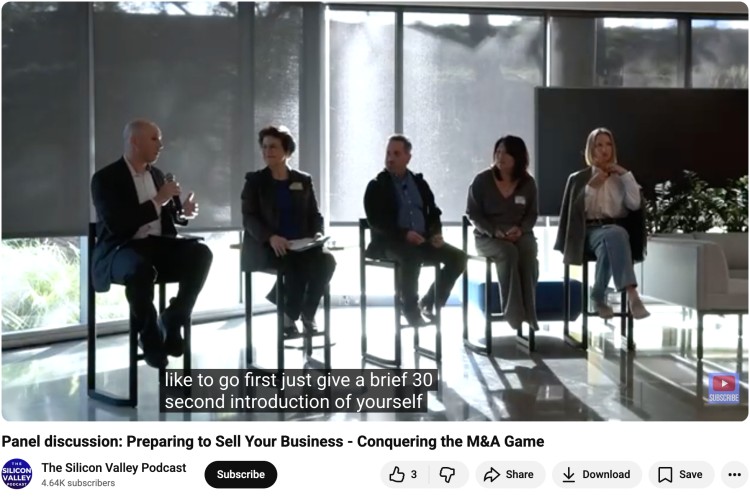
Sean moderated the Preparing to Sell Your Business Panel Discussion, asking four experts for blunt advice on timing, planning, and mindset.
- Set the stage: Jane Bule, Tyler Martin, Sherry Pan, and Anna von Sola shared quick, human introductions that go beyond titles.
- Tax and finance spotlight: Pension planning, 401(k)s, and cash-flow moves that can preserve hundreds of thousands many owners miss.
- Storytelling edge: Cautionary tales of lost 401(k)s, chasing the “highest” offer without control, and post-sale lifestyle shocks.
Every insight was actionable, human, and real.
Prepped From Start to Finish
Knowing how to moderate a panel discussion means calling people by name, steering energy, and leaving the audience with something they can actually use.
You’ve got the framework to prep questions, read the room, and close hard.
Now? You can take it even further.
With Talks, you don’t chase opportunities. You get matched instantly with hosts, panels, webinars, and online stages in your niche.
Pitch once, get booked, and scale your visibility without the nonstop email tennis.
Ready to get your ideas in front of the right people?
Create your free Talks profile and start hosting your next panel today.