

You’ve been pouring your heart into episodes, building your voice, growing your audience. Now you need a way to turn that attention into sustainable support.
If you’re a creator trying to earn income, choosing between Ko-fi vs Patreon can feel like picking your long-term business partner.
Both these players top the creator economy and are well-known by self-starters who don’t wait for sponsors and ads to gain income.
In this guide, I’ll break down Ko-fi and Patreon key features, pricing, and pros and cons, so you can pick the right platform to monetize based on your workflow.
Which is Better? Ko-fi vs Patreon
Before deciding which platform is best, it helps to understand how each one works and what kind of content creators they serve.
Both tools help creators monetize, but they do it in very different ways depending on your audience and workflow. Ko-fi suits quick, casual support. Patreon fits deeper, ongoing connections.
Let’s take a closer look at the key features and reviews to see a better fit for your monetization strategy.
What is Ko-fi?

Ko-fi is a crowdfunding platform built for content creators who want flexibility without complexity. It started as a simple tip jar where fans could buy you a virtual coffee.
Now it’s evolved into a full suite where creators can extend their reach through membership options, shop features, and donation pages. Ko-fi allows creators to monetize their content through multiple streams without locking themselves into strict structures.
Key points about Ko-fi offers:
- Ko-fi allows creators to receive donations instantly with low friction.
- You can post your content publicly or behind a paywall.
- It supports integrations like Zapier, WordPress, and Google Analytics.
Feedback from creators on Ko-fi:
- “Ko-fi changed my game. I made $500 in tips my first month without hassle.” – Sarah, indie author
- “Ko-fi lets me focus on content, not chasing subs.” – Mike, consultant and podcaster
What is Patreon?
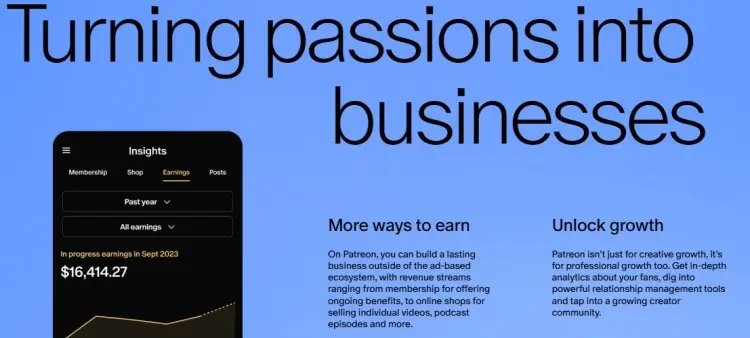
Patreon is a membership platform built for creators to run a subscription business. It focuses on recurring income through different membership tiers, making it ideal for predictable monthly revenue.
Through Patreon, you can encourage fans to subscribe and access exclusive content regularly. If you post consistently and want to build a loyal paying audience, this is a top choice.
Key features offered by Patreon:
- Patreon allows creators to build structured membership offers.
- You can create different membership tiers with perks.
- It supports community tools and messaging.
- It tracks metric insights to grow your audience.
What users say about Patreon:
- “Patreon turned my hobby podcast into a full-time gig with 200 patrons.” – Lisa, entrepreneur coach
- “Patreon’s community features keep my audience hooked monthly.” – Tom, business speaker.
Because Patreon focuses on long-term support, it’s often seen as a stronger option for creators building a serious online business.
What Is the Difference Between Ko-fi and Patreon?
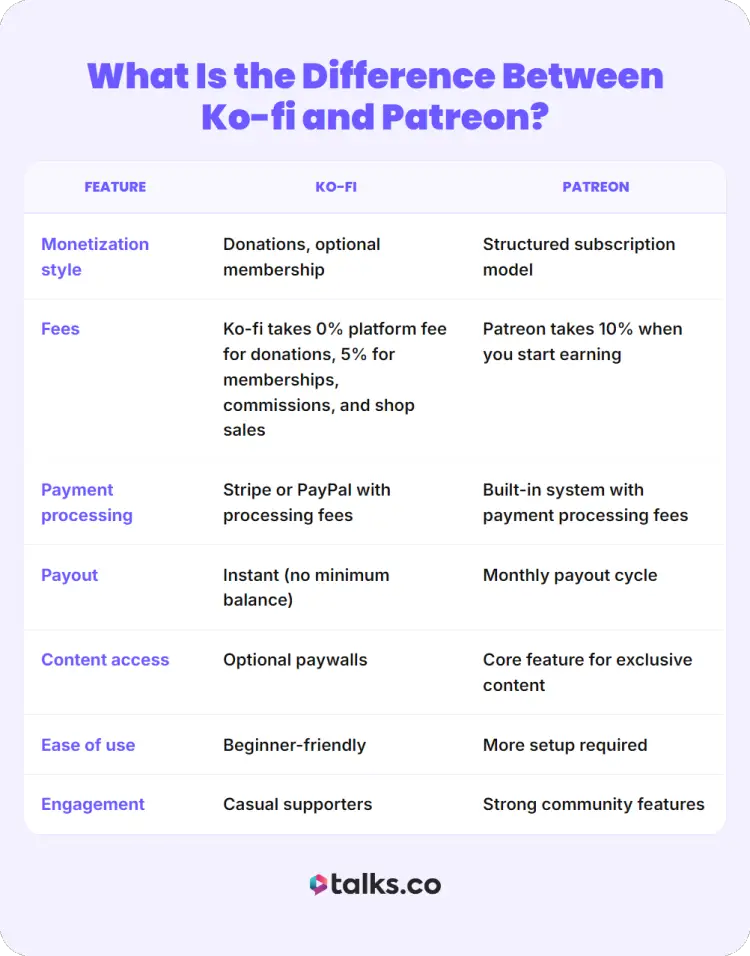
Understanding the differences between Ko-fi and Patreon helps you align your monetization strategy with your goals.
| Feature | Ko-fi | Patreon |
|---|---|---|
| Monetization style | Donations, optional membership | Structured subscription model |
| Fees | Ko-fi takes 0% platform fee for donations, 5% for memberships, commissions, and shop sales | Patreon takes 10% when you start earning |
| Payment processing | Stripe or PayPal with processing fees | Built-in system with payment processing fees |
| Payout | Instant (no minimum balance) | Monthly payout cycle |
| Content access | Optional paywalls | Core feature for exclusive content |
| Ease of use | Beginner-friendly | More setup required |
| Engagement | Casual supporters | Strong community features |
Whichever you choose, both tools work perfectly with Talks, where you can grow your visibility. Through podcast guestings or interviewing guests, you gain exposure, grow your audience, and then turn them into supporters willing to pay for your efforts.
Ko-fi vs Patreon pros and cons

Every platform for creators comes with trade-offs. Here’s what you gain and lose with each option.
Ko-fi keeps things light. It’s easy to set up and keeps the pressure low for fans.
Pros:
- Zero platform fee on one-time donations
- Instant payouts without waiting periods
- Built-in shop to sell digital and physical products
- Fans can support daily or monthly without committing
- Help creators maintain creative freedom
- No need to upgrade to Ko-Fi Gold anymore
Cons:
- Smaller built-in audience discovery
- Fewer native community management tools
- Payment processing costs still apply
Patreon builds recurring revenue streams. That means predictable income freedom achieved by nourishing audiences that already like you.
Pros:
- Predictable monthly income from subscription commitments
- Different membership tiers let you segment offerings
- Strong community features and patron management
- Patreon also offers merchandise integration now
Cons:
- Higher overall fees and payment processing fees
- Minimum balance requirements for payouts
- Can feel overwhelming for casual creators
Ko-fi vs Patreon feature comparison

Both platforms have different features, and the right choice depends on your workflow and audience.
Ko-fi excels in one-offs: tips, commissions, and selling digital and physical products. If you want flexibility and fast setup, this is where Ko-fi stands out.
- One-time donations and memberships
- Ko-fi shop for selling products
- Commission tools for services
- Instant payouts with no minimum balance
Patreon wins on engagement: exclusive content, live streams, and membership tier messaging. Ideal for larger groups wanting daily or monthly perks.
- Tier-based memberships
- Scheduled content delivery
- Community engagement tools
- Detailed audience metric tracking
- Built-in messaging and updates
Ko-fi vs Patreon pricing comparison
Budgeting matters when you’re building something sustainable. Both platforms let you monetize your content, but they take different cuts.
Ko-fi is forever free to start.
- Ko-fi Free: There are no monthly costs. You get your tips 100%, but when you earn from memberships, commissions, and sales, you pay 5% for platform fees.
- Ko-Fi Contributor: Instead of Ko-Fi Gold, you can become a Contributor instead. You still don’t have to pay anything monthly, but you pay 5% on tips too. In exchange, you unlock tools like branding customizations and scheduling.
- Other costs: For all earnings, payment processing fees are included (an estimate of 3% + $0.30).
You can join Patreon for free. You only pay when you start earning.
- Standard plan pricing: For new creators who joined starting August 4, 2025, you pay a platform fee of 10% when you start earning.
- Core features: This lets you access membership offers, video hosting, community tools, and audience insights.
- Additional payment processing fees: You’ll be charged depending on your payment method, location, and currency.
How much fees does Patreon take compared to Ko-fi?
Ko‑fi and Patreon both pass the majority of supporter money to creators, but they differ in how they handle platform fees, payment‑processing charges, and when creators actually receive the cash.
Here are the differences in how Ko-fi and Patreon handle payouts:
- Ko-fi offers instant and direct payouts: Ko‑fi routes payments directly and instantly to your connected PayPal or Stripe account, so there’s no waiting for a monthly payout cycle or for Ko‑fi to “hold” funds.
- Patreon works on a schedule: After platform and processing fees are deducted, Patreon transfers your balance to your account with a small per-payout transaction fee. They follow a cycle, so you can’t access earnings instantly.
- Patreon deducts card processing fees: Fees around 2.9% + $0.30 for credit cards, and higher for PayPal or a non‑USD account.
Is Ko-fi Better than Patreon for Creators?
No single platform is best for everyone. The right choice depends on your content style, audience relationship, and income goals.
Ko-fi suits kinds of creators who prefer low-pressure interactions.
- This includes creators who post occasionally, coaches selling sessions, and authors releasing books from time to time.
- It’s ideal if you want to sell individual products, take commissions, or accept tips without forcing fans into ongoing commitments.
Patreon serves creators who want stable, recurring revenue.
- This includes podcasters with weekly shows, educators releasing courses, and entertainers with serialized content.
- If your audience craves exclusive content and community access, Patreon has the structure to nourish relationships naturally.
Consider your metrics for success. If stability and community matter most, choose Patreon. If freedom and low fees matter most, use Ko-fi.
Ko-fi and Patreon Alternatives
The market offers many ways to fund your work. Exploring options makes sure you find the right fit for your specific needs.
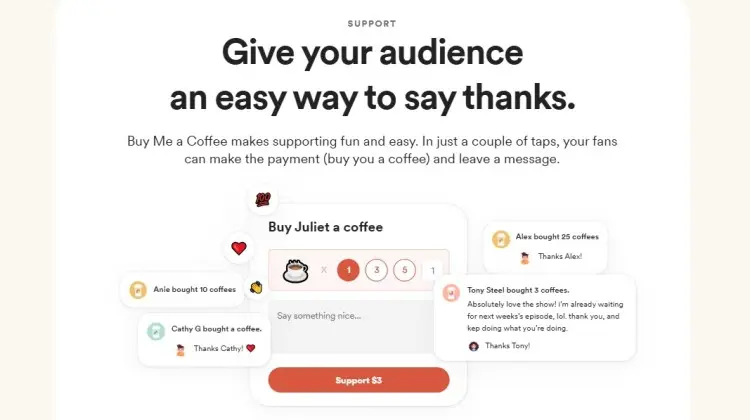
- Buy Me a Coffee: A lightweight crowdfunding platform similar to Ko-fi with simple donation features and lower fees than traditional models.
- Substack: Best for writers and newsletter creators to monetize through paid subscriptions and built-in discovery. It’s one of my top recommendations, as someone who loves to share expert tips on digital marketing.
- Fourthwall: A creator store platform that lets you sell products and memberships with customizable branding options.
- Ghost: An open-source publishing platform with native membership and newsletter capabilities for independent content creators.
- Paddle: A payment infrastructure tool for software creators and digital product sellers needing advanced billing features.
- Liberapay: A non-profit recurring donation platform with zero fees beyond payment processing costs.
Check out other Patreon alternatives and Ko-fi alternatives in these lists.
Buy Me a Coffee vs Ko-fi vs Patreon
These three are the major players of the creator economy. Understanding how they differ helps you pick the right tool for your specific business model.
- Similarities: Buy Me a Coffee functions almost identically to Ko-fi in concept. Both allow quick setup, one-time donations, and simple shop features.
- Differences: The main differences come down to interface preference and specific integrations. Buy Me a Coffee has a slightly more modern design but lacks features like commission management.
- Comparison: Ko-fi wins on fee transparency. Patreon wins on community depth and recurring revenue management.
For podcasters just starting, Buy Me a Coffee or Ko-fi make more sense. For established shows with engaged audiences, Patreon is a stronger contender.
How to Choose the Right Platform for Monetization
Selecting the right tool to match your funding strategy means matching your workflow. Think about the complete process, from attracting new listeners to converting them into paying supporters.
Here are actionable tips to find your perfect fit, whether you’re just starting out or are already one of the most popular podcasts:
- Audit your content frequency: If you don’t post a lot of content but want to keep monetization options open, Ko-fi is the way to go. But if you post podcast episodes regularly and film behind-the-scenes content anyway, go for Patreon.
- Calculate your audience size: Small audiences do better with low-pressure crowdfunding models. Large audiences can sustain subscription commitments.
- Define your revenue goals: Need predictable income? Patreon structures that. Prefer project-based funding? Ko-fi works better.
- Test your technical comfort: Hate complexity? Ko-fi is simpler. Love data and automation? Patreon offers more.
- Evaluate your product mix: Planning to sell digital and physical products? Ko-fi shop integrates seamlessly. Focused on content access? Patreon organizes tiers well.
- Analyze fee tolerance: Calculate how much each platform takes and see how that affects your pricing and earnings.
- Think about audience relationships: Do fans want to support you casually or join an exclusive community?
- Plan for growth: Ko-fi works for you as a new creator, but it can have limited scaling once you get big. Patreon works for those who want to treat their role as a content creator seriously.
- Factor in discovery: Neither platform drives traffic. You need external visibility first.
Whichever platform you choose, it works with Talks. Talks acts as your way to be discovered through podcast guestings before you can monetize your podcast.
Start Earning Today
Comparing Ko-Fi vs Patreon matters for creators with different needs and styles. But if you truly want to monetize your podcast, it’s not just the tools that matter. It’s more about the strategy.
Ever heard of the Podcast Visibility Success Formula? The real key to turning your passion into an earning and sustainable business is by expanding your reach and engaging loyal listeners.
That’s what Talks can do for you. This emerging platform modernized the way you connect to podcasts. That means faster and more relevant matches that get you seen and heard by the right people.
Brian booked 12 guest spots even without having done any before. David went Pro, impressed by the platform.
Sign up for a free Talks profile today and get matched in less than five minutes!


