

Trying to figure out if Ko-fi or Buy Me a Coffee is the better fit for getting paid through your podcast or content?
Both platforms let your audience support your work with a tip, donation, or even paid extras without needing a big setup or subscription model.
Both Buy Me a Coffee and Ko-fi are simple, fast, and work well if you’ve got listeners or followers who want to show support. But they’re not the same. One might look better on your page, the other might pay out faster.
Fees, features, how customizable it is? All of it can make a real difference when you’re deciding between Buy Me a Coffee and Ko-fi.
In this guide, I’ll break down the key differences of Ko-fi vs Buy Me a Coffee and show you how each one works, what they charge, and who they’re best for.
Coffee in hand?
Good.
Now let’s sort out who actually earns a spot on your link page.
Ko-fi vs Buy Me a Coffee: Quick Verdict for 2027
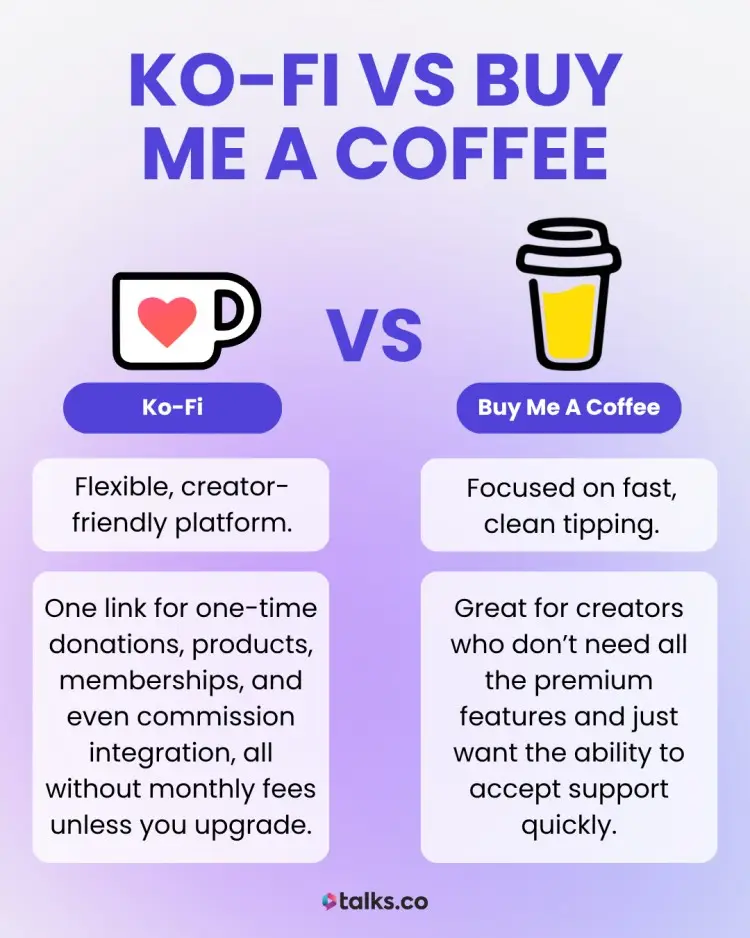
Both platforms let you earn from your audience but they’re built with slightly different goals and types of creators in mind.
Here’s a snapshot of both to help you decide which one works:
- Ko‑fi: Built for creators who want one page for tips, memberships, products, commissions, and exclusive content.
- Buy Me a Coffee: Built around simple fan support, with memberships and a shop available when you want to expand.
Choose Ko-fi if…
Ko-fi makes sense if you want more ways to monetize the same audience from one creator page. It gives you room to go beyond tips as your offers grow.
- You want tips, memberships, products, and commissions in one place.
- You sell digital or physical products.
- You want supporter-only content and more ways to engage your audience.
- You already use PayPal or Stripe and want payments sent directly to your connected account.
Choose Buy Me a Coffee if…
Buy Me a Coffee fits creators who want a simple support page with a few useful ways to earn. It keeps the setup easy while still giving you room for memberships and products.
- You mainly want simple one-time support from your audience.
- You want memberships without building a complicated setup.
- You want a straightforward page for tips, posts, and shop products.
- You’d rather keep your creator monetization setup lean.
Use neither if your goal is higher-ticket monetization
Ko-fi and Buy Me a Coffee work well for audience support, memberships, products, and smaller transactions. If you’re selling coaching, consulting, courses, speaking, or other high-ticket offers, you may need a different kind of platform.
If you need people to find you, hear what you know, and have a reason to reach out, Talks can help with that by putting your expertise in front of podcast hosts looking for speakers, coaches, authors, consultants, and other experts.
A $5 tip can be a nice bonus, but your expertise can open doors to much bigger opportunities.
Can’t you use Buy Me a Coffee and Ko-fi at the same time?
Technically, yes… but you’ll end up with two support links, forcing your audience to choose. That’s unnecessary friction for your podcast content distribution plan. Decide how you want your fans to support you:
- Want to sell ebooks, digital downloads, commissions, or run a shop? Ko‑fi wins.
- Just want a one-time click tip button with zero setup? Buy Me a Coffee is your go-to.
You can also check out how Patreon works for creators to see how Buy Me a Coffee vs Patreon outdo each other.
Patreon vs Ko-fi vs Buy Me a Coffee Comparison Table
Looking to monetize your podcast and trying to figure out which tip jar fits your setup? Here’s a quick side-by-side look between Buy Me a Coffee vs Ko-Fi vs Patreon:
| Patreon | Ko-fi | Buy Me a Coffee | |
|---|---|---|---|
| Best for | Paid memberships and content | Tips, memberships, shops, and commissions | Tips, memberships, and simple shops |
| Monthly cost | $0 to start | $0 | $0 |
| Platform fee | 10% on the current standard plan + processing | 0-5%, depending on payment type and setup + processing | 5% + processing |
| One-time tips | Yes | Yes | Yes |
| Memberships | Yes: monthly and annual | Yes: recurring tiers | Yes: monthly and annual |
| Digital products | Yes | Yes | Yes |
| Physical products | Limited compared with dedicated shops | Yes | Yes |
| Commissions/services | Limited | Yes | Yes |
| Paid content | Yes | Yes: supporter-only content | Yes: posts and member content |
| Community tools | Chats, comments, polls, memberships | Posts, messages, polls, Discord integration | Posts, messages, memberships |
| Podcast tools | RSS, podcast importing, Spotify integration, paid feeds | Creator page, memberships, exclusive content | Creator page, posts, memberships |
| Payouts | Platform-managed payouts | Direct to PayPal or Stripe | Stripe to bank |
| Payout timing | Depends on payout method | Direct payments; no Ko-fi payout queue | Depends on Stripe and bank processing |
| Supporter account | Usually required for memberships | Not always required | Not required for one-time support |
| Ease of setup | More features to configure | Simple and flexible | Simple and quick |
| Control over your page | High | High | Moderate |
| Good fit for | Creators building recurring revenue | Creators using several revenue streams | Creators who want simple fan support |
Quick take:
- Want memberships and paid content? Patreon has the tools.
- Want tips, memberships, products, and commissions? Ko-fi covers them.
- Want simple tips, memberships, and a shop? Buy Me a Coffee keeps it straightforward.
Fees and platform cuts
Fees can look tiny until you’re collecting hundreds of payments. Take a minute to check the platform cut, payment processing, and any extras before you pick a home for your support button.
Buy Me a Coffee fees
Buy Me a Coffee charges a 5% platform fee per transaction, with no monthly subscription. You keep 95% before payment processing. Stripe processing fees are separate, so factor both into your numbers when comparing Buy Me a Coffee fees.
So when you’re comparing Buy Me a Coffee fees, the simple math is 5% platform fee + payment processing.
Ko-fi fees
Ko-fi fees range from 0% to 5%, depending on the payment type and setup. One-time tips can have a 0% Ko-fi service fee, while memberships, shop sales, commissions, and other payments can carry 5%. PayPal or Stripe processing fees still apply.
Memberships, shops, and digital products
This is where you look once tips aren’t the whole plan. Each platform gives you different ways to turn your audience into paying customers.
- Patreon: Strong focus on memberships, paid content, and recurring revenue.
- Ko-fi: Tips, memberships, digital and physical products, and commissions.
- Buy Me a Coffee: Tips, memberships, posts, and digital or physical products.
Payouts and payment methods
Getting paid should be simple enough and the three platforms all handle your money differently.
- Patreon: Platform-managed payouts, with timing based on your payout method.
- Ko-fi: Payments go directly to your connected PayPal or Stripe account.
- Buy Me a Coffee: Uses Stripe for payouts to your bank after the required account review.
Ease of use and audience experience
Your audience has better things to do than figure out your payment page. Keep the support path simple and match the platform to the experience you want to give them.
- Patreon: More features to configure, especially around memberships and paid content.
- Ko-fi: Flexible creator page with several ways for supporters to pay or engage.
- Buy Me a Coffee: Simple support experience, especially for one-time contributions.
What Is Buy Me a Coffee?
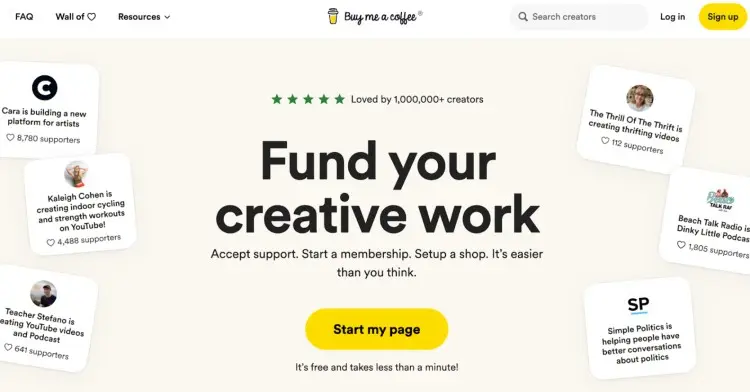
Buy Me a Coffee makes it ridiculously simple to get paid by your fans.
No complicated setups, no long waits after you create an account. Just a quick way to keep your audience engaged, and for your supporters to say thanks and help you keep creating.
It’s used by everyone from freelancers and indie artists to niche YouTube creators like Jim Newstead, who shares music reaction videos and original compositions with his loyal community.
Is Buy Me a Coffee legit?
Absolutely.
More than 2 million creators use Buy Me a Coffee, including podcasters, YouTubers, artists, writers, and developers.
Creators can use their page to collect one-time support, run memberships, sell products, and publish content for their audience.
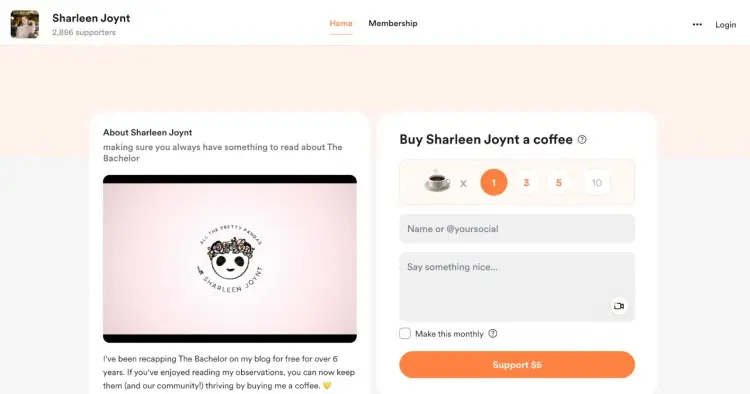
From Sharleen Joynt recapping The Bachelor with the loyal readers of her blog posts, to Kevin Wilson’s “chai club” fans on TikTok, it’s a reliable platform with fast payouts and no sneaky fees beyond the straightforward 5% cut when you subscribe.
Who owns Buy Me a Coffee?
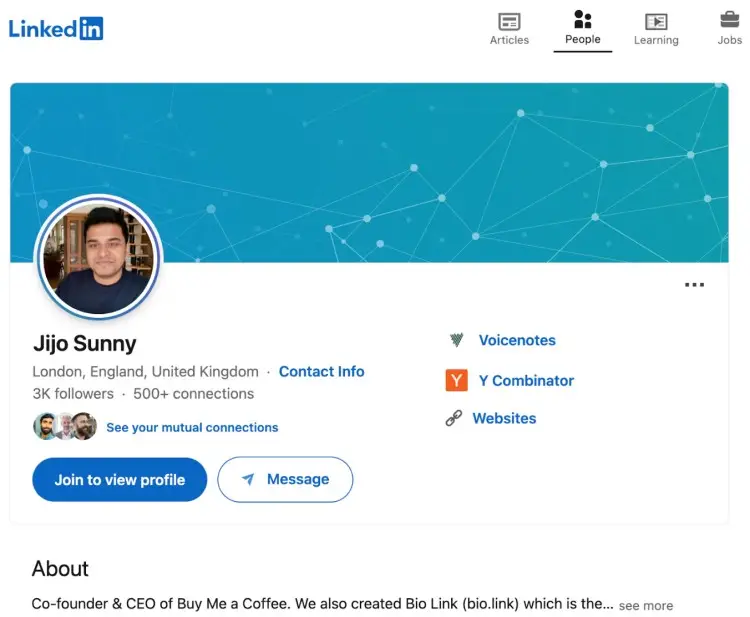
Founded in the UK in 2017 by creators Jijo Sunny and Joseph Sunny, Buy Me a Coffee is an independent company built by creators for creators. The company has backing from Y Combinator and Stripe.
How to use Buy Me a Coffee
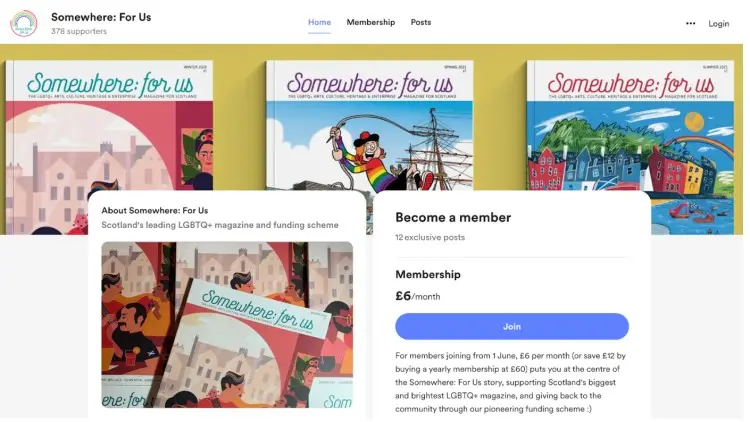
Getting started takes less than a minute, and the steps are straightforward:
- Set up your page: Add a photo, short bio, and link your payment details.
- Choose your income options: Accept one-off tips (“buy me a coffee”), start memberships, or set up a shop to sell digital products or services.
- Share your link: Post it on social media, your website, or your content channels as part of your podcast advertising strategy.
- Receive support: Fans can tip instantly without needing an account, leave messages, or join your membership.
- Publish exclusive content: Share members-only posts, audio, or updates to keep supporters engaged.
- Get paid instantly: Money lands in your bank or PayPal without delays.
Example: Somewhere: For Us uses their page to offer rainbow lattes as donations, send out quarterly magazines to members, and reinvest 20% of proceeds into LGBTQ+ arts and enterprise funds.
Members also receive print/digital editions, thank-you gifts, and sneak peeks at future projects.
How much is Buy Me a Coffee?
Buy Me a Coffee has no monthly subscription or setup fee. You can create a page for any type of podcast and use its core creator tools without paying a monthly platform charge.
You still pay transaction and payment processing fees when you earn money through the platform.
How much does Buy Me a Coffee take?
Buy Me a Coffee (BMC) keeps things simple and transparent when it comes to fees.
- 5% flat fee on every transaction.
- You keep 95% of what you earn.
- No hidden fees, no monthly charges.
- Payments go straight to your bank. No 30-day waiting period.
Ko-fi Fees in 2027
Ko-fi fees depend on how you use the platform. Here’s what can affect your costs:
- Monthly cost: $0, with Gold advertised at $12/month.
- Service fee: 0% on eligible one-time tips; other payments can carry 5%.
- Processing: PayPal or Stripe fees still apply.
- Currency conversion: Your payment provider may charge conversion fees.
- Payouts: Ko-fi doesn’t add a separate payout fee.
Your actual cost comes down to Ko-fi’s service fee, payment processing, and any applicable conversion fees.
Does Ko-fi take a cut?
Yes, depending on the payment. Ko-fi charges 0% on one-time tips with Free, while memberships, monthly tips, shop sales, and commissions carry a 5% service fee. Standard applies 5% to all payment types. Payment processing fees are separate.
Ko-fi free vs paid plan considerations
The important bit is figuring out which setup makes sense for how you earn or if it’s time to look at Ko-fi alternatives. Here’s the quick comparison:
| Free | Gold | |
|---|---|---|
| Monthly cost | $0 | $12/month |
| One-time tips | 0% Ko-fi service fee | 0% Ko-fi service fee |
| Memberships | 5% service fee | 0% service fee |
| Shop sales | 5% service fee | 0% service fee |
| Commissions | 5% service fee | 0% service fee |
| Payment processing | PayPal/Stripe fees still apply | PayPal/Stripe fees still apply |
If most of your income comes from one-time tips, the free plan may be all you need. If you want to offer regular memberships, shops, or commissions, run the numbers before paying for a Ko-fi Gold subscription.
What Is Ko-fi: How does it work?
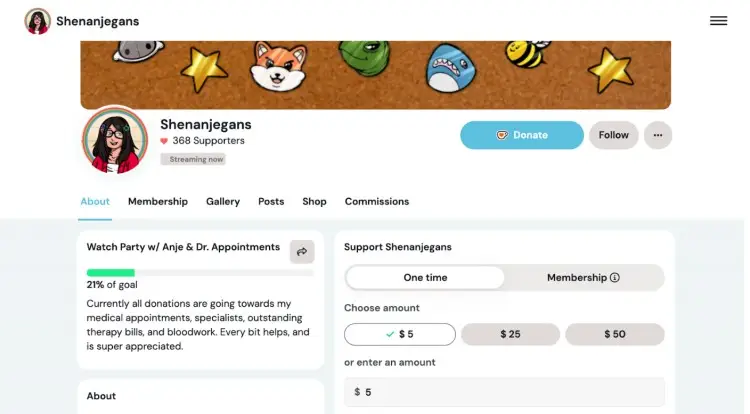
Ko-fi gives you everything you need to earn from your creative work, all in one place, and on your terms. Here’s how Ko-fi works:
- Connect PayPal or Stripe: Payments go directly to your connected account. Ko-fi doesn’t hold your money or add a payout queue.
- Offer more than tips: Add memberships, sell products, take commissions, and offer custom perks just like Shenanjegans, a streamer who offers art commissions and exclusive livestream perks to help fund her medical expenses.
- Engage your fans: Use polls, goals, supporter-only content, and Discord roles to connect with your audience. Plantskid, a digital artist, uses Ko-fi to post exclusive art previews and progress shots for monthly supporters.
- Use your existing platforms: Integrates with Twitch, YouTube, Instagram, and more.
- Pay based on how you use it: Ko-fi has no monthly fee. One-time tips can carry a 0% Ko-fi service fee, while other payment types can carry a 5% service fee depending on your setup. Payment processing fees still apply.
What does Ko-fi mean?
Ko-fi started as a simple way to say thanks with a small tip and grew into a full platform for creators. Here’s what Ko-fi stands for:
- Born from gratitude: Started in 2011 to let people say thanks by “buying a coffee” to support creators.
- Grew beyond tips: Evolved into a full creative storefront with tools for creators looking to monetize in multiple ways.
- Freedom first: No algorithms or schedules, just flexible, creator-driven growth. RayncloudArt puts it best: “Ko-fi literally changed the course of my life. I now earn enough to pay my bills through doing what I love.”
- Independently run: Built without outside investors to stay 100% focused on creators.
Is Ko-fi better than PayPal?
Ko-fi and PayPal do different jobs but work well together to grow your podcast. Here’s how they compare:
- Payment basics: PayPal handles sending and receiving money. Ko-fi uses PayPal (and others) to take payments but adds creator tools on top.
- What they offer: PayPal is just payments. Ko-fi offers you ways to make money like memberships, commissions, and a shop all in one spot.
- Connecting with fans: Ko-fi helps you manage supporters, send updates, and keep everything tidy (an important step in podcasting 101). PayPal doesn’t do any of that.
- Simple setup: PayPal is popular and trusted but leaves you juggling links and messages elsewhere. Ko-fi keeps it all under one roof, made for creators.
- Money flow: Both pay straight to your account. Ko-fi makes monthly memberships easy, which PayPal alone can’t do without extra work.
So, PayPal is great for payments. Ko-fi makes those payments work harder for you.
Best Buy Me a Coffee and Ko-fi Alternatives
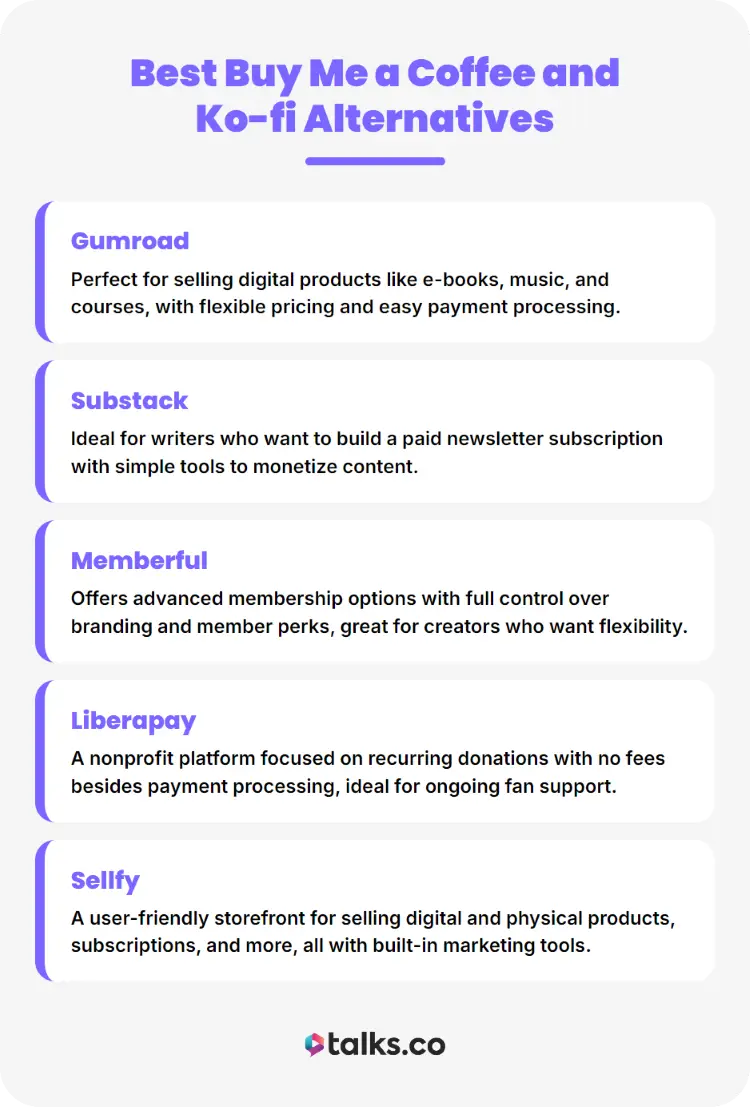
Looking for a different way to get contributions from your fans or the best platforms to monetize your podcast?
Here are five solid alternatives to Patreon and top Buy Me a Coffee alternatives that keep things simple and creator-friendly:
- Gumroad: Perfect for selling digital products like e-books, music, and courses, with flexible pricing and easy payment processing.
- Substack: Ideal for writers who want to build a paid newsletter subscription with simple tools to monetize content.
- Memberful: Offers advanced membership options with full control over branding and member perks, great for creators who want flexibility.
- Liberapay: A nonprofit platform focused on recurring donations with no fees besides payment processing, ideal for ongoing fan support.
- Sellfy: A user-friendly storefront for selling digital and physical products, subscriptions, and more, all with built-in marketing tools.
Should Podcasters Use Tip Jars at All?
A tip jar can be a nice extra revenue stream when listeners already get real value from your show and you want to make money from your podcast somehow. It works best when the ask fits naturally into your podcast and business.
When tips make sense
A tip jar is worth considering if:
☐ Your listeners are loyal: You have people who regularly listen, share episodes, or respond to your content.
☐ Your podcast is independent: You want listeners to help cover production or hosting costs.
☐ You publish consistently: Regular episodes give your audience more reasons to support the show.
☐ You have a clear purpose: You’re raising money for equipment, production, research, or a special series.
☐ Your audience likes supporting creators: Some listeners are happy to chip in when they enjoy what you make.
Keep the ask short. A quick mention in your outro or show notes is plenty.
When sponsorships, paid sessions, affiliates, or guesting are stronger
Look at other options when your podcast supports a bigger business goal:
☐ Sponsorships: You have an audience brands want to reach.
☐ Paid sessions: You sell coaching, consulting, or another service.
☐ Affiliates: You regularly recommend products your audience actually needs.
☐ Guesting: You want more visibility, authority, leads, or clients.
For experts selling higher-ticket offers, guesting can be especially useful. You’re putting your expertise in front of an audience that already listens to podcasts, then giving interested people a clear next step.
Final Recommendation: Which Platform Should You Use?
The right pick comes down to how you want your podcast to make money. A tip jar can be useful, but it doesn’t need to become the center of your monetization strategy.
- Choose Ko-fi if you want tips alongside memberships, products, commissions, or other ways to earn from your audience.
- Choose Buy Me a Coffee if you want a simple support page with tips, memberships, and a shop.
- Choose Patreon if recurring memberships and paid content are a bigger part of your plan.
- Skip the tip jar for now if your podcast is mainly there to sell higher-ticket services, products, courses, or consulting. Sponsorships, affiliates, paid sessions, and guesting may fit your business better.
Look at podcast monetization as a whole if you want the show to generate meaningful business revenue. A tip jar is one piece of the puzzle, while sponsorships, offers, affiliates, guesting, and other revenue streams can give you more ways to monetize your audience.
For a deeper look at the options, check out the Podcast Monetization Blueprint.
Brewing Your Choice
Ko-fi vs Buy Me a Coffee? It depends on how you want to connect with your fans, whether selling, tipping, or memberships.
If you’re tired of chasing podcast bookings or hunting for great guests, here’s a better way:
Create your free Talks creator profile today. Get matched with the right shows or guests fast. Pitch with confidence, get booked quicker, and reach the audience you want.
Get Your Free Talks Creator Profile and Start Getting Booked Today


