
Five minutes can open doors that years of networking never will.
A great speech can win clients, book podcast interviews, land speaking opportunities, or leave a room talking about you long after you’ve finished.
The catch? Five minutes isn’t much time.
Knowing exactly how many words in a 5 minute speech can fit gives you a huge advantage.
This guide breaks down the ideal word count for different speaking styles, shows you how to calculate your own pace, and shares practical tips to help every word earn its place.
How Many Words in a 5 Minute Speech?
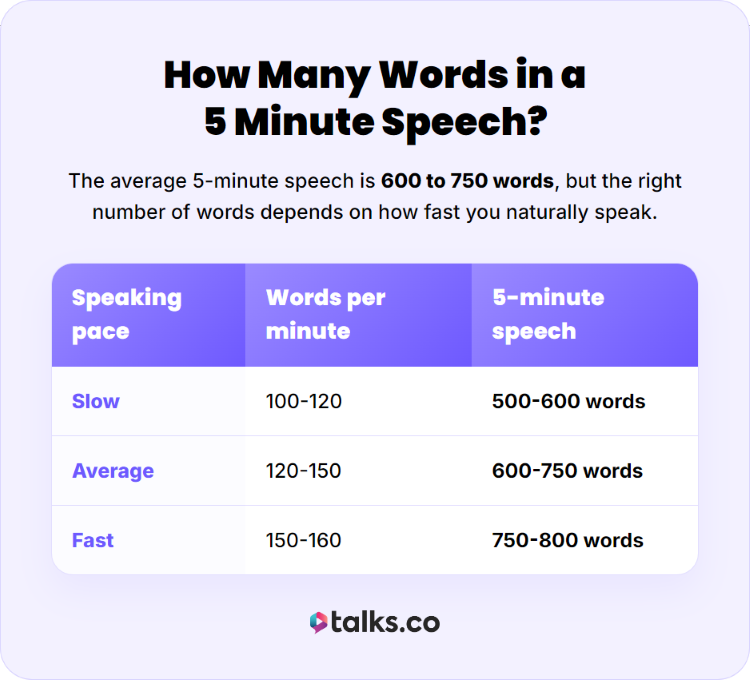
The average 5-minute speech is 600 to 750 words, but the right number of words depends on how fast you naturally speak. Some speakers comfortably deliver closer to 500 words with thoughtful pauses, while others can reach 800 words without sounding rushed.
As a general guide:
| Speaking pace | Words per minute | 5-minute speech |
| Slow | 100-120 | 500-600 words |
| Average | 120-150 | 600-750 words |
| Fast | 150-160 | 750-800 words |
Treat these numbers as a starting point, not a rule.
A speech packed with stories, audience interaction, or dramatic pauses will naturally include fewer words than a presentation that’s mostly facts.
How many words is a 5 minute speech on average?
For most speakers, 600 to 750 words is the sweet spot. That gives you enough room to introduce your topic, develop one or two key ideas, and finish with a memorable takeaway without racing through your delivery.
If you’re new to public speaking opportunities, aim for the lower end of that range. It’s much easier to add a few extra sentences after rehearsing than to cut large sections the night before your speech.
How many words should a 5 minute speech be?
Your speech should be as long as it needs to be to deliver one clear message within five minutes. Trying to maximize your word count often has the opposite effect.
You speak faster, skip natural pauses, and leave your audience trying to catch up instead of absorbing what you’re saying.
A comfortable pace almost always beats squeezing in another paragraph.
How many words needed for a 5 minute speech to succeed
Most 5-minute speeches need around 600 to 750 words, but don’t chase an exact number. If your rehearsals consistently finish in five minutes at a natural pace, you’ve found the right word count for you.
How many words to make a 5 minute speech?
The fastest way to estimate your target is to multiply your average speaking rate by five.
For example:
- 110 words per minute: Around 550 words
- 130 words per minute: Around 650 words
- 150 words per minute: Around 750 words
You’ll learn how to calculate your personal speaking rate later in this guide, along with a simple workflow to test and adjust your speech before presentation day.
How Many Words In a 5 Minute Presentation?

A 5-minute presentation is often shorter than a 5-minute speech, even if both have the same time limit. That’s because presentations usually include slide transitions, visual demonstrations, audience interaction, and natural pauses that don’t require you to keep talking.
For most presentations, 500 to 700 words is a comfortable range. If you’re presenting without slides or interruptions, you may reach 600 to 750 words, similar to a traditional speech.
| Format | Recommended word count |
| Speech | 600-750 words |
| Presentation with slides | 500-700 words |
| Storytelling presentation | 500-650 words |
How many words for a 5 minute presentation?
Aim for 500 to 700 words, depending on how much time your visuals do the talking.
For example, if you’re explaining a graph, walking through a case study, or demonstrating a product, your audience will spend several seconds looking at the screen instead of listening to you. Those moments count toward your five minutes, even though you’re speaking less.
On the other hand, if your presentation is mostly spoken with only a few supporting slides, you can comfortably work closer to the 600 to 750-word range.
Check out these informative speech examples and persuasive speech examples to help you nail your timing.
How many words should a 5 minute presentation be?
The best presentations aren’t measured by word count. They’re measured by clarity.
Instead of trying to fill every second with speech, build your presentation around one key idea and let your visuals support it. A simple chart, image, or statistic can replace an entire paragraph of explanation, giving your audience more time to absorb your message.
As a rule of thumb, leave yourself a 15 to 30-second buffer during rehearsals. Finishing slightly early looks confident. Running over time rarely does.
How Many Words In 5 Minutes of Speaking?
Speaking time doesn’t increase in perfectly equal jumps. The longer you speak, the more likely you are to pause for emphasis, tell a story, interact with your audience, or slow your pace. That’s why these ranges are guides, not hard rules especially if you’re still learning how to be a guest on a podcast.
Here’s a quick benchmark for common speech lengths:
| Speech length | Slow (100-120 WPM) | Average (120-150 WPM) | Fast (150-160 WPM) |
| 3 minutes | 300-360 words | 360-450 words | 450-480 words |
| 5 minutes | 500-600 words | 600-750 words | 750-800 words |
| 7 minutes | 700-840 words | 840-1,050 words | 1,050-1,120 words |
| 10 minutes | 1,000-1,200 words | 1,200-1,500 words | 1,500-1,600 words |
If you’re deciding between two word counts, always choose the shorter version. Giving yourself room to pause, breathe, and connect with your audience almost always leads to a stronger presentation.
How many words in a 3 to 5 minute speech?
A 3 to 5-minute speech usually falls between 300 and 750 words, depending on your speaking pace and how much audience interaction you include.
As a quick guide:
- 3 minutes: Around 300-450 words
- 4 minutes: Around 400-600 words
- 5 minutes: Around 500-750 words
If your speech has a strict time limit, write for the lower end of the range first. After a few practice runs, you’ll quickly see whether you have room to add another example or need to trim a section.
8 Factors That Impact Your Speaking Rate
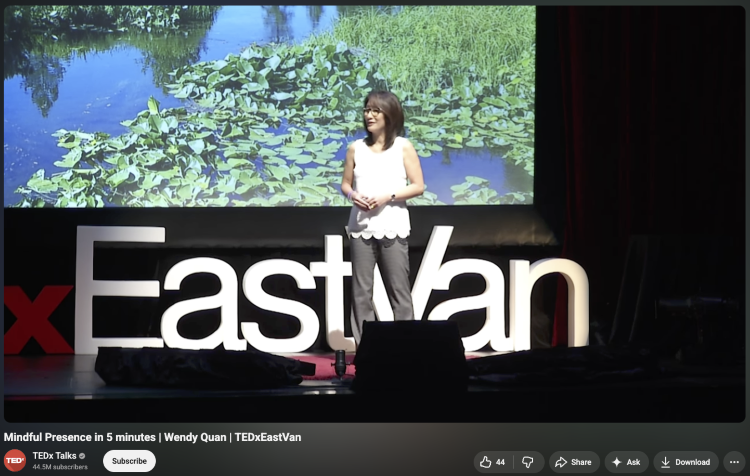
Two speakers can read the exact same script and finish at completely different times. That’s because speaking pace is influenced by far more than words per minute.
Some of the biggest factors include:
- Experience: Confident speakers usually maintain a steadier pace.
- Topic complexity: Technical ideas often require slower explanations.
- Audience familiarity: New audiences may need more context.
- Stories and examples: Personal stories naturally slow your delivery.
- Visual aids: Slides, charts, and demonstrations reduce speaking time.
- Questions or interaction: Audience participation adds extra seconds or even minutes.
- Pauses for emphasis: Strategic silence in speech examples help important points land.
- Nerves: Speaking too quickly is one of the most common habits for first-time presenters.
Remember, speaking slower doesn’t mean speaking poorly. It often makes you sound more confident, gives your audience time to process your message, and helps your key points stick.
Factors affecting word count when writing a 5-minute speech
Before you decide on your target word count, think about how you’ll actually deliver your speech.
Ask yourself:
- Will you use slides? Plan fewer spoken words.
- Will you tell a personal story? Leave room for natural pauses.
- Will the audience ask questions? Build in extra time.
- Will you quote statistics or research? Slow down so listeners can absorb the information.
- Will you finish with a call to action? Don’t rush the ending.
A good rule of thumb is to write your first draft, rehearse it aloud with a timer, then adjust your word count based on your natural speaking pace.
That approach is far more accurate than aiming for a specific number from the start.
How to Calculate Words for Your 5-Minute Speech
Average speaking speeds are helpful, but your own pace is what really matters. Some people naturally speak at 110 words per minute, while other emcees comfortably reach 150. The easiest way to find your ideal word count is to measure it yourself.
Start with this simple formula:
Words per minute x 5 = Your target word count
For example:
- 100 words per minute: Around 500 words
- 120 words per minute: Around 600 words
- 140 words per minute: Around 700 words
- 160 words per minute: Around 800 words
To calculate your personal speaking pace:
- Write a draft: Don’t worry about the word count yet.
- Read it aloud: Speak naturally instead of rushing.
- Time yourself: Use your phone or a stopwatch.
- Count the words: Divide your total word count by the number of minutes you spoke.
- Adjust your draft: Add or remove content until you consistently finish within five minutes.
Aim to finish 15 to 30 seconds early during rehearsals. That gives you enough room for natural pauses, audience reactions, or the occasional moment where you need to gather your thoughts.
How to use AI to figure out how many words are in a 5 minute speech
AI can speed up the editing process, but it shouldn’t replace rehearsal. Use it as a second opinion, then test the result by reading your speech aloud.
A simple workflow looks like this:
- Write your first draft: Focus on your message instead of word count.
- Ask AI to estimate the timing: It can tell you if your draft is likely too short or too long.
- Trim or expand the speech: Remove repetition, tighten long explanations, or add another example where needed.
- Practice with a timer: Read the updated version at your natural pace.
- Repeat until your timing is consistent: Your rehearsals matter more than any estimate.
You can also ask AI to:
- Shorten sections: Cut unnecessary words without losing your message.
- Simplify sentences: Make your speech easier to deliver out loud.
- Improve transitions: Help ideas flow naturally.
- Suggest stronger openings and closings: Create a more memorable first and last impression.
Think of AI as an editing partner. The final test is always your own voice, your own pace, and a stopwatch. You can even pair your AI with any of these podcast script templates you can customize so you always stay ready.
How to Prepare a 5-Minute Speech for Public Speaking
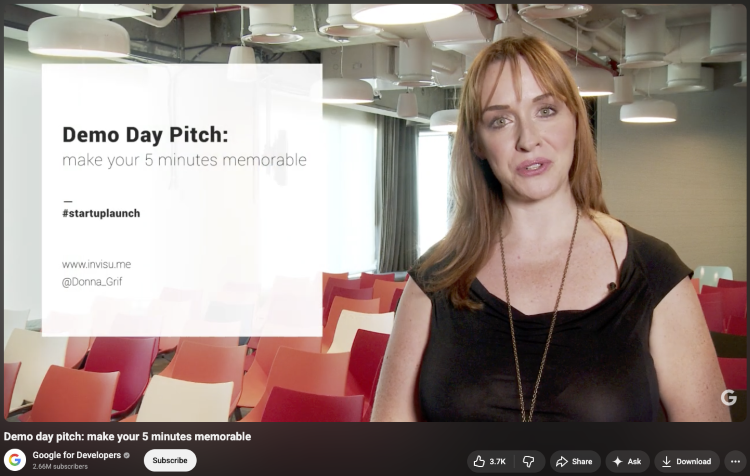
A great 5-minute speech doesn’t try to cover everything. It focuses on one clear idea and delivers it in a way that’s easy to follow, easy to remember, and easy to act on.
The shorter your time limit, the more every sentence matters. Before you start writing, decide what you want your audience to remember after those five minutes are over.
If they leave with one powerful takeaway, you’ve done your job.
Writing tips for your 5-minute speech
Strong speeches are built around clarity, not word count. Keep your message focused and avoid trying to squeeze in every point you know.
A simple structure works well:
- Opening: Capture attention and introduce your main idea.
- Main point: Explain one or two key ideas with a relevant example or story.
- Closing: Reinforce your message and finish with a memorable takeaway or call to action.
As you write, keep these tips in mind:
- Stick to one core message: If your audience remembers one thing, what should it be?
- Write for the ear: Use short, conversational sentences that sound natural when spoken.
- Cut unnecessary detail: Every sentence should support your main point.
- Leave room for pauses: Silence can be just as powerful as words.
- Read every draft aloud: If a sentence feels awkward to say, rewrite it.
Here’s what a well-paced 5-minute speech might look like:
| Time | Purpose |
| 0:00-0:45 | Hook your audience and introduce your topic. |
| 0:45-2:15 | Share your first key point with an example. |
| 2:15-3:45 | Expand with a story, insight, or supporting evidence. |
| 3:45-4:40 | Reinforce your main message and explain why it matters. |
| 4:40-5:00 | End with a clear takeaway or call to action. |
You don’t have to follow this structure exactly, but it gives you a reliable framework that keeps your speech balanced and prevents one section from taking over.
Speaking tips for your 5-minute speech
A well-written speech still needs confident delivery. Your audience won’t remember every word, but they’ll remember how you made them feel.
Focus on these speaking habits:
- Slow down: Most speakers feel slower than they actually sound.
- Pause with purpose: Give important ideas a moment to land.
- Make eye contact: Connect with people instead of reading from your notes.
- Vary your voice: Change your pace and tone to keep listeners engaged.
- Practise standing up: Rehearse in conditions that feel as close to the real event as possible.
- Finish strong: Don’t trail off. End with confidence and give your audience a clear final thought.
One final tip: rehearse until you know your message, not your script. Memorizing every sentence can make your delivery sound robotic. Understanding your key points gives you the confidence to speak naturally while staying on track.
Tips for Delivering a Well-Paced 5-Minute Speech
A five-minute speech isn’t about fitting in as many words as possible but about making every minute count. The speakers people remember aren’t usually the fastest or the loudest. They’re the ones who communicate one clear idea with confidence.
Once you’ve written and rehearsed your speech, focus on your delivery.
How can you make the most of your 5 minutes? (Checklist)
The best speakers don’t try to impress their audience with how much they know. They make it easy for people to understand, remember, and act on their message.
Before you step up to speak, run through this quick checklist:
☐ Know your opening: Start confidently without relying on your notes.
☐ Focus on one message: Keep bringing your audience back to your main idea.
☐ Pause instead of rushing: A short pause is far more effective than filling every second with words.
☐ Watch the clock: Rehearse enough times that you know roughly where you should be each minute.
☐ Leave a buffer: Aim to finish 15 to 30 seconds early rather than cutting it close.
☐ End with purpose: Finish with one clear takeaway your audience can remember.
Just as important is knowing what to avoid.
Common pacing mistakes include:
- Writing too much: Trying to fit 10 minutes of content into five.
- Speaking too quickly: Racing through important points because you’re watching the clock.
- Skipping pauses: Giving your audience no time to absorb what you’ve said.
- Reading word for word: Sounding stiff instead of conversational.
- Adding last-minute ideas: Turning a focused speech into an overloaded one.
- Ignoring practice runs: Assuming the timing will work itself out on the day.
The easiest way to improve is surprisingly simple: rehearse your speech out loud with a timer. Every practice run will help you refine your pacing, smooth out awkward transitions, and build confidence before you step in front of an audience.
Five minutes may not sound like long, but when every word has a purpose, it’s more than enough time to make a lasting impression.
Feeling more confident with your new skills? Check out my full guide on how to be a content creator and put those skills to good use.
Your Next 5 Minutes Could Be Your Biggest Opportunity
Now you know how many words in a 5 minute speech. The next step is getting that speech in front of the right audience.
Every podcast interview is 5, 20, or 60 minutes that could lead to clients, speaking gigs, and partnerships. The people getting booked aren’t always the best speakers. They’re the ones putting themselves out there.
Create your free Talks profile to get matched with podcast hosts, automate your outreach, and start booking interviews without spending hours pitching.


![How Much Does a YouTuber Make? Earnings per Subscriber & Views [Guide]](https://talks.co/p/wp-content/uploads/2026/04/how-much-does-a-youtuber-make.png "How Much Does a YouTuber Make? Earnings per Subscriber & Views [Guide]")