

A podcast show with no listeners? A keynote speaker who lost his voice?
Bet that tugged at your heartstrings. That’s what irony can do.
Irony gives simple statements a deeper meaning, both in a comedic and profound kind of way.
For podcasters and professional speakers, it’s what you need to turn a flat story into a viral moment that leaves your audience begging for more.
Want to show off your wit and charm with this literary tool? Explore these types of irony and learn how you can use them for hosting and speaking opportunities.
What Are Examples of Irony?
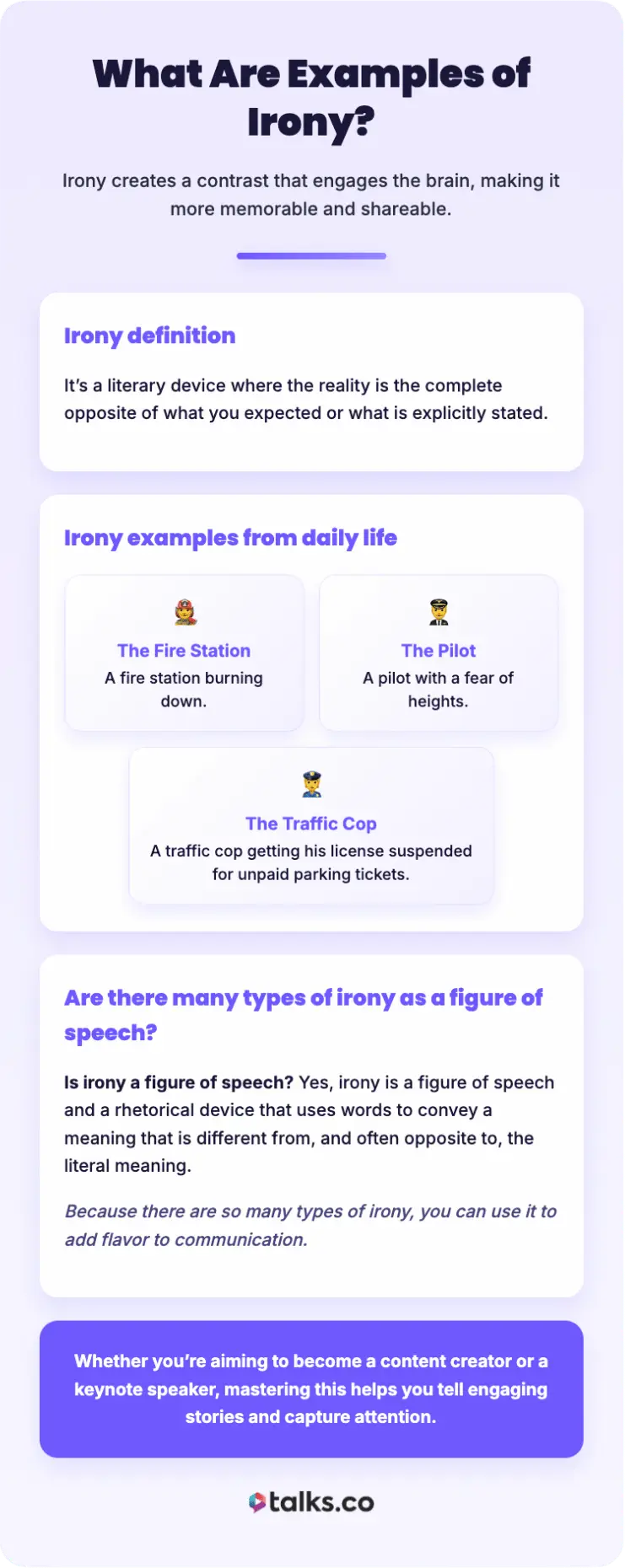
Irony creates a contrast that engages the brain, making it more memorable and shareable.
- Irony definition: It’s a literary device where the reality is the complete opposite of what you expected or what is explicitly stated.
- Irony examples from daily life: A fire station burning down, a pilot with a fear of heights, and a traffic cop getting his license suspended for unpaid parking tickets.
Are there many types of irony as a figure of speech?
Is irony a figure of speech? Yes, irony is a figure of speech and a rhetorical device that uses words to convey a meaning that is different from, and often opposite to, the literal meaning.
Because there are so many types of irony, you can use it to add flavor to communication.
Whether you’re aiming to become a content creator or a keynote speaker, mastering this helps you tell engaging stories and capture attention.
What Are the Different Types of Irony?
There are various types of irony that you can use to spice up your content and keep your audience hooked.
Knowing the different types of irony helps you choose the right strategy for the job, whether you’re writing a script or improvising during an interview.
Understanding these distinctions helps you wield irony with precision in your content strategy.
Different types of irony and their definitions

There are 3 types of irony most commonly used in storytelling and speaking.
- Verbal irony occurs when someone says one thing but means the complete opposite.
- Dramatic irony occurs when the audience knows something important that the characters don’t.
- Situational irony occurs when the outcome of a situation is the exact opposite of what you expected to happen.
More types of irony and sarcasm evolved over the years. These sub-types of irony creatively use contrasts to achieve a dramatic effect.
- Socratic irony: This uses Socratic irony as an argumentative technique where a speaker pretends to be ignorant to expose the other person’s inconsistency.
- Cosmic irony: Also known as the irony of fate, this describes when a higher power or the universe intervenes to break expectations.
- Tragic irony: A specific type of dramatic irony where the audience is aware of a tragedy awaiting a character who remains oblivious.
- Structural irony: This occurs when a narrator is unreliable or naive, creating a gap between their perception and the reality the reader understands.
- Historical irony: This definition of irony is when the outcome of the situation, such as historical events, is viewed in hindsight and has a deeply ironic outcome.
- Poetic irony: Often called poetic justice, this is when virtue is rewarded, and vice is punished fittingly or ironically.
What are the types of irony and their impact?
For podcasters, irony can also be used to engage your listeners for many reasons:
- Irony creates a connection because it invites the audience to solve a puzzle or share an inside joke with you.
- Irony adds layers to your message, making you sound more insightful and authoritative in your niche.
- When you weave irony into your podcast interview answers, you’ll be more memorable to listeners. (Instant soundbite!)
What are the types of irony and why do they work?
Different types of irony can turn a casual chat into a colorful conversation. Here’s why they work:
- Irony describes the truth in a way that’s more powerful than a direct statement.
- Irony works because it subverts expectations and surprises the brain.
- Irony creates a gap between expectation and reality, which prompts audiences to laugh or be shocked.
- Irony plays with perspective, forcing the audience to look at a subject from a new angle.
- Irony highlights the absurdity of life, making your content feel more relatable and authentic.
18 Main Types of Irony and Examples
A podcast host with no speaking skills? Now that’s ironic.
Let’s remedy that with the main forms of irony and examples of how they work in real life. Whether you’re planning on spicing up your podcast scripts or producing a narrative podcast show, these examples will inspire you.
Different types of irony examples
For podcasting, verbal irony shines the best, especially with the right tone of voice to emphasize the hidden meaning. Here are other types of irony that works on a podcast interview:
- Example of verbal irony: You can say, “Great radio voice,” to a guest coughing uncontrollably. Another example is saying, “I love it when my recording software crashes right after the best interview of my life.”
- Example of situational irony: This creates a funny narrative arc for an episode. For example, “We did an entire episode on how to start a podcast and then forgot to hit the record button.”
- Example of dramatic irony: You can use this to build suspense during an interview story. For example, “I already knew the surprise guest was waiting in the lobby, but my co-host was still complaining that we had no one to interview.”
Examples of types of irony for speeches
When you’re on stage, irony can be a powerful tool to connect with a live crowd. Irony is a way to humble yourself and make your expertise more accessible.
- Situational irony: Start your speech with a short story about a failure when you were expected to succeed. For example, “I was hired to speak about punctuality, and I arrived ten minutes late because I was setting my watch.”
- Verbal irony: Sarcasm is a type of verbal irony used to make a point about a common industry frustration. For example, “Because we all know how much everyone loves sitting in three-hour compliance meetings on a Friday.”
- Dramatic irony: Let the audience in on a secret that you pretend not to know during a storytelling segment. For example, “Little did I know, the microphone was on while I was singing in the green room.”
You can find more inspiration in our collection of speech examples.
Types of irony in writing
If you’re writing a blog or a book, irony is a literary device that keeps readers glued to the page. Irony lends a sense of wit that makes your writing feel smarter and more polished.
- Verbal irony: Use this to add voice and personality to your non-fiction writing. For example, “Writing a book is easy. You just sit at a typewriter and expect the words to magically come out.”
- Situational irony: Use this to structure your chapters around unexpected outcomes. For example, “The productivity expert who never meets a deadline.”
- Dramatic irony: Use this in your intros to hook readers with a tense scenario. For example, “I was about to make the biggest mistake of my career, but I walked into the meeting feeling like a genius.”
Types of irony in literature with examples

Irony in literature has been a foundation of storytelling for centuries. Get inspiration from these types of irony and how they drive narratives forward:
- Dramatic irony: In Romeo and Juliet, the audience knows Juliet is just sleeping, but Romeo thinks she’s dead.
- Situational irony: In The Gift of the Magi, a wife sells her hair to buy a watch chain, while the husband sells his watch to buy her combs.
- Verbal irony: In Julius Caesar, Mark Antony calls Brutus “an honorable man” while clearly implying he’s a traitor.
- Cosmic irony: In Oedipus Rex, a man tries to avoid a prophecy only to fulfill it because he attempts to avoid it.
Different types of irony in literature
Let’s look at more types of irony in literature that you can adapt for your brand storytelling.
- Tragic irony: This is when a character’s actions lead to their downfall, which the audience sees coming. For example, “A business owner who refuses to pivot, thinking their legacy product will last forever, while the market clearly shifts.”
- Structural irony: This involves a naive narrator who doesn’t understand the full implications of their story. For example, “A blog post written from the perspective of a newbie who thinks podcast guesting is just about showing up and talking.”
- Socratic irony: This is often found in philosophical texts, but it works in business books too. For example, “Asking ‘Why do we do it this way?’ when you already know the process is broken.”
Types of irony in poetry
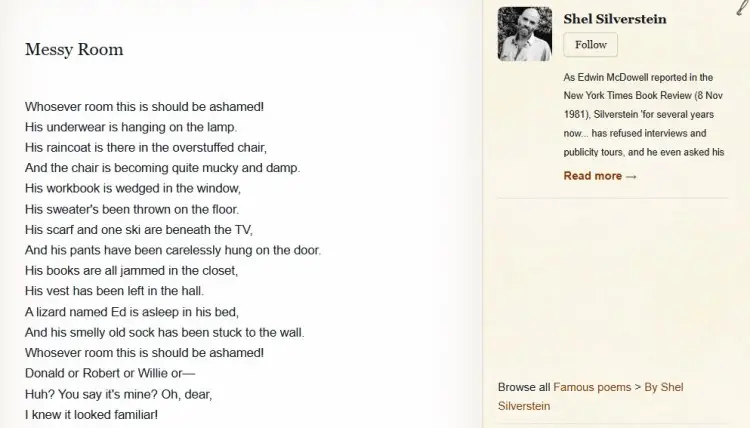
Irony in poetry relies on vivid imagery and sharp contrasts.
- Structural irony: The narrator of Messy Room by Shel Silverstein describes a room in detail only to realize later that it’s their room.
- Situational irony: Samuel Taylor Coleridge’s “The Rime of the Ancient Mariner” features thirsty sailors who can’t drink even if they’re surrounded by seawater.
What Types of Irony Are There?
There are many types of irony used every day, especially since it’s a pretty common figure of speech.
People use irony for communication constantly, even without thinking. It’s what makes most memes and punchlines humorous and creates tension in your favorite movies.
How many types of irony are there?
How many types of irony are there? It depends on who you ask, but generally, there are three major categories with several subtypes. Three different types of irony are verbal, situational, and dramatic irony.
You can also refer to the other subtypes, like cosmic and Socratic irony. They’re more popularly used for literature, but you can also use them if your podcast episode has a narrative arc or if you want to write an interesting podcast description.
How many types of irony are there in literature?

There are many types of irony in literature, with authors constantly looking for new ways to tell stories.
Some popular examples in literature include:
- Dramatic irony: “Othello trusts Iago, but the audience knows better.” – Othello
- Verbal irony: “I drink to the general joy o’ the whole table.” – Macbeth (before disrupting).
How to Use All Types of Irony for Impact
Irony is a sign of wit. As a podcast host, mixing irony into what you say appeals to your audience and makes your content shareable.
Wield irony like a pro by following these tips:
- Use verbal irony: Sarcasm is verbal irony, but there’s a fine line between being sarcastic and being plain rude. Make sure your guest is comfortable with your ironic comments so they don’t misunderstand.
- Teach lessons with situational irony: Situational irony reveals a deep human truth. Just because you do all the right things doesn’t mean success is guaranteed. Use this to tell real stories of entrepreneurs growing their business.
- Tell stories with dramatic irony: You can tell stories of well-known founders with dramatic irony. Audiences know they’ve already succeeded, but when you share their origin stories and struggles, it’s like taking them back in time.
- Skillfully use contrast: Irony is the opposite of what is expected. Use that contrast to highlight your main points.
Becoming a professional speaker or host is more than just knowing how to speak. Learn how to book speaking gigs with this guide on speaker bio examples.
Expect the Unexpected

Mastering the types of irony allows you to craft stories that stick, speeches that resonate, and interviews that get shared.
Put your new skills to the test and get more visibility for your brand. Banter with podcast guests or hop onto other shows yourself.
The plot twist? You don’t have to manually pitch anymore when you use Talks.
- Opt-in ecosystem: Once you create your free profile, AI brings you in front of relevant matches. No emails, pitch decks, or waiting needed.
- Mutual matching: Both parties interested? Messaging unlocks instantly, and if you have Auto-Accept on, you can move on to recording.
Actual leads without unnecessary work? That’s not ironic. It’s just how Talks works.
Create your free Talks Profile and get a match instantly today.


