

So, you’re about to do your first podcast interview. Or maybe your last ten went… poorly. Really poorly. Like “please don’t let anyone hit play” kind of poorly.
I’ve hosted and guested on 500+ interviews and even I’ve been there.
You’re sweating in the chair, your guest is giving one-word answers, and you’re silently panicking because somewhere deep down you know your listeners can feel the awkwardness.
Many podcast interviews flow like jazz. Easy, playful, insightful with the right guest. Other interview shows? They’re a trainwreck in slow motion.
Guests look like they’d rather be anywhere else. You look like you forgot how to breathe. The audience? They click away faster than you can say “mic check.”
Interviewing isn’t just asking opening questions or trying hard to dig into your guest’s story. It’s using tried and tested podcast interview tips to steer a good conversation so your guest forgets they’re “on” and starts giving honest answers to specific topics like a true human.
That’s where great content for podcasting lives. The laughter between host and guest, the aha moments from witty and specific questions, the guest experience and chit-chat other podcasters will actually remember.
Here’s what you’ll learn in this guide:
- How to prep your guest (so you’re not sweating bullets five minutes pre-interview).
- How to structure your podcast episodes without sounding like a robot reading a script.
- How to ask questions that make people actually want to answer.
- How to keep awkward silences from eating the energy of your show.
If you’re done with boring, stiff, forgettable interviews and ready to host conversations people can’t stop listening to… welcome.
You’re in the right place.
What Makes a Good Podcast Interview?
A good podcast interview isn’t just a guest reading off a prepared script while the host nods politely. If that’s your vibe, your listeners are scrolling past before the intro jingle is even over.
A great interview? It’s messy in all the right ways. It’s real.
Your guest forgets the cameras, the mics, the audience, and starts talking like they actually want someone to hear their story. You know the stuff they’ve never told anyone. That’s what keeps listeners hooked.
The difference between “meh” and “must-listen” isn’t fancy equipment or the perfect question list.
It’s: how well you, the host, can read the room, improvise, and create a conversation that feels alive.
What makes a great interviewer?
A great interviewer doesn’t just ask questions. They shake loose answers that even the guest didn’t know they had.
Here’s how I look at it: the guest is a treasure chest, and your questions are the keys.
Bad keys? The chest stays locked, your episode is flat, and everyone leaves disappointed. Good keys? Gems everywhere from insight and laughter to vulnerability and stories that stick.
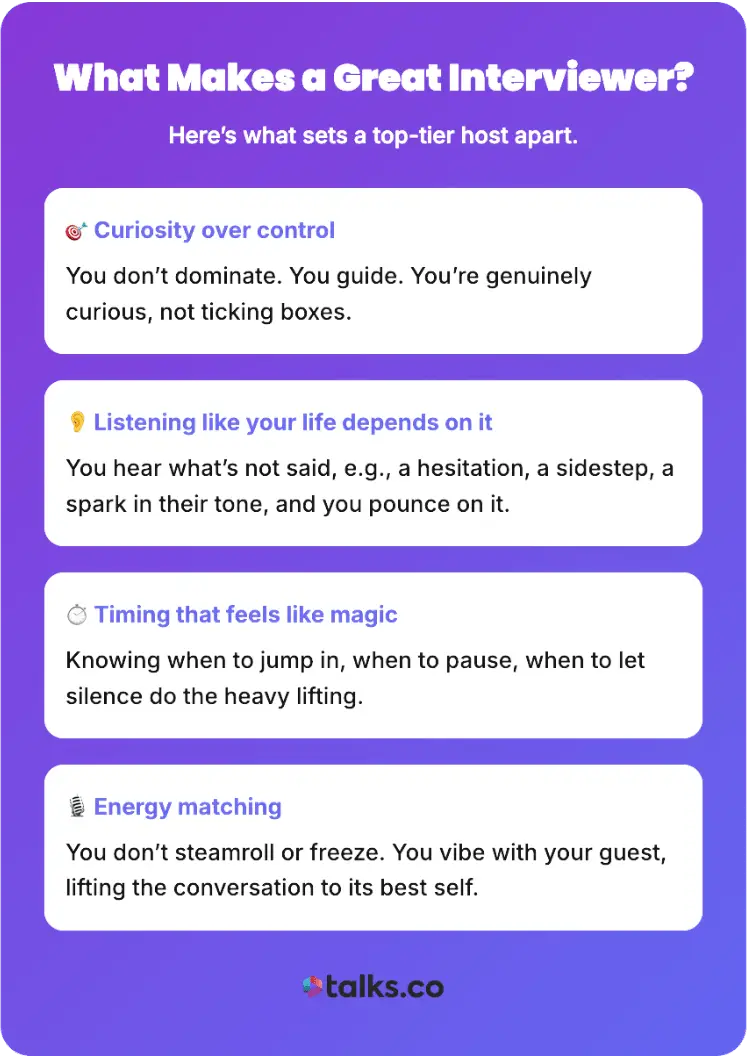
Here’s what sets a top-tier host apart:
- Curiosity over control: You don’t dominate. You guide. You’re genuinely curious, not ticking boxes.
- Listening like your life depends on it: You hear what’s not said, e.g., a hesitation, a sidestep, a spark in their tone, and you pounce on it.
- Timing that feels like magic: Knowing when to jump in, when to pause, when to let silence do the heavy lifting.
- Energy matching: You don’t steamroll or freeze. You vibe with your guest, lifting the conversation to its best self.
Stop trying to sound smart. Start trying to make your guest feel safe, excited, and open. Everything else flows from that.
Podcast structure for an interview
Structure doesn’t mean stiffness. It’s more like a rollercoaster and you need the track to keep the ride safe, but the thrill comes from the curves, drops, and unexpected turns.
A simple, solid structure keeps you from spiraling into awkward tangents, but it doesn’t replace creativity.
Here’s a framework I share with all my clients:
☐ Opening: Hook your guest and listeners in 30 seconds or less. Skip the boring intros. Jump straight into something real.
☐ Core conversation: Three to five main themes or topics, but leave wiggle room. The best gems happen off-script.
Deep dive moments: Ask follow-ups that dig into stories, mistakes, or “aha” moments. Sit in the silence a second longer than feels comfortable.
☐ Closing: Bring it home with a memorable takeaway. Something actionable, surprising, or just plain human.
The trick? Your structure is a skeleton, not a straightjacket. Follow it like a roadmap, not a script.
The moment your guest feels like they’re following instructions instead of having a conversation, you’ve lost them, and your listeners, too.
How to Prepare for a Podcast Interview
A great interview starts long before you hit record. The better your podcast interview prep, the smoother the conversation. Here’s how to set yourself up for a great conversation.
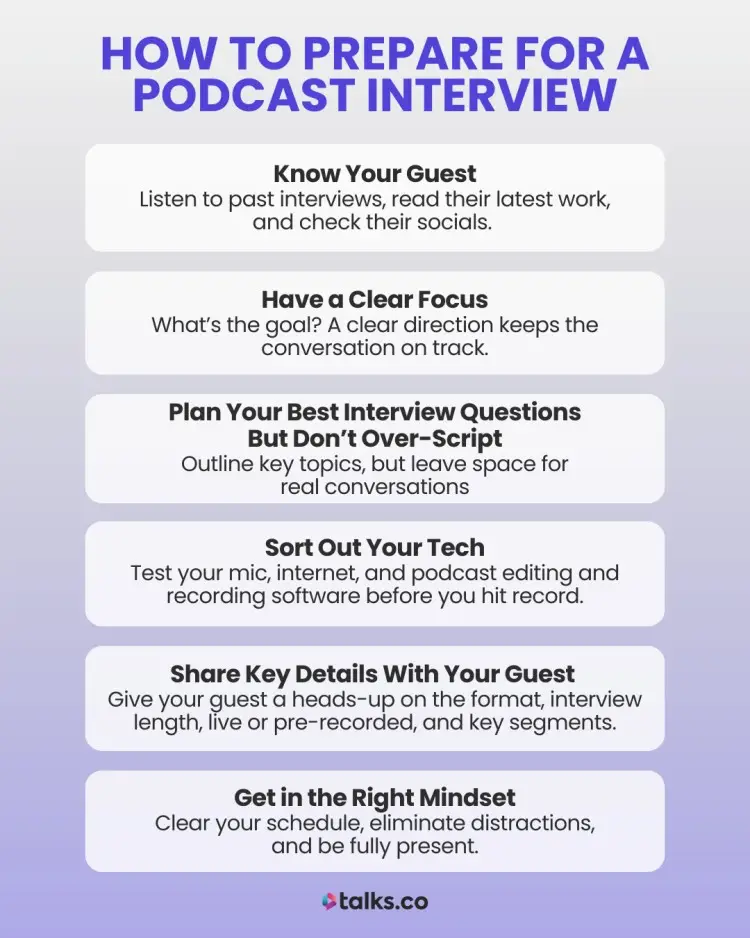
Podcast interview preparation in 6 steps
- Know your guest: Go beyond bios and one episode. Read their latest articles, watch past interviews, and spot contradictions or bold opinions. Those are the moments that make listeners gasp, laugh, or lean in.
- Have a crystal-clear focus: Decide your episode’s purpose: sharing expertise, uncovering a life story, or surfacing a bold opinion. A clear focus keeps the conversation sharp and your audience hooked.
- Plan questions around 3-5 key themes: E.g., industry myths, failure and resilience, habits that shaped success, or lessons no one else is talking about. Prepare questions, but leave room to pivot when something unexpected drops.
- Pre-sort your tech: Your best USB mic, headphones, your best podcast interview software, test everything. Even a 5-minute dry run prevents “Can you hear me?” and helps your guest feel confident and relaxed.
- Share key details ahead of time: Episode length, format, and any curveballs like lightning rounds or polls: tell your guest upfront. Prepared guests open up; nervous ones freeze. Give them the chance to show up confidently.
- Get in the right mindset: Clear distractions, focus fully, and bring curiosity. Your energy sets the tone, and a present host makes the conversation flow naturally.
How to Interview Someone for a Podcast

A great podcast interview is about creating an engaging, natural conversation that keeps listeners hooked and gets the best out of your guest.
How to start interviewing someone
The first few minutes of running a podcast interview sets the tone for everything that follows. If your guest feels comfortable and engaged early on, the rest of the conversation will flow naturally. Here’s how to start strong.
- Greet your guest with confidence and warmth. Make them feel welcome right away. A simple “Thanks for being here. Excited to chat with you today!” sets the right energy for authentic interviews.
- Break the ice before hitting record. Jumping straight into questions can feel stiff. Before recording, have a quick, informal chat. Ask how their day is going, mention a mutual connection, or comment on something interesting from their background. This eases nerves and builds rapport.
- Give them a quick rundown of what to expect. Even if you’ve discussed details before, a short recap helps. Let them know how long the interview will be, the overall style (structured, conversational, rapid-fire, etc.), and if there are any segments or offbeat questions they should expect.
- Start with a strong, engaging question. Your first question sets the tone for the whole conversation. Instead of the generic “Tell me about yourself,” try something more engaging like “What’s the most exciting thing happening in your world right now?” or “Was there a moment that completely changed how you see your work?” These get your guests thinking and excited to share.
- Match your guest’s energy. Pay attention to their vibe early on and adjust accordingly. If they’re enthusiastic, match their excitement. If they’re more reserved, ease into deeper topics with softer follow-ups.
- Keep introductions short and move into the conversation quickly. Long-winded intros can lose your audience. Instead of listing off credentials for minutes, hit the highlights and get into the discussion.
- Reassure your guests if they seem nervous. If you sense hesitation, remind them that this is just a conversation, not an interrogation. Let them know there’s room for pauses or rewording answers, it’s okay to take a moment to think, and they don’t need to be perfect – just authentic.
- Keep your tone conversational. The best podcast interviews feel like a natural back-and-forth. Speak as if you’re having a coffee chat, not a press conference. The more relaxed you are, the more your guests will follow your lead.
A strong start builds trust, wins the guest over, and makes it easy for the best interviews to emerge. Set the right tone and the rest of the conversation will unfold naturally.
How to Conduct a Podcast Interview
Once you’ve started the conversation, your role as the host is to keep things flowing, build guest relationships, and make sure your audience stays hooked.
How to do a podcast interview
Great podcast interviewing done right doesn’t feel like a rigid Q&A podcast script. It’s often a natural, dynamic exchange that brings out the best in your guest. Here’s how to make sure your interviews hit the mark.
- Nail your delivery. Even the best questions fall flat if they’re asked poorly. Keep your tone confident, conversational, and curious. If you sound bored, so will your audience.
- Use follow-ups to dig deeper. Instead of moving straight to the next question, ask things like “Why do you think that happened?” or “What did you learn from that?” to get more insight.
- Control your speaking-to-listening ratio. If you’re talking more than your guest, you’re doing it wrong. Keep your responses brief and focus on guiding the conversation.
- Keep guests on track without shutting them down. If they veer off-topic, gently steer them back with a simple redirect like “That’s a great point. How does that relate to [main topic]?”
- Keep the conversation dynamic. Avoid flat, predictable interviews by varying your tone, reacting in real time, and letting your personality shine through.
- Use silence strategically. Don’t rush to fill every gap. Pauses allow your guest to think and provide deeper insights.
- End with something memorable. Close the interview with a strong takeaway question like “If listeners could take away just one lesson from this, what should it be?” or “What’s the best way for people to connect with you?”
How to interview someone well
Here’s the secret: the best podcast interview setup doesn’t feel like interviews at all. They feel like conversations your listeners just happen to be eavesdropping on.
So how do you get there? Forget the script. Forget the checklist. Instead, lock into the moment. Treat your guest like an old friend at the cafe. Be genuinely curious, fully present, and listen with the intent to uncover something new.
Most hosts fire off questions and move on. That’s the mistake.
The real treasure is in the second layer. When your guest is more likely to share something interesting, don’t rush to the next topic.
Sit in it.
Ask: “What was going through your mind at that moment?” or “Did that change how you approach things today?” That’s where the real stories live.
A good interview asks questions. A great one creates a moment. Be the host who does that.
15 Podcast Interview Tips To Help You Nail Your Interview
After hundreds of interviews (both as a guest and a host), here’s what I’ve learned: the best interviews aren’t about what you ask. They’re about what you unlock.
Most hosts think they need a perfect list of questions. They don’t. What they need is a way to get guests to say something they’ve never said before.
Want to be that host? Here’s how to start a podcast interview:
- Make your guest forget it’s an interview. The moment they stop “performing” and start actually talking, you’ve won. Drop the robotic intros, talk to them like a real person, and set the tone early.
- Don’t move on too quickly. If your guest shares something unexpected, sit in it. Ask “What did that moment teach you?” or “How did that change your perspective?” That’s where the magic is.
- Challenge them (respectfully). If they say something vague or rehearsed, push back: “I hear that a lot, but I want your real take – what do you actually believe about this?”
- Use silence as a tool. Ask a great question, then shut up. If they hesitate, don’t rush to fill the gap. Give them space. Those extra few seconds often lead to the most thoughtful answers.
- Make it personal. Facts and frameworks are fine, but stories are what stick. If they talk about a concept, ask: “When did you first realize this?” or “What’s a moment in your life that proves this works?”
- Be unpredictable. If they’ve done 50 other interviews, they’re expecting the same 10 questions. Hit them with something fresh: “What’s a belief you held five years ago that you no longer agree with?”
- Let them steer sometimes. You don’t have to control every turn. If they light up about a topic, let them run with it. The best moments happen when guests go off-script.
- Spot the unfinished thought. If they start to say something, then backtrack, there’s something valuable there. Circle back: “You almost said something interesting just now – what was it?”
- Don’t be afraid to interrupt – for the right reasons. If they’re repeating something generic, cut in with: “Hold on. Before we move past that, can you give me an example?”
- Read their energy and adjust. If they’re warming up, keep things light and let them settle in. If they’re already fired up, dive straight into the deep stuff.
- Ditch the long-winded intros. Nobody needs a three-minute bio rundown from guest to guest. Hook your audience by jumping straight into something engaging.
- Keep your reactions real. If something surprises you, say so. If something confuses you, ask about it. Your listeners will feel more engaged if they sense your genuine curiosity.
- Don’t just listen. Show that you’re listening. Paraphrase a key insight back to them or build on their idea before moving forward. It keeps the conversation connected.
- Give them something they can’t get anywhere else. Before you wrap up, ask: “What’s something you’ve been thinking about lately but haven’t shared publicly yet?” That’s how you get great exclusives.
- End on a high note. Don’t let the energy fade. Wrap up with a final, memorable question, thank them properly, and leave them excited to share the episode.
A great interview is about what’s revealed. If you can ask questions to get your guests to forget they’re being interviewed, you’ll get moments that no one else does.
30 Best Podcast Interview Questions For Your Next Podcast Guest
Most podcast hosts ask the same predictable questions where the guest is saying the same rehearsed answers they usually give.
If you want to pull out real, memorable stories, you need to ask questions that make your guest pause, think, and reveal something new.
Here are 30 powerful podcast interview questions to help you do just that.
Storytelling and experiences
- If your journey were a book, what would the title be?
- Can you tell me about a time when you completely failed but it turned out to be the best thing for you?
- What’s a decision you almost made that would have taken your life in a completely different direction?
- What’s a lesson you learned the hard way that you wish more people knew?
- Can you walk me through a moment in your career that felt insignificant at the time but changed everything?
- What’s the best risk you’ve ever taken?
- If you could relive one day of your life exactly as it happened, which would it be and why?
- What’s a belief you held at the start of your career that you no longer agree with?
- When was the last time you had to completely rethink how you do things?
- What’s the strangest or most unexpected thing that’s ever happened to you professionally?
Expertise and insights
- What’s a piece of advice you always hear in your industry that you actually disagree with?
- What’s a common mistake people make in your field that drives you crazy?
- If you had to start from scratch in your field today, what’s the first thing you’d do?
- What’s one thing that people assume is important in your industry but actually isn’t?
- What’s an unpopular opinion you hold about your area of expertise?
- What’s the one mindset shift that made the biggest difference in your success?
- If you had to teach a masterclass on one topic, what would it be?
- What’s something people think is complicated but is actually simple once they understand it?
- What’s a question people should be asking you but rarely do?
- If you could change one thing about your industry overnight, what would it be?
Personal reflections
- What’s something you’ve changed your mind about recently?
- How do you personally define success, and has that definition changed over time?
- What’s one thing you’ve had to unlearn to grow?
- If your future self met you today, what advice would they give you?
- What’s something you’ve done that scared you, but you’re so glad you did?
- How do you handle moments of self-doubt?
- What’s a daily habit or mindset shift that’s had the biggest impact on your success?
- If you could only be remembered for one thing, what would it be?
- What’s the best compliment you’ve ever received?
- If you could give one piece of advice to yourself ten years ago, what would it be?
How to Do Podcast Interviews
Podcast interviews are about creating space where your guest feels safe, curious, and excited. Nail the flow, and listeners lean in; fumble it, and you’ve lost them before the coffee even kicks in.
Here’s how to do podcast interviews people can’t stop listening to:
- Set micro-goals for each segment: Break your episode into chunks: first 10 minutes = rapport, next 15 = insights, last 5 = takeaways. Helps you stay focused and hit the right beats.
- Use the environment: Notice small details like books, pets, background quirks, and turn them into questions. Makes guests feel seen and encourages unique stories.
- Play with pacing: Adjust to your guest’s energy. Fast talker? Slow down. Reserved guest? Ask rapid-fire, fun questions to open them up.
- Anchor with mini-stories: Share a short, relevant anecdote before asking a question. Signals vulnerability is safe and keeps the conversation grounded.
- Spot “rabbit holes” worth exploring: When guests drop hints of drama or failure, dig in: timeline, emotions, lessons. This uncovers fresh stories, not generic answers.
- Layer multi-angle questions: Spin one answer three ways: practical advice, personal reflection, and industry insight. Keeps conversation dynamic and unpredictable.
- Add interactive elements: Polls, quick choices, or lightning rounds create energy and can be repurposed for social content.
- Build suspense: Drop hints before a story, e.g., “You almost canceled that project. What happened?” Listeners lean in, guests reveal more.
- Handle live curveballs: Pets, kids, podcast interview software issues. Acknowledge with humor, reset, and keep going. Authenticity > perfection.
- Close with a provocative question: End with a shareable, memorable question: “What’s one belief you hold that most people think is crazy?” Makes the episode stick.
Bonus: Grab a FREE copy of our Talks Podcast Interview Template to get started faster.
5 Podcast guest interview tips
Even the best guests need guidance to shine. These tips make your guest look good, feel confident, and give listeners content they can’t stop talking about:
- Give them a “warm-up challenge”: Ask a light, fun question before hitting record to loosen them up. Example: “Tell me the weirdest habit you have that actually helps your work.”
- Spot hidden passions: Ask questions that reveal what excites them beyond the obvious. Example: a business leader might geek out over gardening, which could tie into a metaphor about patience and growth.
- Flip expectations: If they’re a subject matter expert, have them explain a simple concept in a completely unexpected way. Example: “Explain cryptocurrency as if you were teaching a 10-year-old and a pirate at the same time.”
- Encourage sensory storytelling: Prompt them to paint a picture. “What did it smell, sound, and feel like when you launched your first project?” Audiences remember details, not generic phrases.
- Name-drop strategically: Have them share the people, tools, or books that shaped their thinking. Example: “Who challenged your beliefs the most early in your career?” It adds credibility and intrigue.
Podcast guest interview tips post-recording
Your interviewing podcast job doesn’t end when the mic is off. Post-interview actions can 10X reach and relationships:
- Highlight their standout quotes: Pull 3-5 lines that would make someone stop scrolling on social media. Send them to the guest with a thank-you note and encourage them to share and promote.
- Send a behind-the-scenes peek: A fun screenshot, a blooper clip, or a pre-release snippet builds excitement and feels personal.
- Invite feedback: Ask your guest, “Was there anything you wish we’d covered or want to edit?” It improves future interviews and shows respect for their voice.
- Create micro-content from the episode: Short clips, quote graphics, or mini-tips from the episode can be shared weekly. Example: one 60-second clip could focus entirely on their most counterintuitive insight.
- Keep the connection alive: Follow up a week later with a small gesture: a curated article, a helpful contact, or just a “how’s it going?” email. Podcast relationships are long-term investments.
How to Be a Good Interviewee
Even top hosts get nervous when it’s their turn on someone else’s mic and relying on another host’s podcast software for remote interviews.
Here’s how you can show up like a #boss, leave an undeniable first impression, and make listeners hit replay over and over and over again on all your interesting topics.
- Create moments. If your goal is to sound polished, you’ll blend in. If your goal is to connect, you’ll stand out.
- Forget the script. The worst guests sound rehearsed. The best ones show up prepared but open to wherever the conversation goes.
- Surprise the host. If they ask about your journey, don’t give the same story you’ve told a hundred times. Give them something fresh, something real.
- Answer, then take them deeper. A weak guest says, “Yes, that was a challenge.” A great guest says, “Yes, and here’s what I learned from it that I’ve never shared before…”
- Stories beat soundbites. People forget advice, but they remember stories. Instead of saying “Consistency is key,” tell them about a time you almost quit but didn’t.
- Let the host lead, but don’t be passive. Great guests don’t just react, they engage. If something sparks a thought, jump in. Make it a real conversation.
- Make your audience feel something. People tune in for insights, but they stay for emotion. If they feel inspired, challenged, or entertained, they’ll remember you.
- Promote yourself without sounding like a walking advertisement. Instead of saying, “Go buy my book,” say, “I go deeper into this in my book, and people tell me it completely changed how they see [topic].”
- Stay in the conversation after recording. The best guests don’t just disappear when the episode airs. Share it, tag the host, and engage with listeners. It makes all the difference.
3 Examples of the Best Interview Podcasts [2027]
Most interviews are forgettable. The best ones make people stop, think, and see the world differently.
They don’t just repeat what a guest has said a hundred times before. They pull out something fresh. Here are three episodes that do it right.
1. Modern Wisdom: Why You Should Spend All Your Money Before You Die
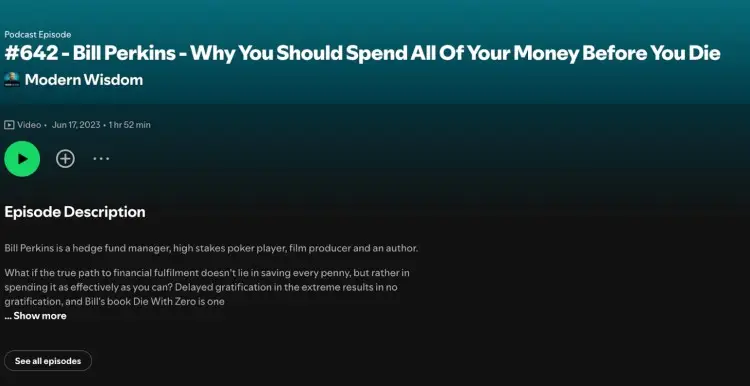
Most people are obsessed with saving, but what if hoarding money for retirement is actually a bad idea?
Bill Perkins, a reasonably well-known guest, argues that wealth should be spent on experiences while you’re young enough to enjoy them.
This Modern Wisdom episode will make you rethink everything you thought you knew about money.
Why it works:
- The host doesn’t just agree, he challenges Bill’s ideas, forcing deeper discussion.
- Instead of a typical finance conversation, it dives into how money connects to life, happiness, and regret.
- It’s packed with real-world examples that make the concept of Die With Zero more than just a theory.
2. The Koe Cast: The Most Profitable Niche is You
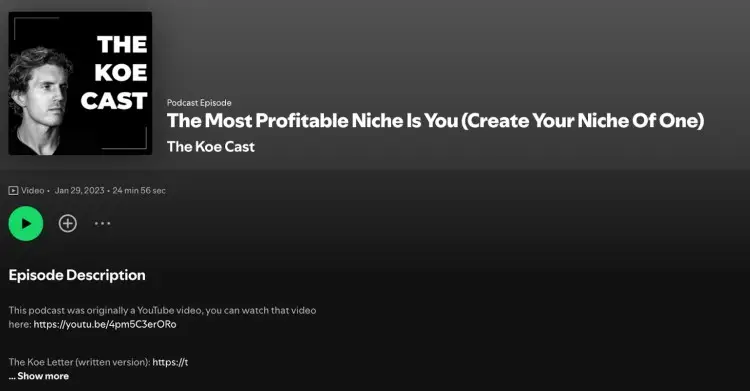
Forget trying to fit into a niche. YOU are the niche. That’s Dan Koe’s philosophy and original interview angle.
In this episode of The Koe Cast, he explains why the most successful personal brands aren’t built around a specific industry, but around the creator themselves.
Why it works:
- Dan breaks the mold of traditional advice and exposes why “niching down” can hold you back.
- He brings in personal stories of failure and success, making the lessons feel real.
- The conversation isn’t just about branding – it’s about building a life that actually fits you.
3. Deep Questions with Cal Newport: How to Think
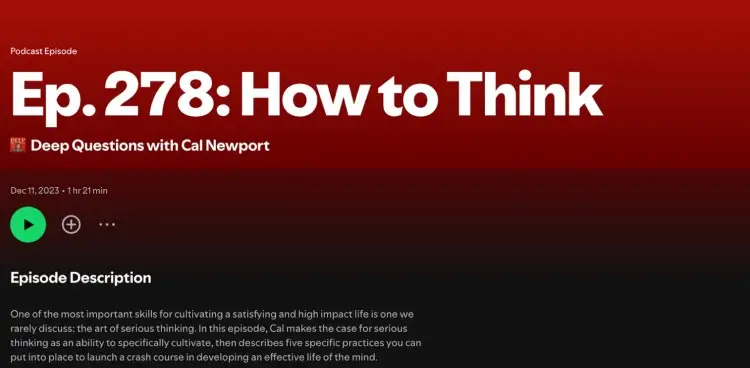
Most people never stop to think.
In this episode of Deep Questions with Cal Newport, he explains why deep thinking is a lost skill and lays out five practical ways to train your brain to focus, reflect, and make better decisions.
Why it works:
- The questions being asked push for depth, making Cal expand on ideas.
- It reveals why most people’s thinking is surface-level and how to break out of that trap.
- Instead of vague advice, Cal gives a step-by-step breakdown of how to improve your ability to think.
One Conversation Can Change Everything
A great interview isn’t about the guest. It’s about you.
The questions you ask, the podcast interview tips you put your own spin on, the moments you chase, the stories you pull out of nowhere. It’s when a pause, a laugh, or a curveball turns a chat into something people actually remember.
The only other catch is… You don’t just ask questions. You uncover. You nudge. You make listeners lean in.
The fastest way to get there? Get behind the mic. Create your free Talks profile.
Auto-match with other hosts, send easy messages, book recordings in minutes, and watch your guest list and your skills explode.
More shows, more stories, more moments people can’t stop talking about. This is how great hosts get made.
Yes! Show Me How to Book Recordings In Minutes for FREE!


