
Looking for informative speech examples that actually work for podcasters, speakers, and guest experts?
If you’re prepping for your next podcast interview, planning a panel discussion, or building your speaker portfolio right now, having a library of strong, informative speech formats can make all the difference.
It shows that the best hosts and guests don’t just show up and wing it. They craft their message with intention, structure, and clarity.
This guide breaks down 19 types of informative speeches with real-world examples for anyone who wants to shine on podcasts, webinars, and speaking stages.
You also get a list of informative speech topics you can easily adapt based on your expertise.
What Is an Informative Speech?

An informative speech, also known as an explanatory speech, educates your audience on a specific topic. Unlike persuasive speeches that aim to change minds, informative speeches deliver facts, insights, and knowledge in a clear, engaging way.
Your goal is simple: deliver valuable insights, facts, or skills that people can walk away with and use.
For podcasters and speakers, informative speeches are your bread and butter. They position you as the expert, keep your audience engaged, and give listeners something worth sharing.
What is an informative talk example?

Think of an informative talk as a focused presentation that delivers practical knowledge to a specific audience.
For example, a business coach might deliver a 20-minute talk on “How to Identify Your Ideal Client in Three Steps.” It’s educational, actionable, and directly tied to what the audience needs.
What should an informative speech include?
Every solid informative speech focuses on a few key components:
- Hook: This is an attention getter statement, like a story, a stat, or a question.
- Thesis statement: Clearly state what your speech is about to help the audience understand your topic immediately.
- Main points: Break your topic into two to four digestible sections.
- Supporting evidence: Use examples, data, or anecdotes to back up your points.
- Conclusion: Summarize your main ideas and leave your audience with a takeaway.
What to write an informative speech on

The best informative speech topics come from three places:
- Your expertise: What do you know deeply? What problems have you solved for clients or readers?
- Your audience’s needs: What questions do they ask? What challenges keep them up at night?
- Current trends: What’s happening in your industry right now that people need to understand?
For example, if you’re a wellness coach, you can speak on “The Science Behind Burnout Recovery” or “How to Build Consistent Habits Without Willpower.”
What are informative speech topics?

Informative speech topics are specific subjects you can teach, explain, or demonstrate to an audience. Here are some common informative speech topics you can deliver:
- How-to guides (“How to Negotiate Your First Book Deal”)
- Educational deep dives (“The Psychology of Decision Fatigue”)
- Trend analyses (“What the Rise of AI Means for Content Creators”)
19 Types of Informative Speeches You Can Copy and Use

Ready to see what works? Here are 19 types of informative speeches with examples crafted specifically for podcast guests, panelists, and public speakers.
Each one features the important parts of an informative speech and can inspire you with various podcast topics you can adapt.
Whether you want to get booked on podcasts or you’re looking for a public speaking opportunity, these help you get started quickly.
1. Good informative speech examples
Topic: The Power of Personal Branding in 2026
Introduction: Your personal brand is no longer optional. It’s your competitive edge. Whether you’re a coach, consultant, or entrepreneur, how you present yourself online and on stage shapes opportunities.
Supporting details: Personal branding includes everything from your LinkedIn profile and podcast appearances to the way you introduce yourself at networking events. It’s about consistency, authenticity, and visibility. Entrepreneurs who invest in their personal brand see higher engagement, more speaking invitations, and better client conversions.
Conclusion: Your brand is your reputation in action. Start building it intentionally, and watch how doors open.
2. Informative speech examples PDF
Topic: How to Land Your First Podcast Interview
Introduction: Podcasts are one of the fastest-growing media channels, and getting featured as a guest can boost your visibility and credibility.
Supporting details: Start by identifying shows that align with your expertise. Craft a personalized pitch that explains what value you bring to their audience. Use platforms like Talks to streamline the process and connect with hosts actively seeking guests. Prepare talking points, practice your delivery, and follow up after the interview to maximize impact.
Conclusion: Your first podcast interview is closer than you think. Take action, pitch smart, and let your expertise shine.
3. 2-minute informative speech examples
Topic: What Is Podcast Guesting and Why It Matters
Introduction: Podcast guesting is when you appear as a guest on someone else’s show to share your expertise, tell your story, and reach a new audience.
Supporting details: It’s a low-cost, high-impact way to grow your visibility. Unlike paid ads, podcast interviews build trust and authority. Listeners hear your voice, your passion, and your knowledge in a way that text can’t capture.
Conclusion: If you’re looking to expand your reach, podcast guesting should be at the top of your strategy list.
4. 5-minute informative speech examples
Topic: The Anatomy of a Winning Speaker Introduction
Introduction: A strong introduction sets the tone for your entire presentation. It’s not just about listing credentials. It’s about creating connection and curiosity.
Supporting details: Start with a hook that grabs attention: a surprising fact, a bold question, or a relatable story. Then, establish credibility by sharing your expertise without sounding arrogant. Finally, preview what your audience will gain from listening. Practice your intro until it feels natural, and ask event organizers to read it exactly as written to maintain consistency.
Conclusion: Your introduction is your first impression. Make it count, and you’ll command the room from the start.
5. Descriptive informative speech examples
Topic: Inside a Typical Day of a Podcast Host
Introduction: Ever wonder what goes into producing a weekly podcast? Let me walk you through a typical day behind the mic.
Supporting details: It starts with guest research and interview prep. Hosts review pitches, book guests, and outline key questions. Recording sessions are usually 30-60 minutes, followed by editing, show notes, and promotion. Successful hosts also engage with their audience on social media, respond to listener feedback, and plan future episodes. It’s creative work, technical work, and relationship work all rolled into one.
Conclusion: Podcasting is more than just talking. It’s a full-time commitment to delivering value week after week.
6. Informative speech examples about education
Topic: Why Media Training Should Be Part of Every Entrepreneur’s Education
Introduction: Public speaking and media appearances can make or break your business, yet most entrepreneurs skip the training that makes them effective.
Supporting details: Media training teaches you how to handle tough questions, stay on message, and present yourself confidently on camera or in front of an audience. It’s not just for CEOs. Coaches, consultants, and authors all benefit. Platforms like Talks connect you with opportunities to practice and refine your speaking skills in real-world settings.
Conclusion: Invest in your media skills now, and you’ll reap the rewards in credibility, confidence, and career growth.
7. Informative speech examples about love
Topic: The Love Language of Audience Connection
Introduction: Just like in relationships, connecting with your audience requires understanding what they need to feel valued and engaged.
Supporting details: Some audiences crave stories and emotion. Others want data and facts. The best speakers read the room and adapt their delivery. They use eye contact, vocal variety, and audience participation to build rapport. When you speak with genuine care for your listeners’ experience, they feel it, and they remember you.
Conclusion: Treat your audience with the same attention and respect you’d give a loved one, and your message will land every time.
8. Informative speech examples about nature
Topic: What Nature Teaches Us About Building a Sustainable Speaking Career
Introduction: Nature operates in cycles: growth, rest, renewal. Your speaking career should too.
Supporting details: Speakers burn out by saying yes to every opportunity without considering alignment or rest. Like a forest that thrives through seasonal change, successful speakers know when to push hard and when to step back. They focus on quality over quantity, nurture relationships over transactions, and let their expertise deepen naturally over time.
Conclusion: Build your speaking career like an ecosystem: sustainable, resilient, and designed to thrive for the long run.
9. Informative speech examples about social media
Topic: How to Turn Social Media Posts Into Speaking Opportunities
Introduction: Your social media content isn’t just for likes. It’s a portfolio that can land you speaking gigs, podcast interviews, and consulting deals.
Supporting details: Share insights, not just updates. Post about industry trends, lessons learned, and behind-the-scenes glimpses of your work. Tag hosts, organizers, and platforms like Talks in relevant posts. Use LinkedIn articles and Twitter threads to showcase thought leadership. When event planners search for speakers, they’re looking at your digital footprint.
Conclusion: Social media is your 24/7 pitch deck. Use it strategically, and opportunities will come to you.
10. Informative speech examples oral communication
Topic: The Art of the Elevator Pitch for Speakers and Consultants
Introduction: You have 30 seconds to explain who you are and what you do. Are you ready?
Supporting details: A strong elevator pitch is clear, confident, and conversational. Start with who you help, then what problem you solve, and finish with the transformation you create. Practice out loud until it feels natural. Use it in networking events, podcast intros, and even social media bios. The best pitches invite follow-up questions. They don’t try to say everything at once.
Conclusion: Your elevator pitch is your verbal business card. Perfect it, and you’ll never struggle to introduce yourself again.
11. Public speaking informative speech examples
Topic: How to Command the Stage Without Being Overconfident
Introduction: Confidence on stage is magnetic, but there’s a fine line between confident and arrogant. Here’s how to walk it.
Supporting details: Confidence comes from preparation, not ego. Know your material inside and out. Practice your delivery until it feels effortless. Use body language that projects strength. Stand tall, move with purpose, and make eye contact. At the same time, stay humble. Acknowledge your audience’s intelligence, invite their participation, and admit when you don’t know something.
Conclusion: True stage presence is confidence without cockiness. Master it, and you’ll earn respect every time you speak.
12. Informative speech manuscript example
Topic: Why Every Entrepreneur Needs a Speaker One-Sheet
Introduction: If you’re serious about landing speaking gigs, you need a speaker one-sheet. It’s your professional highlight reel in a single page.
Supporting details: A one-sheet includes your bio, speaking topics, past events, testimonials, and a professional headshot. It shows organizers you’re polished, prepared, and worth booking. Keep it visually clean, easy to scan, and aligned with your brand. Update it regularly as you gain more experience and visibility.
Conclusion: Your one-sheet is your calling card. Make it count, and you’ll stand out in a crowded field of potential speakers.
13. Informative speech writing examples
Topic: How to Write a Speech That People Actually Remember
Introduction: Most speeches are forgotten within 24 hours. Here’s how to write one that sticks.
Supporting details: Start with a strong hook, something unexpected or emotionally charged. Structure your speech around three main points for clarity. Use stories, not just facts, to illustrate your ideas. Repeat key phrases for emphasis. End with a clear call to action or a memorable takeaway. Write the way you speak, not the way you write emails.
Conclusion: Memorable speeches aren’t about being perfect. They’re about being human. Write with authenticity, and your audience will remember you long after you leave the stage.
14. Short informative speech examples about life
Topic: Life Lessons From a Year of Podcast Guesting
Introduction: Becoming a guest on 50 podcasts in one year taught me more about life, business, and connection than any course ever could.
Supporting details: I learned to be concise, stay curious, and embrace vulnerability. I discovered that authenticity beats perfection every time. I built relationships with hosts and listeners that turned into clients, collaborators, and friends. And I realized that showing up consistently, even when I didn’t feel ready, was the key to growth.
Conclusion: Life rewards those who show up and share their truth. Start podcast guesting, and watch how it transforms your perspective.
15. Short informative speech examples for students
Topic: How to Ace Your First Public Speaking Assignment
Introduction: Public speaking feels scary, but it doesn’t have to be. Here’s how to crush your first speech.
Supporting details: Choose a topic you care about. Passion makes delivery easier. Outline your speech into three clear sections: intro, body, and conclusion. Practice out loud at least five times. Make eye contact with different people in the room. Breathe deeply before you start, and speak slowly. Remember, your audience wants you to succeed.
Conclusion: Your first speech won’t be perfect, and that’s okay. The goal is to start, to practice, and to improve every time.
16. Written informative speech examples
Topic: The Future of Speaking Engagements in 2026
Introduction: The speaking landscape is changing fast. Virtual stages, hybrid events, and AI tools are reshaping how we connect with audiences.
Supporting details: Speakers who embrace technology will thrive. Platforms like Talks make it easier to find opportunities, prepare for interviews, and track your media presence. Audiences expect more interaction, more authenticity, and more value in less time. The future belongs to speakers who can adapt, engage, and deliver in any format.
Conclusion: The future of speaking is here. Embrace the tools, refine your craft, and stay ahead of the curve.
17. Informative speech PowerPoint examples
This Stress Awareness Month PowerPoint offers a clean, professional layout perfect for speakers and consultants who want to educate audiences on mental health topics. The design includes slides for key statistics, wellness tips, and actionable takeaways.
Customization tips:
- Replace the stress-related content with your own expertise, whether that’s productivity, leadership, or work-life balance.
- Use the visual hierarchy to guide your audience through complex ideas, and add your branding for a polished, cohesive presentation.
18. Informative speech presentation examples
This Mental Disorders PowerPoint Template features creative illustrations and clear data-driven slides, making it ideal for professionals presenting on health, wellness, or human behavior topics.
Customization tips:
- Adapt the visuals to fit your message. If you’re a coach discussing burnout or a consultant presenting on organizational culture, these illustrations can be recontextualized to represent stress, team dynamics, or leadership challenges.
- Customize the charts and text boxes to reflect your insights and data.
19. Informative speech visual aid examples
This Charcoal and Green Budgeting Presentation uses a modern, visually striking design perfect for speakers discussing financial literacy, business planning, or resource management.
Customization tip:
- Use the bold visual style to keep your audience engaged during dense topics.
- Swap out the budgeting content for your own expertise, like pricing strategies for consultants, monetization for creators, or ROI for marketing campaigns.
140 Ideas for Informative Speech Topics (By Category)
Choosing the right topic is half the battle. Here are 140 ideas organized by category to spark your creativity.
Whether you’re presenting to a small mastermind group or a packed conference hall, these topics will help you educate, engage, and inspire your audience.
Informative speech topics list
Here’s how to build your own list of speech topics:
- Start with your expertise: What do you teach, coach, or consult on?
- Listen to your audience: What questions do they ask repeatedly?
- Spot industry gaps: What’s misunderstood or overlooked in your field?
- Follow trends: What’s happening now that people need to understand?
- Pull from your story: What lessons from your journey can educate others?
Informative speech best topics
The best topics are timely, specific, and solve a real problem. Here’s how to choose:
- Relevance: Is this something your audience is actively struggling with?
- Uniqueness: Do you bring a fresh perspective or insider knowledge?
- Clarity: Can you explain this topic in a way that’s easy to follow?
- Action: Can your audience walk away and apply what they learned?
Informative speech examples topic
Here are specific examples you can adapt:
- How I landed my fist $10K client (and what I’d do differently)
- The five books that changed what I know about businesses
Informative speech topics easy
Here are easy, approachable topics for quick prep:
- How to start a podcast with zero budget
- The basics of SEO for beginners
Informative speech topics fun
Here are light, engaging topics that still deliver value:
- Why your morning routine might be sabotaging your productivity
- The weird history of networking events
Informative speech topics simple
Here are some simple topics to get you started:
- How to start journaling
- The power of a morning walk
Informative speech topics that are interesting
For speakers who want to stand out, here are interesting speech topics:
- What poker teaches us about negotiation
- The psychology of collecting (and why we hoard)
Informative speech topics about animals
For niche audiences or unexpected angles:
- What animal behavior teaches us about leadership
- The surprising science of therapy animals
Informative speech topics about depression
For mental health advocates and wellness professionals:
- How to talk about depression in professional settings
- The link between burnout and depression
Informative speech topics about dogs
For lifestyle and wellness speakers:
- How dogs improve mental health (backed by science)
- The business of pet influencers
Informative speech topics about education
For educators and online course creators:
- Why lifelong learning is the future of work
- How to design courses people actually finish
Informative speech topics about food
For health coaches and lifestyle brands:
- The psychology of eating habits
- How food culture shapes identity
Informative speech topics about love
For relationship coaches and therapists:
- The five love languages explained
- How to maintain intimacy in long-distance relationships
Informative speech topics about business
For entrepreneurs and consultants:
- How to start a podcast that attracts ideal clients
- The real metrics that matter in business growth
Informative speech topics about current events
For speakers who want timely relevance:
- How AI is changing content creation
- The rise of virtual events and what it means for speakers
Informative speech topics about healthcare
For wellness professionals:
- The future of telemedicine
- How chronic stress impacts physical health
Informative speech topics about history
For authors and storytellers:
- How past economic recessions shaped modern entrepreneurship
- The history of podcasting and where it’s headed
Informative speech topics about medical fields
For health professionals:
- How sleep affects cognitive performance
- The science behind mindfulness practices
Informative speech topics about nursing
For healthcare professionals:
- The mental load of nursing and how to manage it
- How nurses are advocating for better patient care
Informative speech topics on early childhood education
For educators and child development experts:
- The importance of play in learning
- How to support parents in early childhood development
Informative speech topics on mental health
For therapists and wellness advocates:
- The stigma around mental health in entrepreneurship
- How to support someone experiencing anxiety
Informative speech topics on music
For artists and creatives:
- How music impacts productivity
- How to make money selling art online
Informative speech topics on social media
For marketers and content creators:
- How to build a personal brand without burning out
- What makes a viral post viral
Informative speech topics on sports
For coaches and fitness professionals:
- The psychology of athletic performance
- How youth sports impact long-term development
Informative speech topics about psychology
For therapists and coaches:
- The science of self-discipline
- How cognitive biases affect decision-making
Informative speech topics about public speaking
For emcees and trainers:
- Public speaking opportunity strategies for introverts
- How to handle stage fright
Informative speech topics about science
For experts and educators:
- The neuroscience of creativity
- How the brain processes storytelling
How to Write an Informative Speech
Writing an informative speech isn’t about cramming in facts. Speech examples show you that messaging and structure matter if you want your ideas to stick.
Let’s look at the steps to write a full informative speech, outlines, introductions, and conclusions.
How to write an informative speech example
Here’s a step-by-step process:
- Pick your focus: Choose one specific topic your audience needs to understand.
- Know your audience: Personalize your content to their level of knowledge and interests.
- Research thoroughly: Gather credible sources, data, and examples.
- Outline your structure: Plan your introduction, main points (usually three to five), and conclusion.
- Write conversationally: Use simple language, short sentences, and the active voice.
- Add stories: Weave in anecdotes or case studies to illustrate key points.
- Include takeaways: Make sure listeners leave with something they can use.
- Practice out loud: Rehearse until your delivery feels natural.
Explore other types of speeches with these guides on persuasive speech examples, narrative speech examples, and commemorative speech examples.
How to Write an Outline for an Informative Speech (Example Outline)
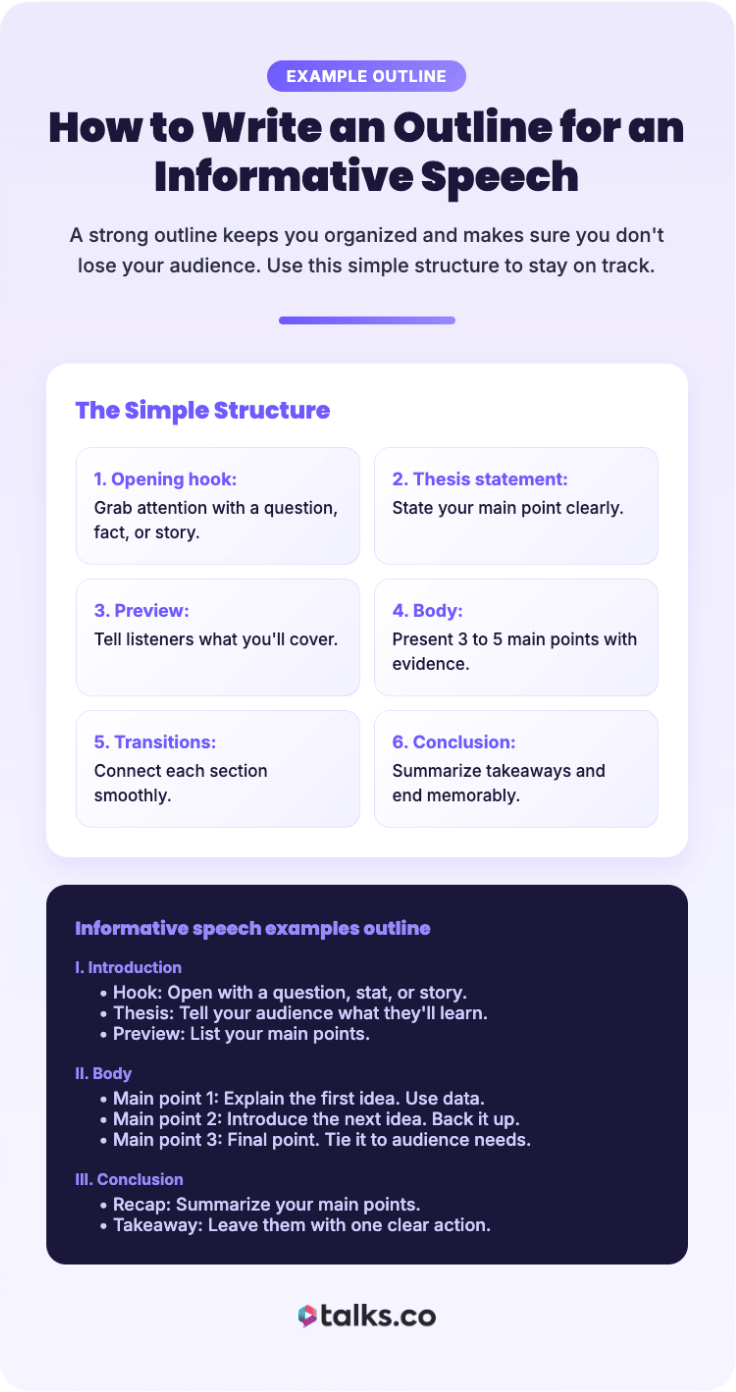
A strong outline keeps you organized and makes sure you don’t lose your audience. Here’s a simple structure:
- Opening hook: Grab attention with a question, fact, or story.
- Thesis statement: State your main point clearly.
- Preview: Tell listeners what you’ll cover.
- Body: Present three to five main points, each supported by evidence or examples.
- Transitions: Connect each section smoothly.
- Conclusion: Summarize key takeaways and end with a memorable closing.
Informative speech examples outline
Here’s a quick informative speech outline you can swipe:
I. Introduction
- Hook: Open with a question, stat, or story.
- Thesis: Tell your audience what they’ll learn.
- Preview: List your main points.
II. Body
- Main point 1: Explain the first idea. Use an example or data.
- Main point 2: Introduce the next idea. Back it up with proof.
- Main point 3: Share the final point. Tie it to the audience’s needs.
III. Conclusion
- Recap: Summarize your main points.
- Takeaway: Leave them with one clear action or insight.
Informative speech outline examples PDF
For downloadable resources, check these structured outlines:
- FAU Informative Speech Outline: This full-sentence outline template focuses on the U.S. educational system. It provides a structured format for organizing speeches with clear sections for introduction, main points, transitions, and conclusion.
- CUNY Sample Outlines: This outline uses the Titanic as a topic to demonstrate how to structure an informative speech. It covers the ship’s history, the tragedy of its sinking, and its cultural impact through the famous movie.
How to Start Informative Speech Examples
Your opening sets the tone. Here’s how to hook listeners fast:
- Ask a question: “Have you ever pitched yourself to a podcast and heard nothing back?”
- Share a surprising fact: “70% of entrepreneurs never get featured on a podcast, not because they lack expertise, but because they don’t know how to pitch.”
- Tell a quick story: “Three years ago, I sent my first podcast pitch. It was ignored. Here’s what I learned.”
Informative speech introduction examples
Here are more good intro spiels for your informative speech:
- Question: “What if I told you that one 30-minute podcast interview could bring you more leads than six months of social media posts? That’s exactly what happened to one of my clients. And today, I’m going to show you how.”
- Statistics: “Over 60% of podcast listeners say they’ve purchased a product after hearing about it on a show. If you’re not using podcasting to grow your business, you’re leaving money on the table.”
- Story: “Two years ago, I was stuck. My business was flat, my audience was small, and I had no idea how to break through. Then I got booked on one podcast. Just one. And everything changed.”
Informative speech conclusion examples
Your conclusion should reinforce your message and leave listeners with a clear next step.
- Summarize and challenge: “So to recap: know your audience, craft a killer pitch, and show up prepared. Now here’s my challenge to you. Send just that one podcast pitch this week. You’ll be surprised at what happens.”
- End with a call-to-action: “If you’re ready to get featured on podcasts and grow your visibility, head over to Talks and create your free profile. Your next big opportunity is waiting.”
- Leave them with a question: “Here’s the real question: if not now, when? Your story deserves to be heard. Let’s make it happen.”
Make the Informed Choice
Whether you’re stepping onto a podcast, taking the stage at a conference, or leading a webinar, having informative speech examples in your pocket makes you stand out.
Ready to put these into practice? Podcasts, presentations, and partnerships are just a click away with Talks.
Talks is one of the fastest-growing modern platforms you can meet your match. Driven by mutual interest instead of cold pitches, you find speaking gigs quickly.
Within five minutes of setup, you’re already confirming your next schedule.
Deborah matched with 10 shows in her niche and Elaine already recorded with 5 guests, with more lined up.
Create a FREE Talks Profile now and start matching with the best shows in your niche!