

All it takes is one line to…
Ease the tension.
Create a memorable moment.
Make someone laugh.
And whether that’s on a podcast episode or onstage, your perfectly timed line can build your authority and create a viral moment.
How do you come up with one?
The key is using verbal irony examples in your practice. Think of it as a tool that helps you sound sharper and more relatable on shows, stages, and online content.
If you want your podcast soundbites to stick, your speeches to feel sharper, and your stories to travel further, mastering verbal irony is one of the fastest ways to do it.
That said, I compiled 77 examples of verbal irony in literature, movies, shows, and music that you can draw inspiration from.
What Are Verbal Irony Examples?
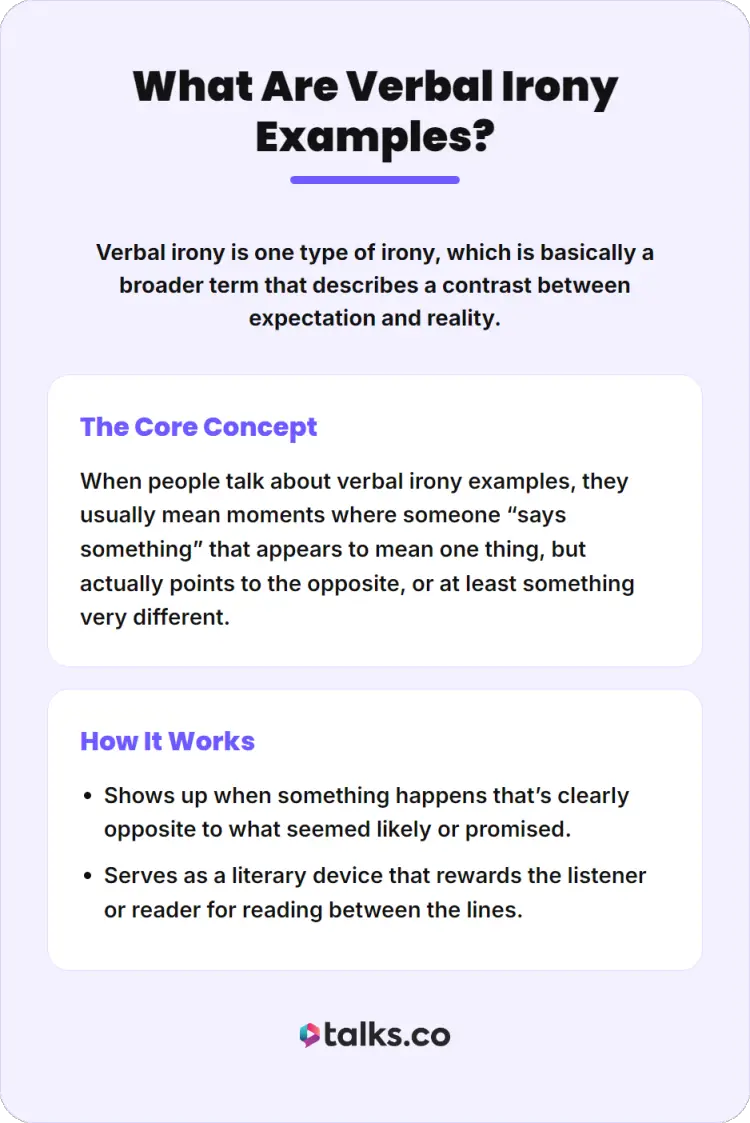
Verbal irony is one type of irony, which is basically a broader term that describes a contrast between expectation and reality.
- Shows up when something happens that’s clearly opposite to what seemed likely or promised.
- Serves as a literary device that rewards the listener or reader for reading between the lines.
When people talk about verbal irony examples, they usually mean moments where someone “says something” that appears to mean one thing, but actually points to the opposite, or at least something very different.
Verbal irony meaning and examples
The meaning of verbal irony is simple: It happens when a person says one thing but means something else. This is a figure of speech where the intended meaning is different from the literal words.
For example, saying “Perfect weather for a picnic,” when it’s raining, brings out humor.
Because of this, verbal irony is closely related to sarcasm. But! Not all verbal irony is sarcasm, even though sarcasm and verbal irony often overlap.
Verbal situational and dramatic irony examples
Verbal irony is only one type of irony. It sits alongside situational irony and dramatic irony.
- Situational irony occurs when the outcome of a situation is the opposite of what was expected, like a fire station burning down.
- Dramatic irony shows up when the audience knows something the character doesn’t, like when a listener watches a hero walk into a trap they already know is waiting.
Each type of irony can be used deliberately to create tension, humor, or surprise in your podcast shows or speeches.
77 Verbal Irony Examples
Verbal irony examples show up in books, poems, lyrics, movies, and casual talk. Once you learn how to recognize that, you can use them in your own writing, speeches, and podcast appearances.
All it takes is one well‑placed ironic line to make your message clearer, more persuasive, and more memorable.
Verbal irony definition literature example
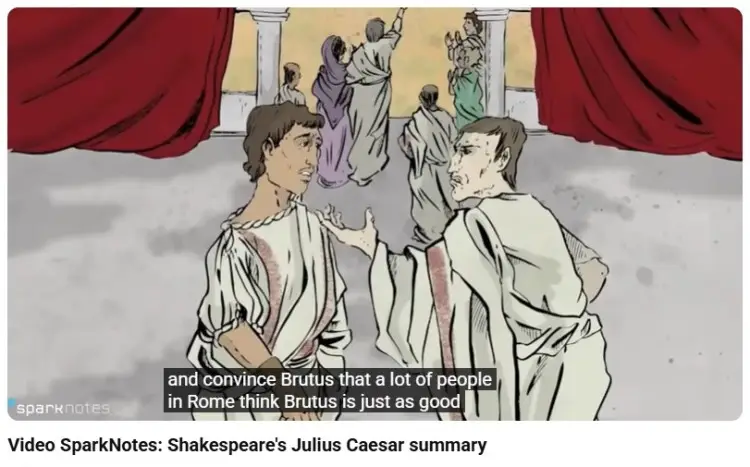
Many classic writers use verbal irony to create wit and tension, or share social commentary. It’s a literary device that adds layers of meaning without spelling everything out.
- In Shakespeare’s Julius Caesar, Mark Antony repeatedly says, “Yet Brutus is an honorable man,” while accusing him of betrayal.
- In Pride and Prejudice, Mr. Bennet describes marriage as “the most important thing in the world,” even though he spends most of his time avoiding it.
- In The Great Gatsby, Nick says Daisy’s voice is “full of money,” which sounds flattering but actually criticizes her shallow values.
- In Lord of the Flies, a character says, “We’re not savages,” right after participating in a violent ritual.
- In To Kill a Mockingbird, Scout’s father says, “It’s a sin to kill a mockingbird,” while the court system is doing exactly that. The line is ironic because it highlights the gap between moral talk and real behavior.
- In 1984, the government calls itself “The Ministry of Peace” while spreading war.
- In Animal Farm, the pigs insist that “All animals are equal,” then add “but some animals are more equal than others.”
- In Macbeth, Lady Macbeth says, “False face must hide what the false heart doth know,” pretending to be innocent while planning murder.
- In Romeo and Juliet, Romeo calls Juliet “a rose,” implying perfection, while their relationship is doomed.
- In Catch‑22, the narrator says, “You’re very hungry, aren’t you,” to someone who hasn’t eaten in days. The line is an understatement.
- In The Importance of Being Earnest, Oscar Wilde has a character say, “I never travel without my diary; one should always have something sensational to read.” This line uses verbal irony to mock social pretense.
Verbal irony examples in literature
Authors across genres use verbal irony in literature to deepen character, add humor, and critique society.
- In Harry Potter and the Order of the Phoenix, Harry says, “Yeah, Quirrell was a great teacher. There was just that minor drawback of him having Lord Voldemort sticking out of the back of his head.” This line is verbal irony that underlines danger with a joke.
- In The Catcher in the Rye, Holden says, “I’m quite ill,” about a tiny brain tumor, downplaying a serious issue.
- In Frankenstein, Victor calls his creation “a monster,” even though he designed it.
- In Hamlet, Hamlet says, “I am too much in the sun,” while clearly grieving his father and angry at his uncle.
- In The Picture of Dorian Gray, Dorian says, “How sad it is that virtue is so often attractive,” mocking morality and righteousness.
- In The Adventures of Huckleberry Finn, Huck says, “All right, then, I’ll just go to hell,” after deciding to help Jim.
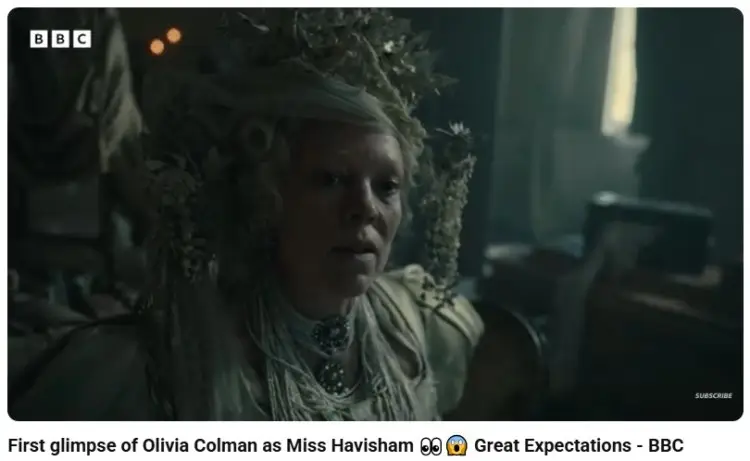
- In Great Expectations, Miss Havisham says, “I have everything I ever wanted,” while living in despair.
- In A Tale of Two Cities, the narrator says, “It was the best of times, it was the worst of times,” which is a kind of romantic irony that frames the contradictions of the era.
- In The Metamorphosis, Gregor’s father says, “He’s still our son,” even though he treats him like a burden.
- In The Handmaid’s Tale, the Commander says, “We’re not your enemy,” while enforcing an oppressive regime.
- In Bernard Shaw’s Pygmalion, Professor Higgins says, “I never swear. I detest the habit. What the devil do you mean?” when he actually swears a lot.
- In Lady Windermere’s Fan, the line “I can resist everything except temptation,” contradicts itself.
- In The Sign of the Four, Sherlock Holmes mocks a police officer about his flawed deduction, saying, “On which the dead man very considerately got up and locked the door on the inside.”
Verbal irony examples in poetry
Poets slip verbal irony in poetry to add surprise or emotional power. A single ironic line can change how the whole poem is read.
- In a modern poem, you could write, “What a beautiful day for a funeral,” using the pleasant weather to underline sorrow.
- In a love poem, you could write, “I never noticed you,” about someone they obsess over.
- In a protest poem, the speaker calls a leader “a man of the people” while listing their selfish actions.
- In a nature poem, you could write, “The city air is so refreshing,” while describing smog and noise.
- In a humorous poem, you could write, “I’m absolutely never late,” moments before arriving hours late.
- In a reflective poem, you could write, “I’m very calm,” while describing a panic attack.
- In a breakup poem, you could write, “I’m really very happy for you,” after losing a partner.
- In a satirical poem, you could write, “He’s a very modest man,” about someone extremely vain.
- In a nature satire, you could write, “The bear is so gentle,” while describing an attack.
- In a confessional poem, you could write, “I never lie,” then admit to lying.
Verbal irony examples in movies

Films pack verbal irony examples into snappy dialogue that makes characters feel sharper and scenes more memorable. For speakers and coaches, watching these lines can help you learn how to use verbal irony in your own stories.
- In The Princess Bride, Westley says, “You seem a very nice person,” right before blocking the villain’s sword.
- In The Avengers, Tony Stark says, “I’m always doing that,” after making a huge mistake, as if it’s something to be expected.
- In Deadpool, the title character says, “I’m not crazy, I’m just a little unwell,” while experiencing extreme symptoms.
- In Jaws, Chief Brody says, “We’re going to need a bigger boat,” calmly as chaos unfolds.
- In The Dark Knight, the Joker says, “I’m not a monster, I’m just ahead of the curve,” while creating chaos.
- In Mean Girls, Cady says, “I’m not that girl,” while clearly acting like the film’s antagonist.
- In The Social Network, Mark says, “I’m not a bad guy,” after hurting others.
- In The Hunger Games, Haymitch says, “Don’t die,” as a farewell to tributes, showing the absurdity of the whole games.
- In Guardians of the Galaxy, Rocket says, “I’m not cute,” while looking adorable.
- In Inside Out, Joy says, “This is great,” during a crisis.
- In The Lion King, Scar says, “Long live the king,” as he pushes his brother Mufasa off a cliff.
- In Shrek, he says, “Of course,” when he doesn’t actually want to stay together with Donkey asks if they can stay together.
- In Monsters Inc., Roz says, “Your stunned silence is very reassuring,” when she catches Mike trying to slip past without submitting his paperwork.
Verbal irony cartoon examples
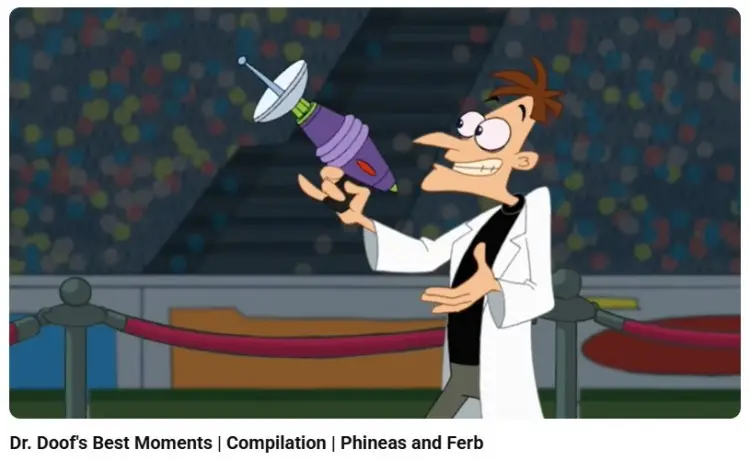
Cartoons exaggerate verbal irony to make jokes land faster and clearer. For coaches and speakers, studying these can help you learn how to use verbal irony in quick soundbites.
- In Phineas and Ferb, Dr. Doofenshmirtz says, “Oh, haha, very funny. Everyone’s a comedian,” to soften the blow of his failed inventions.
- In Family Guy, Peter says, “This isn’t a good idea,” while starting a wild stunt.
- In SpongeBob SquarePants, SpongeBob says, “I’m very calm,” while panicking.
- In South Park, the boys say, “This is totally normal,” during an absurd event.
- In Rick and Morty, Rick says, “I’m not drinking,” while clearly drinking.
- In Peppa Pig, Peppa says, “I’m not scared,” while trembling.
- In Adventure Time, Finn says, “I’m totally fine,” right after getting injured.
- In Scooby‑Doo, Shaggy says, “There’s nothing scary around here,” while trembling in a dark house.
- In The Looney Tunes, Bugs Bunny says, “What’s up, doc?” while actively causing trouble.
- In Beauty and the Beast, Belle tells Gaston, “I don’t deserve you,” to reject him without explicitly saying she doesn’t like him.
- In Daria, she says, “I’m thinking of going into politics,” when praised by her teacher for her art techniques.
Verbal irony examples pictures
You can use verbal irony in ads, memes, and social‑media campaigns to create instant recognition.
- A meme of a person in traffic with text that says, “This is what efficiency looks like,” to make fun of the situation.
- A fitness ad that shows someone sprawled on a couch with the tagline, “Our customers are always in motion,” to tease laziness.
- A photo of a crumbling building labeled, “This place is in perfect condition,” which criticizes the reality.
- A meme of a messy desk with the caption, “This is how I keep things organized.”
- A poster of a dusty garage with the text, “This garage is spotless.”
- A meme of a burned cake with the tagline, “I followed the recipe exactly,” to poke fun at the failed attempt.
- A picture of an enormous utility or credit‑card bill with the caption: “This is just a small, friendly reminder.”
- A person drenched from head to toe, completely soaked, holding a tiny umbrella, with the text: “Looks like we’re having a bit of a drizzle.”
- A clock that has clearly stopped, with the caption: “This clock is perfectly on time.”
- A nearly empty parking lot with a sign that reads: “We’re full to capacity.”
- A poster showing a crowded urban street full of noise and movement, with the tagline: “Escape to our peaceful, tranquil retreat.”
- A gray, rainy street with puddles and bare trees, and the caption: “Welcome to our sunny, cheerful town.”
Verbal irony examples in songs
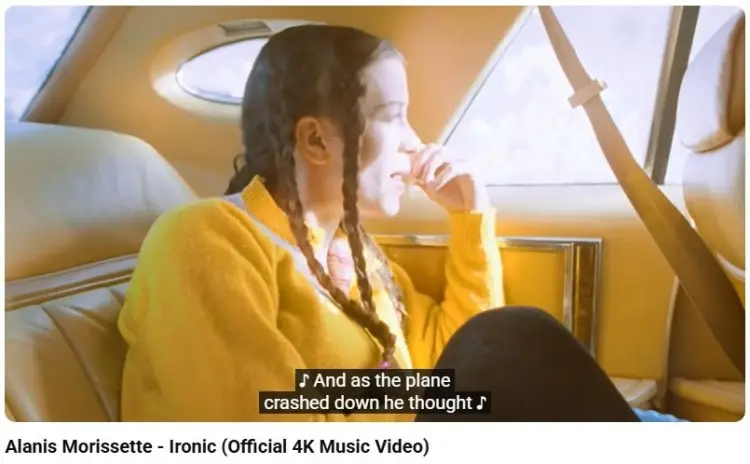
Many songwriters use verbal irony examples in songs to add wit, sarcasm, or emotional depth. The lyrics often sound positive, while the real meaning is critical or sad.
- Ironic by Alanis Morrisette: “And as the plane crashed down, he thought, Well, isn’t this nice?” is a line in the song that adds humor to a serious situation.
- Let Her Go by Passenger: “Only know you love her when you let her go,” contradicts the idea that people who love each other should stay together.
- Sober by P!nk: “But how do I feel this good sober?” plays on the idea that you shouldn’t feel better without the very thing that’s supposed to numb you, flipping expectation into self-reflection.
- good 4 u by Olivia Rodrigo: “Well, good for you, you look happy and healthy. Not me, if you ever cared to ask,” sounds like wishing an ex well when it’s the opposite.
- No Surprises by Radiohead: Instead of using a warm and positive image for love, the lyrics say, “A heart that’s full up like a landfill.”
- Rolling in the Deep by Adele: Two contrasting images appear in the lyrics, “We could have had it all… rolling in the deep,” sounds big and powerful, but it’s really about something that’s already lost.
- Blank Space by Taylor Swift: Taylor mocks her crazy ex-girlfriend’s reputation through the lyrics, “I got a long list of ex‑lovers, they’ll tell you I’m insane.”
- Lost Stars by Adam Levine: “Youth is wasted on the young,” argues that those with more time and energy should be putting it to use.
How to Use Verbal Irony Effectively
For speakers, coaches, authors, and content creators, using verbal irony well can make your message clearer, more engaging, and more shareable.
Here are practical tips for how to use verbal irony in your work:
- Know your audience: Use sarcasm or irony only when you are sure listeners will catch the joke and not take it at face value.
- Match tone to topic: Use verbal irony to lighten tension, not to mock serious trauma or sensitive issues.
- Keep it short and clear: A one‑line ironic comment usually lands better than a long ironic paragraph.
- Use it for emphasis: A well‑placed line can emphasize a problem, like saying, “We’re definitely on track,” in front of a messy project.
- Pair with storytelling: When you tell a story, use verbal irony to highlight your own blind spot or a moment of absurdity.
- Anchor it in truth: Make sure the real meaning is clear through context, so the line is not just confusing.
- Practice in low‑stakes settings: Use verbal irony in casual talks or small webinars before dropping it into big podcast appearances.
- Avoid overuse: If every third sentence is ironic, listeners will stop taking anything seriously.
- Leverage your voice: Slight pauses, changes in pitch, or a smile can signal that a line is verbal irony.
For coaches and speakers preparing for how to do a podcast interview, these techniques help you craft soundbites that hosts can clip and share.
When you use verbal irony in your writing, you also make articles, social posts, and scripts more memorable, which can help you land more public speaking opportunities and media features.
8 Common mistakes to avoid when using verbal irony
Even when you understand the meaning of irony, it’s easy to misfire and sound rude or unclear. Here are common mistakes and cultural nuances to watch out for when you use verbal irony:
- Assuming everyone gets it: Not all listeners will pick up on verbal irony, especially across cultures or age groups.
- Confusing sarcasm with verbal irony: Sarcasm is a form of verbal irony, but it can come across as mean‑spirited if the tone is sharp.
- Speaking too fast: If the audience doesn’t hear the pause or tone, they may think you are being literal.
- Overusing sarcasm: Repeating sarcastic lines too often makes you sound cynical instead of clever.
- Ignoring cultural context: Some cultures use less verbal irony and sarcasm, so what sounds witty in one place can sound confusing or rude elsewhere.
- Failing to reinforce subtext: If the context is weak, the audience won’t grasp the intended meaning behind the line.
- Using it to insult: Verbal irony to create mockery of a person instead of a situation can feel like a personal attack.
- Using it in formal contracts or policies: Verbal irony involves saying one thing but meaning another, which is risky in legal or technical language.
If you plan to be a guest on a podcast, be mindful of these.
Verbal irony examples sentences
Now that you know how verbal irony works, let’s practice turning plain sentences into verbal irony that you can use in speeches, writing, or podcast shows.
- Define reality or what the situation you want to highlight actually is.
- Write it as a literal sentence.
- Flip the framing or exaggerate it.
- Add a hint of humor, being mindful of your tone.
See how it’s done with these examples of literal turned ironic sentences:
Literal: “The meeting started late.”
Ironic: “We’re so punctual around here, the meeting is still waiting for us.”
Subtext: The team is actually late, not punctual.
Literal: “This project is very difficult.”
Ironic: “This project is going so smoothly, it’s almost boring.”
Subtext: The project is chaotic and hard.
Literal: “Leadership is easy.”
Ironic: “Running this team is the simplest thing in the world.”
Subtext: Leadership is stressful and complicated.
Literal: “We have a lot of work left.”
Ironic: “We’re practically done. There’s only a mountain of work left.”
Subtext: The workload is massive.
Literal: “I never make mistakes.”
Ironic: “I’m famously perfect. You’ve never seen me mess up.”
Subtext: The speaker makes mistakes regularly.
Using verbal irony like this can help you sound more engaging when you appear on a podcast or pitch yourself to be on most popular podcasts. You can also adapt these lines into podcast script templates for interviews or promotional clips.
Thrive in the Spotlight
When you add verbal irony examples to your talks, you create moments that listeners replay, share, and quote. This is what helps you stand out on podcasts and social platforms.
Want to be featured on shows or who wants to find public speaking opportunities? Create a free Talks profile to start connecting.
This emerging platform does podcast matching the modern way, bringing your profile in front of other creators already looking for someone like you.
Dinesh booked 50 guests for his show. Sanjai already maxed out his calendar.
Claim your free Talks profile and find your perfect podcast interview match!


