

Most people (Steve Jobs included) struggle because they have way too much to say and way too little time to say it all.
Behind-the-scenes stories, lessons, those three points you really want to make, and probably a brilliant sentence you thought of in the shower. Then you open up Google Docs and suddenly that cursor makes you question how you made it through middle school in the first place.
That’s why studying good speech examples helps.
You can see how a phrase is repeated in public speaking until it becomes unforgettable, or how a great wedding speech turns one ridiculous story into something everyone in the room remembers.
Below, I’ve pulled together famous speech examples and speech topics for different occasions, styles, and goals, plus the techniques and templates you can steal for your own.
What Is a Speech?
A speech is simply a structured way to communicate an idea to a group of people.
That could mean pitching your coaching program at a conference, giving a best man speech in Sydney, delivering a graduation address, or explaining a new business strategy to your team on Zoom.
The common thread? You’re asking people to give you their attention. Your job is to make that attention worth their time.
What are the different types of speech examples?
You’ll run into very different speech styles depending on the room, audience, and job the speech needs to do.
- Persuasive speech examples: A business coach at SXSW challenging how founders price their offers.
- Direct speech examples: A startup founder explaining a sales strategy change to 20 employees.
- Informal speech examples: A podcast guest on The Diary of a CEO sharing how they reached their first $10K month.
- Speech examples short: A 60-second pitch at an Austin networking event.
- Famous historical speech examples: Winston Churchill’s 1940 “We Shall Fight on the Beaches” speech delivered to the House of Commons in London.
- Motivational speech examples: A former athlete speaking to teenagers before a Melbourne competition.
- Graduation speech examples: A founder telling graduating students at Stanford what they wish they’d known before launching their first company.
- Informative speech examples: A health coach teaching corporate employees about sleep.
- Wedding speech examples: A best man recounting a disastrous first date.
- Business speech examples: A SaaS founder launching a product in San Francisco.
- Inspirational speech examples: An entrepreneur rebuilding after closing their first company.
- Demonstration speech examples: A fitness coach teaching a 30-minute resistance-band workout.
What is the correct format and structure of speech examples?
Think of a speech like a conversation with a beginning, middle, and end.
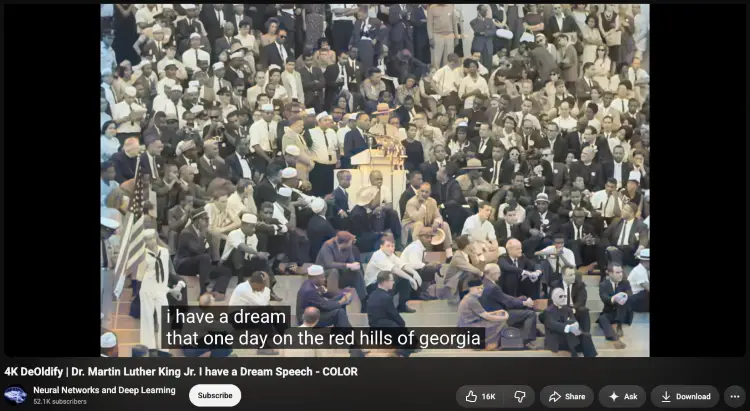
Dr. Martin Luther King Jr.’s “I Have a Dream” speech follows that basic shape:
- Beginning: Introduce the subject and why it matters.
- Middle: Explain the problem, share your ideas, and build your argument.
- End: Leave people with your strongest message.
Dr. King starts by talking about freedom and racial injustice, builds toward his vision of equality with “I have a dream,” then closes with “Let freedom ring.”
You can use the same structure for a keynote, business presentation, graduation speech, or even a 10-minute talk about your coaching niche.
Effective Speech Examples for Beginners and Professionals
1. Persuasive speech examples
Best for: Sales presentations, keynote talks, advocacy speeches, and convincing an audience to rethink an existing belief through a persuasive speech.
Angela Lee Duckworth’s Grit TED Talk starts with a classroom observation, then builds toward a bigger argument using research from West Point, the National Spelling Bee, schools, and businesses.
- Talks Tip: Give your argument something solid to stand on. Pair your opinion with a story, study, result, or real-world example.
- Template: “I used to think [common belief]. Then [experience] made me question it. What I found was [evidence]. So now I believe [new perspective].”
2. Direct speech examples
Best for: Leadership address, team meeting, or difficult business conversation.
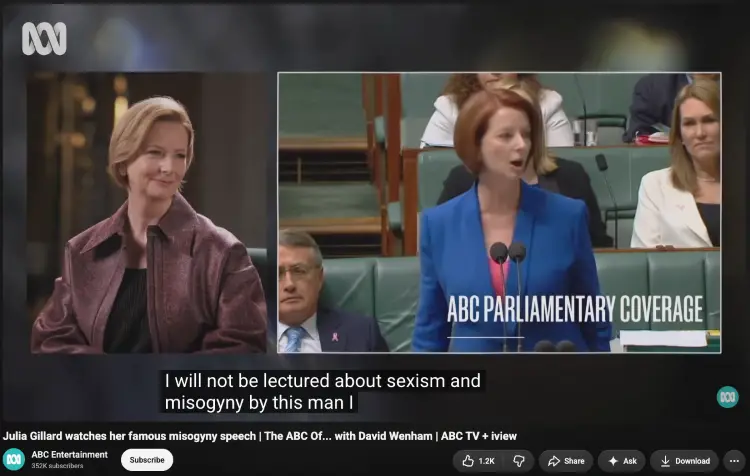
Julia Gillard’s 2012 misogyny speech is a masterclass in direct language. She names the behavior, confronts the argument, and repeats key phrases with increasing force.
- Talks Tip: Use short sentences when the stakes are high. Name the problem before explaining your position.
- Template: “[Problem] is happening. Here’s what it looks like: [specific example]. Here’s where I stand: [position].”
3. Informal speech examples
Best for: Awards ceremonies, team events, podcasts, celebrations, and talks where personality matters.
Rebel Wilson’s 2020 BAFTA speech feels spontaneous because she mixes jokes, personal stories, and topical commentary without sounding scripted.
- Talks Tip: Let your personality carry the transitions. A quick joke or personal aside can make a formal speech feel like a conversation.
- Template: “So, [topic] has been on my mind. Funny thing is… [personal observation]. But seriously, [main point].”
4. Speech examples short
Best for: Quick introductions, social videos, networking events, public speaking opportunities, and short motivational talks.
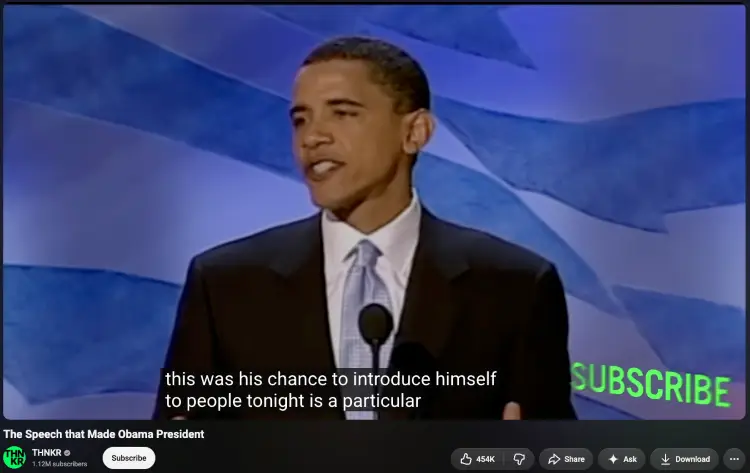
Barack Obama’s short failure speech makes its point quickly: successful people fail, learn from it, and keep working.
- Talks Tip: Give one idea enough room to land. One strong example can do more work than five rushed ones.
- Template: “[Person/example] failed at [challenge]. They learned [lesson]. If you’re facing [problem], remember [takeaway].”
5. Famous speeches in history
Best for: Keynotes, leadership talks, major announcements, and speeches built around a bold shared goal.
John F. Kennedy’s 1962 Rice University speech turns the moon landing into a national challenge, using repetition, vivid detail, and a clear deadline to build urgency.
- Talks Tip: Make a huge goal feel tangible by describing the effort required to achieve it.
- Template: “We’re going to [big goal]. It will require [challenge], but we’re willing to do it because [bigger reason].”
6. Motivational speech examples
Best for: Personal development talks, coaching and emcee events, team motivation, and speeches about overcoming setbacks.
Lisa Nichols’ I Can Do It speech uses her story of having $11.42 in the bank to build toward a powerful message about giving your future a chance.
- Talks Tip: Start with the moment that changed you, then make the lesson useful to everyone listening.
- Template: “I was at [low point] when I realized [lesson]. From that day, I decided to [action]. You can do the same by [challenge].”
7. Graduation speech examples to inspire action
Best for: Commencement addresses, graduation ceremonies, career talks, and speeches about entering a new chapter.
Roger Federer’s 2024 Dartmouth commencement speech turns lessons from tennis into advice about work, failure, relationships, and life after graduation.
- Talks Tip: Build your advice around one world your audience already understands, then translate its lessons to their lives.
- Template: “I learned [lesson] through [experience]. You’ll face your own version of it when [future situation]. Remember [advice].”
8. Informative speech examples
Best for: Educational talks, conference presentations, classroom speeches, and explaining complex topics to a general audience.
Nadia Franzen’s Who You Callin’ Hysterical? is the example when it comes to informative speech examples. She traces the history of hysteria through medicine, culture, and gender, using research, humor, and storytelling to keep a heavy topic engaging.
- Talks Tip: Give your research a narrative. Move from the origin of an idea to its consequences so every fact has a reason to be there.
- Template: “This idea started with [origin]. Over time, it changed [impact]. Today, we still see it in [modern example].”
9. Wedding speech examples for special occasions
Best for: Best man speeches, maid of honor speeches, wedding toasts, and personal celebrations.
Sam’s best man speech gets laughs from specific childhood stories, then shifts into a genuine tribute to his friend Cameron’s growth before ending with a toast.
- Talks Tip: Let the humor set up the heartfelt moment. The emotional shift hits harder after the room has been laughing with you.
- Template: “I could tell stories about [funny memory] all night. But watching you become [quality] has been something I’ll always be proud of.”
10. Business speech examples
Best for: Leadership talks, company presentations, founder speeches, and talks about workplace culture.
Simon Sinek uses simple stories, like the lumberjack who stops to sharpen his axe, to explain ideas about sustainable performance, leadership, empathy, and teamwork.
- Talks Tip: Give an abstract business idea a physical image people can remember. A good metaphor can carry your message long after the speech ends.
- Template: “Think about [familiar situation]. It looks like [obvious interpretation], but the real lesson is [business insight].”
11. Inspirational speech examples
Best for: Keynotes, personal development talks, graduation speeches, and talks designed to leave people with a new perspective.
Matthew McConaughey’s motivational speech turns personal philosophy into memorable ideas, from treating yourself as the author of your life to chasing a future version of yourself.
- Talks Tip: Give your audience a phrase they can carry with them after the speech.
- Template: “When [challenge] happens, remember this: [memorable principle]. You are capable of [possibility], so [specific action].”
12. Demonstration speech examples
Best for: Educational talks, workshops, product presentations, training sessions, and speeches where showing beats explaining.
Seven-year-old Molly Wright’s TED Talk uses baby Ari and his dad to demonstrate how connection affects children, turning research about brain development into something the audience can actually see.
- Talks Tip: Let the demonstration prove your point before you explain it.
- Template: “Watch what happens when [action]. Now notice [result]. This shows us [lesson], which means you can [practical takeaway].”
How To Write A Speech Example
Start your speech outline with the outcome you want, then build the speech around the few ideas that deserve the audience’s attention.
- Pick one takeaway: Decide what you want people repeating on the drive home.
- Know your room: A keynote for 500 founders needs different language than a toast for 30 relatives.
- Write the opening first: Start with a story, question, surprising fact, or bold statement that earns attention.
- Build 3 main beats: Give your speech a clear progression instead of throwing every idea onto the page.
- Add proof: Use a personal story, statistic, example, or observation to make your point believable.
- Write for the ear: Read each paragraph aloud and replace anything that sounds awkward when spoken.
- Finish with purpose: End with the sentence, idea, or action you want people to remember.
How to start speech examples
Your first few seconds decide how much attention you’ll get. Skip the long introduction and give people a reason to listen immediately.
- Open with a confession: “I nearly quit my business 3 months before it finally took off.”
- Ask a sharp question: “What would you do if your biggest mistake became your best opportunity?”
- Drop into the story: “At 6:17 a.m., I was standing outside the emergency room with my phone at 2%.”
- Challenge an assumption: “Most founders think they need more customers. I think many need fewer.”
- Use a striking fact: Lead with one statistic that makes your audience rethink the topic.
- Make a promise: Tell people exactly what they’ll know, understand, or be able to do by the end.
Practical Tips to Write a Good Speech
The strongest speeches usually have a few small decisions doing a lot of heavy lifting. These are the details I’d check before you start rehearsing.
- Leave one sentence unfinished: A well-placed pause after a key thought can give the audience a second to catch up.
- Put your best story later: Save a personal story for the middle or final third when attention starts to dip.
- Write the audience’s reaction: Mark places for a laugh, pause, applause, question, or moment of reflection directly into your draft.
- Cut your favorite line: If a clever sentence distracts from the point around it, bin it. Your ego will survive.
- Change the sentence length: Follow a longer explanation with something short enough to land like a punch.
- Give statistics somewhere to live: Pair every important number with a person, situation, or consequence people can picture.
- Create a callback: Mention an image, phrase, or story near the beginning and bring it back near the end.
7 Mistakes to avoid when writing speech examples
Some types of speech problems only become obvious once you imagine 200 people sitting eagerly in front of you. Catch these on the page first.
- Starting too politely: “Thank you for having me” rarely gives strangers a reason to care about minute one.
- Explaining the joke: If your audience needs 3 sentences of context before laughing, rewrite the setup.
- Saving every good idea: A speech can become weaker when 5 strong points compete for the same 10 minutes.
- Ignoring the room layout: A story involving slides, movement, or audience interaction can fall apart when the setup changes.
- Writing one giant paragraph: Dense pages make rehearsal harder and hide the moments where you need to slow down.
- Ending after the ending: Once you’ve delivered the strongest line, resist the urge to add three more “quick thoughts.”
- Practicing only from the script: Rehearse from bullet prompts at least once so you can recover if you lose your place.
Free Speech Example Template
Staring at a blank page? Use this as your starting point. Fill in the brackets, then adjust the wording, examples, and length to fit the speech you’re giving.
Copy-and-fill speech template:
“Hey everyone.
Let’s begin with [a question, surprising fact, story, or bold statement].
Here’s what happened: [briefly explain the situation or reason you’re speaking]. If you’ve ever [shared experience], you know [the challenge or feeling].
I learned this: [main lesson].
First, [main point and explanation]. Second, [supporting example, story, statistic, or observation]. Finally, [third point and why it matters].
Together, these ideas show that [larger lesson].
Remember: [core message]. I encourage you to [specific action or next step].
Thanks for listening.”
Your Voice Should Already Be Out There
Great speech examples give you ideas for making your next talk stronger. But imagine taking that same expertise and getting it in front of people who are already interested in what you know.
That’s what makes podcast guesting worth adding to your plans.
Talks helps you find relevant shows, connect with hosts, and get those conversations moving. And you can start for free.
Create your Talks profile today and see which podcast opportunities could be waiting for you.


