

Ever tried explaining something you could do with your eyes closed, only to sound like you’ve never done it before?
That’s happened to me while filming a Talks tutorial, walking a new client through a virtual summit, and showing a guest speaker where to click next on their screen.
Once another person has to follow your instructions, every little step suddenly matters. If you skip the bit you assumed was obvious, they’re staring at a screen wondering what they missed.
A demonstration speech works much the same way. If your audience has to guess what you’re doing, you’ve already lost them.
So what could you demonstrate, how should you structure it, and how can you keep five minutes from feeling like fifty?
These demonstration speech examples give you plenty of places to start.
What Is a Demonstration Speech?
A demonstration speech takes a process, skill, technique, or task and puts it in front of the audience. It works especially well when people need to see how something works rather than hear a definition or explanation.
Common uses of a demonstration speech include:
- Teach a practical skill: Show beginners how to replace the inner tube on a Trek FX 3 bicycle.
- Explain a process: Walk first-time homebuyers through the steps involved in making an offer on a house.
- Demonstrate a technique: Show a beginner how to perform a proper tennis serve at a local court.
- Explain how a product works: Demonstrate how to use a Breville Barista Express to make a flat white.
- Make a complex task manageable: Break down the process of creating a three-course dinner for eight guests.
Who uses a demonstration speech?
Anyone who needs to teach through showing rather than telling could use a demonstration speech, from a student presenting in class to an experienced founder training a team. You might see them used by:
- Students: A biology student could demonstrate how to prepare an onion-skin slide for a microscope.
- Coaches: A fitness coach could demonstrate a beginner-friendly kettlebell swing.
- Entrepreneurs: A SaaS founder could show customers how to build their first workflow on the platform.
- Authors and speakers: A public speaking coach could demonstrate how to turn a messy story into a three-minute public speaking opportunity or keynote.
- Teachers: A cooking instructor could demonstrate fresh pasta using a Marcato Atlas 150.
- Content creators: A YouTuber could show emcees and viewers how to edit a talking-head video in Final Cut Pro.
What are the benefits of using a demonstration speech?
Showing the process gives people something tangible to follow, which can make practical information easier to understand and remember. It can also help a speaker:
- Make instructions clearer: Showing someone how to assemble an IKEA KALLAX shelf can make each step easier to follow than describing the pieces alone.
- Give people something memorable: A live paper-airplane demonstration could make an explanation of lift and aerodynamics stick with a classroom.
- Build credibility through your process: A wedding photographer could walk through the exact lighting setup used for an indoor reception at a hotel ballroom.
- Keep attention focused: Demonstrating a simple knife-skills technique could give a cooking class something to watch while each movement is explained.
- Turn expertise into useful content: A financial coach could turn a budgeting exercise into a workshop, YouTube tutorial, or conference presentation.
Best Demonstration Speech Examples
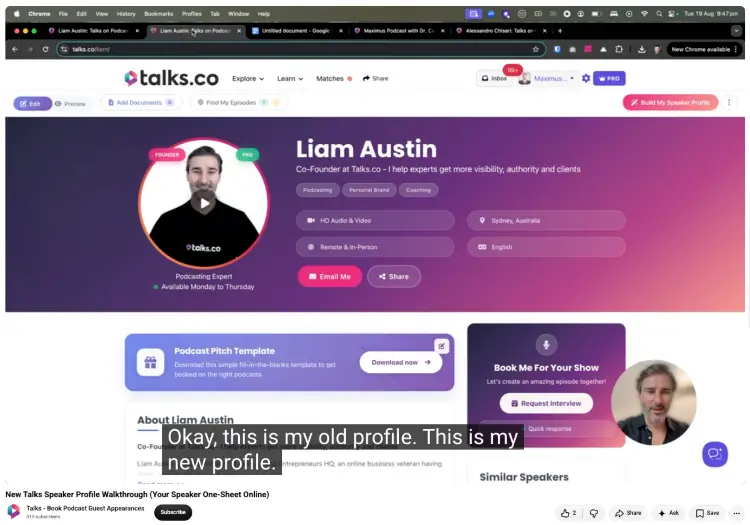
The Talks Inbox walkthrough is a useful example for authors and speakers because it shows a complete process on how to prepare for a podcast interview and the benefits of podcast guesting rather than simply describing features.
- Start with the problem: Keeping podcast conversations organized and turning opportunities into recorded interviews.
- Show the process: Walk through active, scheduled, recorded, review, and archived stages.
- Use a real example: Follow one podcast conversation from matching through interview scheduling.
- Explain each step: Show how scheduling, reminders, reviews, and response tracking keep things moving.
- End with the result: The conversation reaches a published interview instead of getting lost in the inbox.
Authors and speakers could borrow this format to demonstrate podcast preparation, building a speaker profile, or turning a book idea into a talk.
How to demonstration speech examples for authors and speakers
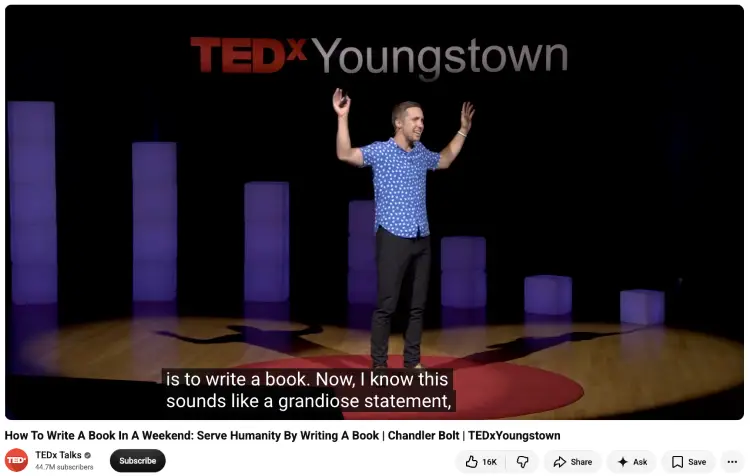
Chandler Bolt’s TEDx talk, “How To Write A Book In A Weekend,” is a useful demonstration speech example for authors and speakers. Rather than talking generally about writing a book, he presents a specific system for getting from an idea to a finished manuscript.
You can borrow that approach by:
- Start with the outcome: Define exactly what the audience will accomplish.
- Break down the process: Turn a big goal into clear, manageable steps.
- Show the method: Explain how each step works instead of simply naming it.
- Make it practical: Give the audience actions they can try immediately.
- Attach it to the bigger goal: Show how each step contributes to the finished result.
Demonstration speech example videos for coaches
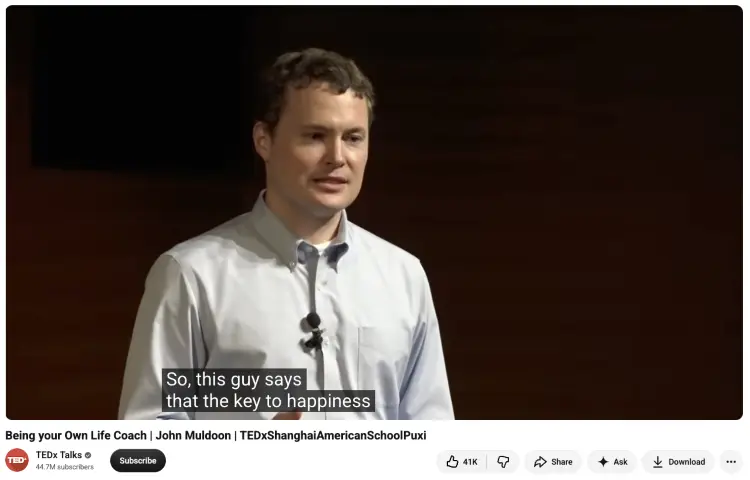
John Muldoon’s TEDx talk, “Being Your Own Life Coach,” shows how a coach can demonstrate a concept through personal experience. He connects his story to metacognition and the way internal dialogue can shape how we respond to situations.
A coach could borrow this structure by:
- Start with a real experience: Share a situation your audience recognizes.
- Introduce the coaching concept: Name the idea that explains what happened.
- Show it in action: Walk through how the concept changed your response.
- Give the audience a takeaway: Offer a question, exercise, or practice they can try.
- Connect it to their situation: Explain where they could use it in everyday life.
5 minute demonstration speech examples for professionals
A short professional demonstration or type of speech needs to give the audience something useful quickly and in real-time.
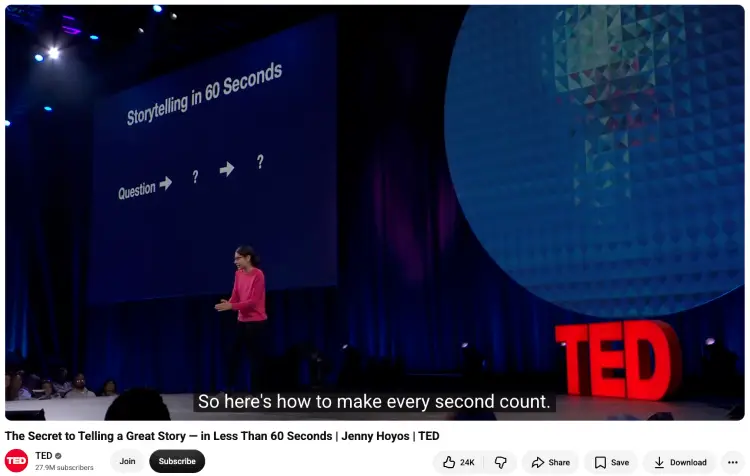
Jenny Hoyos’ TED Talk, “The Secret to Telling a Great Story — in Less Than 60 Seconds,” is a strong example where she breaks down a specific storytelling framework using questions, tension, and structure, giving viewers a method they can try immediately.
For your own five-minute speech, borrow that approach by:
- Introducing one problem: What does your audience struggle with?
- Showcasing your method: What hands-on process or framework solves it?
- Demonstrating each part: How does each step work?
- Giving a practical example: What does it look like in action?
- Ending with an action: What can the audience try today?
Demonstrative speech example essay
Martin Luther King Jr.’s “I Have a Dream” speech is a useful example of informative speech writing and how a speaker can demonstrate an idea through vivid language and repetition instead of relying on visual aids to captivate and teach the audience.
Delivered at the March on Washington in 1963, King moves from describing racial injustice to showing the future he wants his audience to have a deeper understanding of step-by-step.
To get your best demonstrative speech example essay, you could analyze how he:
- Sets the context: Explains the problem.
- Creates a clear vision: Shows what change could look like.
- Uses repetition: Reinforces the central message.
- Builds to a conclusion: Leaves the audience with a memorable picture of the future.
What to Do for a Demonstration Speech (Checklist)
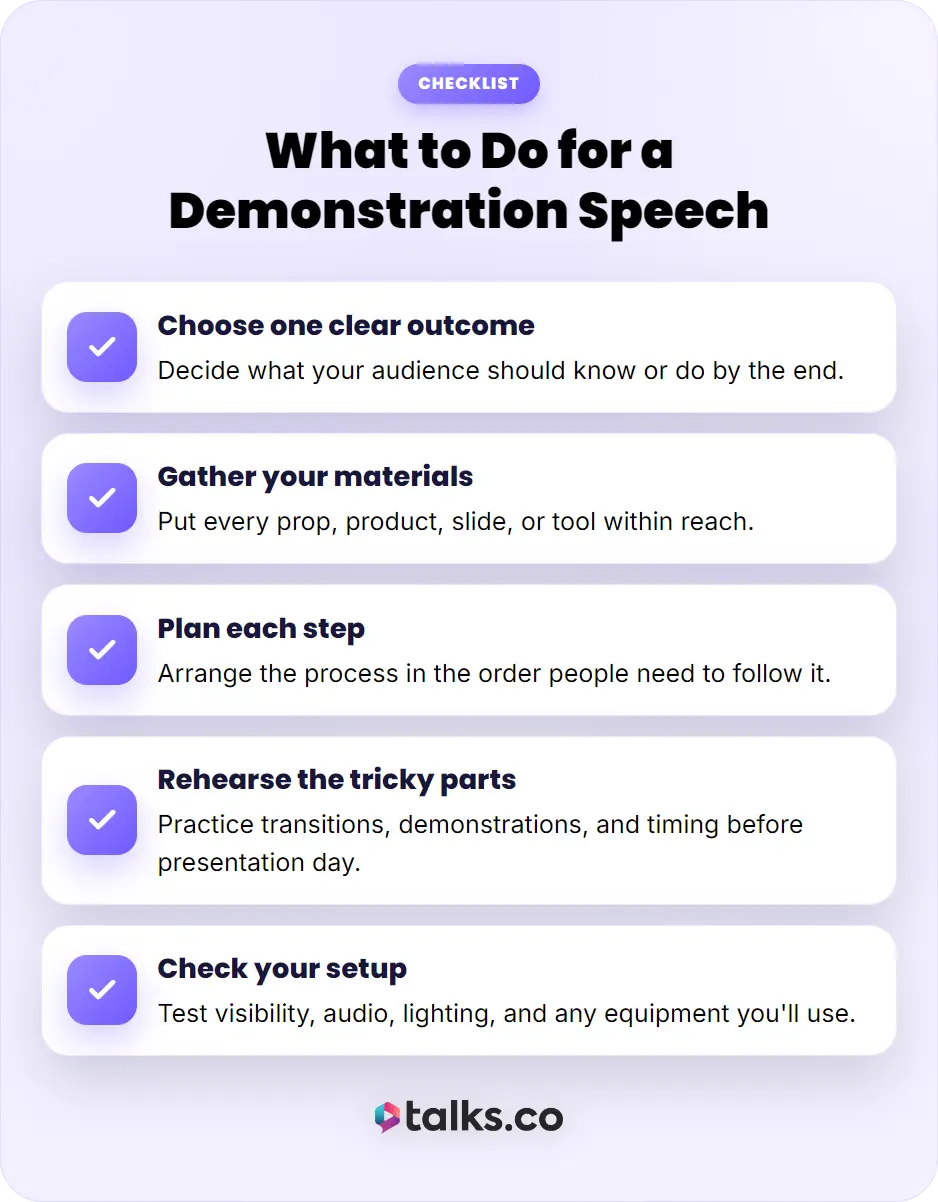
Before you start rehearsing, make sure the audience can see, hear, and follow each part of the demonstration. A quick check could cover:
☐ Choose one clear outcome: Decide what your audience should know or do by the end.|
☐ Gather your materials: Put every prop, product, slide, or tool within reach.
☐ Plan each step: Arrange the process in the order people need to follow it.
☐ Rehearse the tricky parts: Practice transitions, demonstrations, and timing before presentation day.
☐ Check your setup: Test visibility, audio, lighting, and any equipment you’ll use.
10 Unique ideas for demonstration speech
Need a demonstrative speech topic that gives you something concrete to show?
These ten demonstrative speech ideas span creative activities and professional tasks in each group to keep your target audience engaged during your PowerPoint presentations.
Creative activities
- Fold an origami crane: Demonstrate each fold using a square sheet of paper.
- Paint a sunset: Recreate an Australian beach scene using acrylic paints.
- Decorate a cake: Pipe a simple birthday design using a Wilton 1M star tip.
- Make a photo collage: Turn holiday photos from a trip to Kyoto into a printed keepsake.
- Create a terrarium: Layer pebbles, activated charcoal, soil, moss, and miniature plants in a glass jar.
Practical skills
- Change a car tire: Demonstrate how to safely use a jack and replace a flat tire.
- Make sushi rolls: Prepare sushi rice, nori, fillings, and a California roll using a bamboo mat.
- Tie climbing knots: Demonstrate how to tie and check a figure-eight follow-through knot.
- Build a raised garden bed: Assemble the frame, prepare the soil, and arrange the planting space.
- Make homemade soap: Demonstrate the basic process using a melt-and-pour soap base, fragrance, and silicone molds.
How to demonstration speech ideas
Some examples of demonstrative speech topics practically demonstrate themselves.
Making fresh pasta gives you something to mix and shape, editing a video gives you a before-and-after, and planning a virtual summit gives you a process people can watch unfold.
These easy demonstration speech ideas give you that kind of material to work with when you make your speech to engage your audience and boost your confidence.
Everyday skills
- How to make pour-over coffee: Demonstrate a Hario V60, gooseneck kettle, coffee grounds, and brewing technique for your audience to follow along.
- How to change a flat bicycle tire: Create a brief presentation on how to remove the wheel, replace the inner tube, and check the tire pressure using visual aids to share practical knowledge and the step-by-step process.
- How to fold a fitted sheet: Refine your delivery for a more memorable speech by using your public speaking skills to practice how to demonstrate the corner-to-corner method for getting those elastic edges under control.
- How to pack a suitcase: Create hands-on learning experiences for a particular task like organizing clothing, shoes, toiletries, and electronics for a five-day trip while keeping it engaging and informative.
- How to make fresh pasta: Perfect topic that requires clear explanations to complete a specific task or process like how to mix, knead, roll, and cut dough into homemade tagliatelle.
Professional skills
- How to set up a home podcast studio: Position a microphone, boom arm, headphones, lighting, and recording software.
- How to create a budget in Google Sheets: Build income, expenses, savings, and monthly totals into a simple spreadsheet.
- How to edit a short video in CapCut: Turn raw interview footage into a polished 60-second social clip.
- How to create a professional email signature: Add your name, role, contact details, website, and social links.
- How to plan a virtual summit: Map the speakers, sessions, registration process, attendee communications, and event schedule.
Demonstration speech ideas easy for students
Easy demonstration topic ideas work best when the process has a few visible steps and doesn’t require specialist equipment to complete a task. A student could select a topic to demonstrate:
- How to make a study flashcard system: Turn class notes into key points and choose visual aids like question-and-answer cards for a more memorable experience and learning process.
- How to create a simple presentation: Build three slides in Google Slides with images, headings, and speaker notes.
- How to make a paper bookmark: Fold and decorate one using basic craft supplies.
- How to organize a backpack: Sort books, notebooks, electronics, and supplies for a typical school day.
- How to make a simple smoothie: Measure ingredients, blend them, and explain the order of each step.
Demonstration speech ideas funny parents
Parenting gives you plenty of everyday situations that can become funny narrative speech examples and demonstrations, especially when the audience recognizes the true chaos of parenthood.
Try:
- How to pack snacks for a road trip: Demonstrate the questionable amount of food required for a two-hour drive.
- How to get a child out the door on time: Walk through the morning routine, including the inevitable missing shoe.
- How to build the perfect school-night lunch: Show what happens when you ask what the child actually wants.
- How to survive a family group chat: Demonstrate the difference between useful messages and 47 consecutive photos.
- How to assemble a toy without losing your mind: Narrate the instructions, missing pieces, and leftover screws.
How to Write a Demonstration Speech (Checklist)
Before you write the full speech, work through these steps to make sure your demonstration has a clear purpose, logical flow, and enough detail for the audience to follow.
☐ Choose one clear outcome: Decide exactly what the audience should know or be able to do by the end.
☐ Know your audience: Match the language, examples, and level of detail to the people you’re speaking to.
☐ Break the process into steps: Put every action in the order the audience needs to follow it.
☐ Gather your materials: Have every tool, product, prop, image, or piece of equipment ready before you begin.
☐ Explain the important details: Point out anything the audience needs to know to complete a step correctly.
☐ Show as you explain: Demonstrate each action while talking through what you’re doing.
☐ Plan your timing: Give the most time to the steps that require the most explanation or attention.
☐ Include a useful tip: Share a shortcut, common mistake, or small detail that could help the audience get better results.
☐ Rehearse the full demonstration: Practice the process from start to finish and remove anything that slows it down or distracts from the main outcome.
☐ End with the result: Show what the finished process looks like and remind the audience what they can now do themselves.
Demonstration speech outline examples
Use these as working templates. Replace the prompts in brackets with your own details, then read the finished version out loud and adjust anything that sounds unnatural.
Basic demonstration speech outline
Start with this version when you need a flexible structure that can work for almost any topic. Fill in the prompts as you go, then use the finished outline as your speaking notes.
Opening
“Have you ever [describe a problem, frustration, or situation your audience recognizes]?
Today, I’m going to show you how to [specific result or skill]. By the end, you’ll know how to [what the audience can do].”
What you’ll need
“Before we start, you’ll need [material/tool/product 1], [material/tool/product 2], and [material/tool/product 3].
We’ll use these to [briefly explain what they’re for].”
Step one
- “First, [describe the first action].
- The reason we’re starting here is [explain why this step matters].
- [Demonstrate the step while explaining what the audience should watch for.]”
Step two
- “Next, [describe the second action].
- Make sure you [important instruction or warning].
- [Show the audience exactly what this should look like.]”
Step three
- “Now it’s time to [describe the next action].
- You’ll know you’ve done this correctly when [describe the visible result].”
Final step
- “Finally, [complete the process].
- At this point, you should have [describe the finished result].”
Close
“So, you’ve now seen how to [repeat the main outcome]. When you try it yourself, remember [one key tip].”
Five-minute demonstration speech
A five-minute demonstration needs to earn its place. This version keeps the structure tight while leaving room for a hook, the essential steps, and one useful takeaway.
Hook
“[Open with a question, quick story, surprising result, or problem your audience has experienced.] In the next five minutes, I’ll show you how to [specific result].”
Set up
“To do this, you’ll need [materials]. We’re going to go through three main steps: [step one], [step two], and [step three].”
Step one
- “Let’s start with [first essential action].
- [Demonstrate the step.]
- The main thing to remember here is [key instruction].”
Step two
- “Next, [second essential action].
- [Demonstrate the step.]
- Watch for [common mistake, visual detail, or important change].”
Step three
- “Finally, [third essential action].
- [Complete the demonstration.]
- You should now have [finished result].”
Quick takeaway
“What people usually get wrong is [common mistake]. So when you try this yourself, remember [one simple tip].”
Close
“That’s how you [repeat the outcome]. Your next step: [simple action the audience can practice today].”
From “What Do I Say?” to “Watch This”
The best demonstration speech examples give people something they can actually see, follow, and try. Once you’ve got your topic, outline, and steps sorted, the next question is where else you can put those speaking skills to work.
Want more people hearing what you know?
Set up your free Talks profile and connect with podcast hosts looking for experts like you. Your next speaking opportunity could already be waiting.
Yes! I Want to Join Talks Now!


