
“How much does YouTube pay per view?” sounds like a simple question.
It isn’t.
The real answer depends on what you make, who watches you, how long they watch, and how advertisers value your audience.
Two channels can get the same number of views and walk away with completely different payouts. One might earn a few dollars. The other might cover their rent.
That gap is where most creators get confused, and where most bad advice on YouTube monetization comes from.
In this guide, you’ll see what YouTube actually pays per view, what numbers matter more than views on YouTube, and how creators increase their earnings without needing millions of subscribers.
If you’re building a YouTube channel, a video podcast, or a content business, this is the math you need to understand before you plan your next move.
How Do YouTubers Get Paid?
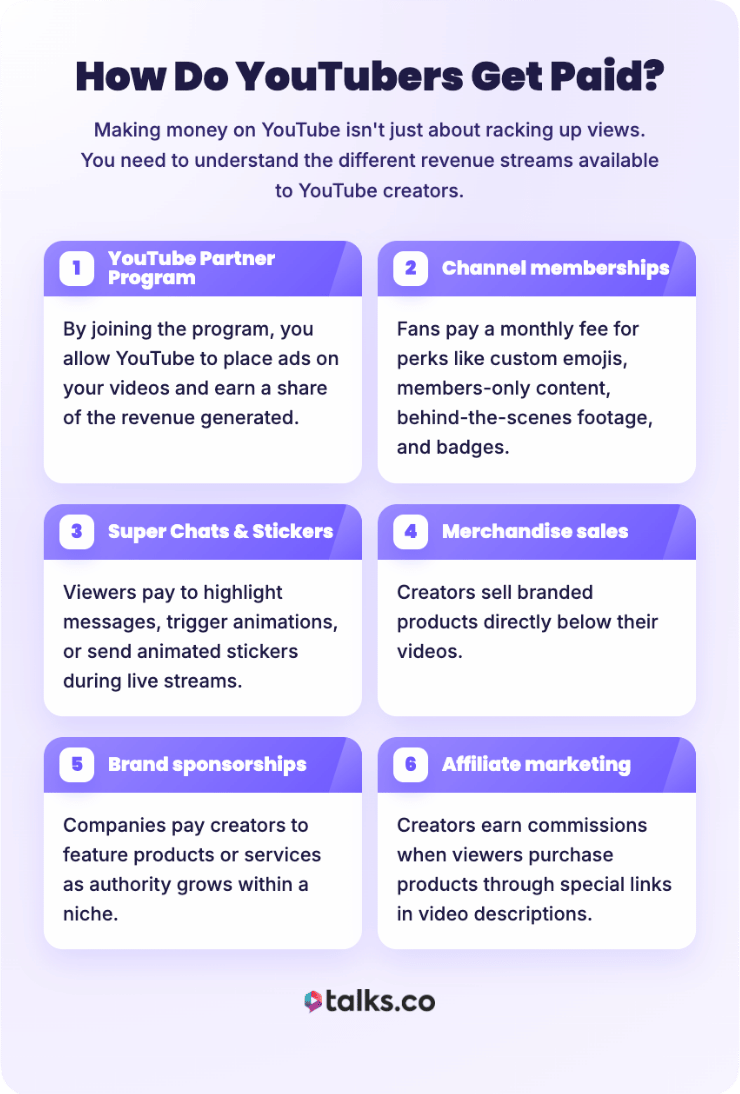
Making money on YouTube isn’t just about racking up views. You need to understand the different revenue streams available to YouTube creators.
Here are the primary ways YouTubers get paid:
- YouTube Partner Program (AdSense): By joining the program, you allow YouTube to place ads on your videos. In return, you receive a share of the revenue generated from those ads.
- Channel memberships: Your biggest fans pay a recurring monthly fee in exchange for exclusive perks. These can include custom emojis, members-only content, behind-the-scenes footage, or special badges that appear next to their name in comments and live chats.
- Super Chat, Super Thanks, and Super Stickers: During live streams, viewers can purchase a Super Chat (highlighted message), Super Thanks (fun animation), or Super Stickers (animated images).
- YouTube merchandise sales: You can sell your own branded products directly below your videos.
- Brand sponsorships: As you build authority in your niche, companies will pay you to feature their products or services in your videos.
- Affiliate marketing: You include special links to products or services in your video descriptions. When a viewer clicks one of those links and makes a purchase, you earn a commission.
How much does YouTube pay per view without ads?
Here’s the truth: YouTube does not pay creators any fixed amount per view. You aren’t paid just because someone clicked on your video.
Instead, the platform operates on a revenue-sharing model:
- Creators earn money on YouTube through different monetization features, primarily from YouTube ad revenue.
- You get paid when an ad is shown (and watched) on your YouTube content.
- If a viewer uses an ad blocker or skips the ad immediately, you generally don’t get paid for that view.
How much does YouTube pay per view and subscriber?

To start earning from views and ads, you need to be part of the YouTube Partner Program. It’s not automatic, so you have to earn your spot.
To become eligible for the YPP and unlock monetization features, you need to meet specific criteria:
- Subscriber count: You must have at least 1,000 subscribers. This signals that you’ve built a core and loyal audience.
- Watch time or Shorts views: You need to reach either 4,000 valid public watch hours in the past 12 months or ten million valid public Shorts views in the last 90 days. This signals that your content is engaging enough to hold viewers’ attention.
- Location: You must reside in a country or region where the YouTube Partner Program is available.
- AdSense account: You need to have a linked AdSense account, which is Google’s platform for managing and receiving ad payments.
- Compliance: Your channel must follow all of YouTube’s monetization policies, community guidelines, and terms of service.
Once you’re eligible to join the YouTube Partner Program, you can turn on monetization, so YouTube can show ads on your videos.
You earn per ad views and not by video views or subscriber count.
How much YouTube pays per view in every country
Not all views are created equal.
A view from the US is usually worth more than a view from many other countries, and it comes down to one thing: what advertisers are willing to pay to reach that audience.
Your viewer’s location plays a huge role in your earnings because ad rates change by market. Countries with stronger ad economies tend to pay more, while regions with smaller ad budgets pay less.
Here’s how it usually breaks down:
- Tier 1 countries (US, UK, Canada, Australia): Advertisers pay premium rates to reach these audiences. That’s why they command the highest rates, typically between $2-$15 CPM (cost per thousand views).
- Tier 2 countries (European nations, Japan, South Korea): There’s a lower advertiser demand for these areas. Earnings are generally moderate, ranging from $1-$5 CPM.
- Tier 3 countries (Asia, Latin America, Africa): In these regions, advertiser budgets are typically smaller. That leads to lower payouts, often between $0.10-$2 CPM.
If you’re a coach aiming to attract high-ticket clients, creating content that resonates with audiences in Tier 1 countries can increase your earning potential.
How Much Does YouTube Pay per View on a Video?
Not all videos are created equal. The type of content you produce dictates how much advertisers are willing to pay.
YouTube statistics show that different content categories generate varying levels of revenue based on advertiser demand and audience value.
For example, a video targeting luxury audiences can earn more per view than prank videos, simply because one is more attractive to advertisers with bigger budgets.
How much does YouTube pay per view on long videos?
Long-form content is the bread and butter of YouTube revenue. These are the standard videos you watch on your TV or laptop.
YouTube pays creators between $2-$12 per 1,000 views for longer videos.
- Mid-roll ads: For long videos, your goal is to use mid-roll placements. By placing ads in the middle of the video, you increase the number of views on ads per single video view.
- Average duration: Many creators publish videos that are eight to ten minutes long to maximize ad placements.
- Higher CPM: In high-value niches like personal finance or business coaching, the average CPM can be much higher.
How much does YouTube pay per view on Shorts?
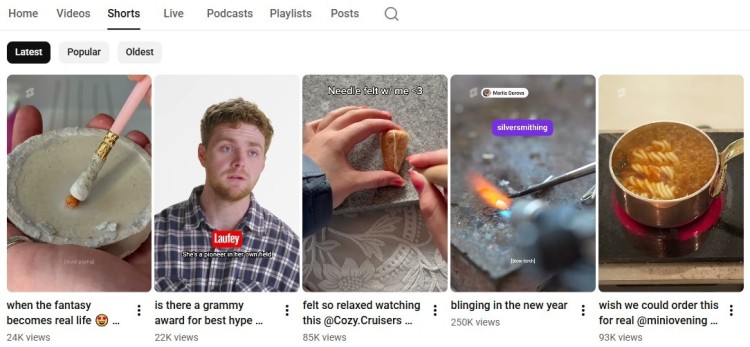
YouTube Shorts has introduced new monetization opportunities for creators who prefer quick, snappy content. But the pay structure is different from a regular video.
- YouTube Shorts monetization program: Creators earn money from their short-form content through a revenue-sharing model based on total views across the platform.
- Revenue pool: Because ads run between videos in the Shorts Feed (not directly on your video), the revenue is pooled and distributed based on your share of total views.
How much does YouTube pay for 1000 views on Shorts?
The payment structure for Shorts differs from regular YouTube videos, with creators typically earning less per view.
- Lower income per view: RPMs (Revenue Per Mille) for Shorts are often between $0.01-$0.06 per 1,000 views.
- Higher engagement potential: While the income is just a fraction compared to a long video, short-form content tends to go viral faster, making it easier to reach a million views.
Talks tip: If Shorts are part of your video podcast strategy, produce a lot of them. Use AI tools like Descript or Riverside to automatically edit clips.
How much does YouTube pay for 1 million views on Shorts?
For one million views on a Short, creators can typically expect to earn between $10-$60, depending on factors like audience geography and overall engagement.
The payout is definitely higher at the one-million-view mark, but compared to regular videos, it still doesn’t really compare.
- Let’s say a creator’s RPM is $0.05. For one million views, they earn $50.
- For long-form videos, a million views could potentially net creators thousands of dollars.
Because of this, many successful creators use Shorts as a top-of-funnel marketing tool. Use them to drive traffic and subscribers to your main channel, instead of counting on them as a primary income source.
How much does YouTube pay per view on music videos?
Music is a big part of the YouTube ecosystem, but monetization for music videos can be complex. Your earnings are heavily influenced by copyright ownership.
- Channels with original music or music-related content, like analysis and trends: You can earn anywhere from $1,000-$30,000 for a million views (average at $15,000).
- Channels using copyrighted music without rights: Revenue will likely be claimed by the music publisher or record label through YouTube’s Content ID system. This means that even if your video gets millions of views, you won’t see any of the ad revenue.
How much does YouTube pay per view on live stream?
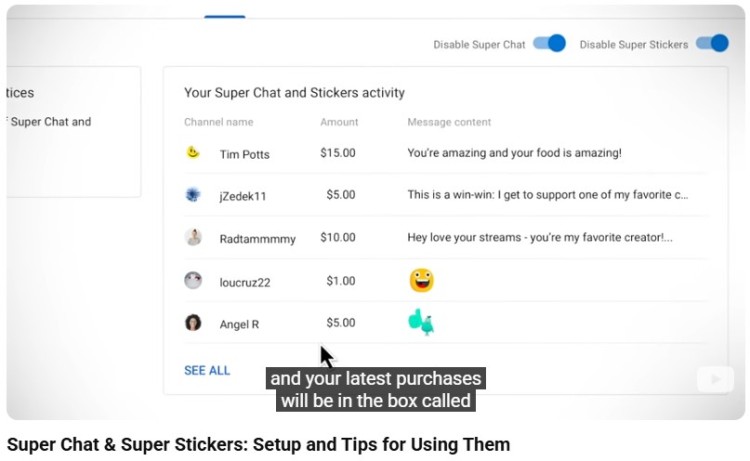
Live streaming offers a dynamic way to engage with your community in real-time, and it comes with its own set of powerful monetization features.
- Ad revenue: On a live stream, creators can potentially earn $10 or more per 1,000 views from ad revenue alone.
- Lifetime value: A stream that accumulates 1,000,000 views over its lifetime could generate $10,000+ from ad revenue.
- Direct audience interaction: During a live event, viewers can support you through Super Chats, Super Stickers, and channel memberships, adding another layer to your earnings that isn’t dependent on ad views.
- Offline income: If you archive the stream and it continues to get views, you can earn significant passive income.
How Much Money Does YouTube Pay per View?
Why does one channel make $5,000 a month while another with the same views makes $500? It comes down to a few must-know variables.
These factors determine exactly how much a YouTuber gets paid:
- Niche: Niches like personal finance and technology attract advertisers with deep pockets. They’re willing to pay more just to reach audiences that are actively looking for high-value products and services.
- Audience location: Tier 1 countries are more valuable to advertisers. A channel with a predominantly American audience will earn significantly more than a channel with the same number of views from a Tier 3 country.
- Engagement: The longer people watch your videos, the more ads they can be shown. A video with a 60% average view duration will earn more than a video of the same length with only a 30% duration.
- Ad formats: Not all ad types pay the same. Non-skippable in-stream ads and bumper ads generally pay more than standard display ads or skippable ads.
- Seasonality: Rates typically surge in the fourth quarter (Q4) leading up to the holiday season, as brands compete for consumer attention. But after the holiday rush (Q1), rates dip.
How much does YouTube pay per 1000 views?
Pay per 1,000 views (known as Revenue per Mille) is the core metric that creators obsess over.
YouTube video statistics show that creators are paid $2-$12 per 1,000 views on average, which translates to $0.002–$0.012 per single view.
That said, the formula for your revenue is simple. It’s based on how much advertisers pay (Cost Per Mille) and how many of your views actually show an ad (monetized playbacks).
Revenue = CPM x (Number of monetized playbacks / 1000)
If you have a high CPM and good engagement, your earnings per 1,000 views will be on the higher end.
How much does YouTube pay per million view?
Reaching the one-million-view milestone on a video is a major achievement for any creator. But what does that look like in your bank account?
- On average, YouTube pays anywhere from $2,500-$5,000 for a million views.
- For high-paying niches like finance or tech, this figure can go as high as $15,000-$40,000.
Since it’s a wide range, you really have to be strategic in the niche you choose.
How much does YouTube pay for a million views?
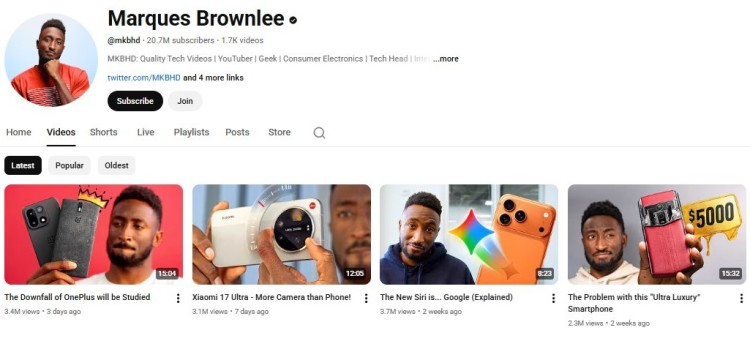
A million views sounds like a jackpot, but what it actually pays depends far more on who is watching than how many people clicked play.
Here’s how getting one million views plays out for actual creators.
- Marques Brownlee (MKBHD): As one of the world’s top tech reviewers, his audience is highly sought after by tech companies. His estimated earnings for 1 million views on a video are between $10,000-$25,000.
- Joshua Mayo: Operating in the finance niche, his content on topics like investing and credit cards attracts high-paying advertisers. He can potentially earn $20,000-$40,000 from a million views.
- Kara and Nate: As a popular travel vlogging channel, their content appeals to a broader audience, including travel companies and lifestyle brands. Their million-view videos typically earn between $5,000-$10,000.
How Much Does YouTube Pay for Watch Hours?
You hear the term “watch hours” constantly when discussing YouTube monetization, but it’s important to understand what it actually means for your bottom line.
Watch hours refers to the total amount of time viewers have spent watching your videos.
- While you’re not paid directly for these hours, this metric is a powerful indicator of audience engagement.
- High watch time tells the YouTube algorithm that your content is valuable and keeps people on the platform, leading YouTube to promote your videos more widely.
- This increased exposure leads to more views and, eventually, more opportunities for ad placements.
How much does YouTube pay per watch hour?
There’s no “per hour” pay rate on YouTube. You don’t get paid for the time viewers spend on your channel.
- YouTube’s payment system is based on ad impressions, not time.
- A rough estimate is that one hour of watch time could generate $0.05 to $0.15, depending on how many ads were shown during that hour.
- It’s better to focus on earnings per view (RPM) as your primary metric.
How much does YouTube pay per view (Calculator)?
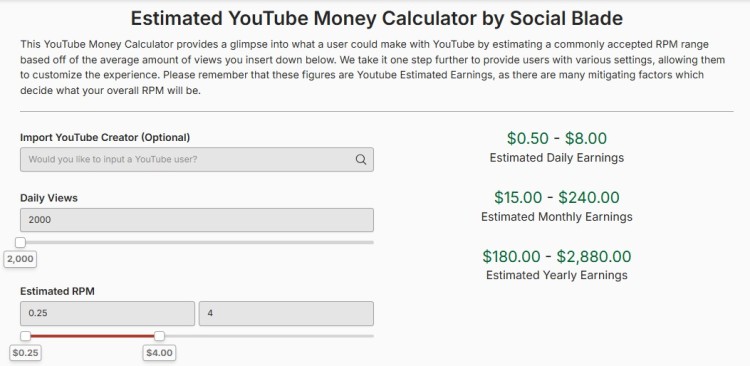
Stop guessing and start estimating with the help of a calculator to forecast your potential earnings. If you want to crunch the numbers for your specific channel, I recommend checking out these tools:
- Social Blade Calculator: Computes your daily, monthly, and yearly earnings based on your daily view count and estimated RPM.
- Influencer Marketing Hub Calculator: This YouTube Money Calculator uses your daily view count and average engagement rate to project your earnings.
- Views4You Calculator: Determine both your monthly and yearly views and projected revenue with this tool.
Get more insights on YouTube earnings with these YouTube views statistics and YouTube channel statistics.
How Much Does YouTube Get Paid per View?
I talked about what you get, but what does the platform take?
For ad revenue generated on long-form videos through the YouTube Partner Program, YouTube takes a 45% cut, while the remaining 55% goes to the content creator.
So, if an advertiser pays $10 for ads to be shown on your video, YouTube keeps $4.50, and you receive $5.50. This split covers the platform’s costs for hosting, streaming, and development, keeping it free for billions of users worldwide.
How to Increase YouTube Engagement and Earnings
Are you ready to turn your channel from a passion project into a revenue-generating asset? It’s not just about luck. It’s about strategy.
Here’s how to stack the right moves in the right order for better engagement and payouts:
- Upload your videos to Talks: Create your free Talks creator profile, upload your YouTube videos, and use the platform to match with other creators and podcast hosts. It’s a easy, practical way to build authority and drive traffic back to your own content.
- Keyword research: Don’t just guess what people are searching for. Use tools like TubeBuddy or VidIQ to find keywords that your ideal clients are using.
- Balance your video duration strategy: Use YouTube Shorts to build the hype and bring new audiences to your channel. But also, upload long videos that they can binge once they’re there.
- Use the Community Tab: Use it to engage with your subscribers directly. Run polls asking what topics they want you to cover next. Reply to their comments.
- Hook your audiences: Capture them with an interesting podcast name (doubles as your channel name), episode titles, and descriptions.
- Master your thumbnails: A compelling, eye-catching thumbnail with clear text dramatically increases your click-through rate (CTR). A high CTR signals to YouTube that your content is appealing, so the algorithm actively serves it to your target viewers.
- Collaborate with other experts: Guest appearances on other YouTube channels or podcasts put you in front of warm, relevant audiences and grow your viewers’ trust in you.
Exploring more monetization paths? Read my deep dive on whether or not podcast guests get paid.
You’re Worth Every View
If you’ve ever asked how much does YouTube pay per view, you’re already thinking like a business owner, not a hobbyist.
That question is where monetization actually starts. Because once you know what a view is worth, you stop chasing numbers and start building for revenue.
Ready to monetize?
Start by expanding your reach. Interview an expert in your niche or hop on another podcast yourself. Take that first step to build your authority and connections.
That’s where Talks comes in.
If you need quick matches and direct access to the podcasting community, this platform is for you. Brian booked 12 guest spots in just 4 weeks. Elaine already interviewed 4 guests and has more lined up.
You could be next.
Create Your FREE Talks Profile Today and 10X Your Impact!