

Every coach, consultant, and entrepreneur is throwing out tips, tactics, and strategies. Most of it lands nowhere.
People forget it. They scroll past it. They tune out.
Drop a story that hits them in the chest, makes them laugh, cry, or flare up with “hell yes,” and suddenly you exist. You stick. You’re remembered.
This is influence in action. Pathos moves hearts, shifts minds, and gets people to actually listen. Not skim. Not nod. Listen.
In this guide, I’ve pulled 22 pathos examples from ads, speeches, movies, and real life. Take notes, steal the mechanics, and start creating moments your audience won’t forget.
What Is Pathos Examples?
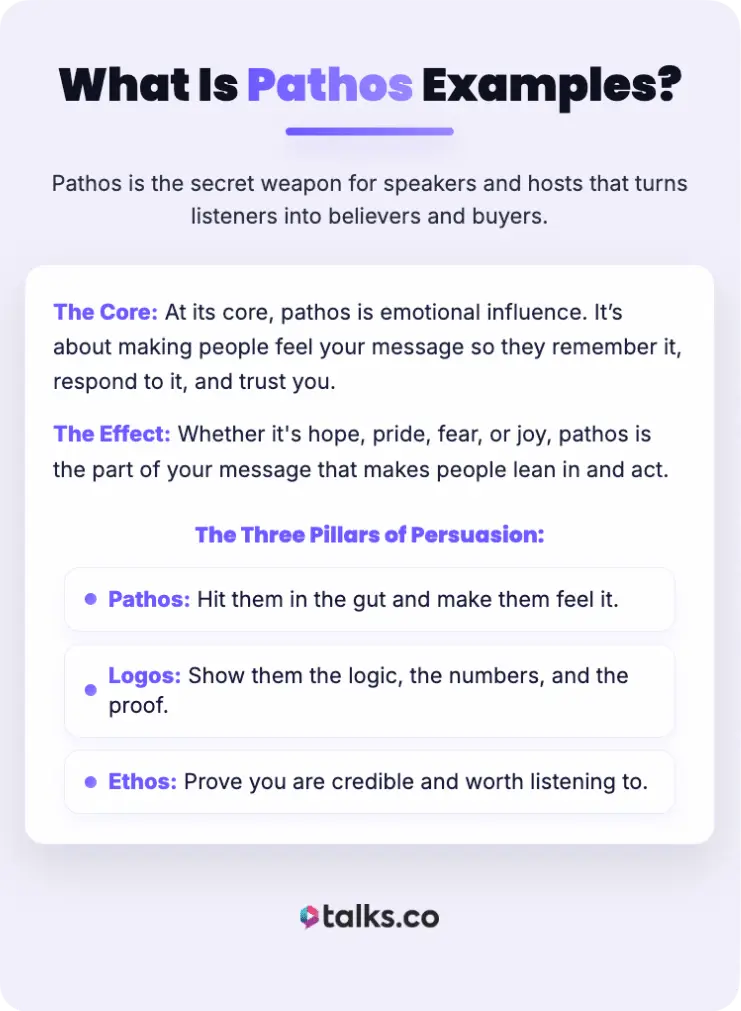
If you’re a speaker, host, or entrepreneur, pathos isn’t optional. It’s the secret weapon that turns listeners into fans, fans into believers, and believers into buyers.
Pathos in action looks like:
- Your audience wipes away a tear after a personal story you told.
- Listeners nod in agreement as you lay out a framework that just clicks.
- Someone tells you later that your talk changed the way they think or act.
So what is pathos, really?
At its core, pathos is emotional influence. It’s about making people feel your message so they remember it, respond to it, and trust you.
Master it, and every word you say gains weight.
Pathos definition examples
Pathos is using emotion to make people pay attention, care, and act. It’s the part of your message that brings on that hope, pride, fear, joy, or even frustration. Whatever makes people lean in.
It’s one of three classic ways to persuade, according to Aristotle:
- Pathos: Hit them in the gut, make them feel it.
- Logos: Show them the logic, the numbers, the proof.
- Ethos: Prove you’re credible, trustworthy, and worth listening to.
Combine them right, and your message sticks.
Pathos root word examples
The word pathos comes from the Greek term “pathos,” meaning suffering, feeling, or deep emotion. This root word shows up in other words related to emotions, like “sympathy” and “empathy”.
This etymology reveals what pathos is really all about. It’s a way of using language to move the audience’s emotions and influence their frame of mind.
What is the example of pathos?
Examples of pathos connect a speaker with their audience.
- Inspirational messages: A speaker sharing how they nearly gave up on their business before one client’s message changed everything.
- Lived experiences: You can share personal anecdotes on your podcast, showing listener a different side of you that they can relate to.
When you appeal to an audience’s emotions, you aren’t manipulating them. You are helping them connect your message to their own life.
What are pathos examples sentences?
Here are some short sentences that use pathos:
- “Imagine watching your dreams slip away because you were too afraid to try.”
- “No child should go to bed hungry in a country this rich.”
- “If we do nothing, more families will lose everything they’ve built.”
Each sentence aims to arouse feelings and push the listener to feel a certain way before taking action.
How Does Pathos Function as a Persuasive Device?
Pathos is a rhetorical device that taps into emotion to support persuasion. Here are the main ways it functions:
- Builds emotional connection: Pathos helps create an emotional connection between the speaker and the audience, which increases trust and attention.
- Motivates action: When people feel something strongly, they are more likely to act.
- Simplifies complex ideas: Instead of only using facts and figures, you show what those facts mean in real life.
- Shapes perception: It can place the audience in a certain frame of mind before presenting your solution.
- Strengthens memory: People remember how you made them feel more than what you said.
- Humanizes data: Pairing emotion with reason and facts makes your message feel real.
22 Examples of Using Pathos
Below are different examples showing how pathos can be found in modern communication. These examples are tailored for coaches, consultants, authors, and speakers who are trying to persuade new audiences.
Pathos persuasive technique examples
In podcasting, emotion hooks attention fast. Notice how hosts open with stories, not stats, in the most popular podcasts.
- Share your experience with overcoming business challenges: Start an episode with, “Three years ago, I almost shut down my business after losing my biggest client.”
- Paint a picture of a listener’s struggle before offering advice. This helps them feel seen and positions you as an expert who understands.
Pathos examples in speeches
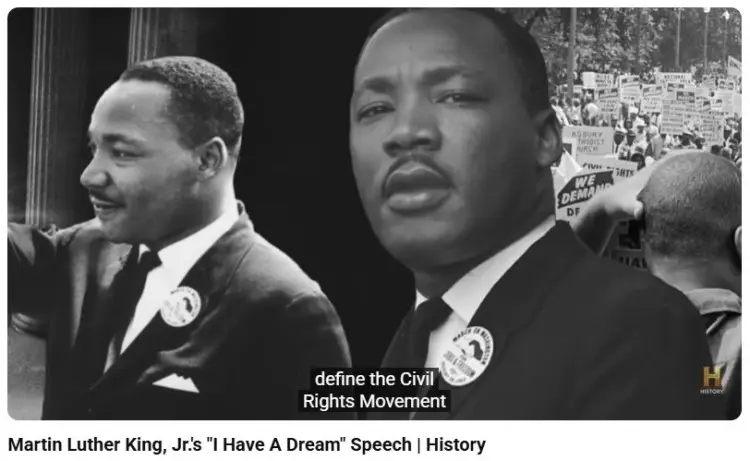
Great speeches often use pathos to energize a crowd.
- Martin Luther King Jr.’s “I Have a Dream”: In that historic political speech, he described injustice vividly, helping the audience’s hearts feel the weight of inequality.
- Patrick Henry’s famous “Liberty or give me death” line: That bold phrase stirred fear and pride at the same time.
Pathos appeal examples

In marketing, a simple ad campaign can go viral when you sprinkle a bit of pathos.
- World Wildlife Fund: They share their advocacy on climate change with a heartfelt ad, emphasizing how Earth is a shared home. Showing scenic nature views and animals, this two-minute clip tugs at heartstrings.
- Chevrolet: This is not just a commercial. “Memory Lane” gives you the feeling of nostalgia and shows you how you can build your family history around a product.
If you’re exploring podcast advertising, think about how sponsors also use emotion to connect with niche audiences.
Pathos examples in real life
You don’t have to look far for pathos examples in real life. Your own story and authentic voice are enough to resonate with your audience.
That’s what I’ve done with my business. I openly share stories about how I got started, and it attracted clients who stood by my message.
With Talks, it was all about people who believed in the power of a strong network. Visibility through people first. Not a complicated strategy that won’t work.
I know this because I’ve been there.
I’ve hopped on podcasts. I’ve connected with people to share what I know. And it all led to establishing my own podcast matching site for people who want to follow the same success formula.
Pathos statement examples
You can use pathos statements in your social media posts:
- Tell them about pivotal moments when running your business: “I remember crying in my car because I thought I had failed my team.”
- Foreshadow a mistake while giving value: “If this post helps just one person avoid the mistake I made, it’s worth sharing.”
These example statements invite followers into a vulnerable moment, encouraging an emotional response and deeper engagement.
Pathos example in writing
If you’re writing blogs, use pathos to convince your readers take action.
For example, write about how you suffered from imposter syndrome the first time you launched your offer. This can make your audience feel understood and more likely to say YES to your proposal.
They’d know it’s coming from someone who’s been there.
Pathos examples in persuasive writing
Emotions can be the biggest factor that persuades someone.
For example, when you’re pitching to become a podcast guest, using pathos in your outreach email can make a big difference.
- Appeal to the emotions by going beyond your credentials and sharing the story of how you actually built your expertise.
- Since you’re in the same niche, empathize with a common concern your audiences have.
- There can be hundreds of experts in the same niche as you, but with a personal anecdote, your pitch becomes unique.
For more inspiration, see my all-time favorite persuasive speech examples.
Pathos examples in literature

There are many examples of pathos in literature.
- In Charles Dickens’ A Christmas Carol, Tiny Tim’s fragile health makes readers care about him, and on a bigger scale, the inequality that prevents him from getting treated.
- This shows how you can persuade audiences about your advocacy by showing them the heart of your mission.
Pathos definition literature examples

Other examples of pathos show how emotions are what make themes stick.
- In Percy Jackson and the Olympians, Percy’s fatal flaw of being loyal to a fault is highlighted in a deeply emotional scene. Instead of saving himself, he chooses to fall with Anabeth to Tartarus.
- Readers vividly remember this turning point in the plot because of the shock factor it has.
Examples of pathos in In a Modest Proposal
A popular but shocking example of pathos can be read in Jonathan Swift’s A Modest Proposal.
- He uses irony to highlight the inhumanity experienced by Ireland’s poor.
- He makes satirical suggestions to push the reader’s buttons.
- The reader’s discomfort and horror force them to think more deeply about social injustice.
Pathos article example
When you’re writing articles for a blog or podcast website, you can use pathos to emphasize the gravity of an issue.
For example, this article on the benefits of virtual events highlights the common struggles of coaches and entrepreneurs in:
- Getting enough of the right leads
- Growing their reach and engagement
- Establishing their offer and coaching business
Instead of just facts and figures, the article includes actual situations that readers face.
Pathos essay example
Like articles, essays with an added emotional layer are more effective.
For example, in a college essay about overcoming failure, a student can describe the joy and belongingness they felt when they first stepped into the university campus. Even if they’re not yet admitted, they carry hope and a strong inner knowing that translates to their words.
Pathos examples for students
Learning about pathos teaches students the importance of genuine connections.
- For example, a student council candidate can be so much more convincing if they back up their platforms with reasons why such policies matter to them in the first place.
- They can explain that they’re proposing to add more computer units, since they’ve also been unable to access the lab like their peers.
Pathos examples in movies
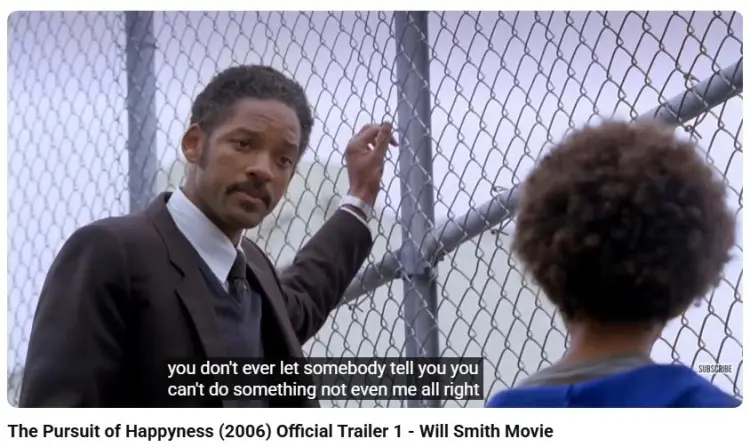
Filmmakers have mastered the use of pathos in movies.
- In the film “The Pursuit of Happyness”, scenes of a father and son struggling with homelessness create empathy.
- Viewers root for the main character because they feel his pain.
- To achieve this emotional effect, movies use close-up shots and sad music.
Pathos examples ads

The most memorable commercials go beyond the screen. Take the Redfin x Rocket Mortgage ad, for example.
Winning the title as the most emotionally engaging ad of Super Bowl 2026, it invited viewers to be good neighbors to each other.
Pathos examples pictures

A picture tells a thousand words, and in this case, a thousand emotions too. Just think about the emotional impact of:
- A firefighter carrying a child away from a burning house
- A discharged military officer coming home to their family
- A small puppy taking shelter under a car
- Images of starving children who are completely frail and bone-thin
How to Use Pathos Effectively
Here’s how you can apply pathos in your podcast scripts and at public speaking opportunities:
- Know your audience: Study your audience’s struggles so you can speak to their real fears and hopes.
- Share stories: Use personal anecdotes instead of abstract claims.
- Show stakes: Explain what happens if nothing changes.
- Use contrast: Compare pain before with relief after transformation.
- Add detail: Sensory details help listeners picture the moment.
- Blend logic: Support emotion with appeals to logic and reason.
- Call to action: Direct the feeling toward a clear next step.
- Strengthen your brand: Align your emotional stories with your public speaker website.
Pathos analysis example
A pathos analysis examines how a message uses emotion as a rhetorical strategy. This process determines whether the emotion supports the argument or distracts from it.
To know if pathos was used well, check:
☐ Relevance: Does the emotion connect to the main point?
☐ Authenticity: Does it feel real, not forced?
☐ Balance: Is it supported by reason and facts?
☐Audience fit: Does it match the audience’s values?
☐ Clarity: Is the emotional message easy to understand?
Check combined breakdowns of ethos, pathos, and logos examples for inspiration.
Pathos fallacy examples
A pathos fallacy happens when emotion takes over and evidence disappears. It stops being persuasion and turns into pressure.
Here’s what that looks like in real life:
- Fear overload: “If you don’t buy this course right now, your business will collapse.” No data, but it definitely causes panic.
- Pity play: “I worked so hard on this, so you should support it.” Effort isn’t proof of value.
- False dilemma: “You either care about your family’s future or you don’t invest.” Only two emotional options, both loaded.
- Bandwagon emotion: “Everyone serious is joining. Don’t be left behind.” Social pressure replaces substance.
- Ignoring logic: A tearful story with zero explanation of how the solution actually works.
Emotion is powerful. But when it stands alone, it weakens your credibility.
The fix is simple: pair feeling with facts. Move people, then back it up. That’s persuasion with backbone.
How to Balance Pathos with Logos and Ethos
To communicate well, you need all three rhetorical devices. Logos and ethos join pathos to create strong, persuasive strategies.
- Logos appeals to logic through data and structure.
- Ethos builds trust and credibility.
Pathos alone can move people, but when combined with logic and trust, it becomes truly effective rhetorical communication.
Logos and pathos examples
Think about a podcast guest discussing burnout. Hosts share a tearful story about hitting rock bottom, then present research on workplace stress.
- The story is pathos.
- The research is using logos.
The blend shows how emotion and appeal to logic work together.
Here are lots of examples of logos and pathos working together:
- A coach combines their client’s transformation stories with their success rate and case study data.
- A speaker recounts their first success story, including figures like the increase in email list subscribers and the amount they earned.
- Paint a picture of what financial freedom looks like on your podcast and back it up with actual metrics.
Ethos and pathos examples
Think about a consultant sharing a personal failure story before explaining how they rebuilt their business.
The vulnerability is pathos. Their years of results and testimonials are examples of ethos. This mix of ethos and pathos helps them persuade clients more effectively.
Here are more examples of how pathos and ethos work together:
- A podcaster cites their ten-year expertise and shares their raw story of overcoming burnout.
- A coach with an ICF certification talks about their early worries that pushed them to build their credentials.
- A speaker mentions their previous events to talk about how they hustled.
The Path Forward
Emotion is power when you use it right.
If you want more reach, visibility, and bookings, learn to leverage pathos examples as a mode of persuasion and put yourself in rooms where your stories evoke strong emotional responses from potential listeners.
Put your persuasive appeal to emotion to the test. Get a guest spot on Talks or invite a guest over to tell their own stories that make the audience feel deeply connected to your guest’s ethos or logos.
It takes less than ten minutes to get matches, so your workflow is uninterrupted.
- Quick setup: Just upload a speaker one sheet and use AI tools to generate your profile with a click.
- Automations: If interest is mutual, it’s as good as a YES. No more back-and-forth messages.
- Powered up inbox: Everything’s designed to get you responses and recordings, including filters and scheduling tools.
Create your FREE Talks profile today and share messages that truly move people.


