

A persuasive speech can change a mind, win a room, or make someone reach for their notebook and write down your name.
That sounds great until you’re staring at that annoying cursor blinking in… out… in… out… in… thinking, “So. Where do I even start?”
Most speakers obsess over what they want to say. But you should really be asking what your audience needs to hear first, what they need to believe next, and what finally gets them to act.
That’s the psychology behind a persuasive speech outline.
Get the order wrong and even a brilliant idea can feel like a sales pitch nobody asked for. Get it right, and your argument starts pulling people forward.
Here’s how to build an outline that holds attention, earns trust, and gives your audience a reason to do something with what you’ve said.
What Is a Persuasive Speech?
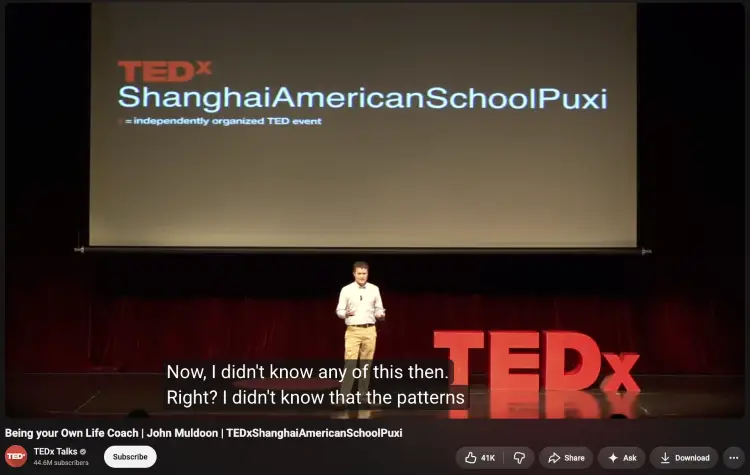
A persuasive speech is designed to make an audience transition towards a specific belief, decision, or action. You’re effectively presenting an argument, supporting that pose with evidence, and giving people a compelling reason to care.
What is the purpose of a persuasive speech?
A persuasive speech gives your audience a reason to reconsider something, believe something, or do something specific.
- Change a belief: Challenge an existing assumption with a stronger argument.
- Influence a decision: Help someone choose an option, such as joining a coaching program.
- Prompt action: Encourage a clear next step, such as booking a discovery call.
- Create urgency: Show why addressing the problem now matters.
- Build credibility: Use relevant evidence, stories, examples, and expertise to make your argument believable.
What Is the Structure of a Persuasive Speech?
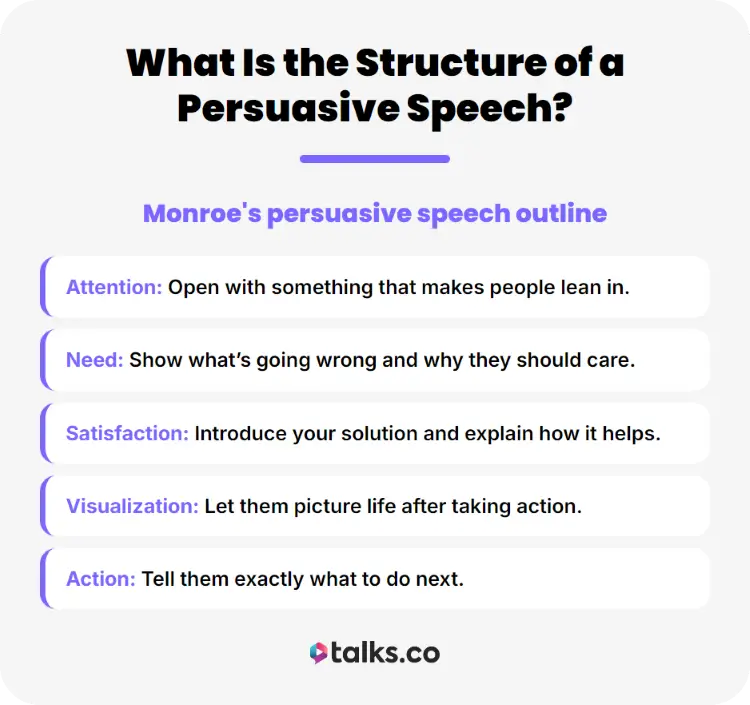
Think of your speech like a conversation that gets progressively harder to ignore. You grab attention, make the problem feel real, show people a better option, then give them somewhere to go with it.
Monroe’s persuasive speech outline
Monroe’s Motivated Sequence is handy when you want that progression baked into the outline:
- Attention: Open with something that makes people lean in.
- Need: Show what’s going wrong and why they should care.
- Satisfaction: Introduce your solution and explain how it helps.
- Visualization: Let them picture life after taking action.
- Action: Tell them exactly what to do next.
What Does a Persuasive Speech Outline Look Like?
A persuasive speech outline gives you the skeleton before you start filling in the good stuff. Use the templates below as your starting point, then swap in your audience, problem, proof, offer, story, and call to action.
1. Persuasive speech outline format for coaches
Use this when you’re speaking to potential coaching clients, an audience at an event, or people attending one of your workshops.
Speech title: [Name the result your audience wants]
Opening:
“[Ask a question, share a surprising result, or describe a situation your audience knows all too well.]”
The problem:
[Describe the specific challenge your audience is facing.]
For example: “[Your audience is doing X, but it keeps leading to Y.]”
What’s really going on:
[Name the deeper issue behind the problem.]
“I see this all the time: [specific pattern you’ve noticed with clients].”
The shift:
“If you want [specific result], you need to [your core belief, method, or change in approach].”
Show them what this looks like:
[Share a specific client story, personal experience, or before-and-after example.]
“[Client name] came to me [specific starting point]. After [specific change], [specific result].”
Give them something they can use:
- [Step or principle #1]: [Explain what to do and why it matters.]
- [Step or principle #2]: [Explain what to do and why it matters.]
- [Step or principle #3]: [Explain what to do and why it matters.]
Close:
“[Bring the audience back to the problem you opened with and show how their situation can change.]”
Call to action:
[Give them one clear next step, such as trying [specific exercise], attending [program/workshop], or booking [type of call].]
2. Persuasive speech outline format for authors
This is the persuasive speech outline to use when you’re speaking about an idea from your book, promoting a message, or encouraging an audience to rethink a familiar topic.
Speech title: [Turn the central idea of your book into a compelling talk title]
Opening scene:
“[Describe a specific moment that captures the problem your book explores.]”
The question:
[Ask the question your audience has probably wrestled with.]
Example: “Why do [specific group] keep [specific behavior] even when they know it’s hurting them?”
The story behind the idea:
[Explain the specific experience, conversation, failure, discovery, or turning point that led you to write [Book Title].]
What I realized:
“I realized [your central argument or belief].”
3 things I want you to remember:
- [Idea #1]: [Explain the idea and give a specific example.]
- [Idea #2]: [Explain the idea and give a specific example.]
- [Idea #3]: [Explain the idea and give a specific example.]
Picture this:
“If you started [specific action from your book] tomorrow, [describe the realistic outcome your audience could experience].”
Before you leave:
[Give the audience one action they can take today.]
“If you want to explore this further, [mention your book, website, workshop, or next step].”
3. Persuasive speech outline format for speakers
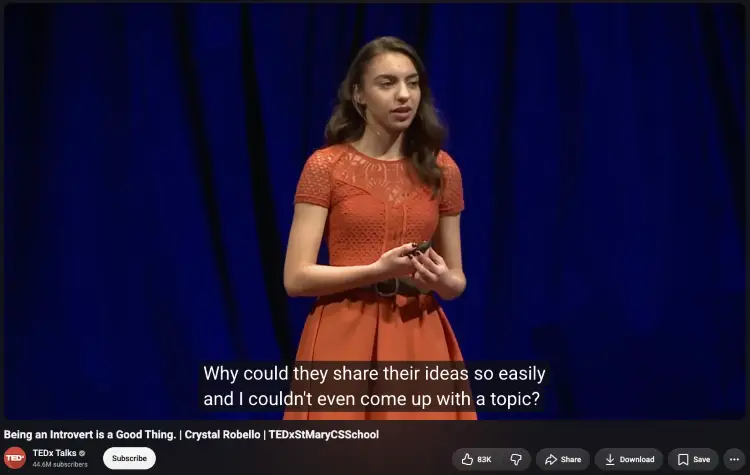
Use this when you’re pitching an idea from the stage, preparing a conference talk, or using a persuasive speech to create more opportunities to speak.
Speech title: [Write the audience-focused promise of your talk]
Walk-on opening:
“[Your first sentence. Make it something strong enough to stop people checking their phones.]”
The moment that changed my thinking:
[Tell one specific story from your career, industry, or personal experience.]
“I used to think [old belief]. Then [specific event] happened.”
What’s actually going on:
[Explain the problem your audience is experiencing.]
“Here’s what I’ve noticed: [specific observation].”
The shift:
“The answer starts with [your central idea].”
Let me show you:
[Teach the audience your first key point.]
[Give a specific example.]
[Teach your second key point.]
[Give a specific example.]
[Teach your third key point.]
[Give a specific example.]
Now make it practical:
“Before you leave today, [specific action you want the audience to take].”
The line I want you to remember:
“[Write one short, repeatable statement that captures the entire talk.]”
Closing:
[End with a story, challenge, question, or direct invitation that naturally connects to your next step.]
4. Persuasive speech outline format for entrepreneurs
This is the outline to use when you’re asking people to believe in an idea, buy into a vision, or back your business because your speech needs a clear point of view.
Speech title: [Turn the business idea you’re defending into a clear, audience-focused title]
Start here:
“[Open with a surprising number, bold claim, customer story, or moment from building your business.]”
The problem worth solving:
[What specific problem exists? Who has it? What happens when they leave it unsolved?]
The idea:
“I believe [your business idea, position, or recommendation] because [strongest reason].”
Make it real:
[Show the idea in action using a specific customer, product, market, or business example.]
For example: “[Customer type] uses [product/program] to [specific outcome].”
The proof:
[Add your strongest evidence: revenue figure, customer result, market data, testimonial, experiment, or case study.]
The objection:
“You might be thinking [most obvious objection].”
[Answer it with evidence or a concrete example.]
The opportunity:
“If we [specific action], we can [specific outcome].”
Your ask:
[State exactly what you want your audience to do: invest, buy, sign up, test the product, book a meeting, introduce you to someone, or take another specific action.]
Final line:
“[End with a short statement that reinforces why this idea deserves attention now.]”
5. Persuasive speech introduction outline for a webinar
A webinar gives you more time to teach, so use this outline to take people from a problem they recognize to a practical solution they can act on for your next one.
Webinar title: How to Get Your First 10 Podcast Guest Spots Without Sending 100 Cold Pitches
Opening:
“You’ve pitched 30 podcasts and heard nothing back. Before you send pitch number 31, there’s probably one thing worth fixing.”
The problem:
Most new guests pitch themselves instead of giving the host a compelling reason to feature them.
The argument:
A better pitch starts with the show, its audience, and the conversation you can bring to it.
Proof:
[Insert a real example of a guest who changed their pitch and secured appearances on specific shows.]
The solution:
Use this 3-part approach:
- Find the right shows: [Describe your criteria.]
- Pitch a specific conversation: [Explain how to choose the topic.]
- Make the host’s job easy: [Show what information to include.]
Action:
“Before you leave, find three shows where your expertise genuinely fits and write one episode idea for each.”
6. Simple persuasive speech outline sample for a keynote talk
The easiest way to understand a persuasive speech outline is to see one in action.
Keynote title: Stop Waiting to Be Discovered
Opening:
“Imagine being excellent at what you do and still being almost invisible to the people who could benefit from it.”
The problem:
[Explain how talented experts can spend years improving their work while doing little to increase their visibility.]
The turning point:
[Share a specific personal story about realizing that expertise alone doesn’t guarantee attention.]
The argument:
You need to put your ideas in rooms where your ideal audience already spends its time.
Proof:
[Insert examples of speaking appearances, podcast interviews, media features, or events that created meaningful exposure.]
3 shifts:
- Choose your rooms: [Name the platforms, events, podcasts, or communities that matter.]
- Build a recognisable idea: [Explain the idea you want people to associate with you.]
- Keep showing up: [Explain how repeated exposure builds familiarity.]
Close:
“[Return to the opening idea and challenge the audience to choose one room where they need to be seen.]”
7. Example of persuasive speech outline for consultants
Use this when you’re pitching a recommendation, explaining a business problem, or convincing a client to change how they’re doing something.
Speech title: [Write the specific business problem or result your talk addresses]
Opening hook:
“[Ask a question that exposes the problem, share a surprising statistic, or describe a familiar business situation.]”
The situation:
Right now, [describe what your audience is doing].
The result? [Explain the cost, e.g., lost revenue, wasted hours, missed opportunities, etc.].
The uncomfortable truth:
[Challenge the assumption your audience has about the problem.]
For example: “[Specific misconception your audience needs to reconsider].”
Here’s what I’d do:
If I were in your position, I’d [recommendation].
Start with [specific first step], then [second step], followed by [third step].
Proof it can work:
[Insert a specific client example, case study, research finding, or business result.]
“[Company/client] went from [starting point] to [result] after [specific change].”
Your takeaway:
“If you’re dealing with [specific problem], start by [specific action].”
Final line:
“[End with a memorable statement that reinforces your recommendation.]”
8. Persuasive speech outline example for a podcast guest appearance
Podcast guest appearances are a little different because you’re speaking to someone else’s audience. This is the template that leaves your audience wanting more.
Podcast topic: Why Your Expertise Isn’t Getting You More Clients
Opening answer:
“I spent years assuming that getting better at my work would naturally bring more people to it. It doesn’t work that way.”
Host’s problem:
[Connect your persuasive speech topic to something the host’s listeners are already struggling with.]
Your argument:
Being highly skilled doesn’t help much if the right people don’t know what you do or why they should care.
Story:
[Share one specific turning point, client situation, or lesson from your own experience.]
Three points to explore:
Visibility: [Explain where experts should be showing up.]
Positioning: [Explain how to make their expertise easier to understand.]
Authority: [Explain how appearances, partnerships, or useful content can build credibility.]
Memorable takeaway:
“[Write the one sentence you want listeners to repeat after the episode.]”
Soft CTA:
“If you want to [specific result], start by [specific action].”
9. Persuasive speech outline example for a sales presentation
This template gives you a clean way to frame the problem, make your case, handle objections, and lead people toward a decision.
Presentation title: How [Specific Audience] Can Cut [Specific Problem] by [Specific Amount]
Opening:
“Last quarter, [specific company or hypothetical company] lost [specific amount] because [specific problem]. Here’s what caused it.”
The cost of the problem:
[Show the financial, operational, or time cost using specific numbers.]
Why the usual fix fails:
[Explain the common solution and why it hasn’t solved the underlying issue.]
Your recommendation:
“[Product, service, or program] helps [specific audience] solve this by [specific mechanism].”
Proof:
[Insert a case study, customer result, before-and-after metric, testimonial, or product demonstration.]
The offer:
[Explain exactly what the buyer gets, how it works, price, implementation timeline, and relevant support.]
Handle the objection:
“You might be thinking [specific objection].”
[Answer it with evidence, a comparison, or a concrete example.]
The decision:
“If [specific problem] is costing you [specific consequence], your next step is [specific action].”
Close:
“[End with the clearest reason to act now, tied directly to the problem you opened with.]”
How to Structure a Persuasive Speech
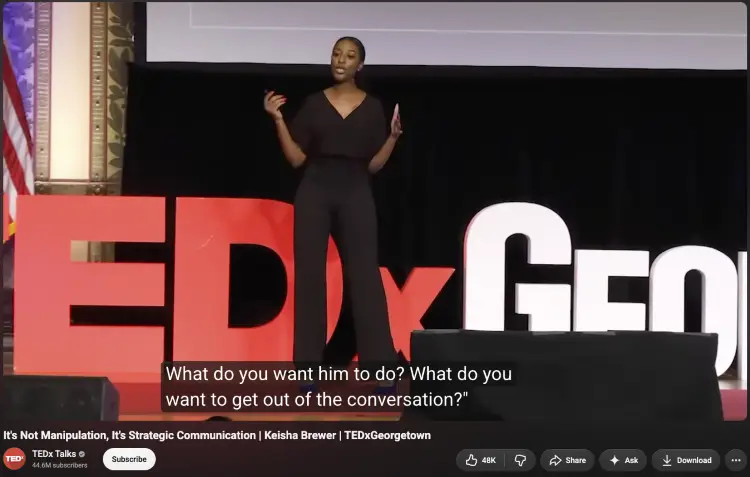
Know the one thing you want people to think, feel, or do when you finish. Then build every section around getting them there.
How to write a persuasive speech that creates impact
Get specific enough that people can see the situation in their heads.
- Lead with tension: A career coach opens with a client who sent 86 applications in 6 months and got 4 interviews.
- Make it specific: A consultant compares 12 leads from LinkedIn ads with 47 from one guest spot on a 50-minute industry podcast.
- Earn the claim: An author discussing sleep cites a Stanford study, then connects the findings to someone waking at 3 am every night.
- Make the stakes clear: A sales consultant shows how postponing a CRM switch left 15 reps manually chasing 600 Q4 leads.
- Finish with direction: After a webinar on podcast guesting, ask attendees to shortlist 3 relevant shows and send one pitch by Friday.
Techniques for an effective persuasive speech
The strongest techniques give your audience something concrete to picture, question, remember, or act on.
- Storytelling: A leadership coach could tell the story of “Maya,” a VP in Chicago who kept losing strong employees until she changed how her weekly one-on-ones worked.
- Rhetorical questions: “If your best prospects are already listening to 45-minute podcasts every Tuesday morning, why are you spending your entire marketing budget fighting for their attention elsewhere?”
- Social proof: A speaker selling a presentation program could reference 37 clients who used the program to prepare keynote talks for events such as INBOUND or SXSW.
- Repetition: An entrepreneur arguing for consistent publishing could return to one phrase throughout the speech: “Be findable before you need to be famous.”
- Direct language: Replace “There are several potential benefits associated with developing a podcast strategy” with “A podcast can put you in front of 10,000 people who already care about your subject.”
How to Make a Persuasive Speech Outline
Start with the outcome, then work backward. You want a clean line from the audience’s problem to your argument, proof, solution, and next step.
A few simple tools can handle the actual outline creation. Pick the logical one that appeals to your working style and tell a story that grabs and maintains your audience’s attention:
- Google Docs: Best for a straightforward outline you can edit, share with a co-speaker, and reuse as a template for future webinars.
- Canva: Useful when you want to strengthen your thesis presented with a more visual template for a keynote outline, workshop plan, or even a practice persuasion speech.
- Notion: Best for reusable outline templates, research, speaker notes, and keeping multiple speeches organized.
I’ve got a full guide on how to become a content creator for you to study if you’re preparing for your next public speaking opportunity as an emcee.
How to write a persuasive speech outline example
Say you’re a business coach giving a 30-minute webinar called “How to Get Your First 10 Podcast Guest Spots.” Your persuasive speech example outline could look like this:
- Opening: “You’ve pitched 30 podcasts and heard nothing. Here’s probably why.”
- Problem: Generic pitches make hosts work too hard to figure out your value.
- Argument: A strong and confident guest pitch starts with the host’s audience instead of your bio preview.
- Proof: Compare a vague pitch with one built around specific main points for a show like The Goal Digger Podcast that easily persuades your audience.
- Solution: Show your 3-part pitching method, e.g., relevant show, specific topic, clear listener benefit.
- Action: Have attendees write one episode idea for a relatable podcast they could freely deliver and genuinely contribute to.
How to make persuasive speech outline templates (Top mistakes to avoid)
A template saves time, but copying the same structure for every speech can make your argument feel predictable.
Instead, build your template around the audience, the situation, and the action you want them to take.
- Starting too broadly: “Social media is changing business” gives you nowhere to go. Start with the specific problem your audience recognizes.
- Packing in too much: 10 talking points can bury your strongest argument. Pick 2 or 3 ideas worth remembering.
- Making claims without proof: If you say podcast guesting brings clients, show the result, story, or data behind that claim.
- Forgetting the audience: A keynote for 2,000 founders at SXSW needs a different angle than a webinar for 30 first-time coaches.
- Ending vaguely: “Think about what we discussed today” gives people nothing to do. Ask for one concrete action, such as creating a Talks profile and identifying three relevant podcasts to pitch.
Let That Speech Go (To The Right Crowd)
A persuasive speech outline can help you win the room. The bigger question is how many rooms you’re actually getting into.
That keynote could lead to a podcast interview. That podcast interview could put you in front of thousands of potential clients. One good conversation can turn into another speaking invite, a new connection, or a client you never would’ve met otherwise.
And there are hosts looking for experts right now.
Create your free Talks profile, get matched with relevant shows, and start putting your ideas in rooms you haven’t reached yet.
Your next opportunity could already be looking for someone like you.
Yes! Get Me On Talks Right Now!


