
584 million people listened to podcasts in 2025, and that number is only growing.
Every episode you launch is a chance to grab a slice of that audience or get swallowed by the proverbial podcast void.
I’ve done 400+ interviews as both host and guest, and trust me, I’ve seen every podcast intro that grips listeners and every opening segment that sinks.
Your podcast introduction script is the first handshake, the first magnet, the first 30 seconds that kick off your podcast and convince new listeners to stick around.
In this guide, you’ll get great podcast intro script samples, real podcast introduction examples you can swipe, and actionable tips to craft high-quality intros that hook both new and regular listeners instantly.
You’ll learn how to set the tone, show your personality, and make listeners lean in instead of tuning out.
Stop hoping for luck. Start scripting short and snappy intros that make people hit play again and again.
What Is a Podcast Introduction Script?
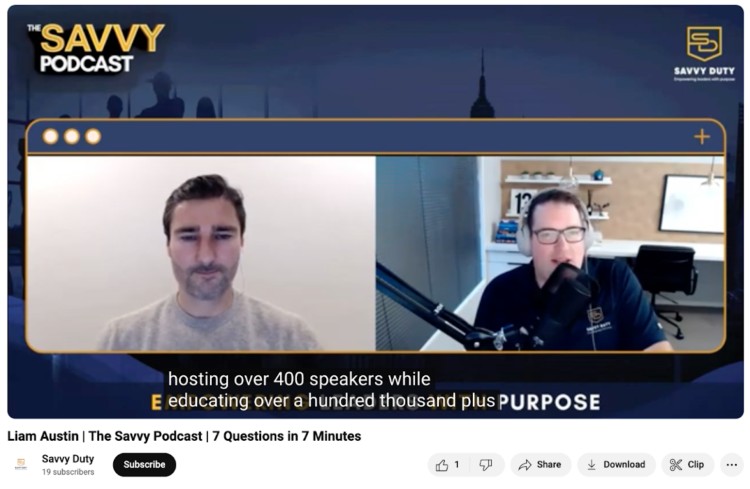
Your podcast intro is the first impression podcast listeners get. It sets the tone, introduces your show, and, most importantly, keeps your target audience from clicking away.
A strong introduction script helps listeners know exactly what they’re getting and why they should stick around for the rest of the episode.
Why your podcast introduction matters
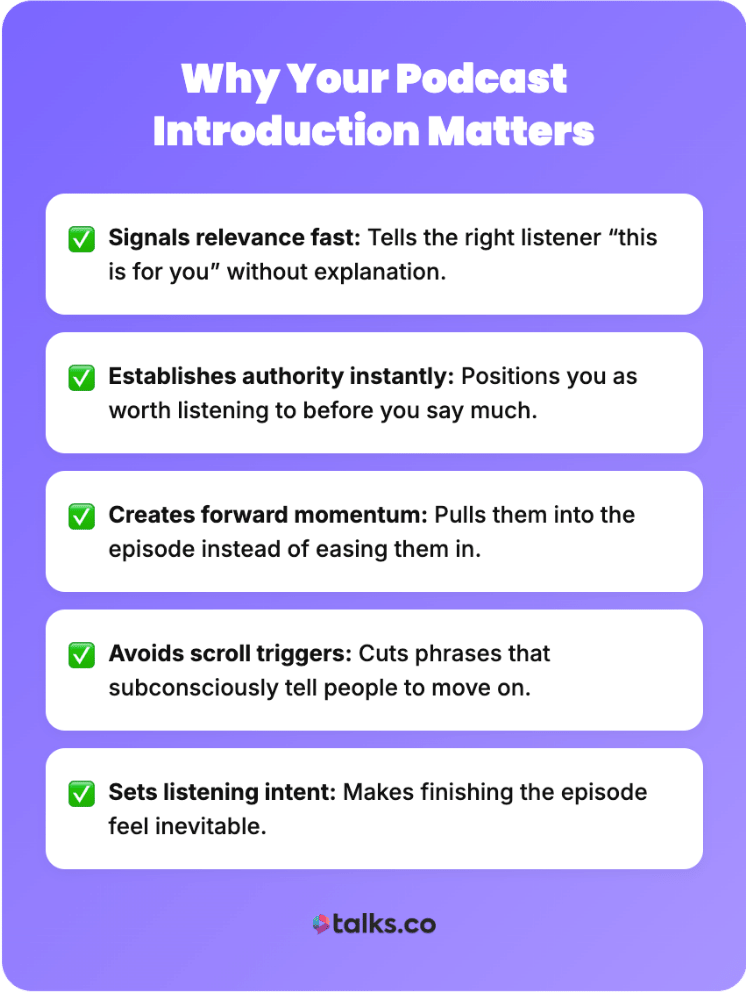
34% of Americans listen to an average of 8.3 types of podcasts per week, but attention drops in the first 30 seconds if you don’t hook them. A strong podcast introduction script:
- Signals relevance fast: Tells the right listener “this is for you” without explanation.
- Establishes authority instantly: Positions you as worth listening to before you say much.
- Creates forward momentum: Pulls them into the episode instead of easing them in.
- Avoids scroll triggers: Cuts phrases that subconsciously tell people to move on.
- Sets listening intent: Makes finishing the episode feel inevitable.
How to Start Off a Podcast Script
When you write a podcast script, it should start with intention, not introductions.
Before you say your name, the name of your podcast, or what today’s episode is about, you need to earn attention. The goal is simple: make the listener want the next sentence of your new podcast episode.
Here’s how to achieve that with your pre-recorded podcast intros, step by step.
- Start mid-thought: Drop them into a moment that already feels in motion.
- Introduce tension or curiosity: Hint that something went wrong, changed, or surprised you.
- Delay the context: Resist explaining until they’re emotionally invested.
- Signal payoff: Let them know staying will be worth it.
- Then introduce the episode: Only after they’re hooked.
Podcast hook examples discovery narrative
Discovery narrative hooks work because they sound unfinished. They feel like the listener arrived right before something important was revealed.
Use these customizable openers to start your podcast script:
- The unexpected realization: “I didn’t realize this intro and outro were killing my podcast until episode 73.”
- The tension reveal: “I almost cut this episode. Then I realized it was the most important one I’d recorded.”
- The pattern break: “Everyone says to start a podcast this way. That advice cost me listeners.”
- The quiet confession: “This is the part most podcast hosts never admit.”
Podcast Introduction Script Template
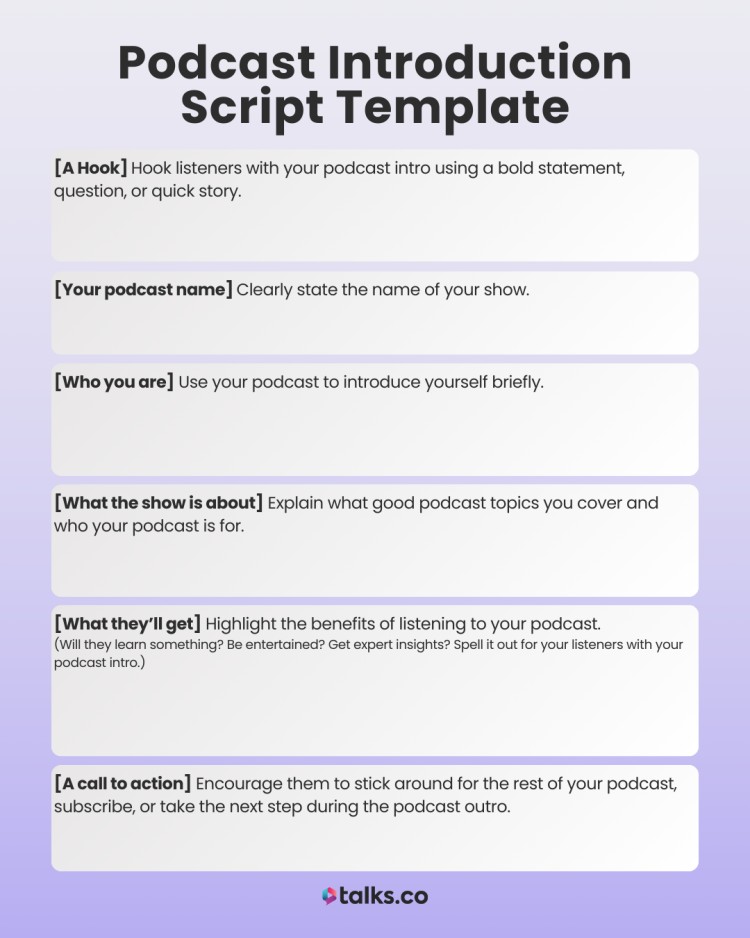
A good podcast introduction script is short, deliberate, and written to be heard. Not read. This podcast script template gives you structure without killing your personality, so you know exactly what to say and what to skip.
Use this as your foundation, then adapt it to your voice.
[A hook] Hook listeners with your podcast intro using a bold statement, question, or quick story.
[Your podcast name] Clearly state the name of your show.
[Who you are] Introduce yourself in one sentence. Not your life story. Just why they should trust you.
[What the show is about] Explain what good podcast topics you cover and who your podcast is for.
[What they’ll get] Tell them the benefits of listening to your podcast. Will they learn something? Be entertained? Get expert insights? Spell it out for your listeners with your podcast intro.
[A call to action] Encourage them to stick around for the rest of your podcast, subscribe, or take the next step during the podcast outro (like asking listeners to follow you on social media).
Podcast Introduction Script Example: 11 Customizable Options
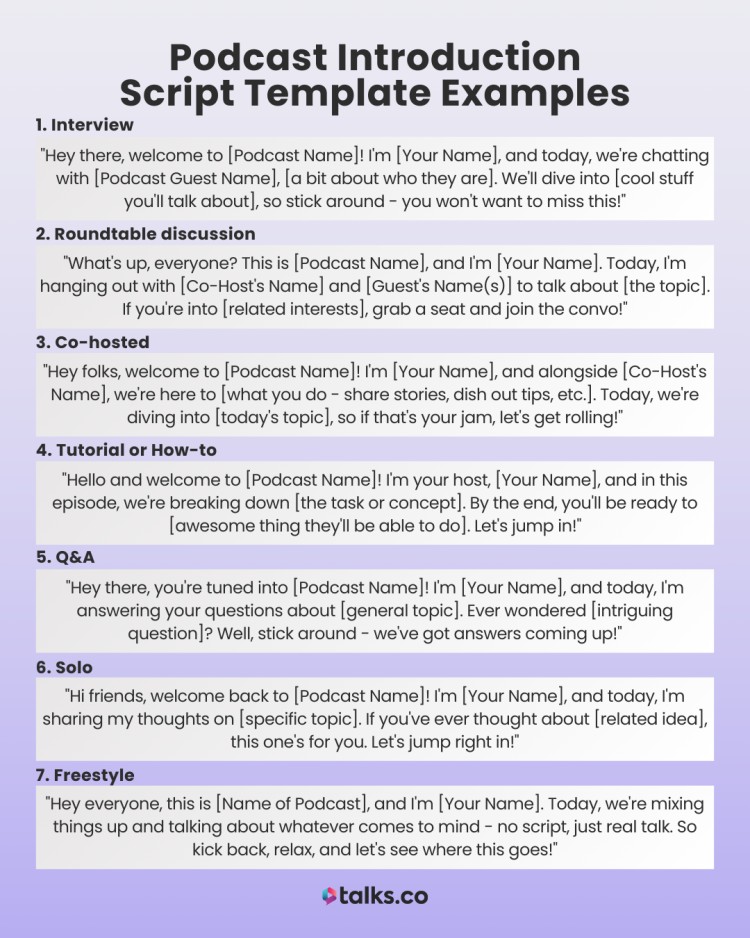
Use these plug-and-play podcast intro templates to write a podcast intro script. They’re your free starting lines that give your listener instant clarity and a reason to stay.
Swap the brackets, read it out loud, and adjust until it sounds like you and your audience feel at home in the first 30 seconds.
1. Interview podcast intro
Interviews are your chance to let someone else shine while you guide the story. This intro gets listeners curious and positions your guest as the star.
[Music intro]
[Speaking introduction]
“Hey there, welcome to [Podcast Name]!
I’m [Your Name], and today we’re chatting with [Podcast Guest Name], [one-line bio or interesting fact].
We’ll dig into [specific topic or story], and I promise, you’ll walk away with [tangible insight or takeaway].”
Talks tip: Open with a jaw-dropping fact about your guest to make them lean in before you even introduce yourself.
2. Roundtable discussion intro
Multiple voices can get messy fast. This intro keeps listeners oriented and shows there’s a method behind the banter.
[Music intro]
“Welcome to [Podcast Name]!
I’m [Your Name], here with [Co-Hosts], and today’s episode digs into [specific topic].”
Structure:
- Topic #1 Duration: [X mins]: [main point + short anecdote + supporting data]
- Topic #2 Duration: [X mins]: [main point + short anecdote + supporting data]
- Audience Q&A: [listener questions, emails, or reviews]
Talks tip: Assign a “conversation guard” to call out drift or off-topic chatter without killing the flow.
3. Co-hosted podcast intro
Two perspectives = double energy, but only if handled right. This intro teases both your voice and your chemistry.
[Music intro]
“Two perspectives. One conversation people avoid having out loud.
Welcome to [Podcast Name]. I’m [Your Name], here with [Co-Host Name].
Today we’re breaking down [topic] and why almost everyone gets it wrong.”
Talks tip: Kick off with one quick back-and-forth that shows your personalities before diving into content.
4. Tutorial/how-to podcast intro
Tutorials need clarity. This intro immediately sets the stage for a step-by-step learning experience.
[Music intro]
“Hi, this is [Podcast Name], I’m [Your Name], and today we’re breaking down [task/skill].
By the end, you’ll be able to [specific result].”
Structure:
- What listeners should know before starting
- Materials or prep needed
- Step-by-step execution
- Summary + next steps
Talks tip: Use timestamps for each segment so listeners can skip straight to what they need.
(Grab these free podcast segment ideas to help kick off your next episode.)
5. Q&A podcast intro
Kick off with a question that makes your listener nod, gasp, or whisper, “Finally someone asked this.” This intro signals you’re diving straight into what they actually care about.
[Music intro]
“This question comes up more than you think.
Welcome to [Podcast Name]. I’m [Your Name], and today I’m answering your questions about [topic], starting with one that stops a lot of people in their tracks.”
Talks tip: Drop a one-sentence personal insight before answering to humanize yourself and make even a common question feel exclusive.
6. Solo podcast intro
Solo episodes thrive on authority and voice. This intro frames you as both guide and storyteller.
[Music intro]
“I wasn’t planning to record today, but this topic kept nagging at me.
Welcome to [Podcast Name].
I’m [Your Name], and today we’re unpacking [specific insight, mistake, or lesson].”
Talks tip: Open with a mini-story or unexpected stat that hits the listener in the gut.
7. Freestyle podcast intro
Some shows are conversation-first. This intro sets a relaxed, real-world tone.
[Music intro]
“This idea has been sitting with me, and it needed a conversation.
Welcome to [Podcast Name].
I’m [Your Name], and today we’re talking about [topic] and what it looks like in real life.”
Talks tip: Works best for conversational or experimental shows. Keep it short to avoid listener drift.
8. Education podcast introduction script example
Teaching requires confidence and clarity. This intro signals the value and sets expectations.
[Music intro]
“Understanding [topic] gets easier once you know how the pieces fit together.
You’re listening to [Podcast Name].
I’m [Your Name], and today we’re breaking [concept] down in a way you can actually use.”
Talks tip: Use a real-world example to immediately connect abstract ideas to your listener’s life.
9. Story-based sample podcast intro script
Stories hook faster than stats. This intro drops listeners into your narrative and promises a lesson.
[Music intro]
“This started with [specific moment or mistake], and it changed how I think about [topic].
Welcome to [Podcast Name].
I’m [Your Name], and today I’m sharing the story behind [lesson] so you don’t have to learn it the hard way.”
Talks tip: Use sensory details to make listeners feel like they’re in the moment.
10. Author-led podcast intro script sample
Your credibility is the draw. This intro positions your authority while teasing actionable takeaways.
[Music intro]
“After [credible experience or result], one thing has become very clear.
This is [Podcast Name].
I’m [Your Name], and today we’re talking about [topic] and what actually works when it matters.”
Talks tip: Mention a specific, quantifiable result or challenge your audience can relate to. It makes your authority believable and relevant.
11. Short-form podcast intro script example
Short-form listeners want immediate value. This intro dives straight into the payoff.
“If [pain point] sounds familiar, this episode is for you.
Welcome to [Podcast Name].
I’m [Your Name], and today we’re diving straight into [specific outcome].”
Talks tip: Deliver your hook and outcome in under 20 seconds to hook fast-moving listeners.
3 Best Podcast Intro Script Examples
If your intro sucks, your listeners bail. Copying anyone else won’t fix that.
But studying how top shows start their podcast scripts can give you a blueprint for grabbing attention, setting tone, and establishing authority in 30 seconds or less.
1. Unsolved Mysteries intro script
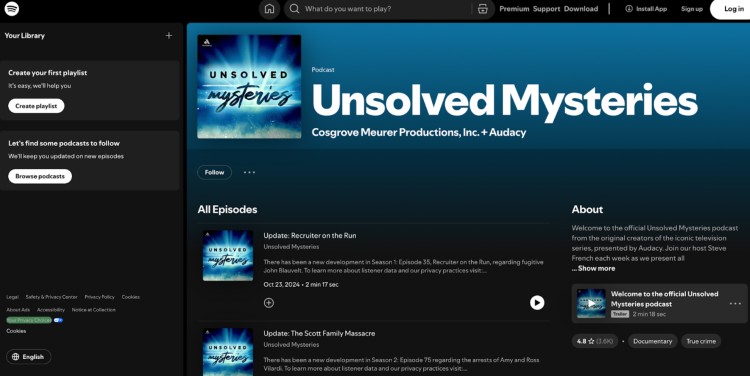
The Unsolved Mysteries podcast sets a suspenseful tone right from the start:
“Have you ever heard a story that completely defied explanation? Or a story about a crime so baffling and disturbing, you couldn’t get it out of your head? Or stranger than fiction and testimonies that challenge the perception of reality?
Perhaps you can help uncover the truth.
This is the Official Unsolved Mysteries podcast from Cosgrove Meurer Productions, the original creators of the iconic series.”
Why it works:
- Hooks with questions that force curiosity.
- Sets a tone that’s instantly eerie and compelling.
- Drops credibility in one line. People trust the original creators.
Mini takeaway: Start your podcast intro scripts with a question or statement that makes listeners squirm, gasp, or nod in agreement. Then promise the answers they can expect from the episode.
2. How I Built This intro script
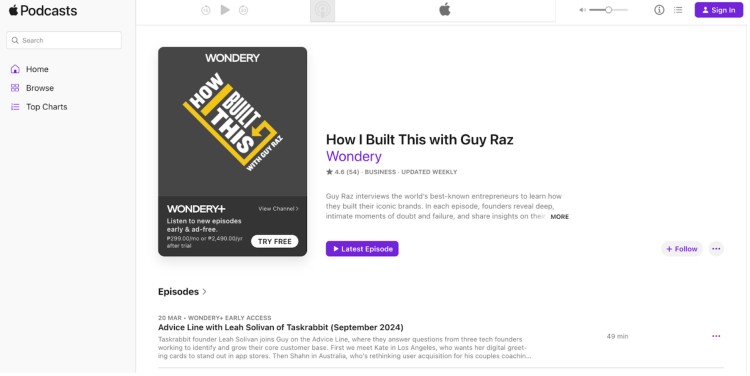
Guy Raz’s How I Built This podcast often begins with a teaser to hook listeners:
“Hello, this is Guy Raz, and welcome to How I Built This.
It’s a show about founders and visionaries and how they built some of the best-known brands in the world.
You get a free masterclass on business from hundreds, literally hundreds, of founders of brands like Chipotle, Instagram, and Airbnb.
And what you’ll love about these stories is that so many successful founders started out totally clueless.”
Why it works:
- Opens with a hook that promises insider knowledge.
- Frames content in a way that makes learning feel effortless.
- Personal and energetic tone keeps listeners engaged from the first word.
Mini takeaway: Let your intro sell the payoff. What will your listener actually walk away with? Spell it out in one vivid sentence.
3. The Daily intro script
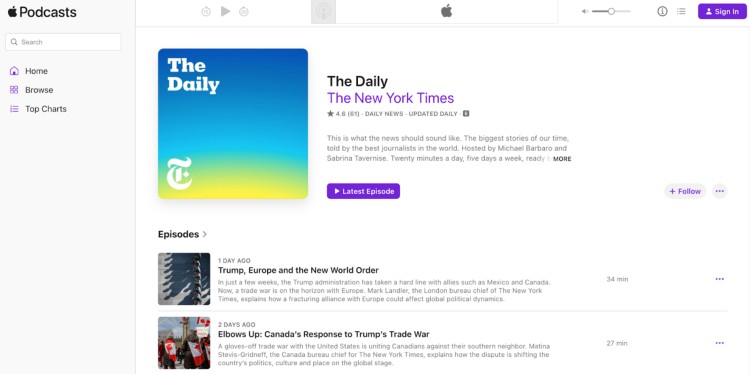
The New York Times’ The Daily podcast is an example of a great podcast script – short and direct to the point:
“From The New York Times, I’m Michael Barbaro. This is The Daily.” followed by a brief summary of the day’s main story.
Why it works:
- Instant recognition builds trust.
- Concise, no filler. The listener knows who, what, and why immediately.
- Gets straight into content without hesitation, respecting listeners’ time.
Mini takeaway: Brand or host credibility can do half the heavy lifting. If you can establish authority quickly, don’t waste words on anything unnecessary.
How to Write a Podcast Opening Script
Your opening script is the make-or-break moment of your episode. Nail this and listeners lean in. Flub it and they’re gone before you finish saying your name.
Here’s my exact podcasting 101 playbook on how to craft an intro that hits, hooks, and sticks.
1. Hook listeners from 0:00
Set the emotional bait before anything else. Start with tension, curiosity, or a small shock to make them lean in.
- Ask a provocative question: “What if everything you thought about productivity was wrong?”
- Drop a jaw-dropping stat: “80% of new podcasts fail by episode ten. This one won’t.”
- Start mid-story: “I almost quit podcasting after episode seven. Then this happened…”
- Break expectations: Say the thing listeners don’t expect to hear first.
- Tease the payoff: Let them know sticking around will reveal the answer or secret.
If opening lines aren’t your strength, the Talks podcast intro generator can spin up hook variations you can tweak until one sounds like you.
2. Introduce your show and yourself
Quickly let them know who’s talking and why they should listen without rambling.
- State your podcast name confidently: “Welcome to [Podcast Name].”
- One-line bio: “I’m [Your Name], host, entrepreneur, and human guinea pig for all things productivity.”
- Credibility kicker: Include a unique proof point or interesting fact to show you’re worth listening to.
- Keep it human: Add a small quirk, joke, or relatable line to signal personality.
3. Create connection and trust
Show them the value in the next few minutes. Specificity beats vagueness every time.
- Outline topics clearly: “We’re covering three ways to hack your morning routine.”
- Use numbers or steps: “In the next 15 minutes, you’ll learn…”
- Highlight results: “By the end, you’ll be able to actually… [insert tangible outcome].”
- Signal format: “We’ll go quick-fire through tips, then tackle listener questions.”
4. End with a clear next step
Make listeners feel seen, understood, and like they belong before you dive in.
- Call out your audience: “If you’ve ever struggled to stick to a routine, this episode is for you.”
- Share vulnerability: “I’ve messed up this exact routine more times than I care to admit.”
- Name shared pain points: Pick 1-2 common experiences and acknowledge them.
- Keep tone conversational: Speak like you’re sitting across from a friend.
You can map this out manually or use the Talks podcast script generator to structure your intro in seconds, then personalize it before recording.
How to Start a Podcast Introduction
Even the best words fall flat if you deliver them stiff, flat, or lifeless. Nail the flow, inject energy, and make listeners feel like they just found the episode they didn’t know they were waiting for.
Here’s how to make that happen every single time:
- Keep your pacing natural: Don’t rush, don’t drag. Record, listen back, and adjust until it sounds natural, confident, and alive.
- Use intentional pauses: A well-placed pause adds emphasis and makes your intro feel conversational. Instead of reading straight through, take a second to breathe between key points.
- Avoid sounding like you’re reading: Even if you have a script, speak like you’re chatting with a friend, not reading a textbook.
- Match your tone to your podcast style: Business, comedy, true crime? Your energy should scream your podcast style.
- Smile while you speak (yes, really!): Even if people can’t see you, they can hear the difference in your tone. Smiling while you talk makes your voice sound warmer and more magnetic.
- Cut out unnecessary filler words: If you catch yourself adding “um,” “like,” or “you know” too often, practice tightening up your delivery.
- Record multiple takes: Your first try might not be your best. Try reading your intro in different styles (slower, faster, more energetic) to find what sounds best.
- Keep your setup simple: A Blue Yeti mic boom arm helps keep your mic at mouth level, reduces desk noise, and lets you speak naturally without hunching or drifting off-axis.
Bonus: If your intro still sounds flat after a few takes, your mic could be the issue. Choosing between a condenser vs dynamic mic can change how present, warm, or punchy your voice comes through.
A great podcast introduction is how you bring your entire podcast episode to life. Deliver it like you mean it, and your audience won’t just listen. They’ll stay until the very end.
What to Say In a Podcast Intro (Niche Examples)
Your first 30 seconds can either pull listeners in or send them running. The trick? Speak directly to the people you want to reach, in a way that feels human, not rehearsed.
Below are niche-specific podcast intro examples you can adapt immediately.
1. Health and fitness podcast intro example
Hook your subscribers with results and relatability:
- Start with a punchy promise: “Tired of workouts that feel like punishment? Let’s fix that.”
- Introduce your show: “Welcome to [Podcast Name], where we decode fitness, nutrition, and mindset so you actually stick to your goals.”
- Introduce the host: “I’m [Your Name], certified trainer and human guinea pig for every trend in health so you don’t have to be.”
- Episode teaser: “Today, we’re busting the 3 diet myths that keep people stuck for months.”
- Call to action (CTA): “Stick around and hit subscribe. We’re making fitness actually fun.”
2. Parenting podcast intro example
Make your audience feel seen before they even realize it:
- Hook with empathy: “Ever feel like your toddler is secretly running the house?”
- Introduce your show: “You’re listening to [Podcast Name], the podcast for real parents surviving the chaos with sanity intact.”
- Host intro: “I’m [Your Name], a parent of three and professional chaos negotiator.”
- Episode teaser: “Today, we’re tackling bedtime battles without tears or bribery (well, maybe a little).”
- Call to action: “Subscribe so you’re armed with sanity-saving tips every week.”
3. Business/entrepreneur podcast intro example
Lead with a pain point and authority:
- Hook with tension: “Ever wonder why some startups skyrocket while others crash in months?”
- Show intro: “This is [Podcast Name], where founders, hustlers, and misfits get the strategies they need to win in the real world.”
- Host intro: “I’m [Your Name], serial entrepreneur, investor, and occasional human stress ball.”
- Episode teaser: “We’re breaking down 5 revenue hacks most startups overlook.”
- Call to action: “Hit subscribe and get the insider knowledge before your competitors do.”
4. True crime/mystery podcast intro example
Drop them into the story instantly:
- Hook with suspense: “What really happened on that foggy night in 1983?”
- Show intro: “Welcome to [Podcast Name], the show where we dig into cases that baffle even the experts.”
- Host intro: “I’m [Your Name], investigator and storyteller, bringing cold cases back to life.”
- Episode teaser: “Tonight, we uncover a twist in the Lindstrom case that no one saw coming.”
- Call to action: “Subscribe and join me as we chase the truth together.”
5. Self-improvement/mindset podcast intro example
Inspire curiosity and a promise of transformation:
- Hook with reflection: “What if the thoughts holding you back are completely optional?”
- Show intro: “You’re listening to [Podcast Name], the podcast that helps you hack your mind, habits, and life.”
- Host intro: “I’m [Your Name], coach, speaker, and serial overthinker turned action-taker.”
- Episode teaser: “Today, we’ll dismantle the 3 mindset traps keeping you stuck in the same rut.”
- Call to action: “Stay tuned, take notes, and hit subscribe. You’re about to level up.”
Once your intro pulls listeners in, your ending matters just as much.
Studying strong podcast outro examples can help you close with clarity, reinforce your message, and give listeners a reason to come back for the next episode.
10 Podcast Introduction Script Mistakes to Avoid
Even experienced hosts slip up in their intros. A few small missteps can make your first 30 seconds fall flat, but knowing the common mistakes gives you the chance to fix them before you hit record.
- Starting with your life story: Unless you were a ninja astronaut billionaire, keep it short and relevant.
- Overhyping the episode: Promising a “life-changing secret” and delivering a mild tip makes listeners roll their eyes.
- Overexplaining the format: “We’ll have three segments, Q&A, a bonus, and maybe interpretive dance.” Just jump in.
- Sounding like a robot ad: “Welcome to The [Insert Name] Podcast, the definitive show for…” Yawn. Be human, not a brand tagline generator.
- Name-dropping for no reason: “I once shook hands with Elon Musk…” If it doesn’t matter to the listener, leave it out.
- Using weak hooks: “This episode might be interesting…” Kill the wishy-washy. Make them feel the hook.
- Apologizing for being unpolished: “Sorry, this mic is terrible…” Your confidence matters more than perfect audio.
- Being too abstract: “We talk about life and stuff.” Specific beats vague every time.
- Dropping jargon bombs: “We’ll explore the synergetic paradigms…” Nope. Speak human.
- Ignoring your own energy: If you’re sleepy, sarcastic, or monotone, your audience feels it. Bring yourself fully or postpone recording.
How to Introduce Yourself in a Podcast
Here are my tried-and-road-tested examples you can borrow, remix, and make entirely yours every time you’re hosting a podcast interview.
- No-BS expert: “I’m [Your Name], a marketing nerd who spends more time reading email funnels than sleeping. And I promise to make it worth your while.”
- Relatable guide: “Hey, I’m [Your Name]. I’ve failed spectacularly at business, life, and productivity hacks… and I’m here so you don’t have to.”
- Story-first host: “I’m [Your Name], and this all started when I accidentally burned my first business down. Here’s what happened next.”
- Humorous opener: “Hi, I’m [Your Name], professional overthinker and snack enthusiast, helping you get your life slightly more together.”
- Authority flex (subtle): “I’m [Your Name], host, writer, and the person your inbox secretly fears, here to make your mornings smarter, faster, better.”
- Empathetic connector: “I’m [Your Name], and I’ve been where you are: overwhelmed, under-inspired, and in desperate need of a win. Let’s fix that together.”
- Ultra-specific niche intro: “I’m [Your Name], a sleep coach for night-shift nurses, and I help you actually enjoy eight hours of rest without nightmares or scrolling.”
- Conversational teaser: “I’m [Your Name]. Today, I’m spilling the one mistake that cost me $10K and how you can avoid it. Let’s dive in.”
How Long Should a Podcast Intro Be?
Podcast intros need space to hook, introduce yourself, and tease the episode. Here’s a practical range on podcast length:
- Ultra-short (5-10 seconds): Quick and punchy. Example: “This is [Podcast Name]. I’m [Your Name]. Let’s fix your productivity in 10 minutes.”
- Average (20-40 seconds): Enough to hook and tease without dragging. Example: “Welcome to [Podcast Name]. I’m [Your Name]. Today, we cover three mistakes that cost most entrepreneurs their first $10K.”
- Longest acceptable (45-60 seconds): Only if every second adds value. Example: “I’m [Your Name], and today we uncover the hidden traps in productivity most experts ignore.”
How Long Should Podcast Intro Music Be?
Intro music sets the mood, not the stage. Keep it short, intentional, and aligned with your show:
- Ultra-short (3-5 seconds): A quick punch telling your audience “we’re live.”
- Average (6-8 seconds): Enough to establish tone and style without slowing the episode.
- Longest acceptable (9-10 seconds): Only if listeners can expect that every second adds energy or context.
Match your style, fade in/out smoothly, and never overpower your voice. Test variations to find what feels right.
All You Need Is 30 Seconds
Your podcast introduction script is where listeners decide who you are before they decide if they care. Not after the episode. Not halfway through. Right there.
It’s the moment you choose clarity over cleverness, intention over habit, and confidence over noise.
Get that right and every episode works harder for you. Miss it and even great content struggles to breathe.
Once your intro pulls people in, the next move is obvious: get heard more often by the right audiences.
That’s where Talks fits naturally.
Create a free profile, get matched with other podcast hosts automatically, message without cold outreach, and let your speaker page update itself as you appear on more shows.
Fewer dead ends. More real conversations.
Yes! Show Me How to Get Booked on Podcasts for Free