

You’re walking into the recording booth, heart pounding, ready to record the ultimate podcast episode.
You grab the mic, and instead of worrying about what could go wrong, you feel a solid, reliable gear in your hands.
That’s the Shure 58 microphone experience.
For podcasters looking for a confidence boost in the studio, this isn’t just a piece of equipment. It’s your partner in commanding the room and making sure your voice is heard loud and clear.
This guide will cover everything you need to know about Shure SM58.
From vocal performance, inclusions, and key features to possible alternatives and simple microphone techniques, keep reading to find out why the Shure microphone is a top go-to choice for many creatives.
What Is the Shure SM58 Microphone?
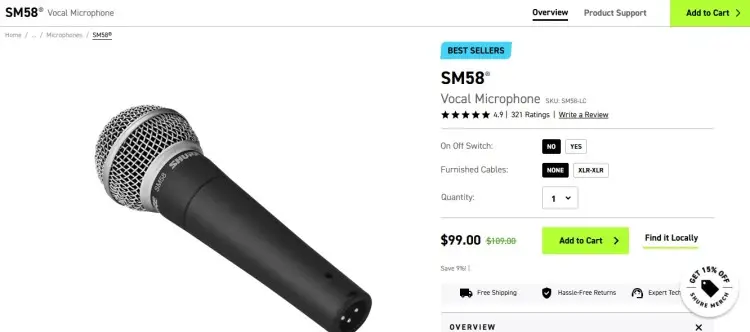
The Shure SM58 is a dynamic vocal microphone designed for professional vocal use, and it’s widely considered the industry standard for live performance and speaking engagements.
Since its release in 1966, it has become the go-to mic for everyone from rock stars to presidents. Its reputation is built on durability, reliability, and its ability to deliver clear, warm vocal audio.
Shure SM58 Inside: Parts, Specs & How It Works
The Shure SM58 is simple, tough, and built to last. It’s not flashy. It doesn’t need to be. Every part has a purpose, and that purpose is reliable sound. Here’s what makes it tick.
Shure SM58 microphone parts
The Shure SM58 is known for its simple, rugged construction. The main components include:
- The body, which is a die-cast metal handle.
- The condenser cartridge, which is the heart of the microphone.
- The steel-mesh grill ensures that even with rough handling, the cartridge stays protected.
- An internal pneumatic shock-mount system.
- A built-in filter that minimizes wind and breath sounds.
- An XLR connector at the base.
Shure SM58 microphone specifications
Understanding the technical details can help you appreciate why the SM58 performs so well. Here are the key specifications:
- Type: Dynamic (moving coil)
- Polar pattern: Unidirectional (cardioid pickup pattern isolates the main sound source)
- Frequency response: 50 to 15,000 Hz
- Output impedance: 300 ohms
- Weight: 0.33 kg (0.72 lb)
- Connector: Three-pin professional audio (XLR), male
Shure SM58 microphone manual
The user manual provides all the essential information to get you started. It typically includes:
- Details on general use and maintenance tips
- Placement techniques for the best sound (e.g., keeping the mic six inches away).
- Product specifications (e.g., How to connect the 3-pin XLR connector to your sound system or interface).
The manual also explains the proximity effect and how to use it to your advantage.
Shure SM58 Recording Mic (Key Features and Alternatives)
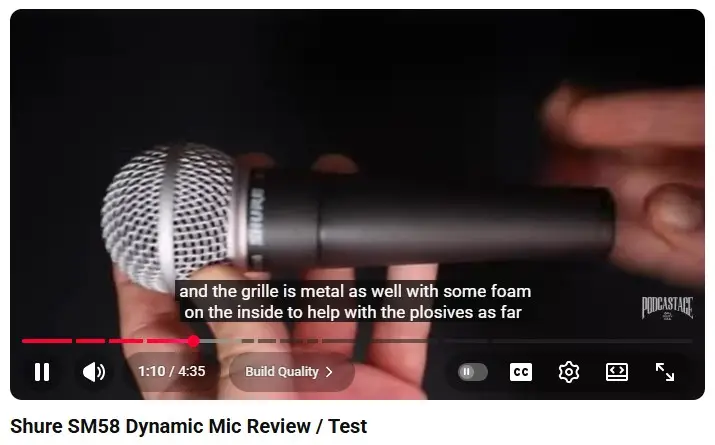
Famous for live stages but just as capable in studios and home setups, the SM58 is built for professional vocal use in sound reinforcement, podcasting, and spoken-word recording.
It’s trusted by sound engineers because it controls feedback, handles pop, and delivers consistent results in imperfect rooms.
From the standard dynamic mic to wireless, Beta, and headset versions, each option has a specific purpose and understanding the differences helps you pick the right tool for your setup.
Core recording mics
These are the SM58s that built the reputation. Rugged, reliable, and tuned for vocals and instruments in real-world environments.
If you’re recording in a home studio, office, or untreated room, these excel at minimizing unwanted background noise while keeping your voice front and center.
1. SM58 dynamic mic
The classic Shure SM58 vocal mic. Rugged, reliable, and great for environments that aren’t soundproofed.
- No phantom power or batteries needed.
- Plug-and-play on almost any mixer or interface.
- Cardioid pickup pattern helps control feedback.
- Solid bass response with a natural presence peak for vocals.
Its built-in spherical filter minimizes wind and breath, reducing harsh pop sounds without killing how clear your audio is.
2. Shure SM58 handheld microphone
Balanced for long sessions and on-location recordings.
- Perfect for interviews or man-on-the-street style content.
- Easy to pass between host and guest without losing quality.
Wireless and mobility-focused recording
Freedom to move without sacrificing sound. These options set you free from cables and give you flexibility for live sessions, workshops, or active podcasts.
The Shure SM58 wireless mic is perfect for when you want your voice to go wherever you go.
Shure SM58 wireless microphone only
Transmitter-only option for existing receivers.
- Replace or upgrade without buying a full system.
- Cost-effective for studios or venues.
Shure SM58 headset microphone
Hands-free solution for active recording sessions.
- Keeps audio consistent while moving, turning, or presenting.
- Pairs with wireless systems like the SM35.
Accessories and recording enhancements
The parts that make the SM58 last and perform like new. Grilles, switches, and other add-ons keep your mic protected, clean, and under your control so you never lose a beat.
1. Shure SM58 microphone grill
The iconic RK143G replacement steel mesh grille protects the mic and improves recording quality.
- Reduces plosives, wind, and breath sounds.
- Replacements (RK143G) restore old mics instantly.
2. Shure SM58 microphone with switch (SM58S)
The Shure SM58 microphone with switch adds instant control to mute your mic when needed.
- Lockable on/off switch prevents accidental hot-mic moments.
- Useful during panels, breaks, or live podcast recordings.
Shure SM58 wireless microphone replacement and alternatives
More power, more precision, more options.
Beta mics, USB adapters, and replacement parts let you push the SM58 beyond its standard setup for brighter sound, higher output, or direct-to-computer recording.
1. Shure SM58 Beta microphone (Beta 58A)
The Shure Beta 58A is brighter, more sensitive, and better at rejecting side noise.
- Higher output and extended high-frequency response.
- Supercardioid pattern for focused capture.
- Tougher grill for frequent use.
2. Heil PR 35
The Heil PR 35 is a dynamic vocal mic with SM58-level reliability that produces smooth, clear sound with minimal proximity effect.
- Internal shock mount reduces handling noise.
- Comparable price and build quality to SM58.
3. Audio-Technica ATR2100x-USB
The Audio-Technica ATR2100x-USB is the best XLR + USB hybrid for digital recording.
- Plug directly into your computer without extra adapters.
- Dynamic capsule handles room noise well.
- Works with interfaces or standalone, making it one of the best podcast mics for Mac podcasters.
Shure SM58 Microphone Bundle (Benefits and Inclusions)
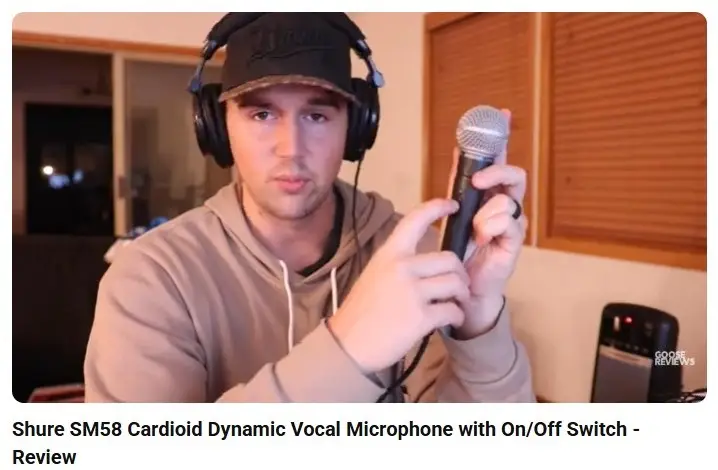
Buying the microphone alone is great, but bundles offer even better value. Think about all the time and energy you can save with a pre-packed podcast equipment kit instead of mixing and matching.
Shure SM58 microphone package benefits
Here are reasons why you should buy the complete Shure SM58 bundle:
- Cost-effective: Buying a package is often more affordable than purchasing each piece of podcast equipment separately.
- Seamless integration: You can be sure that all your components are compatible and you’re ready to start recording or performing right out of the box.
- Saves time: No need to run around looking for the right cables and mic stands. You can be up and running in minutes, focusing on your content.
Shure SM58 microphone kit inclusions
A typical microphone kit or podcast equipment bundle typically includes these key items:
- The Shure SM58 microphone
- An XLR cable
- A microphone stand
- A mic clip
- A carrying pouch
Making sure you have all of these ready helps you set up quickly and start recording.
Shure SM58 Microphone Accessories
Accessories can make or break your recording experience. A simple foam windscreen (A58WS) comes in various colors and further reduces breath noises and wind.
For podcast equipment for beginners, these small additions are affordable upgrades. They help color-code mics for multiple guests and keep the grill clean from moisture.
Shure SM58 microphone and stand
A bundle with a Shure SM58 microphone stand is extremely useful for podcasters and speakers.
- Consistent audio levels and placement
- Prevents handling noise
- Keeps your hands free
Whether it’s a desktop stand for podcasting or a floor stand for speeches, the right support gear is essential.
Shure SM58 microphone cable
The SM58 requires an XLR Male to XLR Female cable. A high-quality shielded cable reduces interference and hum, so your voice sounds clean.
Bundles typically include a quality cable of a practical length, so you don’t have to worry about buying one separately.
Shure SM58 microphone cover
A foam microphone cover, or windscreen, is a helpful accessory. It helps reduce wind noise when recording outdoors and minimizes plosives (the harsh ‘pop’ sounds from letters like ‘p’ and ‘b’) for cleaner audio.
They are also cheap to replace, making them a great hygiene barrier if you share mics. Just swap the foam cover for each new speaker.
Why Podcasters Choose Shure SM58 for Recording and Performance
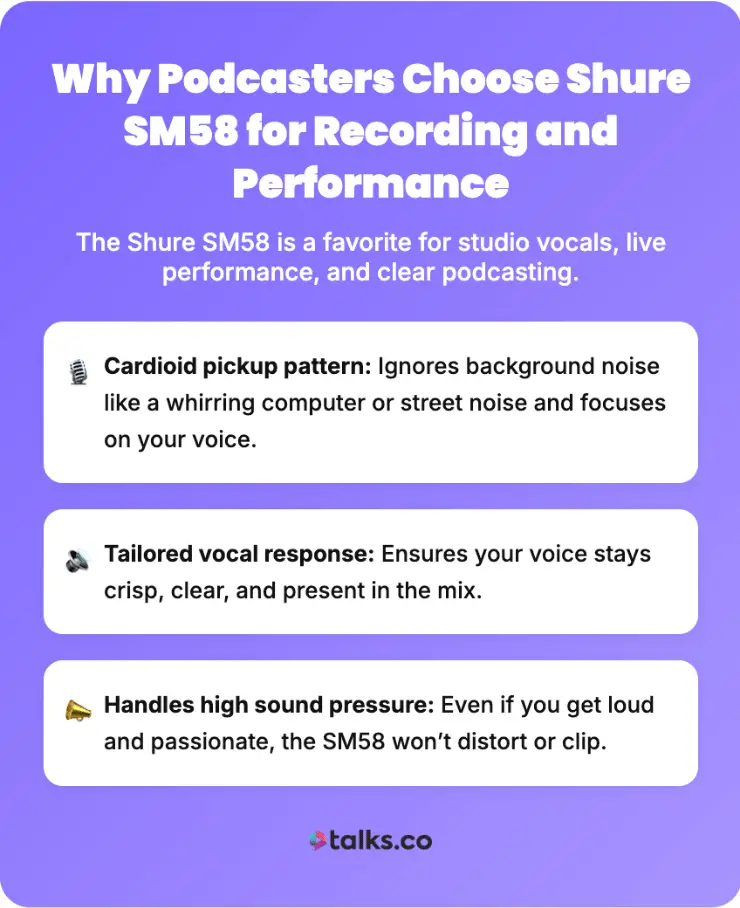
So, why do so many podcasters and recording engineers swear by a live performance mic for the studio?
The Shure SM58 is a highly effective choice for studio recording, especially for vocals and speech.
- Cardioid pickup pattern: Ignores background noise like a whirring computer or street noise and focuses on you.
- Tailored vocal response: Makes sure your voice is clear and present.
- Built to handle high sound pressure: If you get excited and shout during a passionate point, the SM58 won’t distort
Shure 58 Microphone Review: Is It Worth It?
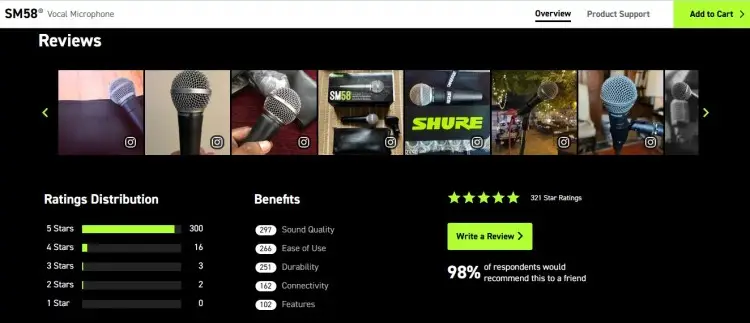
Is the legend still relevant in 2027? Absolutely.
The handheld Shure 58 is appreciated by users worldwide and is often compared with other similar Shure mic models. Fakes and dupes have even come up, just trying to recreate its performance.
Let’s see how it holds up in the real world and what people have to say about it.
Shure SM58 wireless microphone review

The wireless version of the SM58 is praised for its reliable performance. Here are some customer reviews:
- “Always wanted to get rid of the wires and this mic did it the best without breaking the bank. No dropouts and clear sound. Simple set-up and operation.” – Jim Mayercak, Musician
- “The clarity, simplicity of operation and build quality is first class.” – Mark V
- “From music streaming to video games, music production and recording, voice over work the name says it all. Shure.” – Mathew F.
Shure 58 vs 58A
When comparing the classic SM58 versus the Beta 58A, here are some differences:
- Sound quality: The SM58 has a warmer sound, while the Beta 58A is brighter with more sensitivity.
- Polar pattern: The Beta 58A’s supercardioid pattern provides better side rejection, but it’s also more sensitive to sound from the rear.
For most podcasters, the classic SM58 offers a more forgiving pickup pattern and a timeless, warm tone that is easier to work with.
Shure SM58 vs SV100
Here’s how SM58 fares against SV100:
- Cost: The Shure SV100 is a more budget-friendly option from Shure.
- Performance: While the SV100 is a decent entry-level mic, the SM58 offers superior build quality, better sound, and greater durability.
If you’re serious about your audio, the investment in an SM58 is well worth it for its professional-grade performance and reliability.
Shure SM58 original vs fake
Spotting the difference between an original and a fake SM58 can be tricky, but there are signs.
- A genuine SM58 has a certain weight to it, high-quality printing on the body, and specific details on the XLR connector, like raised pin numbers.
- A fake often feels lighter and may have a shiny grille instead of the matte grey finish.
Shure SM58 fake microphone
Fake mics are a real problem, so always buy from an authorized dealer. Telltale signs of a fake SM58 include:
- A price that seems too good to be true.
- Poor quality packaging and printing.
- A shiny, chrome-like grille instead of the dull finish.
- Misspellings or incorrect logos.
- A thin, tinny sound compared to the rich tone of a genuine SM58.
How Much Is the Shure 58 Microphone Price?
So is the Shure SM58 worth it?
Podcast equipment cost is always a factor, but with audio gear, you usually get what you pay for. The SM58 sits in a sweet spot of affordability and professional performance.
Shure SM58 wireless microphone price
The price for an SM58 varies depending on the configuration.
- No cables and switch: $99
- With switch but no cables: $109
- With cables but no switch: $118
- With cable and stand: $149
Shure microphone price list
If you’re looking for other options, Shure offers a wide range of mics at different price points. Here’s a quick look at some popular models:
- Shure MV7+: $269
- Shure SM57: $99
- Shure Beta 58A: $169
- Shure SM7B: $399
You can also explore other budget microphones like the Blue Yeti for comparison.
Which Shure Mic Is the Best?
The best podcast microphone is one that matches your needs. If you’re aiming for specific goals, there are sure winners.
That said, it’s also important what makes Shure the household brand it is today. Before you finalize your checkout, assess if its reputation measures up to what it provides.
From the most popular Shure mic to the best wired options, let’s look at which belongs in your toolkit.
What is the best Shure microphone wired?
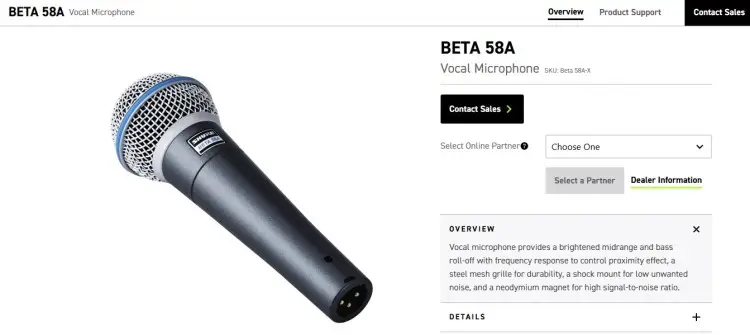
For wired vocals, the SM58 is often considered the best choice for its balance of quality, durability, and price.
If you have a higher budget and want more clarity, the Beta 58A is another excellent wired option. For many, finding the best Shure mic for podcasting starts and ends with these two models.
What is the most popular Shure microphone?
The Shure SM58 is without a doubt the most popular Shure microphone.
It’s recognized and used widely across the globe by musicians, speakers, and creators of all kinds. Its legendary status is built on decades of dependable performance.
Are Shure mics good?
Yes, Shure mics are known for being exceptionally good.
They’re an industry standard for a reason: they offer outstanding sound quality, unmatched durability, and incredible reliability. From live concerts to podcasting studios, Shure’s mics perform consistently.
What is the Shure microphone history?
The history of Shure is a story of innovation. Founded by S.N. Shure in 1925, the company started as a radio parts supplier. But they began manufacturing microphones in the 1930s.
The Unidyne model, introduced in 1939, was the first single-element unidirectional microphone, and its technology paved the way for future classics like the SM57 and SM58.
How to Use a Shure Microphone
Owning the mic is step one. Using it correctly is step two.
If you’re not sure how to install, turn on, repair or clean your Shure mic, here’s a simple guide to make the most out of it.
How to install a Shure microphone
Installation is straightforward with these steps:
- Mount the microphone on a stand using the included clip.
- Connect an XLR cable to the bottom of the mic.
- Plug the other end of the cable into your mixer, audio interface, or PA system.
- If using a mixer or interface, adjust the gain level until you get a strong, clear signal without clipping.
How to turn on a Shure microphone
Turning on the mic is simple.
- No on or off switch: A standard SM58 is always “on” when plugged into a powered channel.
- With a switch: Just slide it to the “On” position.
- Wireless mic: Press and hold the power button on the handheld transmitter until it turns on.
How to clean a Shure SM58 microphone
Keeping your mic clean is important for hygiene and performance.
- Unscrew the grille from the microphone body.
- Gently wash the grille with warm, soapy water and a soft brush.
- Remove the foam filter from inside the grille and wash it separately.
- Let both parts dry completely before reassembling them.
How to repair a Shure microphone
Thanks to its rugged construction, the SM58 rarely needs repairs but follow this guide (just in case):
- If you have an issue, first check your cable and connections.
- Check the typical parts that get damaged (e.g., the grille or the cartridge).
- Order replacement parts directly from Shure or an authorized dealer.
- Once you have the new parts, unscrew the old one and it in.
Ready to Raise Your Voice?
The Shure 58 microphone has remained an industry icon for decades for good reason. It delivers professional sound, is built to last, and provides incredible value.
With a strong partner in your hands, it’s time to start recording. Find the right podcast guests quickly and book interviews with Talks.
Gone are the days of cold outreach and blind pitches. Talks makes matching with experts you need simple and hassle-free.
- Auto-Match: Book guests fast when they match your criteria.
- Auto-Message: Send ready-made but personalized messages as soon as you connect.
Sign Up for a FREE Talks Creator Profile and Start Podcasting Today.


