

When I graduated from Macquarie University, my professional soccer career was coming to an end, and I was getting my first online business off the ground.
I was your typical 20-something year old armed with a marketing degree, a few ideas, and a lot of big dreams I had no idea how I’d make any of them happen.
Bluntly speaking, I don’t remember most of what our valedictorian said that day, but I’ll never forget how his speech made me feel. Like I’d be alright. Like I didn’t need to have my entire future mapped out before walking out of those university gates.
Looking back, that’s what a great valedictorian speech can do. It gives people something to hold onto as they head out into the unknown.
If you’re writing one, I’ll show you how to bring together the stories, non-dad jokes, gratitude, and advice that’ll help your graduating class feel ready for whatever comes next.
What Is a Valedictorian Speech?
A valedictorian speech is a graduation address delivered by the student recognized for outstanding academic achievement, usually to reflect on the graduating class’s experience and send classmates into their next chapter with something worth remembering.
The best valedictorian speeches combine personal stories, humor, gratitude, and advice that feels relevant to the people sitting in the audience.
What is the purpose of a valedictorian speech?
Your classmates have already sat through exams, group projects, and enough graduation announcements to last a lifetime. Your speech gives them a chance to look back at what they’ve shared and feel more prepared for what comes next.
- Celebrate the graduating class: Bring back a shared memory, like the senior class raising money for a school trip to Washington, D.C.
- Recognize the people who helped: Thank teachers, parents, coaches, and mentors, such as the drama teacher who stayed late to help students rehearse.
- Share a meaningful lesson: Use a personal experience to offer advice classmates can apply beyond school.
- Create a memorable send-off: Give your classmates a reason to leave the ceremony feeling proud of what they’ve accomplished and curious about what comes next.
Difference between a valedictorian and salutatorian speech

Your school’s ceremony guidelines determine each speaker’s role, but valedictorian speeches typically reflect on shared experiences and look ahead, while salutatorian speeches often welcome guests and celebrate the class.
| Writing element | Valedictorian speech | Salutatorian speech |
|---|---|---|
| Main focus | Reflect on shared memories and the future. | Welcome guests and celebrate the class. |
| Stories to include | A tough AP Chemistry exam or a memorable senior trip. | A freshman-year memory or a teacher who made a difference. |
| Message to leave | Encourage classmates to face the future with confidence. | Help graduates, families, and faculty feel included. |
| Example closing | Encourage classmates to take chances after graduation. | Thank the school community for its support. |
What Is a Valedictorian Speech Supposed to Be About?
Pick one feeling you want hanging in the gym when you step away from the podium. Pride, relief, nerve, the dizzy gratitude of having survived four years together. Every story and every joke earns its spot by pushing that feeling forward.
A class that changed over four years, a tradition only your school gets, a rough stretch everyone got through: any of them can carry it. Choose the feeling first and the stories will line up behind it.
What are valedictorian speeches about?
Most circle back to a handful of subjects. Find the one your classmates would nod along to before you finish the sentence.
- Belonging: Imagine the new student who found their people at the Friday chess club, and now you’re telling that story to the whole school.
- Class traditions: The senior-versus-teacher volleyball game says more about your class than any motto on a banner.
- Setbacks: When the student council’s spring fundraiser lost its venue with two weeks to go, the scramble taught everyone more than the original plan would have.
- Growth: Directing your first student film meant taking feedback from people who didn’t sugarcoat it, and anyone walking into a first job can use that story.
- Different paths: Community college, trade school, the military, a gap year abroad. Name them all out loud and nobody in the audience feels like an afterthought.
- What comes next: Staying curious when plans shift can lead anywhere, from a neighborhood bookstore job to an exchange program overseas.
What makes a good valedictorian speech?
Watch the faces when you finish. A good speech leaves people laughing, feeling seen, or completely rethinking what comes next.
- One thread: Say your idea in a single sentence. Any story that can’t back it up gets cut, even the one you love.
- Details only your class knows: The Chromebook cart that never held a charge, the vending machine that swallowed everyone’s dollar. Outsiders can’t fake those, and classmates can’t resist them.
- Your real voice: Read it out loud. Wherever you stumble, you’ve written something you’d never say to a friend, so rewrite it until you would.
- A feeling that outlasts the words: Nobody quotes the speech at a ten-year reunion. They remember how it felt to sit in that chair, and that’s what you’re writing for.
How to Write a Valedictorian Speech
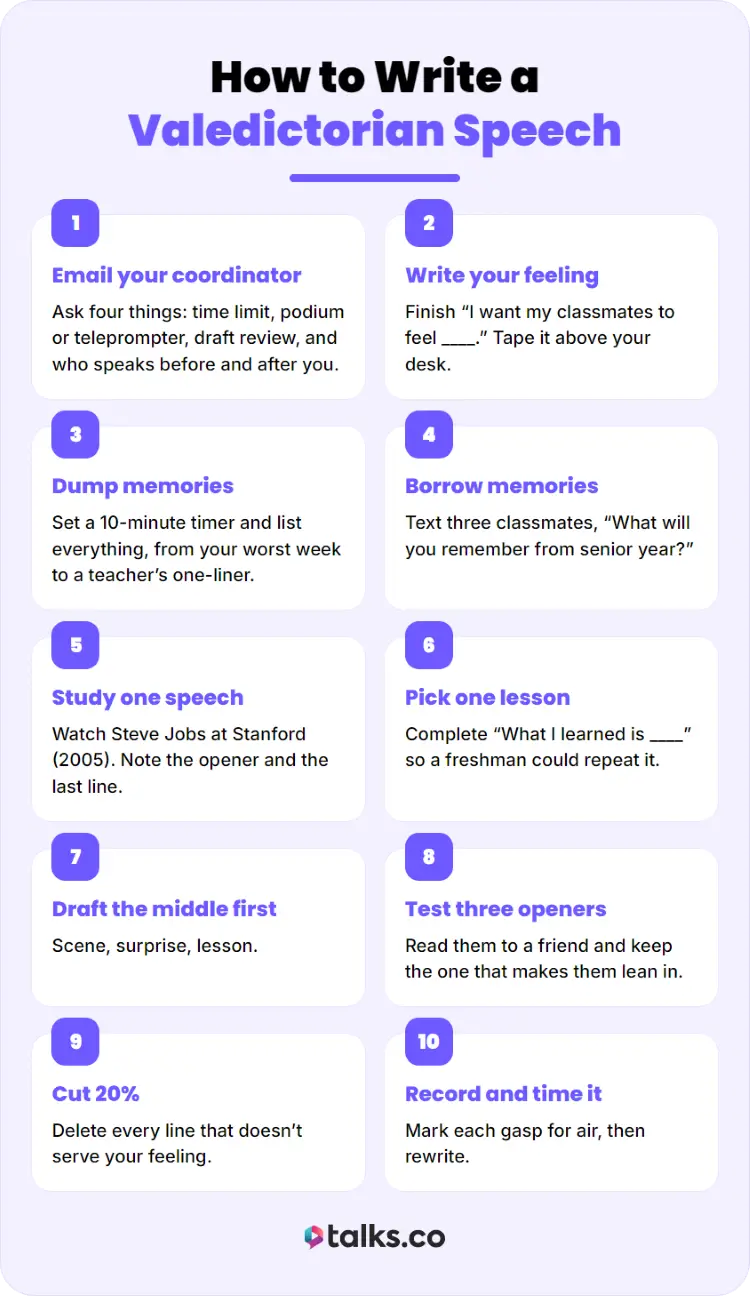
You can draft this in a weekend if you treat it as small jobs instead of one giant one. Work through these in order and borrow every template.
- Email your coordinator: Ask four things: time limit, podium or teleprompter, draft review, and who speaks before and after you.
- Write your feeling: Finish “I want my classmates to feel ____.” Tape it above your desk.
- Dump memories: Set a 10-minute timer and list everything, from your worst week to a teacher’s one-liner.
- Borrow memories: Text three classmates, “What will you remember from senior year?”
- Study one speech: Watch Steve Jobs at Stanford (2005). Note the opener and the last line.
- Pick one lesson: Complete “What I learned is ____” so a freshman could repeat it.
- Draft the middle first: Scene, surprise, lesson.
- Test three openers: Read them to a friend and keep the one that makes them lean in.
- Cut 20%: Delete every line that doesn’t serve your feeling.
- Record and time it: Mark each gasp for air, then rewrite.
Valedictorian speech format
Write for the ear. Every line you draft will be heard once, at speaking pace, by people who can’t scroll back. Read each sentence aloud as you write it, and when you run out of breath mid-line, split it.
Four questions for your ceremony coordinator will save you a rewrite later:
- How long is my slot? Draft to the shortest number you hear, and you’ll never be cut off mid-thank-you.
- Podium or teleprompter? The answer decides whether you format your pages in big type with short lines or as a clean script.
- Does anyone review the draft? Some schools ask to see it a week early, and asking now keeps that surprise away from the night before.
- Who speaks right before and after me? Your opening can nod to the speaker ahead of you, and your last line can set up the one behind you.
Valedictorian speech outline
Five beats give the speech its spine. Each has one job, and the shares below hold whether your slot runs three minutes or ten.
Need the same skeleton for another occasion? Our guide to writing a speech outline adapts it.
| Beat | Share of speech | Its job | Quick check |
|---|---|---|---|
| Opening | ~10% | Pull the room in with a story, a question, or a joke | Would a cousin who’s never met your class keep listening? |
| Shared class moment | ~25% | Take everyone back to something only your class lived through | Could any other school’s student give this word for word? |
| Thank-yous | ~15% | Name the people who got you here in your own voice | Does each name come with one specific detail? |
| One lesson | ~35% | Give your biggest share of time to the single idea you want them to leave with | Can you say it in one sentence? |
| Send-off | ~15% | Hand the feeling to your classmates and let them carry it out the door | Does it point at what they’ll do next? |
Wondering which beat to write first? Start with the lesson. Once you know what your classmates should walk out holding, the class moment, the thank-yous, and the opening all know what they’re working for.
20 Valedictorian speech topics
Pick the topic only your class could tell, and let the rest fall away. Start with this list, then run your top three through the sticky-note test with a friend.
- The group chat that survived four years: Tell what kept your class talking through every crisis.
- The teacher who changed the plan: Share the one comment that rerouted someone’s future.
- Senior year, interrupted: Face the disruption, then show how your class adapted.
- The tradition you almost lost: Revisit the event that nearly got canceled and why everyone fought for it.
- First day versus last day: Compare who you were walking in with who’s standing here.
- The club that found its people: Spotlight the Friday chess club or the robotics team that became a second home.
- The failure everyone remembers: Laugh about the flop, then name what it built.
- Small kindnesses: Recall the lunch table that always had one open seat.
- The unsung crew: Honor the custodian, bus driver, or lunch staff who showed up every day.
- What the group project taught us: Turn four people, one poster board, and a deadline into a lesson.
- Paths we’re taking: Name community college, trade school, the military, work, and the gap year.
- The rival who became a friend: Show how competition turned into respect.
- A school quirk we’ll miss: Pick the vending machine, the clock that ran late, or the hallway that flooded.
- Asking for help: Describe the day you finally did, and what it opened up.
- The thing we outgrew: Say goodbye to a trend, a habit, or a version of yourself.
- Home away from home: Honor the family that drove you to practice at 5 a.m.
- Staying curious when plans shift: Use the course you didn’t expect to love.
- The advice we ignored: Admit what you wish you’d listened to sooner.
- What we’ll tell our kids: Imagine the story of your class in twenty years.
- One thing to do this week: Send a thank-you text to someone who got you here.
What to Say in a Valedictorian Speech
A good speech holds an opening, one story only your class lived, a few thank-yous, one lesson, and a send-off.
The sections below cover the moments that decide whether the room leans in:
- How you begin
- What gets a laugh
- The one quote worth borrowing
- How you leave
Valedictorian speech introduction
Your first 30 seconds make a promise, and the rest of the speech keeps it. Give the room three things in this order:
- A greeting: Address the audience from the top down, faculty, families, then classmates.
- A thank-you: One sentence for the people filling those seats, since they gave up a Saturday for you.
- A hint at your theme: Plant your one feeling in a single line so everyone knows where you’re headed.
Here’s how that sounds like:
“Good evening, families, teachers, and fellow graduates. Four years ago, I couldn’t find the gym. Tonight I want to talk about what we found instead.”
How to start valedictorian speech
Your first line has one job, which is to make a stranger in the back row stop reading the program. Pick the opener that matches your class.
- A story: “Last March, our senior prank went exactly one step further than planned.” Close-knit classes love a shared memory.
- A question: “Who here still owns a charger that works?” Big, chatty classes answer out loud, and that wakes up a room.
- A callback: Reference something from this very ceremony, like the delayed processional or the mic check. It tells everyone you’re in the moment with them.
- A surprise: Open with a number, a confession, or a one-word sentence. Short and strange gets attention fast.
Write all four, read them to a friend, and keep the one that earns a reaction.
Valedictorian speech funny
Here’s how to become the valedictorian who get laughs minus the dad-joke groan. Each joke and funny story has to pass three tests before it makes the cut:
- Is the whole room in on it? A joke about the vending machine that ate everyone’s dollar works for 300 people. An inside joke for six does not.
- Would you say it with your grandmother and the principal listening? If the answer is no, cut it.
- Does it survive without an explanation? A joke that needs context gets a polite silence.
Aim your humor at shared pain or at yourself, like “Four years, and the Wi-Fi password changed more often than our lunch table.”
Two or three jokes spaced through the speech beat one big comedy bit.
7 Valedictorian speech quotes examples
Pick one line, recount and name who said it, and tie it to your class of the last four years in a sentence of your own. Each quote below is under 15 words and comes with the moment it fits best.
- “Stay hungry. Stay foolish.” Steve Jobs closed his 2005 Stanford address with this. It fits a send-off for a class heading into unknown paths.
- “A journey of a thousand miles begins with a single step.” Lao Tzu. Use it in your opener, then call back to it at the end.
- “Alone we can do so little; together we can do so much.” Helen Keller. This fits a shared class moment or your thank-yous.
- “When you know better, do better.” Maya Angelou. It fits right before your lesson, especially if your story involves a mistake.
- “The best way out is always through.” Robert Frost. Use it after a story about a rough stretch your class survived.
- “Nothing great was ever achieved without enthusiasm.” Ralph Waldo Emerson. It fits a lesson about showing up for things you care about.
- “Well done is better than well said.” Benjamin Franklin. Pair it with a story about a project your class finished.
Say the quote, pause one beat, then add your own line: “Helen Keller said, ‘Alone we can do so little; together we can do so much.’ Our yearbook crew proved it at 6 a.m. every Tuesday.”
How to end valedictorian speech
Your last 20 seconds are the part your classmates carry out of the building. Close in this order:
- Callback: Bring back one word or image from your opener so the speech closes its own loop.
- A small action: Give them something to do this week, like texting the person who helped them get here.
- A short last line: Aim for a dozen words or fewer.
- A pause: Count to two before “Thank you,” then stop talking.
Example:
“Four years ago, I couldn’t find the gym. Look around. We found everything else. Thank you.”
How Long Should a Valedictorian Speech Be?
Your ceremony runs on a schedule, and your slot is one line in it. Get the minutes right first, then turn them into words, and every thank-you makes it onto the stage. Here’s the quick answer:
- Most speeches: 3 to 7 minutes
- Sweet spot: 4 to 5 minutes
- Who decides: Your school’s ceremony coordinator
- Safe target: 1 to 2 minutes under the limit they give you
How long is a valedictorian speech?
Most valedictorian speeches fall between 3 and 7 minutes, and 4 to 5 minutes is the sweet spot. Here’s how that plays out at different ceremonies:
- Small high school (under 100 graduates): 4 to 7 minutes. A smaller room forgives a longer story.
- Large high school (300+ graduates): 3 to 5 minutes. The program is packed, so a tight speech earns goodwill.
- College or university: 5 to 10 minutes, depending on how many speakers share the stage.
- Virtual or recorded ceremony: 2 to 4 minutes. Screens shrink attention spans.
- Shared slot (valedictorian and salutatorian): 2 to 3 minutes each.
Your school sets the real number, so get it from your coordinator before you draft any special occasion speech examples. If they say “up to 7,” aim for 5 or 6. That cushion covers laughs, applause, and the pause before your last line.
How many words should a valedictorian speech be?
A comfortable ceremony pace runs 120 to 150 words per minute. Here’s what each slot gives you:
- 2 minutes: 240 to 300 words
- 3 minutes: 360 to 450 words
- 5 minutes: 600 to 750 words
- 7 minutes: 840 to 1,050 words
- 10 minutes: 1,200 to 1,500 words
Pick your row, then shave off 10% for laughs, applause, and pauses. A 5-minute slot, for example, calls for a draft of roughly 540 to 675 words. Read it aloud with a timer to confirm, since your natural pace decides the final number.
Want the full pacing breakdown? Our guide on how many words fit in a 5-minute speech walks through it.
Valedictorian Speech Examples
Reading a finished speech teaches you more than any outline can. Below you’ll find single lines to borrow, a complete sample with every beat labeled, and a fill-in script with stage cues. Swap in your own details and keep the structure.
Short valedictorian speech examples
Three real speech examples show what each beat looks like when someone else pulls it off. Study the structure, then write your own words.
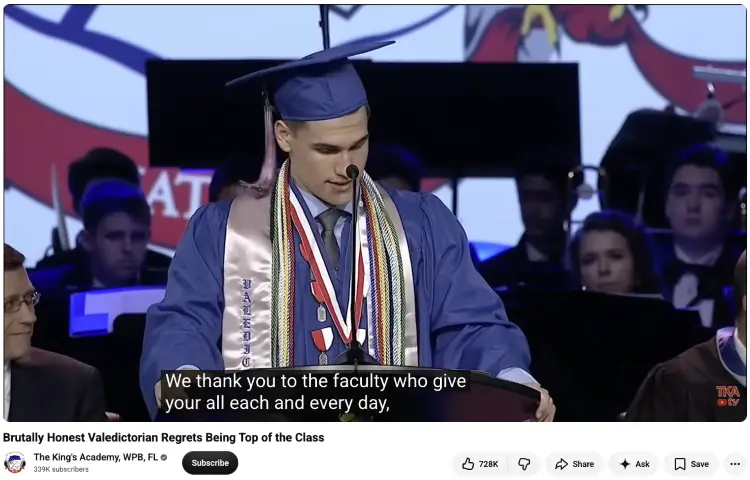
- Kyle Martin, “The 16th Second” (The King’s Academy, 2019): He won the title, felt nothing, and had the guts to tell 24 million viewers why.
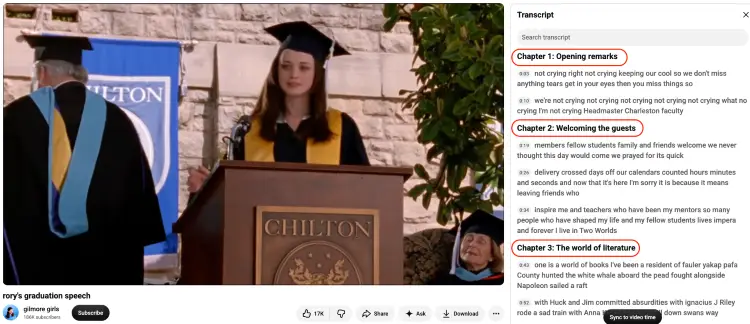
- Rory Gilmore’s graduation speech (Gilmore Girls): She cracks a joke about not crying, then thanks the people who made her with one detail each, and that’s the whole trick.
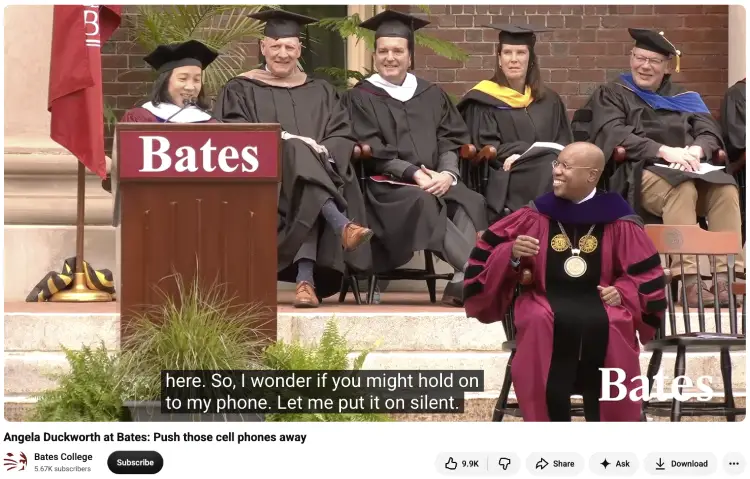
- Angela Duckworth, Bates College commencement (2025): She had everyone hand their phone to a neighbor before she said a word, so the room felt her point first.
Valedictorian speech example
This one runs about two minutes, around 300 words at ceremony pace. Each label shows the beat doing its job.
Opening:
“Good evening, families, teachers, and fellow graduates. Four years ago, I couldn’t find the gym. Neither could half of you. Tonight I want to talk about what we found instead.”
Shared class moment:
“Remember the winter the heat quit in Building C? We wore coats to chemistry for nine days. Someone brought a space heater. Someone else brought hot chocolate. By day four, nobody sat in rows anymore. We sat in a circle around that heater.”
Thank-yous:
“Mr. Alvarez, you gave up a Thursday evening to walk me through every problem on the AP Chemistry review, and I finally believed I belonged in that room. To every teacher, parent, and friend here tonight, thank you.”
One lesson:
“Here’s what that cold classroom taught me: people move toward warmth, and anyone can be somebody’s space heater by showing up with whatever they’ve got.”
Send-off:
“This week, text one person who helped you get here. Four years ago, I couldn’t find the gym. Look around. We found everything else. Thank you.”
Notice the callback to the gym. It closes the loop the opening started.
Valedictorian speech script
Copy this, fill the brackets, and keep the cues for your next public speaking opportunity. The cues in parentheses are for you and never get spoken.
Greeting: “Good evening, [families, teachers, and fellow graduates].” (Smile. Wait one beat.)
Opening line: “[Four years ago, I ______.] [Tonight I want to talk about ______.]” (Pause after the first sentence.)
Class moment: “Remember [shared memory]? [One surprising detail.] [What changed because of it.]” (Slow down on the detail.)
Thank-yous: “[Name], you [specific action] on [specific day], and it [what changed for you].” (Look at the person. Repeat for four or five names.)
Lesson: “Here’s what [the memory] taught me: [one sentence].” (Pause before and after.)
Send-off: “This week, [small action]. [Callback to your opening line.] Thank you.” (Count to two. Stop talking.)
Tips for Valedictorian Speech Writing and Delivery
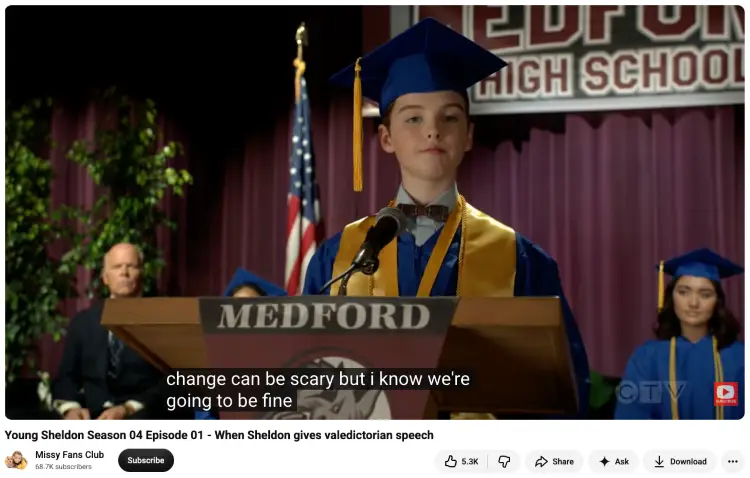
Your draft is done, so now it’s about how it resonates. These seven habits when you practice your speech take a good valedictory speech and make it one fellow students going on to college or the unknown remember.
- Rehearse out loud: Say it standing up, at least five times, because your mouth finds the stumbles your eyes skip.
- Pause on purpose: Count to two after your best line and let everyone in your class and the room time to reflect and catch up to you.
- Skip the cliches: Retire the dictionary definition opener and “the future is bright,” and give us a detail only your class would know.
- Look at faces: Pick three friendly people in different corners and rotate your eyes between them.
- Slow down: Nerves speed you up, so aim for a public speaking pace that feels a little too slow to you.
- Trim to your slot: Cut the line you love least and you’ll finish with time to breathe.
- Keep a backup: Print your speech in big type and save a copy on your phone, in case the teleprompter quits.
One Big “See You Later”
Your valedictorian speech marks the end of one chapter and the start of whatever comes next. Give your classmates a send-off worth remembering, then keep putting your voice out there.
Graduation is one milestone. Getting your ideas in front of people who need to hear them is another.
Create your free Talks profile to connect with podcast hosts in your niche, get matched with relevant shows, and start booking interviews.
Your next audience could be bigger than the one in that auditorium.
Yes! Sign Me Up for Talks Now!


