

Great ideas have a nasty habit of showing up out of order.
You’ve got the story. The lesson. Three points you’re desperate to make. Maybe a killer opening you’ve been rehearsing in your head. Then you get on stage and suddenly everything feels like a big pile of half-cooked spaghetti dumped inside your bedside drawer.
That’s the problem with winging a speech. Your audience has to do the organizing for you.
A good speech outline template or draft gives every idea a job. It tells you what belongs in the opening, what earns its place in the middle, and what deserves the final word.
And once you know how to write a speech outline, you can shape your ideas around your audience, message, thesis, and the minutes you’ve got on the clock set by the organizer.
Time to dust off that speech and get you on stage.
What Is a Speech Outline?
A speech outline is the skeleton of your talk. It maps out your main idea, key points, supporting details, examples, and conclusion so you know exactly where you’re going before you start speaking.
Think of it as the version of your speech you can actually see at a glance.
You might have one sitting beside you while recording a 20-minute guest episode for The Mindvalley Podcast, preparing a keynote for 500 founders in San Francisco, or teaching a 45-minute workshop for health coaches in Syracuse.
Why is it important to outline a speech?
A strong speech outline makes your ideas easier to organize, easier to deliver, and much harder for your best points to get buried halfway through the talk.
- Clarifies your message: Identify what you want listeners to remember.
- Gives points purpose: Place each story, statistic, example, and takeaway intentionally.
- Prevents rambling: Catch tangents before you’re speaking to 300 people.
- Controls timing: Shape material for a 10-minute podcast or 60-minute workshop.
- Strengthens transitions: Move smoothly between ideas.
- Builds confidence: Focus on connection, not memorizing every sentence.
- Speeds editing: Cut or rearrange sections without rewriting everything.
- Supports adaptation: Reshape one message for a 7-minute talk or 45-minute workshop.
What Does a Speech Outline Look Like?
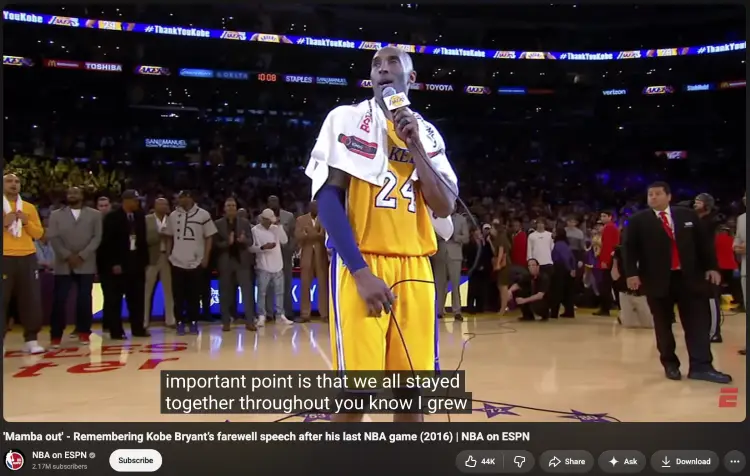
Kobe Bryant’s farewell speech after his final Los Angeles Lakers game shows how simple a speech outline can be. His words felt spontaneous, but the ideas followed a clear progression:
- Opening: React to the moment and his 20-year career.
- Reflection: Remember his Lakers history and the highs and lows.
- Gratitude: Thank the fans for their support.
- Humor: Reference the crowd urging him to shoot.
- Family: Thank Vanessa and his daughters.
- Closing: Leave the audience with his final goodbye.
What a Speech Outline Should Look Like
In speech writing and preparation, your outline can help show the order of your ideas without forcing you to write every sentence. For example:
Topic: Why Your Expertise Isn’t Getting You More Clients
- Introduction: Hook, problem, main message
- Point 1: Expertise needs visibility
- Point 2: Speaking creates visibility
- Point 3: Turn attention into opportunities
- Conclusion: Recap, takeaway, CTA
You should be able to glance at the page and know exactly where your speech is going during your presentation.
How many paragraphs in a speech?
There’s no fixed paragraph count for a speech. Organize your outline around sections and speaking points instead.
- 5 minutes: 3-5 sections
- 10 minutes: 4-6 sections
- 20 minutes: 5-8 sections
- 30 minutes: 6-10 sections
- 45–60 minutes: Multiple sections with examples, activities, or audience interaction
A 10-minute podcast appearance needs far less slide material and speech preparation than a 60-minute workshop for health coaches in Sydney.
How to Do a Speech Outline (Checklist)
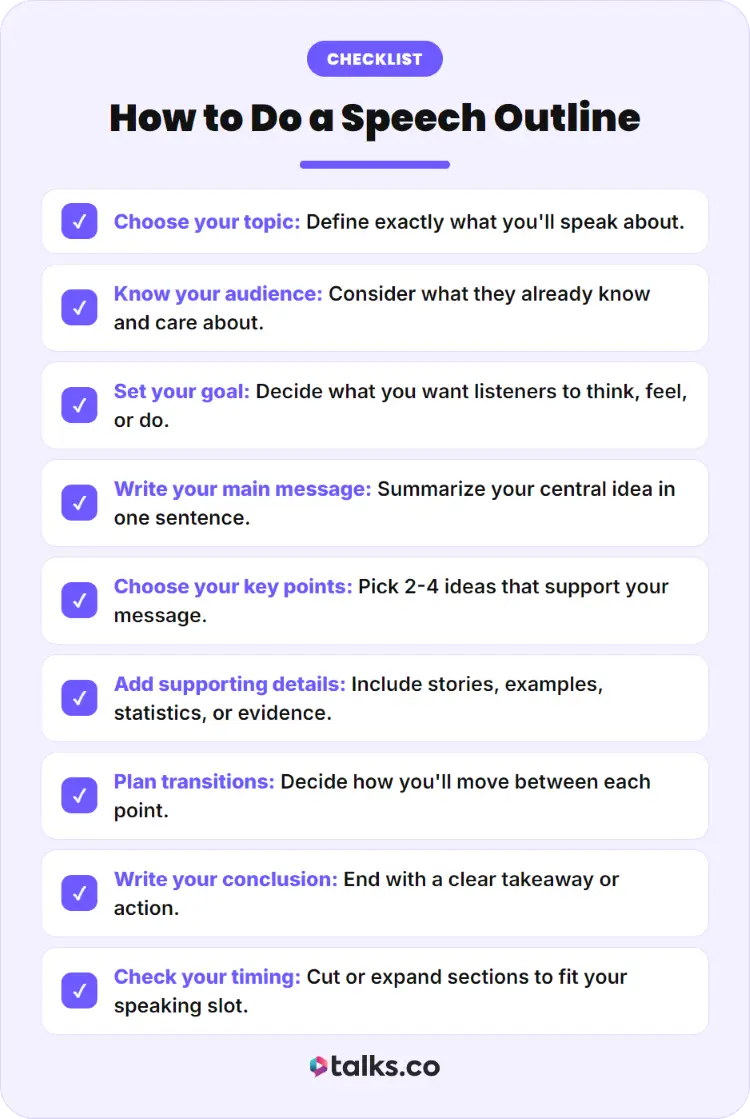
Creating a speech outline gets easier when you work through the same basic sequence each time.
☐ Choose your topic: Define exactly what you’ll speak about.
☐ Know your audience: Consider what they already know and care about.
☐ Set your goal: Decide what you want listeners to think, feel, or do.
☐ Write your main message: Summarize your central idea in one sentence.
☐ Choose your key points: Pick 2-4 ideas that support your message.
☐ Add supporting details: Include stories, examples, statistics, or evidence.
☐ Plan transitions: Decide how you’ll move between each point.
☐ Write your conclusion: End with a clear takeaway or action.
☐ Check your timing: Cut or expand sections to fit your speaking slot.
What Is the Correct Format for a Speech Outline?
Most speech outlines follow a simple structure: introduction, body, and conclusion. Within the body, organize your main points in a logical order, then add supporting details underneath each one.
Standard format for speech outline
A standard speech outline gives you a reliable structure to build from, especially when you’re preparing your first few talks. Use it to organize your introduction, main points, supporting details, and conclusion before filling in the finer details.
I. Introduction
- Hook
- Topic
- Main message
II. Body
- Main point 1
- Supporting detail
- Example
- Main point 2
- Supporting detail
- Example
III. Conclusion
- Recap
- Key takeaway
- Call to action
Customizable template for speech outline
Once you understand the basic structure, you can adapt it to fit your topic, audience, speaking time, and delivery style. Use this template as your starting point, then add the details that make the speech yours.
Speech topic: [Your topic]
I. Introduction
- Hook: [Opening line]
- Topic: [What you’re discussing]
- Main message: [Your central idea]
II. Body
- Main point 1: [Idea]
- Example: [Story, statistic, or evidence]
- Main point 2: [Idea]
- Example: [Story, statistic, or evidence]
- Main point 3: [Idea]
- Example: [Story, statistic, or evidence]
III. Conclusion
- Recap: [Main points]
- Takeaway: [What should they remember?]
- CTA: [What should they do next?]
Examples of Speech Outlines for Different Types of Speeches

The easiest way to understand a speech outline is to see one fully built out. Below are five types of speeches and their examples with a specific speaker, audience, topic, speaking time, and structure you can borrow when planning your own talk.
1. Informative speech outline
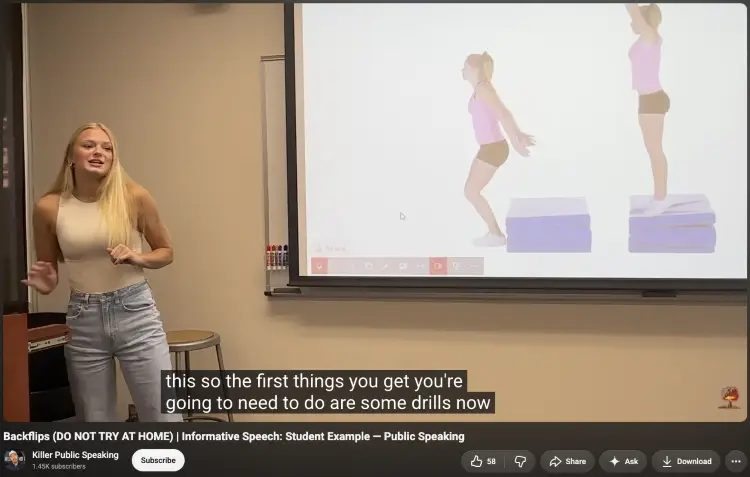
Topic: What Actually Happens When You Stop Eating Enough Protein
- Speaker: Maya Rodriguez, nutrition coach in San Diego
- Audience: 150 women at a wellness conference
- Time: 15 minutes
Introduction
- Hook: “You can eat a salad every day and still struggle to build muscle.”
- Purpose: Explain why protein intake matters for women over 40.
- Preview: Cover protein needs, common mistakes, and practical food choices.
Main point 1: How much protein you need
- Explain protein’s role in muscle maintenance.
- Give a simple daily target based on body weight.
Main point 2: Where people go wrong
- Relying on small portions.
- Saving most protein for dinner.
Main point 3: Making protein easier
- Show examples using Greek yogurt, eggs, salmon, tofu, and chicken.
- Give a sample high-protein breakfast.
Conclusion
- Recap the three key lessons.
- Takeaway: Make protein part of every meal.
Use this: Build informative speeches around clear explanations, useful facts, and concrete examples. The audience should leave knowing something they didn’t know before.
2. Persuasive speech outline
Topic: Why Coaches Should Stop Relying Entirely on Social Media for Leads
- Speaker: Daniel Brooks, business coach in Chicago
- Audience: 80 independent coaches at a business conference
- Time: 12 minutes
Introduction
- Hook: “You can spend 2 hours creating a LinkedIn post that gets 14 likes and still have no idea who actually saw it.”
- Problem: Explain why depending on social media alone can leave coaches with an unpredictable flow of prospects.
- Position: Show why podcast guesting can give coaches another way to build visibility and credibility.
Main point 1: Social media attention is temporary
- Explain how posts disappear quickly from busy feeds.
- Show how inconsistent reach can make lead generation harder to predict.
Main point 2: Podcasts put your expertise in context
- Explain how a 30-minute conversation gives you room to demonstrate how you think.
- Compare a short social post with answering real questions on a podcast.
Main point 3: Turn appearances into opportunities
- Direct listeners to your website, book, coaching offer, or Talks Creator Profile.
- Give one specific next step after every interview.
Conclusion
- Recap why coaches need visibility channels beyond social media.
- Challenge the audience to pitch three relevant podcasts this week.
Use this: Build persuasive speeches by presenting a clear problem, supporting your position with specific reasoning, then giving the audience a practical action to take.
Check out more persuasive speech examples along with other speech examples for inspiration for your next public speaking opportunity.
3. Demonstrative speech outline
Topic: How to Turn One Podcast Interview Into a Week of Content
- Speaker: Jordan Lee, content strategist in Austin
- Audience: 60 coaches and consultants at a creator workshop
- Time: 20 minutes
Introduction
- Hook: “You recorded one 45-minute podcast yesterday. By Friday, you could have seven pieces of content from it.”
- Purpose: Show the audience how to repurpose one podcast interview into useful content.
- Preview: Walk through the recording, extraction, and publishing process.
Main point 1: Start with the interview
- Choose three questions that showcase your expertise.
- Record a 30-45-minute conversation with a podcast host.
- Mark the strongest stories and insights during the interview.
Main point 2: Extract the best material
- Turn one answer into a LinkedIn post.
- Pull a strong story into an email.
- Turn three related answers into a short article.
Main point 3: Package and publish
- Create simple headlines for each piece.
- Add one clear CTA to each asset.
- Schedule the content across the following week.
Conclusion
- Recap the three-step process.
- Action: Choose one existing interview and repurpose it this week.
Use this: Demonstrative speeches work best when the audience can watch a process unfold and follow along.
Use examples, visuals, demonstrations, or live walkthroughs wherever they make the process easier to understand.
4. Special occasion speech outline
Topic: A Retirement Speech for Michael Thompson
- Speaker: Sarah Thompson, Michael’s daughter
- Audience: 75 colleagues, family members, and friends
- Location: The Grand Hotel, Melbourne
- Time: 6 minutes
Introduction
- Opening: “Dad has spent 38 years telling everyone else when to retire. Tonight, we’re finally making sure he follows his own advice.”
- Purpose: Celebrate Michael’s career and the people he has influenced.
- Tone: Warm, personal, lightly humorous.
Main point 1: Remember the career
- Mention Michael’s first day at Westpac in 1988.
- Share how he progressed from graduate trainee to regional manager.
- Highlight his reputation for mentoring younger colleagues.
Main point 2: Remember the person
- Tell the story of Michael answering work calls during a family camping trip in Wilsons Promontory.
- Share how his colleagues became lifelong friends.
Main point 3: Look ahead
- Mention Michael’s plans to travel through Italy with his wife, Helen.
- Wish him more time for golf, family, and the things work made difficult.
Conclusion
- Thank Michael for the example he set.
- Raise a glass to his retirement and whatever comes next.
Use this: Special occasion speeches work best when they honor the person or moment while giving the audience a story they’ll remember after the event.
5. Entertaining speech outline
Topic: What My First Year of Remote Work Taught Me About Myself
- Speaker: Liam Carter, freelance designer in Manchester
- Audience: 120 creative professionals at a networking event
- Time: 10 minutes
Introduction
- Hook: “On my first Monday working from home, I made coffee, opened my laptop, and discovered I’d somehow been promoted to head of household laundry.”
- Purpose: Tell a funny, relatable story about adjusting to remote work.
- Tone: Light, conversational, self-deprecating.
Main point 1: The freedom sounded better on paper
- Describe planning a productive 9 am start.
- Explain how quickly household distractions appeared.
Main point 2: The weirdness of working alone
- Share the story of talking to the delivery driver for five minutes because he’d become the day’s first human interaction.
- Describe accidentally joining a client call with a saucepan still in hand.
Main point 3: Finding a better rhythm
- Explain how morning walks, scheduled breaks, and coworking days changed the routine.
- Share the unexpected benefits of having more control over the workday.
Conclusion
- Return to the laundry joke from the opening.
- Leave the audience with one simple lesson: freedom works better when you give it some structure.
Use this: Entertaining speeches rely heavily on stories, timing, personality, and memorable details. Give the audience a reason to keep listening from one story beat to the next.
Speech Outline Guide (Do’s and Don’ts)
A speech outline should keep you oriented and these quick do’s and don’ts will help you build an outline that’s useful in the moment.
| Do | Don’t |
|---|---|
| Use keywords: Create prompts you can expand on naturally. | Write every sentence: This can make delivery feel stiff. |
| Mark important moments: Flag stories, statistics, and questions. | Overload each point: Too much detail makes scanning harder. |
| Leave breathing room: Build space for pauses and audience reactions. | Pack every second: Constant talking can drain the room. |
| Use specific examples: Make abstract ideas concrete. | Keep examples vague: Generic examples are harder to remember. |
More tips on how to start a podcast and
6 Common speech outlining mistakes
Small problems in your outline can create bigger problems once you’re in front of an audience. Watch for these common issues:
- Too many main points: Cramming 8 ideas into a 10-minute talk leaves every point fighting for attention.
- Writing the entire speech: A full script can make delivery feel rigid and harder to recover from mistakes.
- Vague points: “Talk about confidence” gives you little direction compared with “Explain how emcee Sara Chen used podcast interviews to build authority for her Toronto coaching business.”
- Weak transitions: Jumping from one idea to another makes the speech harder to follow.
- Ignoring timing: A 45-minute workshop outline won’t fit a 10-minute keynote.
- Forgetting the audience: A speech for first-time entrepreneurs needs different examples than one for experienced CEOs.
Best Practices for Outlining a Speech (Checklist)
Before practicing, check the details that affect how usable your outline will be during delivery.
☐ Scan test: Make sure you can find your next point within seconds.
☐ Cue words: Use short prompts instead of full paragraphs.
☐ Story markers: Flag personal stories so they’re easy to spot.
☐ Evidence markers: Label statistics or research you need to cite.
☐ Emphasis marks: Highlight lines that deserve extra weight.
☐ Pause points: Mark places where silence can help an idea stick the landing.
☐ Recovery points: Make it easy to find your place after losing your train of thought.
☐ Practice version: Test the outline aloud before presenting.
Your Speech Deserves a Tough Spine
You’ve got your speech outline, your ideas are finally done fighting for elbow room, your opening has a job, every story is in place, and your final point actually hits every mark.
Now give people a reason to hear you.
Talks helps coaches, authors, speakers, and experts connect with relevant podcast hosts, get matched with shows in their niche, and start booking interviews.
Your next audience could be listening to someone else right now.
Might as well make sure they hear you.
Create Your Free Talks Creator Profile


