

Want to sound sharp, confident, and interesting when someone puts you on the spot?
You can train yourself to think faster, organize your thoughts, and deliver a solid answer without spending hours preparing it.
Think of yourself at a networking event when someone asks what you do or in a meeting when your boss suddenly asks for your opinion. Maybe you’re a coach being interviewed on a podcast, and the host throws you a question you didn’t see coming.
These examples of impromptu public speaking moments can make even the most articulate person stumble (me included). The difference comes down to knowing how to work with the few seconds you’ve got.
I’ve put together these impromptu speaking examples to help you stay sharp without preparation, handle unexpected questions, structure a quick speech, and speak more confidently in public and on stage.
The goal is simple: be ready to make your words count and stick when a storytelling opportunity comes your way.
What Is Impromptu Speech?

An impromptu speech is a talk you deliver with little or no preparation, usually in response to a moment you didn’t plan for.
As a coach, author, or entrepreneur, you need this communication skill whenever the spotlight swings your way without warning.
- Work meetings: Your director turns to you mid-call and asks which budget line you’d cut first.
- Networking events: A stranger at a trade show booth asks what your workshop actually covers.
- Podcast interviews: A host asks what pushed you to walk away from your corporate job.
- Social situations: You’re handed the mic at a retirement party and asked to say a few words.
- Classroom discussions: A teacher asks you to defend an opinion on an info speech topic you haven’t studied in depth.
Impromptu Speaking Examples
Pick the scenario that matches your week. Each example below hands you a structure to borrow, plus a sample answer or a quick drill to lock it in.
Start with the one that makes your stomach drop, because that’s the moment you’re most likely to face. By the end, you’ll have a go-to move for almost any question someone throws your way.
1. Impromptu speech introduction examples using the PREP method
Need to answer a question without sounding like you’re making it up as you go? Use the PREP method (Point, Reason, Example, Point). It gives your answer a clear direction, even when you’ve got seconds to think.
Example: A networking event
Someone at an entrepreneurs’ meetup asks, “What’s the biggest mistake new coaches make?”
- (P)oint: “They try to help everyone instead of choosing a specific audience.”
- (R)eason: “It’s much harder to explain your value when your offer sounds like it could be for anyone.”
- (E)xample: “A career coach who helps mid-level managers move into leadership roles can speak directly to their clients’ challenges.”
- (P)oint: “Pick a clear audience first, then build your offer around the problems they want to solve.”
Try it yourself: Answer “What’s one business skill every new entrepreneur should learn?” using the same four steps.
2. Impromptu speech outline example
When you’ve got a minute to speak, you need a structure you can remember without checking your notes for all your saved public speaking tips.
Use this fill-in-the-blank outline to organize your thoughts before a meeting, interview, classroom discussion, or podcast appearance.
The 60-second impromptu speech outline
- Opening: “I believe [main point] because [primary reason].”
- Supporting point: “One reason this matters is [explanation].”
- Specific example: “For example, [real experience, client scenario, or familiar situation].”
- Takeaway: “The main lesson is [key message or recommendation].”
Example: A workplace meeting
Your manager at a Brisbane marketing agency asks whether the team should introduce weekly client check-ins.
- Opening: “I think weekly check-ins could improve client communication.”
- Supporting point: “They’d help us catch problems before deadlines get tight.”
- Specific example: “Last month, we discovered a client’s landing page changes two days before launch. A short weekly review could have caught that earlier.”
- Takeaway: “Let’s test weekly 15-minute check-ins with two clients for a month and review the results.”
Talks Tip: Write the four blanks on a sticky note and keep it on your monitor. After a week of glancing at it, the structure will show up without the note.
3. Impromptu speaking examples for students and classroom discussions
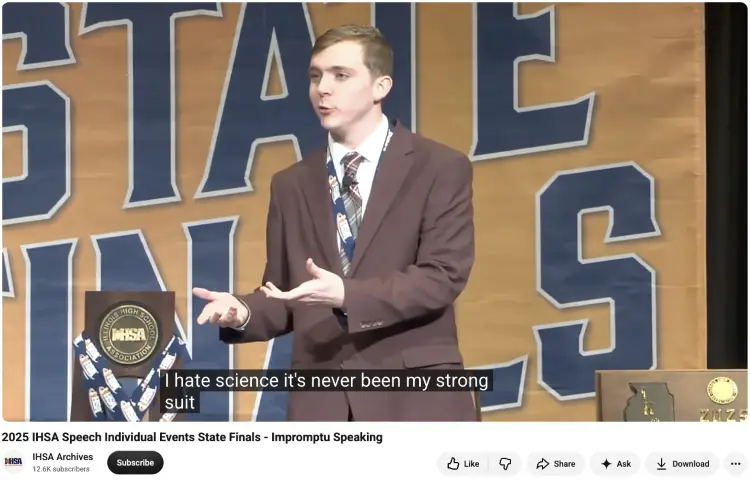
Want to see how a winning student speaker handles an unexpected prompt? Watch Parker Johnson’s performance at the Illinois High School Association (IHSA) Speech State Finals.
What you can learn from his performance:
- Open with a story: Johnson introduces teenage inventor Jack Andraka to connect with his central theme.
- Organize three examples: He discusses Chris Gardner, toilet paper inventor Joseph Gayetty, and Sears to support his argument.
- Use humor: His jokes keep the audience engaged.
- Finish with a takeaway: He returns to Dolly Parton’s quote about paving a new path.
Try this exercise: Pick a quote, such as “Actions speak louder than words.” Give yourself two minutes to prepare a speech with an opening story, three supporting examples, and a closing takeaway. You can borrow Johnson’s structure while using your own stories and evidence.
4. Impromptu speaking examples for workplace meetings

When your manager asks for an answer on the spot, organize your response around a recommendation, a reason, and a practical next step.
Example: Your manager asks how to improve client retention at a downtown marketing agency.
- Recommendation: “I’d introduce monthly performance reviews for each client.”
- Reason: “We could identify campaign problems earlier and keep clients updated on progress.”
- Example: “We could trial this with three clients over the next month and collect their feedback.”
- Next step: “Let’s review the results after 30 days before rolling it out to the whole agency.”
Practice prompt: Your team has missed two project deadlines. Your manager asks what should change. Take 20 seconds to prepare a response with one proposed solution and a way to measure progress.
5. Impromptu speaking examples for job interviews
Unexpected interview questions and impromptu speaking questions can throw you off, so keep your answer focused on a specific situation, the action you took, and what changed as a result.
Example: A hiring manager asks, “What’s a professional weakness you’re working on?”
- Challenge: “I’ve been working on presenting ideas more confidently to senior stakeholders.”
- Action: “I started volunteering to lead project updates during team meetings.”
- Progress: “I also asked colleagues for feedback on my delivery.”
- Result: “I’m now more comfortable explaining recommendations and responding to follow-up questions.”
Practice prompt: You’re interviewing for a customer success role at Canva. The interviewer asks what you’d do if a major client threatened to cancel. Take 20 seconds to outline your impromptu speech example and show how you’d identify the problem, propose a solution, and follow up.
6. Impromptu speaking examples for networking events
A good networking introduction helps people understand what you do and gives them a reason to continue the conversation. Keep it specific enough to be memorable.
Example: Someone at a Sydney entrepreneurs’ meetup asks, “What do you do?”
- Who you help: “I coach mid-career professionals who want to move into leadership roles.”
- What you do: “I help them improve their communication, prepare for interviews, and plan their next career move.”
- The outcome: “My goal is to help them pursue leadership opportunities with more confidence.”
- Keep the conversation going: “What kind of work are you involved in?”
Practice prompt: Let’s say you’re attending a business conference and someone asks what makes your coaching different. Prepare a 30-second answer explaining who you help, what problem you solve, and the outcome you work toward.
7. Impromptu speaking examples for podcast interviews
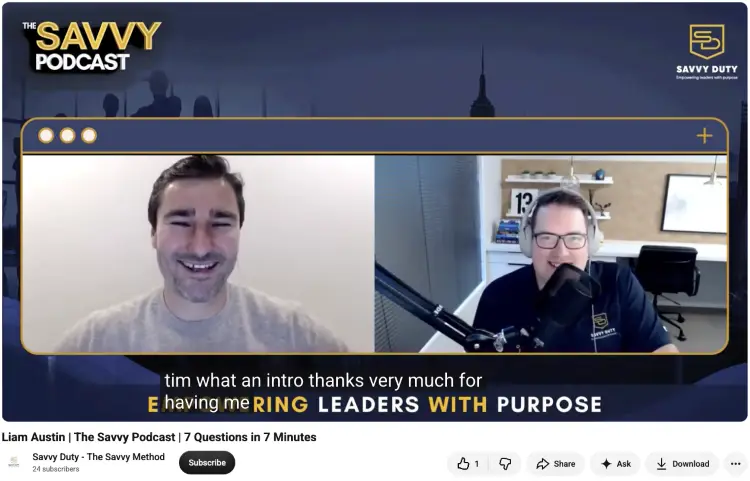
Podcast guestings and public speaking opportunities like interviews are a great way to practice thinking on your feet. You might know your business inside out, but explaining your ideas clearly while answering unexpected questions takes practice.
In my Savvy Podcast interview, I answer rapid-fire questions about my ideal clients, virtual events, common marketing mistakes, and advice for entrepreneurs. Pay attention to how I use specific examples and practical recommendations to make each answer useful to the podcast emcee.
What you can learn from the interview:
- Answer directly: At 1:41, I explain who I help and what they’re looking to achieve.
- Use concrete examples: Around 3:26, I compare workshops with larger virtual summits to explain different options for business owners.
- Give actionable advice: At 6:14, I recommend podcast and video interviews as a way to get comfortable speaking on camera.
- Finish with a clear takeaway: At 7:44, I encourage entrepreneurs to build their own platform.
Practice prompt: Imagine a podcast host asks, “What’s the biggest mistake new coaches make when trying to attract clients?”
Take 20 seconds to prepare, then answer in 60 seconds using a clear point, a specific example, and practical advice.
8. Impromptu speaking examples for social events and special occasions
Getting asked to give a wedding toast without warning can catch anyone off guard. A good speech gives people a glimpse of your relationship with the person being celebrated, with one memorable story and a sincere finish.
Watch this complete best man speech example on YouTube. Cillian combines personal memories, humor, and a tribute to the groom, Kieran, before finishing with a toast.
What you can learn:
- Start with a personal detail: Give the audience a quick sense of your relationship with the groom.
- Tell one memorable story: Choose an anecdote that reveals something about his character and gives guests a reason to laugh or connect.
- Wrap it up: Say something genuine about the couple, then invite everyone to raise a glass.
Talks Tip: If your best friend gives you half a minute of warning, choose one funny memory, one quality you admire, and one wish for the couple. Stretch those three points into a 60-second speech.
9. Impromptu speech introduction examples
Your opening sets the tone before you’ve had time to second-guess yourself. Start with a clear opinion, a surprising detail, or a short story that gives people a reason to listen.
Try these impromptu speech introductions:
- Clear opinion: “I think we can cut onboarding time in half by moving the paperwork to before day one.”
- Bold claim: “Every high school student should learn how credit cards work before they graduate.”
- Honest confession: “My first year as a coach taught me something I wish I’d known earlier: being good at your work doesn’t automatically mean you know how to find clients.”
- Direct promise: “I help yoga teachers turn a packed Saturday class into a full-time income.”
- Playful tease: “I’ve known Jack since university, and I’ve seen him make some questionable decisions. Choosing Sophie was easily his best one.”
Talks Tip: Open any book to a random page, point at a noun, and craft an opening line about it in 10 seconds. Make your main point clear inside the first two sentences.
10. Impromptu speaking examples for unexpected questions
Curveballs can leave you scrambling for the perfect answer. Give yourself a beat to work out what the person really wants to know, then respond with a clear point and a relevant example.
Try these responses:
- Stalling for time: “That’s a good question. Let me consider the best way to answer it.” Take a breath and settle on your main point before continuing.
- Admitting a gap: “I haven’t dealt with that directly, but I’d start by looking at [factor] and then assess [next step].” Explain your reasoning without making up facts.
- Handling pushback: “I can see why you’d look at it that way. My view is [your position], mainly because [reason].” Back it up with a concrete example.
- Fielding a client’s hard question: “I’d want to understand [detail] before recommending a solution. Based on what you’ve shared so far, I’d start with [initial step].”
- Owning a failure: “One mistake I made was [situation]. I responded by [action], and it taught me [lesson].”
Talks Tip: Fill in the brackets of each response above with your own details, recording yourself as you go. Play it back and check whether you answered directly, backed up your point, and stopped when you were finished.
How to Write an Impromptu Speech
The clock might give you 30 seconds or two minutes. Either way, these steps get your thoughts in order before you start speaking.
- Pick one message: Decide on the single idea you want people to remember, such as why health coaches should offer group programs.
- Grab a frame: Match the question to a structure from the examples above: PREP for opinions, STAR for experience questions, and past, present, future for updates.
- Borrow a story: A health coach who kept twelve clients exercising for months through weekly check-ins proves your message better than any statistic.
- Hand off the mic: End with a practical recommendation or a question that keeps the conversation going.
How to Improve Impromptu Speaking
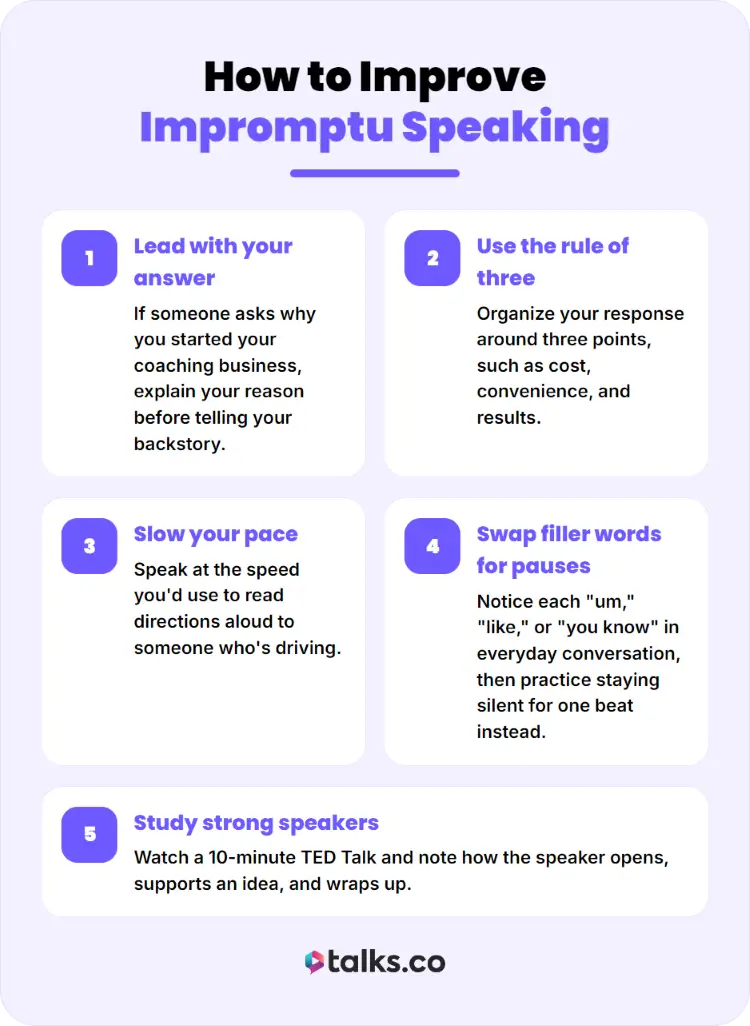
The fastest way to improve is to get comfortable speaking before you feel completely ready. Work on structuring your answers, using concrete examples, and getting your point across without rambling.
- Lead with your answer: If someone asks why you started your coaching business, explain your reason before telling your backstory.
- Use the rule of three: Organize your response around three points, such as cost, convenience, and results.
- Slow your pace: Speak at the speed you’d use to read directions aloud to someone who’s driving.
- Swap filler words for pauses: Notice each “um,” “like,” or “you know” in everyday conversation, then practice staying silent for one beat instead.
- Study strong speakers: Watch a 10-minute TED Talk and note how the speaker opens, supports an idea, and wraps up.
How to Practice Impromptu Speaking
Treat impromptu speaking like a skill you can train. Set aside 10 minutes a day to answer unfamiliar questions and review what you can improve.
- Try the one-minute challenge: Choose an impromptu speaking topic such as remote work or morning routines and speak about it for 60 seconds without stopping.
- Build a question bank: Write 20 prompts about coaching, business, leadership, and personal experiences in your Notes app.
- Practice with a speaking partner: Ask a friend to quiz you over coffee, giving you 15 seconds to prepare each answer.
- Answer the headline: Pick a news headline each morning and give a 45-second take on it.
- Repeat difficult prompts: Revisit questions you struggled with after a few days and compare your answers to track your progress and make sure you find a new way to learn about the gaps you don’t know yet.
Your Next Big Opportunity Won’t Wait for a Script
The right impromptu speaking examples can help you think faster, answer sharper, and handle the unexpected without freezing. Put them to work, and you’ll be ready when someone hands you the mic.
Want more chances to put those skills to work? Create your free Talks creator profile and connect with podcast hosts looking for guests like you.
Talks matches you with relevant shows and helps you start conversations, so you can spend less time hunting for opportunities and more time sharing your expertise.
Your next interview could introduce you to your next client.
Get your free profile set up today.


