

The host turns to you and says the infamous last words, “Any thoughts?”
40 faces. One united silence. Your brain just clocked out in 30 seconds without your knowledge.
I’ve watched sharp guys, the ones running six-figure programs, go blank on a podcast because the host tossed one curveball. We practice impromptu speaking for the pitch every day for weeks to stay ready, then they freeze on a simple follow-up question.
Painful to watch. Much, much worse to live through.
Great speakers have a few simple techniques for thinking on their feet, and you can learn every one of them. The impromptu speech examples below, from classroom moments to famous stages, come with the structure behind each.
Practice any of these examples of impromptu methods for public speaking over your morning coffee, and you’ll be better prepared to handle the unexpected, hold a host’s attention, and give people a reason to invite you back with an undeniable and repeatable formula for storytelling without preparation.
What Is Impromptu Speech?

An impromptu speech is a talk you deliver with little or no time to prepare. Someone asks a question, hands you the mic, or invites you to share an opinion, and you’re expected to make your point on the spot.
Let’s say a Talks podcast host asks for your take on a recent industry hot topic. You can’t script every answer, but you can learn to organize your thoughts quickly and speak confidently.
What is an impromptu speech for?
An impromptu speech helps you communicate clearly when you can’t plan every word in advance. It’s useful for:
- Thinking on your feet: Answer unexpected questions in meetings or interviews.
- Building confidence: Get comfortable speaking without a script.
- Making connections: Share your expertise during networking events or podcast conversations.
- Handling everyday moments: Give a quick toast, offer a team update, or respond to a question from the audience.
Who uses an impromptu speech?
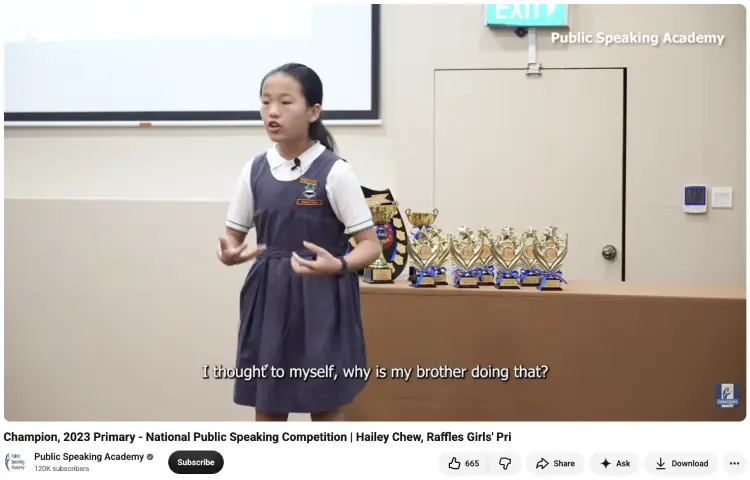
Anyone who gets put on the spot for a public speaking opportunity, from a high schooler in Sydney to a CEO fielding a surprise investor question can use an impromptu speech.
- Students: Classroom drills and debate rounds, like a 60-second talk on a favorite season.
- Coaches and consultants: Live Q&A on an Entrepreneurs HQ virtual summit, where one sharp answer can win a client.
- Authors: Launch night questions at a bookstore in Edinburgh.
- Emcees: Filling an unexpected gap between speakers, handling a last-minute schedule change, or keeping the audience engaged when a segment runs late.
- Leaders: Toasts, town halls, and the dreaded “say a few words” at the team offsite.
Difference between an impromptu speech vs extemporaneous speech
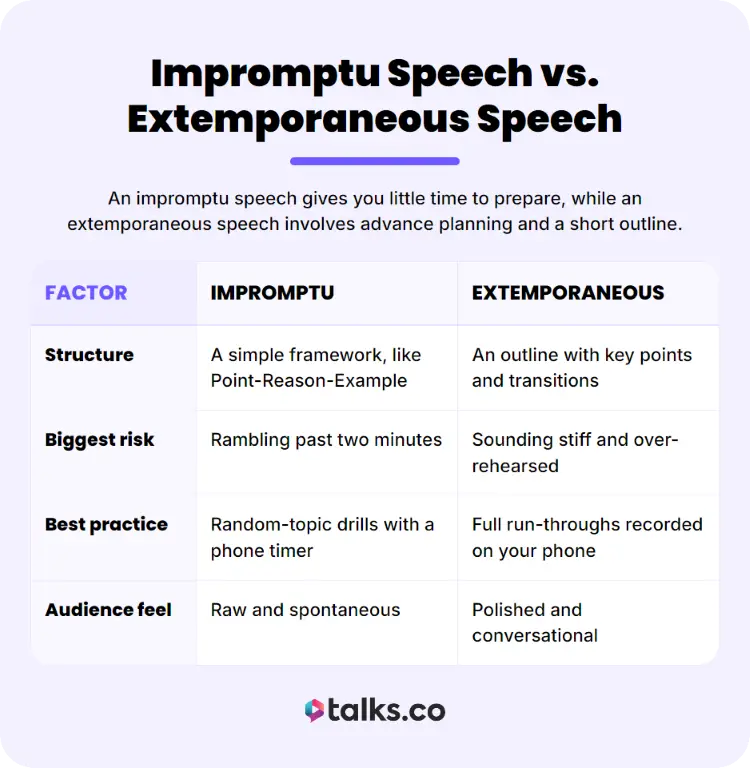
An impromptu speech gives you little time to prepare, while an extemporaneous speech involves advance planning and a short outline. Here’s how they differ in practice.
| Factor | Impromptu | Extemporaneous |
|---|---|---|
| Structure | A simple framework, like Point-Reason-Example | An outline with key points and transitions |
| Biggest risk | Rambling past two minutes | Sounding stiff and over-rehearsed |
| Best practice | Random-topic drills with a phone timer | Full run-throughs recorded on your phone |
| Audience feel | Raw and spontaneous | Polished and conversational |
Top Impromptu Speech Examples You Can Copy
The best way to improve your impromptu speaking is to study how other speakers handle the pressure, shape an argument, and keep an audience listening.
These impromptu speech examples include student exercises, personal stories, everyday situations, and real competition performances you can study and borrow techniques from.
Impromptu speech examples for students
Classroom speaking exercises help students practice organizing ideas quickly, supporting opinions, and speaking clearly under pressure. Try these prompts, then study how student speakers build their arguments in real competitions.
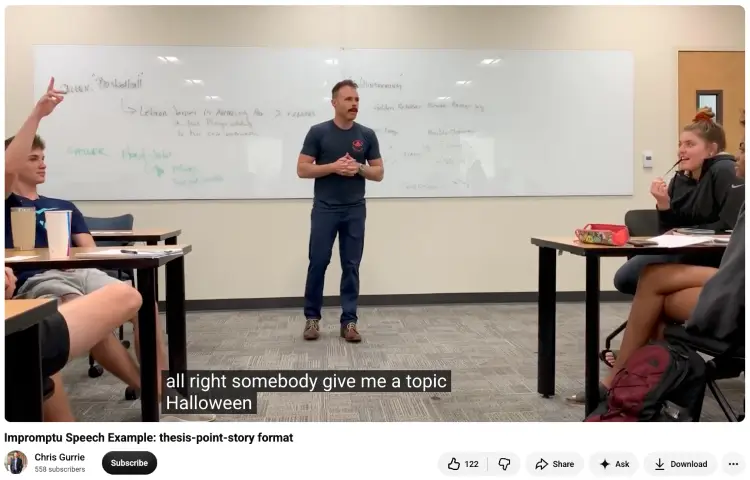
- Halloween costumes: Argue whether costume expectations differ for men and women, using Chris Gurrie’s Halloween speech as a model for humor, cultural observations, and a clear central argument.
- Technology in education: Should students use AI for homework? Give your opinion, support it with a classroom example, and finish with a practical recommendation.
- Overcoming fear: Watch Hiruni Niwunhella’s award-winning impromptu speech, which recounts her fear of jumping into water during an outdoor training program before connecting the experience to personal courage.
- School uniforms: Argue for or against uniforms using one personal observation, one supporting reason, and a memorable closing statement.
Impromptu speech examples about life
Personal experiences give impromptu speeches emotional weight because listeners can picture the moment and understand why it matters.
Use these impromptu speaking examples to practice turning everyday experiences into meaningful points.
- Facing your fears: Hiruni Niwunhella describes confronting a 25-foot jump into water despite being unable to swim, then connects the story to willingness and courage. Notice how the personal experience supports her final message.
- Dealing with rejection: Describe a time a job application, business proposal, or creative project failed, then explain what you changed afterward. Keep the focus on one lesson.
- Technology and daily life: Argue whether smartphones improve our lives, using a specific example such as checking notifications during dinner or relying on Google Maps to reach an unfamiliar venue.
- Handling criticism: Use a hypothetical example of a coach receiving blunt feedback from a client, then explain how separating useful feedback from personal reactions can improve their work.
Impromptu speech examples situation
Unexpected speaking moments often happen at work, during interviews, or at social events. These examples show how to adapt your response to the stakes, the audience, and the time available.
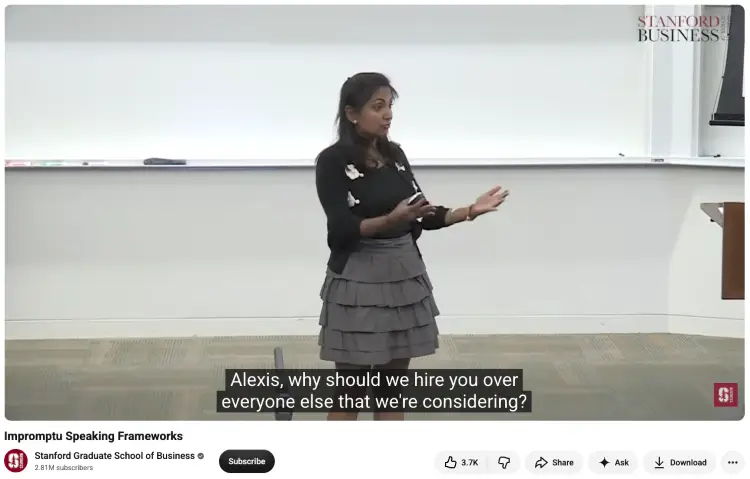
- Job interview: In Stanford Graduate School of Business’s impromptu speaking demonstration, the students demonstrate the STAR framework: Situation, Task, Action, and Result. Use it to answer impromptu speaking questions such as “Tell me about a time you handled a tight deadline.”
- Business meeting: If your manager asks why customer renewals have dropped, use PREP: state your recommendation, explain why, give a specific example, and restate your point.
- Wedding toast: Share a short story about how the couple met, explain what it reveals about their relationship, and finish with a wish for their future together.
- Podcast guest appearance: If a host asks a coach why clients struggle to follow through, offer one clear explanation, illustrate it with a client scenario, and give listeners of the popular podcast one practical step to try.
Impromptu speech introduction examples
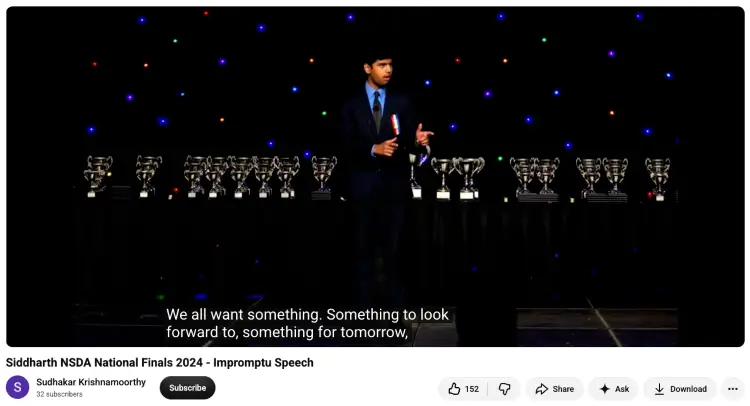
Your opening gives listeners their first clue about where you’re taking the speech. Try these approaches to capture attention and establish your point within the first few sentences.
- Start with a question: “How many hours did you spend on your phone yesterday?” Use this opening for a speech about technology habits.
- Open with a story: In Chris Gurrie’s Halloween speech, he begins with the familiar excitement surrounding Halloween before introducing his argument about costume expectations.
- Use a surprising observation: “A five-minute conversation can change the direction of a career.” Follow with an example of an unexpected professional connection.
- Challenge an assumption: “Being busy doesn’t automatically make you productive.” Explain the difference with a specific example, such as a consultant spending hours on email instead of preparing for a client session.
Extempore speech examples
Extempore speeches are delivered with little preparation, so speakers need to organize their thoughts quickly and support their points with relevant examples.
Use these sample prompts to practice giving a clear, structured response on the spot.
- Technology and society: “Are we becoming too dependent on technology?” State your position, give an example from daily life, and explain what people should do differently.
- Education: “Should college be free?” Give your opinion, explain your reasoning, and support it with a practical example.
- Leadership: “What makes someone a good leader?” Name one essential quality, describe a leader who demonstrates it, and explain its impact on a team.
- Current issues: “Should companies allow employees to work remotely?” Present your view, consider productivity and collaboration, and finish with a recommendation.
- Personal values: “Is failure necessary for success?” Share a relevant experience or hypothetical scenario, explain the lesson, and end with a clear takeaway.
How to Impromptu Speech Examples With Simple Speaking Frameworks
When you’re handed an unfamiliar impromptu speaking topic, a simple structure can help you turn scattered thoughts into a speech with a clear beginning, middle, and end.
Borrow one of these approaches and practice it with a 60-second timer.
1. PREP for opinions
Topic: “Should companies offer a four-day workweek?”
- (P)oint: Yes, where practical.
- (R)eason: Longer recovery time may help employees manage their workload.
- (E)xample: A small consulting firm tests four-day weeks and tracks project completion.
- (P)oint: Keep the arrangement if results support it.
2. STAR for experience-based questions
Topic: “Tell me about a difficult project.”
- (S)ituation: A client moves a project deadline forward by one week.
- (T)ask: Explain your responsibility for delivering the work on time.
- (A)ction: Describe how you reprioritized tasks and coordinated with teammates.
- (R)esult: Share the outcome, including what you learned from the experience.
3. Story, lesson, close for personal topics
Topic: “What does courage mean?”
- Story: Describe a moment when you spoke up despite feeling nervous.
- Lesson: Explain what the experience taught you about courage.
- Close: End your speech with a takeaway the audience can apply to their own lives.
4. Point, reasons, conclusion for debates
Topic: “Should schools limit phone use?”
- Point: Schools should restrict phone use during lessons.
- Reason 1: Notifications can distract students from classroom discussions.
- Reason 2: Phone-free lessons encourage more face-to-face participation.
- Conclusion: Recommend a clear classroom phone policy with exceptions for learning activities and emergencies.
How to Give an Impromptu Speech (Checklist)
You can give a clear impromptu speech in under two minutes of preparation with a simple framework. Use this checklist the next time someone puts you on the spot.
1. Gather your thoughts
☐ Pause and breathe: Take a breath before answering so you have a moment to think.
☐ Identify your main point: Decide what you want the audience to remember.
☐Choose one example: Pick a personal experience, observation, or familiar scenario that supports your point.
2. Organize your speech with PREP
☐ Point: State your answer or main argument clearly.
☐ Reason: Explain why you hold that position.
☐ Example: Give a specific example that makes your reasoning easier to understand.
☐ Point: Restate your main message in a way that reinforces your answer.
3. Deliver your speech
☐ Start with your answer: Give listeners a clear idea of your position from the beginning.
☐ Speak conversationally: Use familiar language and explain your ideas as if talking to one person.
☐ Stay focused: Follow your main point instead of introducing unrelated ideas.
☐ Make eye contact: Look at different people in the room instead of focusing on your notes or the floor.
4. Close your train of thought
☐ Reinforce your message: Return to your main point or recommendation.
☐ Finish cleanly: End with a clear takeaway, a practical suggestion, or a memorable final sentence.
5. Practice for speed
☐ Pick a random prompt: Use a question about work, school, relationships, or everyday life.
☐ Set a 60-second timer: Organize your thoughts, then deliver a one-minute response using PREP.
☐ Review your delivery: Check if your point was clear, your example was relevant, and your conclusion felt complete.
How to write an impromptu speech
Need a quick way to organize an impromptu speech? Use this 6-step process to turn a question into a clear response you can deliver naturally.
- Define your message: Summarize your answer in one sentence.
- Gather three keywords: Use them as prompts for your main ideas.
- Add supporting evidence: Include a personal story, specific example, or relevant fact.
- Prepare your opening: Lead with your answer, a brief anecdote, or a thought-provoking question.
- Finish with purpose: End with a practical lesson or recommendation.
- Speak from your notes: Use keywords as reminders and practice explaining each point in your own words.
When It Pays to Think Fast
Every time you practice impromptu speech examples, you’re training for the moments that count in a podcast interview: answering unexpected questions, sharing useful stories, and making your expertise memorable.
Now imagine putting those skills in front of thousands of potential listeners.
Create your free Talks Creator Profile to connect with podcast hosts in your niche and find shows looking for guests.
Stop keeping your best ideas in practice mode. Get your profile up and start turning conversations into visibility, connections, and potential clients.
Yes! Sign Me Up For Talks NOW!


