

Does your brain currently have 47 brilliant ideas running while you’re in the shower? Does your mouth forget every single one the second someone hands you a microphone?
Public speaking has a nasty habit of making smart people feel like they’ve got nothing to say.
Coaches sit on years of hard-won wisdom. Authors have entire books worth of ideas. Entrepreneurs have stories that could change how someone runs their business.
Then comes the dreaded question: “So, what are you going to talk about?”
Cue the mental tumbleweed.
The right public speaking idea gives your expertise a voice, your story a purpose, and your audience a reason to remember you.
From punchy speech topics to demonstration ideas that’ll get people leaning forward, these 78 public speaking ideas will help you find something worth saying, then say it well.
What Are Public Speaking Ideas?
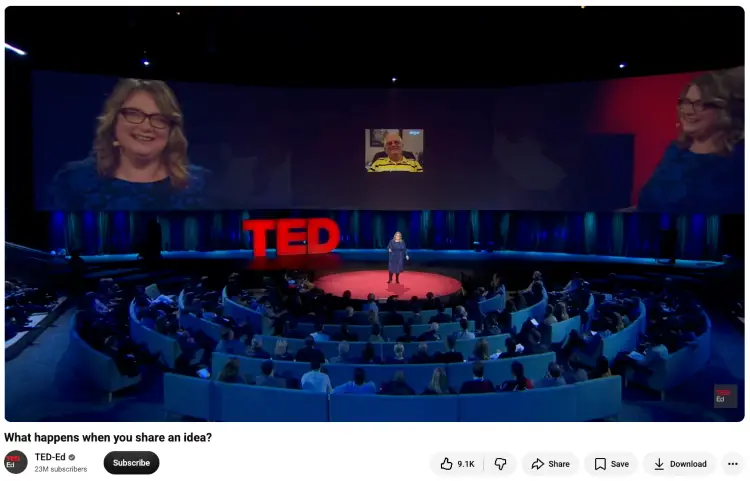
Public speaking ideas are topics and ideas, demonstrations, stories, and presentation formats you can choose to build a speech around.
If you’re a coach, author, consultant, or entrepreneur, your own expertise and experience can give you plenty to work with.
- Speech topics: A fitness coach explains how she helps busy parents stick to a 12-week strength program.
- Demonstrations: A nutrition coach shows office workers how to prepare five high-protein lunches in under an hour.
- Personal stories: An author shares how a failed book launch changed his approach to promoting his next book.
- Presentation formats: A business consultant reviews a Shopify store to show entrepreneurs how to improve their checkout process.
- Audience engagement: A career coach asks attendees to rewrite their LinkedIn headlines in 60 seconds.
You can also find inspiration in movies about public speaking, especially stories that show how people develop confidence, handle nerves, or learn to communicate under pressure.
Examples of Good Public Speaking Ideas
The best public speaking ideas give you something specific to say and your audience a reason to listen. Use these examples to find an info speech topic, build a presentation around a useful concept, or choose an idea that fits your experience and interests.
Public speaking speech ideas to build confidence and critical thinking
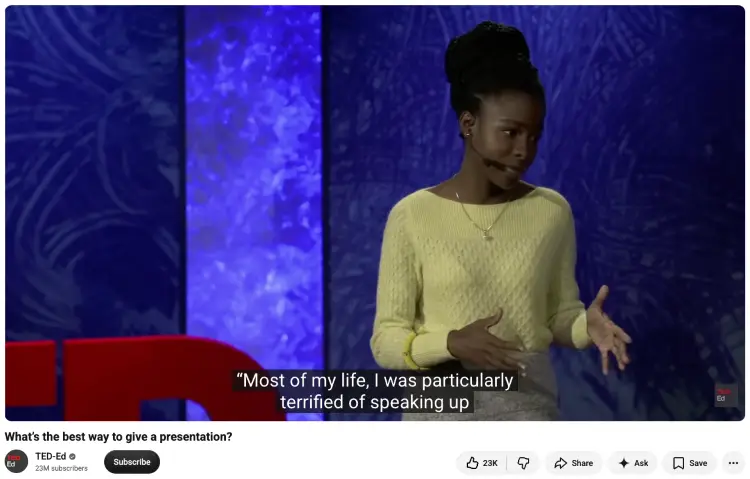
Need a subject you can build a full speech around? Start with public speaking topics that raise a question, emotional topics that challenge an assumption, or give your audience clarity and a useful takeaway regardless of the structure.
- Persuasive speech: Should global companies offer a four-day workweek?
- Informative speech: How does sleep affect decision-making?
- Motivational speech: How to recover from a professional setback.
- Personal speech: The mistake that taught you your most valuable lesson.
- Social issue speech: Should financial literacy be taught in high school?
- Technology speech: How artificial intelligence is changing the way we work.
- Environmental speech: What cities can do to reduce food waste.
- Business speech: Why small businesses should build an email list.
- Health and wellness speech: How daily habits influence long-term well-being.
- Future-focused speech: What will education look like in 20 years?
Talks Tip: Narrow broad subjects into specific questions. “Technology” gives you too much ground to cover, while “Should students be allowed to use AI for homework?” gives your speech a clear direction.
Public speaking concepts to engage students and fellow learners
A strong speech concept gives your presentation a central idea people can understand and remember. Use one of these approaches to develop a fresh angle, even if you’re speaking about a familiar subject.
For inspiration, look at how experienced speakers develop and present a central message in these public speaking TED Talks.
- The myth-busting concept: Challenge a widely held belief, such as the idea that multitasking improves productivity.
- The before-and-after concept: Show how a person, company, or community changed after adopting a new approach.
- The problem-and-solution concept: Identify a specific challenge and present practical ways to address it.
- The unexpected connection concept: Link two seemingly unrelated subjects, such as storytelling and data analysis.
- The lessons-learned concept: Share what a failed project can teach people about leadership or decision-making.
- The case-study concept: Examine a real business, public figure, or community initiative to explain what worked and what didn’t.
- The future-scenario concept: Explore how a current trend could affect everyday life in the years ahead.
- The audience-challenge concept: Give listeners a question or small task that encourages them to rethink a familiar habit.
Talks Tip: Choose a concept that helps you make one clear point naturally. You can use a myth-busting approach for a persuasive speech, an ethical case study for a business presentation, or a future scenario for a university technology talk for different age groups to develop your critical thinking and improve your personal experience.
Public speaking ideas for students
School students can make a strong and meaningful impression with topics and themes connected to school, friendships, technology, or life beyond the classroom.
These essential public speaking topics for students work well for class presentations, speech assignments, and student speaking competitions.
- School life: How to manage schoolwork without burning out.
- Technology: Should schools limit smartphone use during class?
- Relationships: What makes a good friend?
- Mental health: How social media affects self-esteem.
- Financial literacy: Why money management matters before graduation.
- Peer pressure: How to make independent decisions when friends disagree.
- Student rights: Should students have a say in school policies?
- Language learning: The benefits of learning a second language.
- Artificial intelligence: How AI tools are changing education and how children learn.
- Personal growth: What failure can teach you about success.
Public speaking topic ideas for students to choose from and prepare
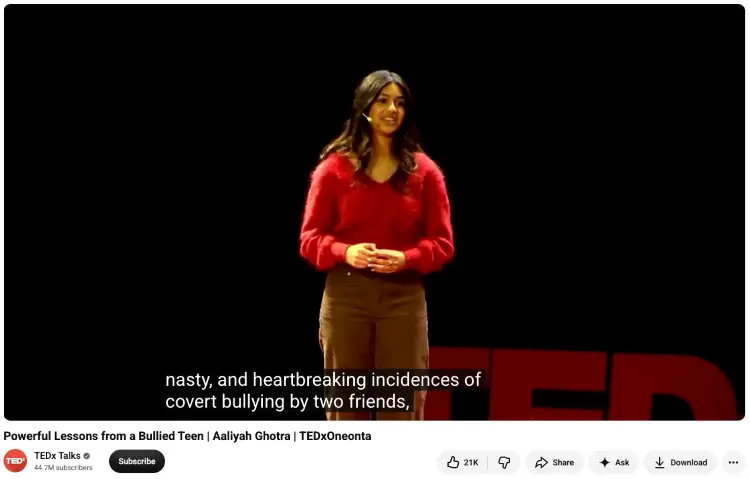
Need more focused topics for your next assignment? These prompts give your students a clear angle to research, discuss, or defend, making it easier to build confidence and your speech with supporting evidence.
- Persuasive: Should community service be required for graduation?
- Informative: How does the human brain form new habits?
- Argumentative: Are grades an accurate measure of intelligence?
- Social issues: How can schools reduce cyberbullying?
- Science: Could lab-grown meat change the food industry?
- History: What can we learn from a major historical protest?
- Environment: Should schools ban single-use plastic?
- Career development: Should internships be part of every college degree?
- Media literacy: How can students, learners, and young minds spot misinformation online?
- Ethics: Who should be responsible when AI produces false information?
Talks Tip: Check the assignment requirements before settling on a topic. An ideal persuasive speech needs a position to defend, while an informative speech needs a subject you can communicate clearly with credible sources.
Public speaking demonstration speech ideas for all age groups
A demonstration speech teaches an audience how to do something through a clear, step-by-step process until the conclusion. Pick a skill you can show live or demonstrate with simple materials, then explain each step as you go.
- Food preparation: How to make a balanced breakfast in 10 minutes.
- Study skills: How to create and organize a revision schedule for exam week.
- Digital skills: How to build a simple budget spreadsheet that shows progress to motivate yourself.
- Creative skills: How to sketch a face using basic shapes.
- Practical skills: How to sew a button back onto a shirt.
- Organization: How to pack a suitcase efficiently.
- Communication: How to deliver a confident self-introduction when you’re shy.
- Personal finance: How to compare prices and calculate discounts.
- Sustainability: How to turn an old T-shirt into a reusable tote bag.
- Everyday safety: How to assemble a basic emergency kit.
Talks Tip: Choose a demonstration you can complete within your time limit. Bring your materials, practice each step in advance to make sure your topics work, and make sure people at the back of the room can see the creativity you’re doing.
Public speaking title ideas
A good speech title gives people a reason to pay attention before you say your first word. Keep it specific, create a little curiosity, and make sure it reflects the message you’re delivering.
- Persuasive speech: Should Your Phone Have a Bedtime?
- Personal development: The Cost of Saying Yes to Everything
- Business: Why Your Best Customers Might Be Your Oldest Ones
- Technology: Who’s Really in Control of Your AI?
- Education: Are We Teaching Students to Think or Memorize?
- Mental health: The Pressure to Have It All Figured Out
- Leadership: What Great Leaders Do When They’re Wrong
- Environment: The Hidden Cost of Throwaway Culture
- Personal finance: Your First Paycheck: What Nobody Tells You
- Motivational: Starting Before You Feel Ready
Talks Tip: Write your main message first, then create a title that captures its central question or tension. A clever title might earn attention, but the speech itself needs to deliver on the promise.
Public speaking presentation formats
The format you choose affects how your audience receives your message. A research-heavy topic may suit a formal presentation, while a practical lesson might work better as a live demonstration or interactive session.
- Keynote speech: Deliver a central message to a large audience at a conference or event.
- PechaKucha: Present ideas through 20 slides shown for 20 seconds each.
- Lightning talk: Explain one focused idea in a short presentation, often five to ten minutes.
- Panel discussion: Share expertise alongside other speakers and respond to different viewpoints.
- Fireside chat: Have a conversational interview with a host in front of an audience.
- Workshop: Teach a skill through guided activities and hands-on practice.
- TED-style talk: Build a concise, story-driven presentation around one central idea.
- Pitch presentation: Persuade an audience to support a persuasive speech topic, proposal, product, or business idea.
- Poster presentation: Explain research or findings using a visual display and direct discussion.
- PechaKucha-style storytelling: Use timed visuals and concise narration to tell a story without lengthy explanations.
Talks Tip: Match the format to your goal, available time, and audience size. Check the event guidelines, too, since some formats have specific rules for slide counts, timing, or speaker participation.
Public speaking audience engagement techniques to create interest
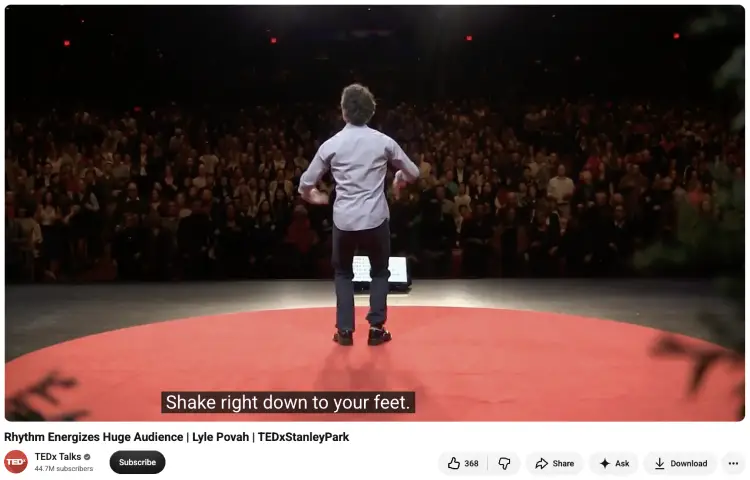
An engaged audience has a reason to keep listening and opportunities to participate. Use these techniques to encourage attention and interaction without forcing people to speak when they’d rather listen.
- Live polls: Ask attendees to vote on a question using a show of hands or a polling tool.
- Audience predictions: Ask listeners to guess the outcome of a scenario before revealing what happened.
- Paired discussions: Give people 60 seconds to exchange thoughts with someone nearby.
- Quick quizzes: Test the audience’s understanding with a short multiple-choice question.
- Show of hands: Ask a low-pressure question about the audience’s experience with your topic.
- Real-time feedback: Invite attendees to submit questions through a chat or digital question board.
- Choose-your-own-scenario: Let the audience select which case study or example you’ll discuss next.
- Audience storytelling: Ask for a volunteer to share a brief experience relevant to your subject.
- Visual comparisons: Show two examples and ask the audience to identify which one works better.
- A closing challenge: Give attendees a small task they can complete after the talk to apply what they’ve learned.
Talks Tip: Choose participation methods that suit the room. A group of 12 people might enjoy a short discussion, while a conference audience of 500 may respond better to live polls or show-of-hands questions.
How to Give a Good Public Speech (Checklist)
A good public speech takes preparation before you reach the microphone and follow-through after you leave the stage.
Use this checklist to plan your content, deliver it confidently and make the most of the public speaking opportunity to become a content creator.
Before the speech: Research and preparation
☐ Research your audience: Ask the event organizer about attendee roles, experience levels, and their biggest questions.
☐ Choose your main message: Write one sentence describing what listeners should remember.
☐ Build your outline: Arrange your opening, three key points, supporting examples, and closing.
☐ Prepare your materials: Check your slides, microphone requirements, and any demonstration props.
☐ Rehearse aloud: Record a full run-through, check the timing, and cut sections that drag.
During the speech: Delivery and audience connection
☐ Start strong: Open with a specific story, surprising result, or question your audience cares about.
☐ Watch your pace: Pause after important points and slow down when explaining complex ideas.
☐ Make eye contact: Finish a thought with one person before shifting your gaze.
☐ Invite participation: Ask attendees to share an example or answer a focused question.
☐ Close with direction: Give listeners one practical action to take after the talk.
After the speech: Follow-up and improvement
☐ Share promised resources: Email your slides, checklist, or recommended reading within 24 hours.
☐ Request feedback: Ask an attendee what was useful and where they lost interest.
☐ Review your recording: Note one strength and one improvement for your next talk.
☐ Continue the conversation: Connect with interested attendees or event organizers on LinkedIn.
10 Quick tips for public speaking
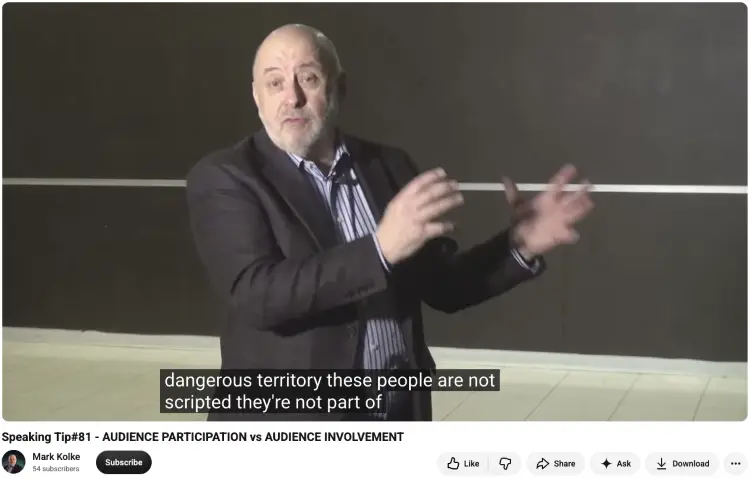
Use these ten practical actions to sharpen your preparation and delivery and become a public speaker.
- Time yourself: Practice with your phone’s stopwatch.
- Memorize your opening: Rehearse your first two sentences.
- Simplify your slides: Give each slide one main message.
- Prepare for nerves: Take three slow breaths before speaking.
- Use purposeful gestures: Keep movements natural and deliberate.
- Vary your voice: Change your pace to emphasize key points.
- Explain jargon: Replace unfamiliar terms with plain-English examples.
- Keep water nearby: Place a glass within easy reach.
- Prepare for questions: Write down three likely audience questions.
- Leave a time buffer: Aim to finish a little before your allotted time ends.
Do and don’ts of public speaking and speech topics
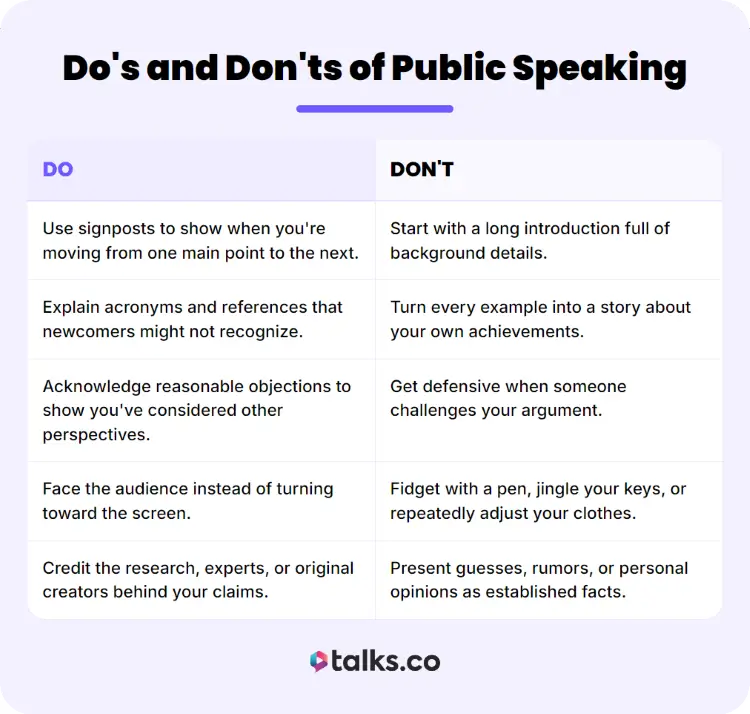
Your habits before, during, and after a speech can affect how well your message comes across. Use these five do’s and don’ts as a final check.
| Do | Don’t |
|---|---|
| Use signposts to show when you’re moving from one main point to the next. | Start with a long introduction full of background details. |
| Explain acronyms and references that newcomers might not recognize. | Turn every example into a story about your own achievements. |
| Acknowledge reasonable objections to show you’ve considered other perspectives. | Get defensive when someone challenges your argument. |
| Face the audience instead of turning toward the screen. | Fidget with a pen, jingle your keys, or repeatedly adjust your clothes. |
| Credit the research, experts, or original creators behind your claims. | Present guesses, rumors, or personal opinions as established facts. |
Your Ideas Belong Out There
From persuasive speeches and student topics to live demonstrations and audience engagement, you’ve got plenty of public speaking ideas and interesting topics to debate on.
Pick public speaking ideas that fit your impromptu communication skills and expertise, build a talk around it, and start sharing what you know.
The right public speaking ideas can open doors, but people need to hear you first.
If you’re ready to share your expertise, Talks helps you connect with podcast hosts in your niche, get matched with relevant shows, and book interviews without spending hours hunting for opportunities.
Your next interview could put you in front of future clients, partners, or event organizers. Someone in your field is already getting those opportunities. Why not you?
Create your free Talks profile and start connecting with podcast hosts in just 5 minutes.


