

How do you make people trust your expertise before you’ve even finished the opening line of your speech?
Public speaking body language can help you appear confident, credible, and engaging through deliberate hand movements, posture, the way you maintain eye contact, facial expressions, and non-verbal movement. I learned playing professional soccer that people use body language to read you long before they hear your instructions.
The same principle applies when you’re presenting a keynote, pitching your coaching program, or appearing as a podcast guest. You can have brilliant ideas and still lose people with restless hands or a gaze fixed on the floor.
So, how do you make use of the power of body language in your physical delivery to build rapport and match the value of your message?
Let’s look at practical cues and body language techniques, real TED Talk examples, common mistakes when you use hand gestures, and non-verbal communication exercises you can use for mastering body language before you speak in public.
What Is Public Speaking Body Language?
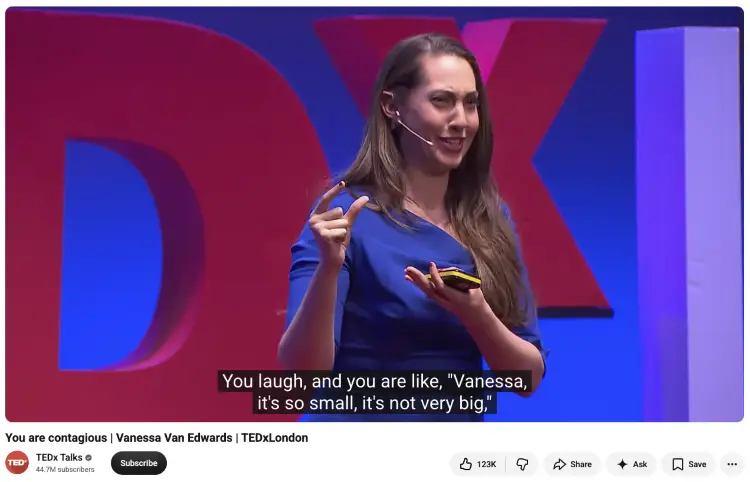
Public speaking body language is the set of physical signals you send while you talk: your posture, hand gestures, facial expressions, eye contact, and movement.
Your audience reads those signals right alongside your words, and people tend to trust whatever they can see.
So what do your hands do when you explain something complicated? Does your face light up at the best part of your story? Those small details decide how your message lands.
Importance of body language in public speaking
Your audience picks up physical cues before they consciously think about them. The way you move, look at people, and show emotion shapes how they receive your message.
- Builds trust: You nod and keep your eyes on a client while they ask a tough question in the Q&A, and the whole room sees you’re listening.
- Makes ideas easier to grasp: You count off three steps on your fingers while explaining a new client onboarding process, giving the audience a visual guide to follow.
- Makes emotion feel genuine: You share how your first online business helped fund a trip to Bali, and your smile reaches your eyes as you describe it.
- Keeps the audience involved: You gesture toward a slide showing a 30% increase in customer retention, then look back at the room to connect the figure to your point.
- Can weaken your message: You encourage an audience to embrace new opportunities while gripping the lectern and barely looking up, and your delivery contradicts your advice.
Key Elements of Effective Body Language
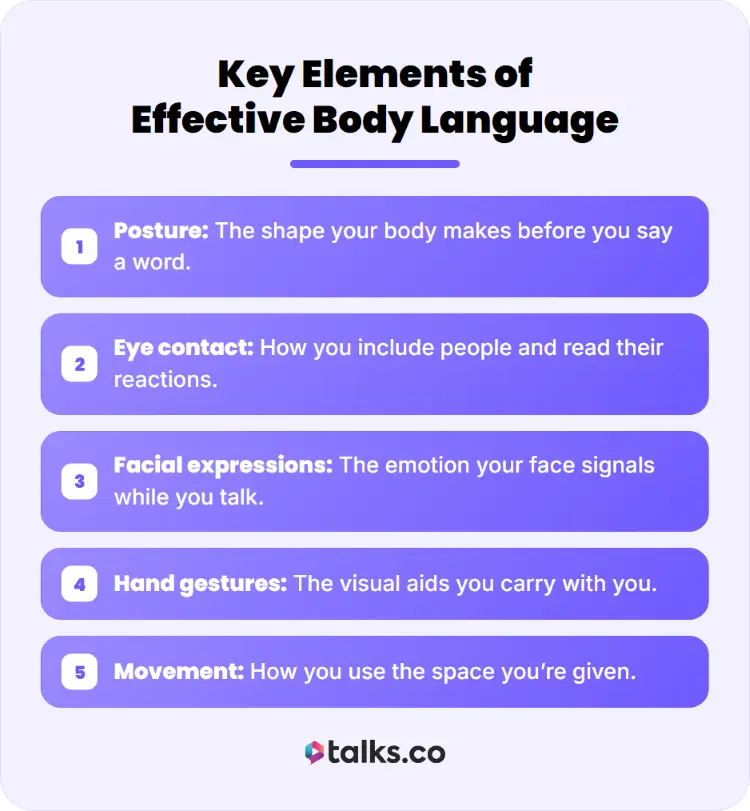
Your audience starts forming an impression before you finish your opening sentence. These five elements do most of the work.
- Posture: The shape your body makes before you say a word.
- Eye contact: How you include people and read their reactions.
- Facial expressions: The emotion your face signals while you talk.
- Hand gestures: The visual aids you carry with you.
- Movement: How you use the space you’re given.
These five elements do most of the work, and they’re the fastest way to become a better public speaker.
Good body language for public speaking
Let’s pretend you’re presenting at a leadership conference in Chicago. You plant your feet, look toward the audience, and let your expression change as you explain a difficult client situation.
These small adjustments help people focus on your message instead of getting distracted by nervous habits.
- Keep your stance steady: Avoid rocking from side to side while explaining your main point.
- Share your eye contact: Finish a thought while looking at one person, then shift naturally to another section of the room.
- Match your face to your words: Show genuine concern when discussing a customer problem and warmth when sharing the solution.
- Check your voice, too: Speak loudly enough for people at the back to hear without shouting at those in front.
Public speaking gestures and body language

Gestures help audiences follow your ideas when your movements reinforce what you’re saying.
In her TEDx talk You Are Contagious, Vanessa Van Edwards describes how her team found that the most-viewed TED speakers in their sample used more hand gestures on average than the least-viewed speakers. That finding shows an association, not proof that using more gestures guarantees a better response.
- Keep your hands visible: Avoid hiding them behind your back or beneath a lectern throughout your presentation.
- Count key points: Hold up three fingers as you introduce the three steps in your employee onboarding process.
- Show comparisons: Use one hand to represent your current sales figures and the other to represent your target.
- Give important ideas room: Let your hands settle after a key statistic instead of fidgeting through the audience’s reaction.
- Practice on video: Record a short presentation and check if your gestures support your words or distract from them.
Public Speaking Body Language Tips and Examples
Small changes to your stance and your gaze change how your audience experiences your presentation. Use these tips to look more engaged and keep people focused on your ideas.
Want more beyond body language? Browse our full list of public speaking tips.
Good posture and stance for public speaking
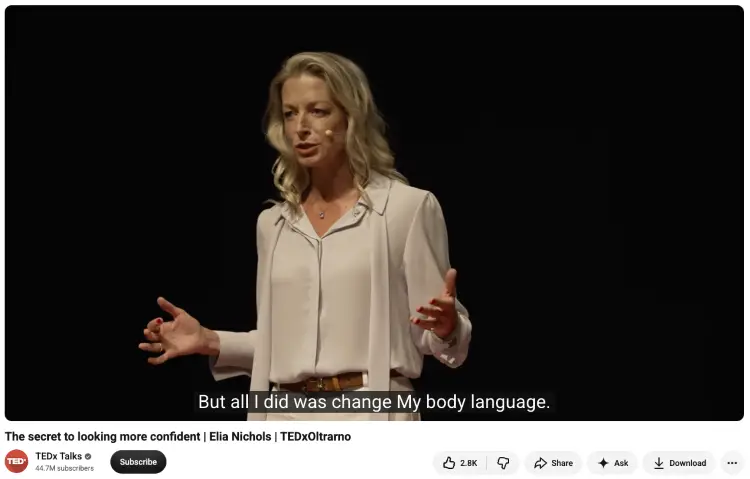
Stand with your feet about hip-width apart, shoulders open, and torso upright. In her TEDx talk, acting coach Elia Nichols calls this the “leader stance,” which combines physical openness, stillness, and steady eye contact.
- Balance your weight: Keep it evenly distributed so you stay planted instead of swaying.
- Open your shoulders: Let your chest stay wide and relaxed.
- Find your base posture: Let your arms rest naturally at your sides between gestures.
- Leave the podium alone: Stand a comfortable distance away so you can move freely.
A steady stance is also the foundation of how to be a confident speaker in public.
Eye contact tips for public speaking
Eye contact helps your audience feel included and lets you gauge their reactions. Keep your gaze direct and steady, with slow, intentional shifts from person to person.
- Finish a thought: Look toward one audience member long enough to complete an idea, then shift to another section.
- Cover the room: Include people at the back and sides, not only the front row.
- Look up from your notes: Practice key sections until you can deliver them while facing the audience.
- Watch audience reactions: Notice who’s leaning in, taking notes, or drifting, and adjust your delivery.
Facial expressions and vocal delivery tips
Your face and voice tell the audience how you feel about what you’re saying. Match both to your message, and pay attention to volume, pace, and tone.
- Let your face carry the stakes: Furrow your brow as you describe the problem, then let it relax when you reveal the fix.
- Vary your vocal delivery: Slow down for an important point and raise your energy when you share an exciting result.
- Speak at the right volume: Make sure people at the back can hear you without straining.
This matters even more on a video podcast guest appearance, where the camera catches every expression.
Hand gestures and placement for public speaking
Gestures help audiences follow your ideas when your hands reinforce what you’re saying. Rest them at waist height where people can see them, then let them work.
For more movements that read well, see these positive body gestures.
- Show comparisons: Use one hand for your current sales figures and the other for your target.
- Present options: Turn your palms upward when you offer ideas or choices.
- Illustrate a point: Use your hands to show size, direction, or how something works.
- Emphasize key statements: Use a deliberate chopping motion to reinforce a strong point.
- Give important ideas room: Let your hands settle after a key statistic and give the audience a beat to react.
Effective body language in public speaking
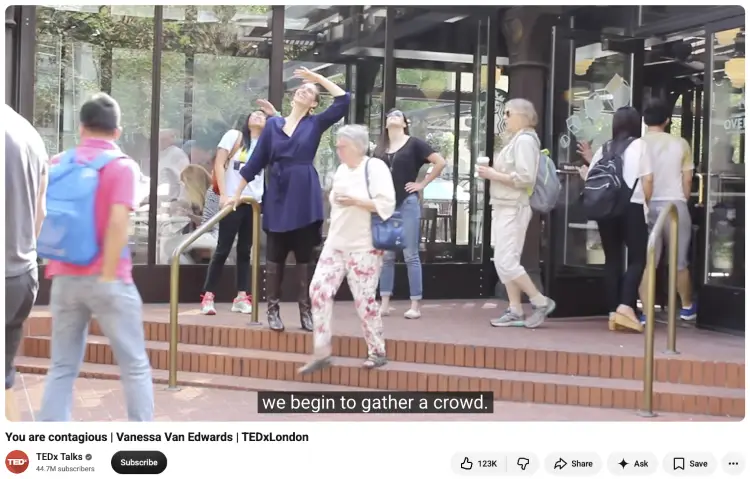
Effective body language helps your audience follow your message and read your intentions. Use these habits to look engaged and make your delivery easier to follow.
- Stand tall: Keep your shoulders open and your weight balanced over both feet.
- Make eye contact: Hold your gaze long enough to finish a thought before looking elsewhere.
- Keep your hands visible: Use natural gestures to explain ideas and emphasize key points.
- Match your expression to your message: Let your face reflect the emotion or seriousness of the subject.
- Move with purpose: Use the stage to mark transitions instead of pacing without a reason.
TED Talk public speaking body language
TED speakers offer useful examples of how posture, gestures, and movement support a presentation.
In Vanessa Van Edwards’ analysis of TED talks, the most-viewed speakers in her team’s sample averaged 465 hand gestures in 18 minutes, compared with 272 among the least-viewed speakers. That’s a correlation within one sample, not proof that more gestures guarantee more views.
When you watch a TED Talk, pay attention to how the speaker:
- Uses gestures: Notice how their hands make an abstract point easier to picture, then compare what each move signals with these hand gesture meanings.
- Reads the room: Watch what they do in the second after a joke lands or a big claim sinks in.
- Opens the talk: Look at what their body does in the first ten seconds, before the first idea arrives.
- Sticks the ending: Notice whether they hold still on the final line or drift away from it.
Public speaking body language exercises
Rehearse your body the same way you rehearse your words, so you catch distracting habits before your next public speaking opportunity.
- Record a practice talk: Review your posture, expressions, and hands, and listen for rushed words, flat delivery, or a voice that’s too soft. It’s the same habit every content creator builds by reviewing their own footage.
- Freeze the frame: Pause your recording at five random spots and check what your hands, shoulders, and face are doing in each one.
- Sticky-note audience: Put notes in four corners of the room and deliver one idea to each.
- Gesture swap: Deliver the same 30 seconds twice, once with no gestures and once with huge ones, then settle on the middle.
- Pause practice: Count silently to two after your strongest line before you speak again.
Movement and use of space onstage
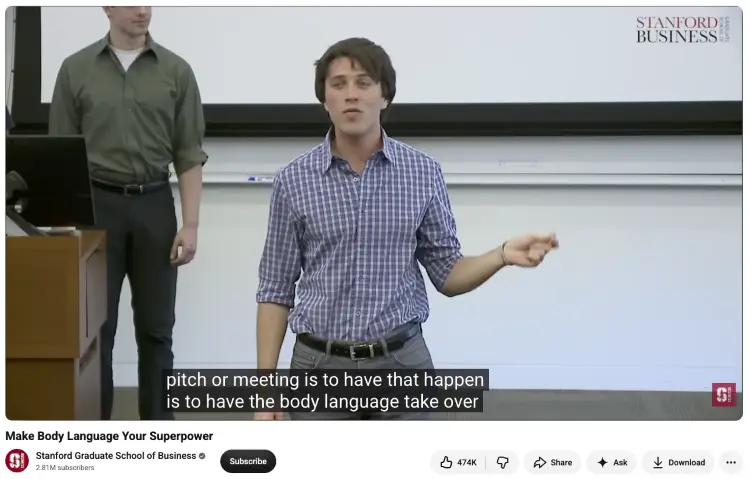
Whether you’re a keynote speaker or an emcee, move with purpose so your audience can follow you without getting distracted.
In Stanford Graduate School of Business’s Make Body Language Your Superpower, presenters recommend facing the audience and choosing a position that keeps attention on the speaker.
- Start in a clear position: Stand where people can see you, away from distracting corners or busy windows.
- Move to mark a transition: Walk to another part of the stage when you shift to a new story, example, or section.
- Face the audience: Turn back toward people after you reference a slide.
10 Public Speaking Body Language Mistakes
Your delivery can distract from a strong message if nervous habits take over. Watch for these 10 common mistakes before your next presentation.
- Avoiding eye contact: Looking at your slides or the floor instead of connecting with the audience.
- Slouching: Hunching your shoulders or letting your head drop while speaking.
- Fidgeting: Playing with your clothes, hair, or microphone during key points.
- Pacing aimlessly: Walking back and forth without a clear reason.
- Crossing your arms: Keeping a closed posture throughout the presentation.
- Hiding your hands: Tucking them behind your back or below the podium.
- Using mismatched expressions: Smiling while discussing a serious problem or keeping a tense face during a lighthearted story.
- Pointing aggressively: Jabbing a finger toward audience members to make a point.
- Standing rigidly: Locking your knees and freezing your posture from nerves.
- Speaking too softly: Making it difficult for people at the back to hear you.
Do and don’ts of public speaking body language
Small adjustments can make your delivery easier to follow and more engaging to watch. Use this quick comparison to spot habits worth changing before you step onstage.
| Do | Don’t |
|---|---|
| Look at different sections of the audience. | Stare at your slides or the floor. |
| Stand tall with balanced weight. | Slouch or rock from foot to foot. |
| Use gestures to emphasize key points. | Wave your hands constantly. |
| Move to mark a transition. | Pace without a clear purpose. |
| Let your expression match your message. | Keep a fixed, tense expression. |
| Keep your hands visible. | Hide them behind the podium. |
| Speak at a volume suited to the room. | Mumble or shout throughout. |
| Pause and let key points register. | Rush to fill every silence. |
Walk Your Talk
Your public speaking body language helps audiences read your energy, follow your ideas, and connect with your message.
Practice your posture, eye contact, facial expressions, and gestures until they support the story you want people to remember. Then take your speaking skills to new audiences.
Talks connects experts with relevant podcast hosts, opening up opportunities to share their ideas, build visibility, and attract potential clients.
Ready to put your expertise in front of more people?
Create your free Talks profile and start connecting with podcast hosts in your niche.


