

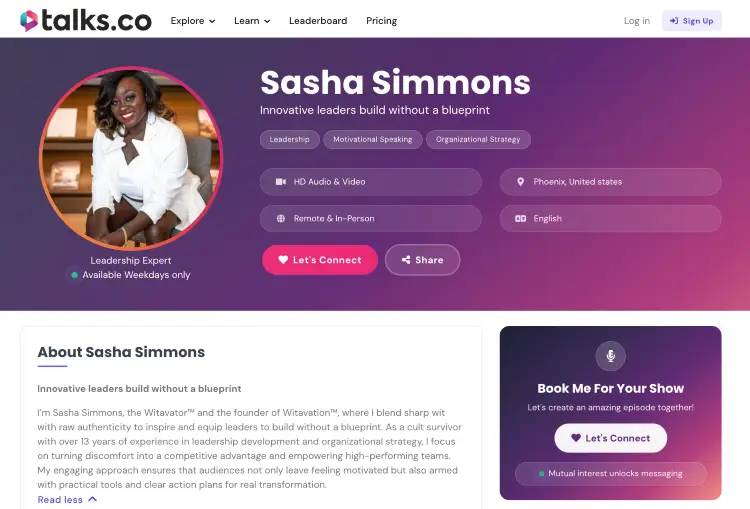
Sasha Simmons survived a cult. Now she speaks to leaders about turning discomfort into a competitive advantage.
Pretty wild career pivot, right?
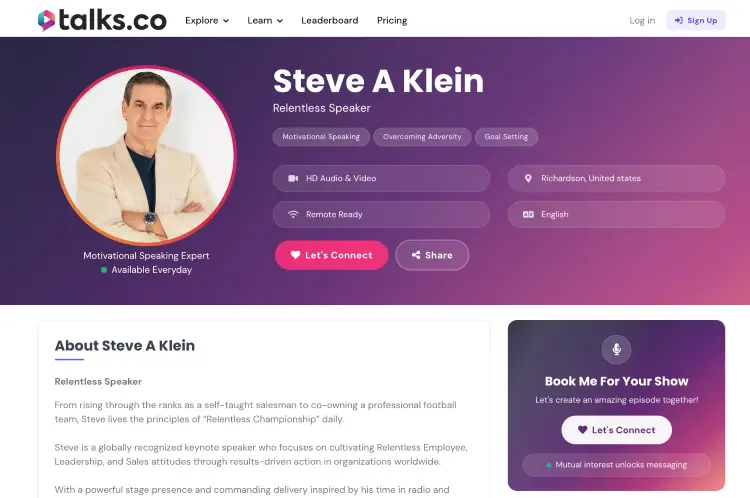
Steve A. Klein’s story takes a different route. He got fired from a radio station, found his feet in sales, became one of the top salespeople in the country, and eventually built a career as a keynote speaker.
And if the dream podcast guesting opportunity comes knocking, you might already have the raw speech material sitting in your own life.
Maybe a setback you came back from? Or a skill you’ve spent years mastering? Could it be a problem you’ve learned to solve that other people are still struggling with?
Whatever your thing is, how to become a motivational speaker is by turning that experience into a successful speaker message worth hearing, then getting yourself in front of the right motivational speaking rooms.
And this is how every successful motivational speaker does exactly that.
What Is a Motivational Speaker?
As a motivational speaker, you use your experience, expertise, and stories in helping people or an audience think differently and take action.
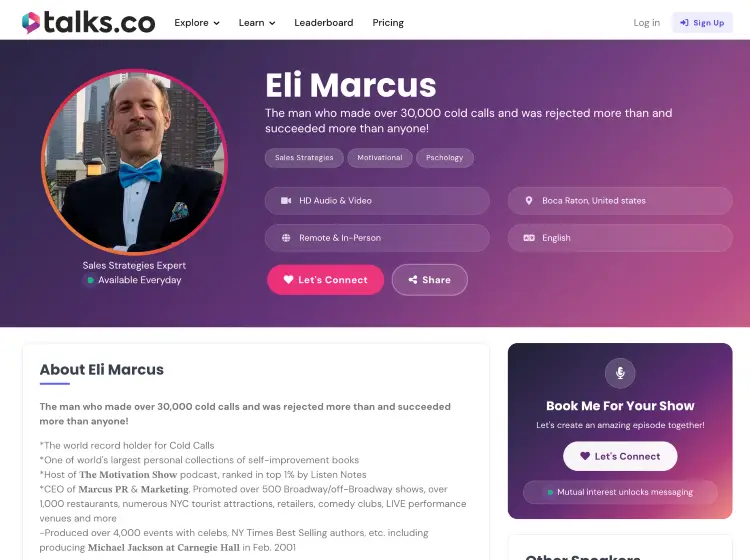
Eli Marcus, for example, has built his speaking around sales, motivation, and lessons from making 30,000+ cold calls.
You might speak for free at a company leadership retreat in Chicago, a university orientation gig in Sydney, or a sales conference gig in Las Vegas, with your talk built around a specific challenge, lesson, or transformation.
What does a motivational speaker do?
Your job as a motivational speaker is to turn what you’ve lived, learned, or overcome into a message people can use. The format changes with the audience, but your work could involve:
- Telling your story: Share a personal experience, career setback, or major breakthrough that gives your audience a useful perspective.
- Teaching practical strategies: Show a sales team how you handle rejection, or help university students build confidence before entering the workforce.
- Creating action: Give people a specific exercise, challenge, or next step they can use after your talk.
- Adapting your message: Shape a 45-minute keynote for a corporate retreat differently from a workshop for teenagers at a youth leadership program.
How To Be A Motivational Speaker
Scared to answer your true motivational speaker calling? Start by picking a message you know well, get comfortable delivering it, and start putting yourself in rooms where people can hear it.
The fastest way to build momentum is to get speaking reps wherever you can.
Free workshops, podcast interviews, local events, and small group sessions can give you the footage, feedback, and confidence you need before you start pitching bigger stages.
How to become a motivational speaker with no experience
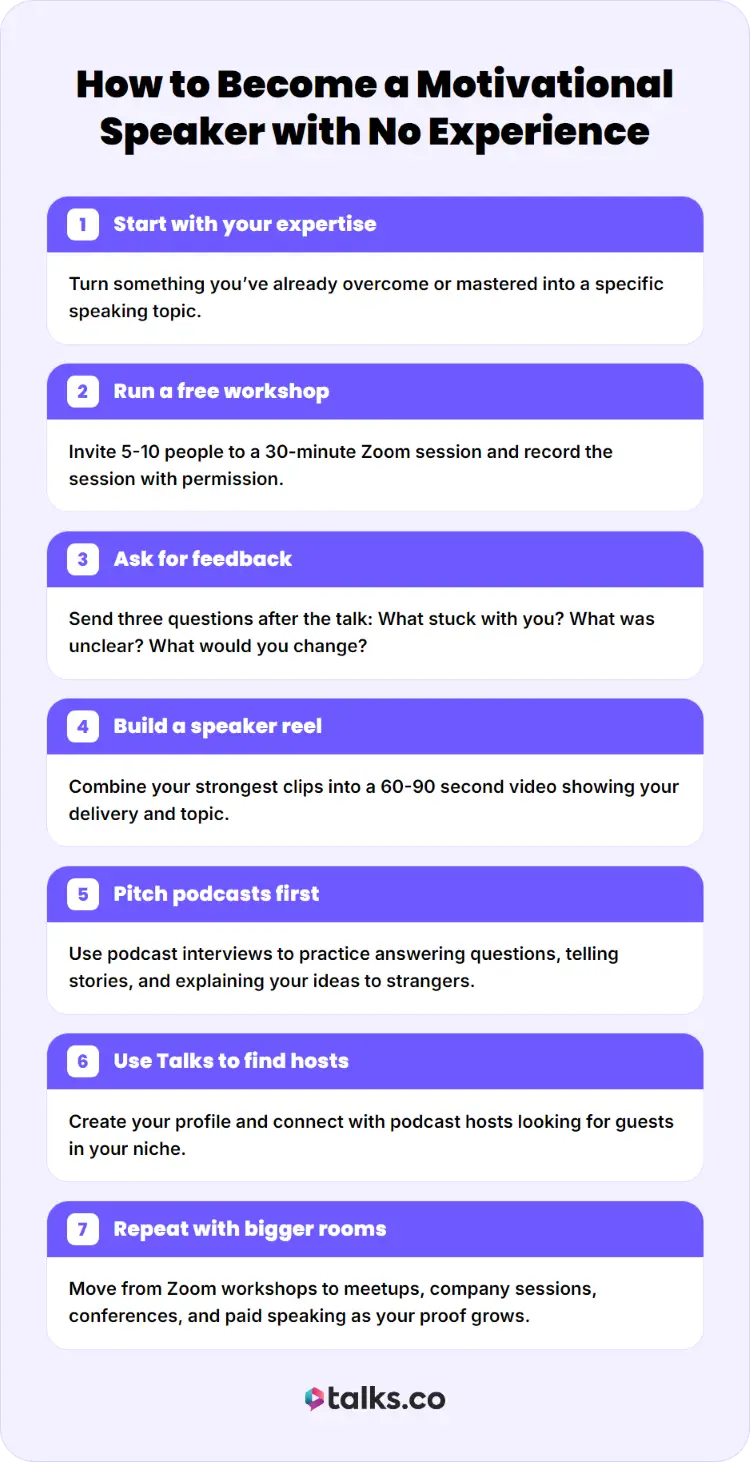
You can create experience before anyone gives you a big stage. Treat every small opportunity as a chance to build speaking reps, footage, feedback, and proof you can use for your next pitch.
- Start with your expertise: Turn something you’ve already overcome or mastered into a specific speaking topic.
- Run a free workshop: Invite 5-10 people to a 30-minute Zoom session and record the session with permission.
- Ask for feedback: Send three questions after the talk: What stuck with you? What was unclear? What would you change?
- Build a speaker reel: Combine your strongest clips into a 60-90 second video showing your delivery and topic.
- Pitch podcasts first: Use podcast interviews to practice answering questions, telling stories, and explaining your ideas to strangers.
- Use Talks to find hosts: Create your profile and connect with podcast hosts looking for guests in your niche.
- Repeat with bigger rooms: Move from Zoom workshops to meetups, company sessions, conferences, and paid speaking as your proof grows.
How to be a motivational speaker for free
You can start building your speaking career with things you already have: your phone, your experience, and access to people who need your message.
Use these steps to get your first reps in without spending any of your hard-earned money.
- Record one 5-minute talk: Pick one lesson you’ve learned the hard way and record it on your phone.
- Post short clips: Turn the strongest 30-60 seconds into LinkedIn, Instagram, or TikTok posts.
- Speak locally: Offer a free 10-minute talk to a coworking space, community group, school, or networking event.
- Practice on camera: Rewatch your recording and note where you ramble, rush, or lose your point.
- Create a Talks profile: Add your topic, audience, and short video so podcast hosts on Talks can find you for speaking opportunities.
- Collect proof: Save audience comments, testimonials, recordings, and event photos from every free speaking opportunity.
How to be a motivational speaker for beginners
Your first goal is to become someone who can consistently deliver one useful talk. Start small, repeat the same core message, and improve it after every audience.
- Choose one audience: Start with something specific, like first-time managers, burned-out salespeople, or university graduates.
- Pick one problem: Build your talk around confidence after rejection, recovering from failure, or staying motivated during career changes.
- Write three stories: Choose personal experiences that prove the lessons you want to teach.
- Build a 10-minute talk: Open with the problem, tell one story, teach three practical ideas, and finish with one action.
- Practice weekly: Deliver the talk to your phone, a friend, a coworker, or a small group.
- Find your first audiences: Use local events, podcasts, LinkedIn, and Talks to start getting in front of real people.
How To Become A Good Motivational Speaker
Being a good motivational speaker comes from getting better at turning your experience into something an audience can actually use.
Study speakers who already connect with the people you want to reach, borrow what works, and keep testing your own material in front of real audiences.
How to become a good motivational speaker for women
Start by getting specific about the women you want to help and the problems they’re dealing with. Look at speakers like Alyson Longe, Jessica Smith, and Jordan Hirsch for ideas you can borrow and make your own.
- Pick your audience: Choose women founders, sales leaders, young professionals, coaches, or another group you understand.
- Choose a real problem: Build your talk around confidence, leadership, public speaking, career growth, or another challenge your audience knows firsthand.
- Study Alyson’s positioning: Notice how she connects public speaking with authority and income instead of treating speaking as a standalone skill.
- Borrow Jordan’s honesty: Talk openly about nerves, self-doubt, and the pressure to perform if those experiences are part of your story.
- Use your own turning points: Jessica Smith draws from going from teen mom to corporate executive to create stories women can relate to.
- Give them something to use: Finish with an exercise, question, script, or action they can take before they leave the room.
How to become a motivational speaker for youth groups
Speaking to young people means meeting them where they are.
Malina Walia talks about leadership, confidence, entrepreneurship, and skills young people aren’t taught in school, while Mark Papadas uses humor and storytelling to make topics like confidence and self-doubt easier for kids to connect with.
- Talk about their world: Use examples around school pressure, friendships, social media, confidence, first jobs, and figuring out what comes next.
- Keep your stories moving: Give them a quick setup, a problem, what happened next, and one lesson they can take away.
- Get them involved: Ask questions, run quick polls, bring someone onstage, or give them a two-minute exercise.
- Study Malina’s approach: Notice how she connects her own experience starting a business at 12 with lessons young people can use now.
- Use humor carefully: Mark Papadas shows how humor can make conversations about identity, fear, and self-doubt easier to engage with.
- Build trust with adults: Create a speaker page that also gives parents, teachers, schools, and youth organizations a clear reason to book you.
How to become a good motivational speaker for men
Look for the experiences that gave you something worth teaching.
Andrew Haley speaks from his experience as a Paralympic gold medalist and two-time cancer survivor, while Creg Effs draws on 22 years of firefighting and network marketing.
- Pick a pressure point: Focus on resilience, career setbacks, leadership, confidence, discipline, personal growth, or another problem you know well.
- Tell the uncomfortable part: Share what went wrong, what it cost you, and what you had to change.
- Turn experience into advice: Give your audience a question, exercise, habit, or decision they can take away.
- Study Andrew Haley’s structure: Notice how he turns a remarkable personal story into practical lessons around resilience and performance.
- Use your working life: Your career can give you plenty of material, just as Creg Effs uses his firefighting and network marketing experience.
- Test your talk in smaller rooms: Try men’s groups, networking events, company sessions, or podcasts before pitching larger events.
How To Become A Professional Motivational Speaker
The strongest motivational speakers usually have skills that never make the obvious “public speaking skills” lists. Pay attention to what happens before, between, and after your words.
- Read the room’s energy: Notice when a sales team in Dallas gets restless after 20 minutes and switch from storytelling to audience interaction.
- Know when to shut up: Let a difficult story breathe instead of filling every pause with another lesson.
- Collect tiny observations: Keep notes on phrases, questions, objections, and reactions you hear in coaching calls, workshops, and conversations.
- Make people feel specific: Replace “you can overcome anything” with a story about rebuilding after losing a job at 47.
- Handle awkward moments: Practice staying composed when your microphone fails, a joke falls flat, or someone challenges your point from the front row.
How to become a certified motivational speaker
A certification can give you structured training, a credential for your motivational speaker website, and a defined curriculum to work through. These three programs take different approaches to help you become a public speaker:
- IAP Career College Motivational Speaker Certificate Course: A self-paced 2-6 week online course covering speechwriting, speaking and emcee skills, finding employers, rates, speaker bureaus, and starting a speaking business; currently $149.
- The Public Speaking Institute Certified Public Speaker (CPS): A 6-day Zoom program covering storytelling, speaking brand, presentation tools, audience handling, and a live 15-minute speaking showcase to prepare you for the next public speaking opportunity.
- National Institute of Coaching Professional Motivational Speaker Certification: A 9-day online program focused on stage presence, storytelling, and audience psychology, with certification from the National Federation of NLP and National Institute of Coaching.
How To Become A Motivational Speaker And Get Paid (Checklist)
You can start building paid speaking opportunities using Talks Pro to build visibility, connect with relevant podcast hosts, and turn interviews into proof for future speaking pitches.
☐ Pick your topic: Focus on one clear angle, such as sales confidence, career resilience, or leadership for first-time managers.
☐ Build your profile: Add a 60-90 second video explaining your topic, audience, and speaking outcomes.
☐ Find relevant hosts: Use premium Talks filters to target leadership, sales, entrepreneurship, or personal development podcasts.
☐ Pitch specific angles: Suggest topics like recovering from a failed product launch or rebuilding confidence after redundancy.
☐ Save your proof: Keep strong podcast clips, testimonials, audience feedback, and event photos in a speaker folder.
☐ Package your keynote: Create a 30-minute virtual keynote or 60-minute conference talk with a clear fee.
☐ Join a speakers bureaus: Research bureaus that represent motivational speakers in your niche, then send your speaker reel, keynote topics, testimonials, and fee range.
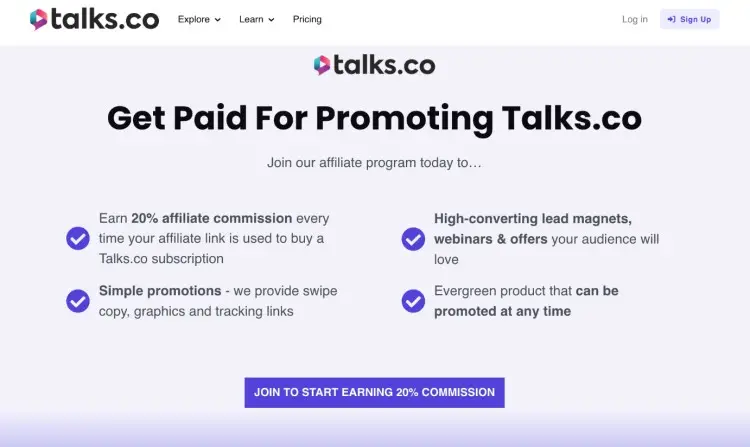
☐ Earn referral income: Join Talks’ affiliate program and earn 20% on referred monthly or yearly subscriptions using its swipe copy and tracking links.
How much do motivational speakers make?
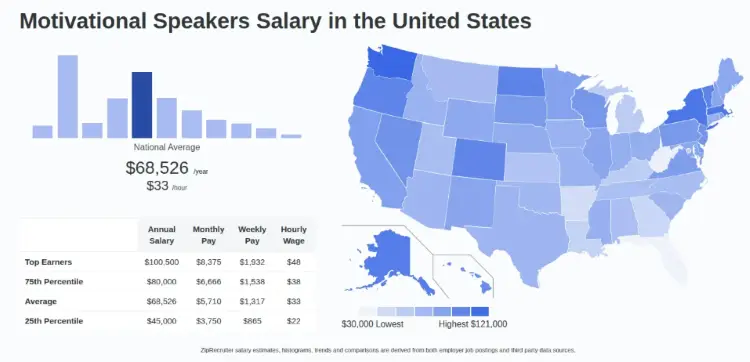
The average U.S. motivational speaker salary is $68,526 a year, or $32.95 an hour. Think of that as a rough employee-salary benchmark rather than a limit on what you can charge per speaking engagement.
- Starting benchmark: $45,000 annually.
- Average: $68,526 annually.
- Higher salary range: $80,000 annually.
- Top earners: $100,500 annually.
- Highest listed city: Santa Barbara, CA at $94,097 annually.
If you build your own speaking business, how much you make as a motivational speaker can also come from keynote fees, corporate workshops, coaching, courses, podcast guest appearances, and related offers.
It Really Does Pay to Pay It Forward
Learning how to become a motivational speaker starts with a message you know well. From there, you need speaking reps, a clear audience, proof that you can deliver, and people who can put you in front of the right listeners.
You’ve now got the steps to start building all four. Record the talk. Get in front of people. Pitch podcasts. Create your Talks profile.
Keep collecting proof until you’ve got something worth putting in front of event organizers and speakers bureaus.
Want to start getting booked on podcasts for free?
Create your Talks Creator Profile, connect with hosts in your niche, and start building the visibility and relationships that can lead to bigger speaking opportunities.
YES! Match Me with Expert Guests and Hosts Right Now!


