

You know your stuff. You’ve spent years building your expertise, helping clients, and getting results. Then someone hands you a microphone, and suddenly you’re wondering what on earth you’re going to say.
If you’ve ever felt that way, you’re in good company. And you can get past it.
When I started in sales, I watched experienced people handle calls, practiced scripts in front of a mirror, and took my turn. Some calls went well. Others taught me what to fix. Each one gave me another chance to improve.
Public speaking works the same way. You can learn ways to overcome your fear of public speaking, manage your nerves and social anxiety, prepare to speak in public without overthinking, and recover when things go sideways instead of things knocking down your confidence.
Let’s look at what actually helps to overcome fear of public speaking, so this phobia and panic stops keeping you from opportunities to share your expertise and address more people the effective way.
What Is Fear of Public Speaking?

Fear of public speaking is the anxiety you feel when speaking in front of an audience, whether you’re presenting to a room full of people, leading a webinar, or recording a podcast interview. It’s also known as glossophobia, and it can show up as a racing heart, sweaty palms, shaky hands, a dry mouth, or a mind that suddenly goes blank.
For coaches, consultants, authors, and entrepreneurs, that fear can get in the way of opportunities to share their expertise. You might know your subject inside and out, yet struggle to explain it when the spotlight turns to you.
The good news is that speaking anxiety is something you can work on. Understanding why it happens is a good place to start.
How common is fear of public speaking?
Public speaking anxiety is common, even among people who know their subject inside and out. It can affect everything from pitching a client to accepting a podcast invitation, and our public speaking fear statistics show how widespread it is.
- Physical symptoms: Sweaty palms, a racing heart, or a shaky voice before a webinar.
- Career opportunities: Turning down a conference panel because the thought of speaking feels worse than missing the opportunity.
- Everyday situations: Rehearsing a 60-second introduction for a networking event in Sydney, then forgetting it when it’s your turn.
- Professional visibility: Avoiding podcast interviews that could introduce your coaching business to new audiences.
Is it possible to overcome fear of public speaking?
Yes. You can learn to manage your nerves and become more comfortable speaking by building experience gradually and working on the thoughts and physical reactions that fuel your anxiety.
- Gradual exposure: Start by recording a two-minute video, the way any new content creator would, then progress to a live webinar.
- Deliberate practice: Rehearse a sales presentation, review the recording, and improve one thing before your next attempt.
- Real-world experience: Accept a short podcast interview before committing to a 45-minute keynote, and our guide on how to be a guest on a podcast shows where to start.
- Professional support: Consider cognitive behavioral therapy (CBT) if anxiety regularly stops you from speaking or pursuing opportunities, and see our guide to public speaking anxiety treatment for your options.
How to Overcome Fear of Public Speaking
To overcome fear of public speaking, focus on three stages: prepare before your talk, manage your nerves while speaking, and learn from the experience afterward. Use this checklist to know what to work on at each stage.
- Before: Organize your message, rehearse aloud, research your audience, and prepare for unexpected questions.
- During: Slow your breathing, focus on your message, pause when needed, and keep going if you make a mistake.
- After: Review what went well, ask for specific feedback, identify one improvement, and look for your next speaking opportunity.
How to beat fear of public speaking before the event (Prep)
Preparation gives you something concrete to focus on instead of worrying about everything that could go wrong. Work through these steps before your next presentation, webinar, or podcast interview.
- Define your main message: Write down the one idea you want your audience to remember.
- Build a simple outline: Organize your talk into an opening, two or three main points, and a clear conclusion.
- Research your audience: Review the event details or podcast description to understand what listeners care about.
- Choose relevant examples: Use a client scenario or practical experience to explain your ideas in relatable terms.
- Rehearse aloud: Practice the full presentation instead of silently reading your notes.
- Record a practice run: Watch a short recording to spot unclear explanations or sections that need work.
- Prepare for likely questions: Write down three questions your audience might ask and practice answering them.
- Create brief speaker notes: Use keywords and prompts to keep your place without reading a script word for word.
- Visualize the opening: Picture yourself starting the talk and moving into your first main point.
- Check the logistics: Test your microphone, slides, camera, and internet connection, and confirm any venue requirements ahead of time.
How to overcome anxiety of public speaking during your speech
Public speaking nerves can show up even when you’ve prepared well. While speaking, bring your attention back to your message and give yourself time to respond instead of rushing to get through the presentation.
- Breathe at a steady pace: Take gentle breaths and allow your exhale to run slightly longer if that feels comfortable.
- Plant your feet: Feel the floor beneath you to give yourself a physical point of focus.
- Start at a manageable pace: Deliver your opening sentence slowly enough to articulate each thought.
- Focus on one person at a time: In a live audience, make brief eye contact with different listeners rather than scanning the entire room.
- Pause when you need to: Give yourself a moment to think instead of filling every silence with words.
- Return to your main point: If your mind goes blank, glance at your notes and continue from the last point you remember.
- Recover from mistakes: Correct a factual error or rephrase a sentence, then carry on without apologizing repeatedly.
- Listen to the question: During Q&A, let the person finish speaking before deciding how to answer.
- Accept some nervousness: You can continue speaking even if your heart is racing or your hands feel unsteady, and that’s how you learn how to be a confident speaker in public.
- Seek support when needed: If speaking anxiety regularly interferes with work or everyday activities, consider speaking with a qualified mental health professional.
Ways to overcome fear of public speaking after your talk
Each speaking experience gives you information you can use next time to overcome the fear of public speaking and help you shake off all that nervous energy that makes you tremble.
Review what happened, make one specific adjustment, and keep looking for manageable opportunities to practice.
- Review the recording: If you recorded your talk, watch it once and note where your message was clearest.
- Identify one success: Write down a moment when you explained an idea well or handled a question effectively.
- Choose one improvement: Pick a specific skill to work on next, such as pacing, transitions, or vocal clarity, and our guide on how to be a better public speaker has more to try.
- Ask for targeted feedback: Ask a trusted colleague what worked and what one change would improve your delivery.
- Compare your progress: Look at an earlier recording or set of notes to see which public speaking skills have improved and spot areas where you can build confidence and master your stage fright.
- Practice in low-pressure settings: Join a Toastmasters meeting or volunteer to speak during a small group discussion.
- Try a different format: If you’ve practiced presentations, try a panel discussion, webinar, podcast interview, or a turn as an emcee at a local event.
- Keep a speaking log: Record the date, type of speaking activity, what went well, and what you’ll adjust.
- Set your next speaking goal: Schedule a specific public speaking opportunity to practice instead of waiting until you feel completely ready.
- Increase the challenge gradually: Once a smaller speaking task feels manageable, take on a longer presentation or a larger audience.
10 Strategies to Overcome Fear of Public Speaking
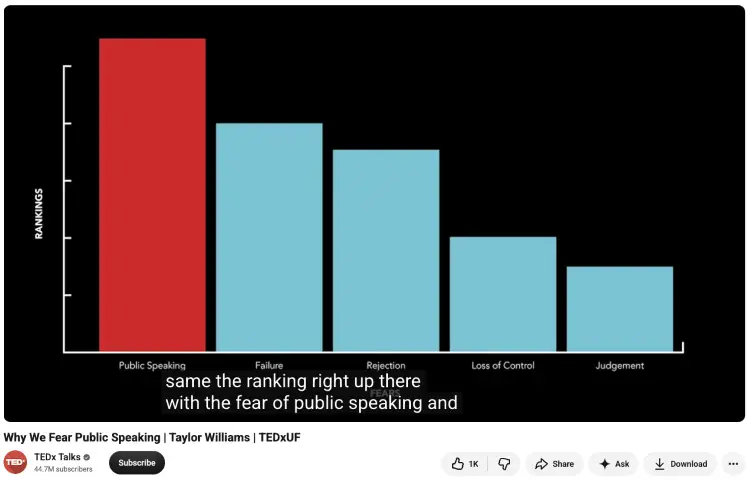
Public speaking anxiety affects an estimated 21% to 33% of people in community samples (Psychological Interventions for the Fear of Public Speaking, 2019).
These strategies help you prepare for speaking situations and reduce avoidable stress.
- Identify your triggers: Write down which situations make you most anxious, such as introducing yourself at a networking event or answering questions from senior executives.
- Learn the venue beforehand: If you’re speaking at a conference in Wales, check the room layout and stage setup before your presentation.
- Warm up your voice: Spend two minutes humming gently and reading a paragraph aloud before your talk.
- Plan your logistics early: Charge your laptop, save your slides offline, and pack your presentation remote the night before.
- Choose a personal story: Use a specific client experience to illustrate a point instead of relying entirely on abstract explanations.
- Prepare your closing: Write one sentence that summarizes your main message and gives the audience a clear next step.
- Practice with an unfamiliar listener: Ask someone outside your immediate team to listen to your presentation and explain what they understood.
- Manage your caffeine intake: If coffee makes you jittery, skip the extra espresso before your presentation.
- Arrive early: Give yourself time to settle in, use the restroom, and get comfortable before the audience arrives.
- Set a 30-day goal: Schedule three speaking opportunities this month, such as a team update, a community discussion, and a podcast interview.
10 Tips to overcome fear of public speaking
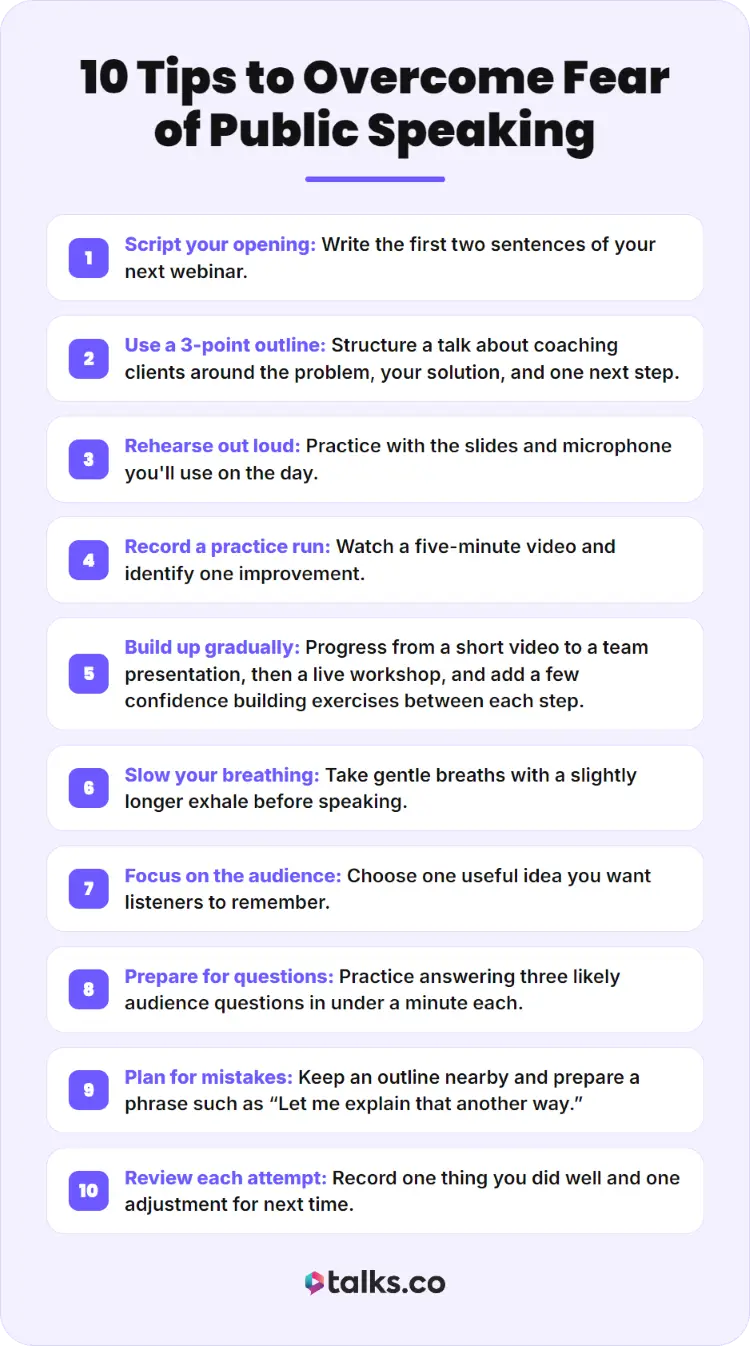
Use these tips to prepare for a real speaking situation, from a client presentation on Google Meet to a guest interview for a business podcast.
- Script your opening: Write the first two sentences of your next webinar.
- Use a 3-point outline: Structure a talk about coaching clients around the problem, your solution, and one next step.
- Rehearse out loud: Practice with the slides and microphone you’ll use on the day.
- Record a practice run: Watch a five-minute video and identify one improvement.
- Build up gradually: Progress from a short video to a team presentation, then a live workshop, and add a few confidence building exercises between each step.
- Slow your breathing: Take gentle breaths with a slightly longer exhale before speaking.
- Focus on the audience: Choose one useful idea you want listeners to remember.
- Prepare for questions: Practice answering three likely audience questions in under a minute each.
- Plan for mistakes: Keep an outline nearby and prepare a phrase such as “Let me explain that another way.”
- Review each attempt: Record one thing you did well and one adjustment for next time.
Books to overcome fear of public speaking
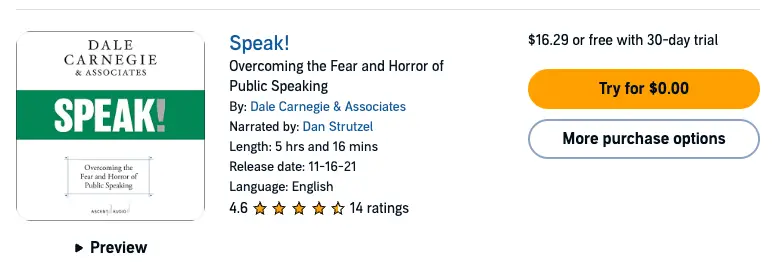
Books can help you understand speaking anxiety and improve your delivery. These four options cover fear management, speech structure, and communicating ideas clearly.
- Speak! by Dale Carnegie & Associates: A useful starting point for managing fear, focusing on your audience, and delivering ideas clearly.
- The Art of Public Speaking by Dale Carnegie: Covers preparation, delivery, tone, gestures, and organizing a talk.
- Talk Like TED by Carmine Gallo: Explains how to shape memorable presentations, use stories, and make complex ideas easier to follow.
- TED Talks: The Official TED Guide to Public Speaking by Chris Anderson: Offers guidance on developing a talk around an idea worth sharing and adapting it to your speaking style.
Talks Tip: Choose one book, apply a technique to your next speaking task, and review the result. For example, use a lesson from Talk Like TED to improve a five-minute webinar introduction, record a second version, and compare the two.
Nerves Can Be Exciting Too
That racing heart before you speak? It might be the start of something bigger.
The coach who finally says yes to a podcast interview gets to share their ideas with a fresh audience, earn trust before the first sales call, and meet potential clients who already connect with their message.
You don’t have to wait until you overcome fear of public speaking to get your name out there.
Create your free Talks profile today, connect with podcast hosts in your niche, and give your expertise a chance to reach the people who need it.
Get your free Talks profile and start connecting with podcast hosts in as fast as 5 minutes.


