

You expect one thing but life basically said, “Nope, here’s the exact opposite.” That delicious little twist is situational irony.
The fire station burns down. A dentist gets a cavity. A burglar gets locked out of his own house.
Funny? Sometimes. Painfully ironic? Ab-so-lute-ly.
An example of situational irony occurs everywhere, from Shakespeare’s Romeo and Juliet and bestselling novels to Hollywood films about a kid who can see dead people and the ridiculous moments hiding in everyday life. The trick is spotting the gap between what we expect to happen and what the actual outcome is.
Once you see that gap, cosmic irony starts appearing everywhere.
And honestly, that’s just half the fun.
Let’s look at some of the best situational irony examples in literature and film and see exactly why this literary device works.
What Is Situational Irony?
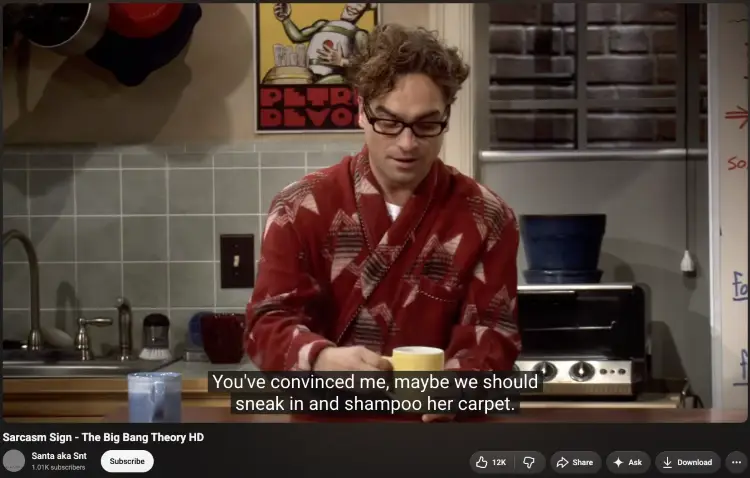
Situational irony happens when the outcome of a situation clashes with what we reasonably expect to happen.
The key is the gap between expectation and reality.
You expect a fire station to be prepared for fires. Then the fire station catches fire. You expect a professional chef to make a great meal. Then they burn dinner.
That unexpected outcome is what gives the situation its irony.
Situational irony can be funny, frustrating, awkward, or even tragic. What matters is the contrast between what we expect and what actually happens.
Situational irony meaning and examples
The simplest definition of situational irony is an unexpected outcome that contradicts the expected result of a situation.
Think about a burglar getting locked out of the house they’re trying to rob. Getting inside should be the easy part of the job. Instead, the burglar ends up stuck outside, creating a situation that’s almost comically opposite to what you’d expect.
Here are a few simple situational irony examples:
- A traffic cop gets a speeding ticket.
- A professional chef burns dinner.
- A swimming instructor falls into the pool.
- A locksmith gets locked out of their house.
- A weather reporter gets caught in a storm without an umbrella.
Good situational irony can subvert what we think is coming, making the final outcome feel surprising without feeling random.
That’s why these examples stick with you. You form an expectation, the story takes it somewhere else, and suddenly the whole situation looks different.
If you’re looking for a watch to buy, for example, you probably expect it to tell the time. Finding out it doesn’t work would be disappointing, but it wouldn’t automatically mean a situational irony takes place.
The contrast of poetic irony needs to come from a meaningful expectation built into the situation.
What is the difference between situational, dramatic, and verbal Irony?
Irony comes in several forms, and they’re easy to mix up. The simplest way to separate the types of irony is to look at where the contradiction comes from.
| Type of irony | What happens | Simple example |
|---|---|---|
| Situational irony | The outcome is different from what we expect | A fire station catches fire |
| Dramatic irony | The audience knows something a character doesn’t | We know the villain is hiding upstairs, but the character doesn’t |
| Verbal irony | Someone says something that means the opposite of their literal words | Saying “Lovely weather” during a hurricane |
- With situational irony, the surprise comes from the outcome.
- With dramatic irony, the audience has information that a character doesn’t have.
- With verbal irony, the contradiction comes from someone’s words.
Think of it this way: if you’re watching a movie and know the character is walking straight into a trap, that’s dramatic irony.
If the character somehow walks into the trap while trying to avoid it, that outcome can create situational irony. If someone watching says, “Well, that went brilliantly,” after everything goes horribly wrong, that’s verbal irony.
Keeping those three distinctions in mind will make the examples ahead much easier to spot.
Types of Situational Irony Examples
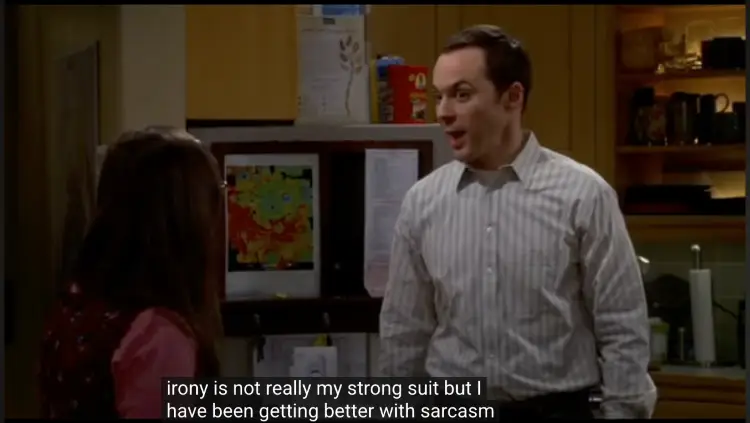
Situational irony can show up in a tragic novel, in film and TV, a newsworthy event, or a completely ordinary Tuesday. The setting changes, but the basic idea stays the same: something happens that adds an element of surprise to what we’d reasonably expect.
The examples below cover different types of situations, so you can see how situational irony works in stories and real life.
- Role reversal: Someone experiences the opposite of what we’d expect from their job, position, or expertise. A dentist getting a cavity is a simple example.
- Unexpected consequences: An action leads to a result that contradicts the person’s original goal. A character trying to prevent a disaster accidentally causes one.
- Poetic irony: Someone’s choices eventually bring about an outcome that undermines what they were trying to achieve. A dishonest person being exposed by their own deception fits this pattern.
- Tragic irony: The unexpected outcome has serious or devastating consequences, often changing a character’s life completely.
- Comedic irony: The unexpected outcome creates an amusing or absurd situation, often because the result is so far removed from what we’d naturally predict.
Situational irony examples in literature
Literary irony hits harder because you’ve got time to watch a character’s expectations build before everything flips. These three examples show situational irony working through romance, comedy, and survival.
1. The Fault in Our Stars by John Green
Hazel and Augustus fall in love despite knowing that their illnesses could drastically shorten their time together.
The relationship gives them the kind of connection they both hoped for, but Augustus eventually becomes seriously ill again and dies.
- Why it’s situational irony: The relationship Hazel and Augustus hope will give them more time together ultimately becomes a source of grief when Augustus dies before Hazel.
2. The Importance of Being Earnest by Oscar Wilde
Jack creates a fictional brother named Ernest so he can escape his responsibilities in the country and enjoy a different life in London.
The identity he invents eventually becomes central to his own romantic prospects and leads to the discovery that his real name is, in fact, Ernest.
- Why it’s situational irony: Jack invents an identity to control his romantic and social life, only to discover that the identity he created was unexpectedly connected to his actual identity.
3. The Hunger Games by Suzanne Collins
Katniss enters the Hunger Games with one main goal: survive.
She eventually threatens to eat poisonous berries alongside Peeta rather than allow the Capitol to choose which of them dies, forcing the Gamemakers to declare them both winners.
- Why it’s situational irony: The Games are designed to force contestants to kill one another until only one survivor remains, yet Katniss and Peeta survive by refusing to play by that rule.
Situational irony examples in books
Books give authors plenty of room to build an expectation before pulling the rug out from under the reader. These examples show how situational irony can shape a character’s fate, expose a contradiction or turn a seemingly straightforward situation on its head.
4. The Great Gatsby by F. Scott Fitzgerald
Gatsby spends years building his wealth and reputation around one goal: winning Daisy back.
He believes his success can recreate their past, but his carefully constructed dream ends with Daisy returning to her husband while Gatsby is killed.
- Why it’s situational irony: Gatsby believes everything he’s built will finally bring him the life he wants, yet his success ultimately fails to give him the future he imagined.
5. The Crucible by Arthur Miller
John Proctor spends much of the play protecting his reputation, even when doing so causes serious personal consequences.
When he finally refuses to falsely confess to witchcraft, he chooses his integrity over the reputation he once tried so hard to protect.
- Why it’s situational irony: Proctor expects protecting his name to be his priority, but the moment that costs him his life is also the moment he finally preserves his good name.
6. Animal Farm by George Orwell
The animals overthrow their human owner hoping to create a society where every animal is equal. Over time, the pigs take control and recreate many of the same systems of power and inequality the animals originally rebelled against.
- Why it’s situational irony: The revolution is supposed to create equality, yet it eventually produces another oppressive hierarchy.
Situational irony examples in movies
Movies can make situational irony especially memorable because we watch the expected outcome develop right in front of us. Sometimes the reversal gets a laugh. Other times, it changes the entire meaning of the story.
7. The Truman Show
Truman spends his life trying to understand why his world feels strange and eventually searches for a way out.
The escape he fears and the freedom he wants turn out to be connected to the same doorway at the edge of the world he’s been living in.
- Why it’s situational irony: The exit from Truman’s entire world is also the literal threshold into the real life he’s been searching for.
8. Toy Story
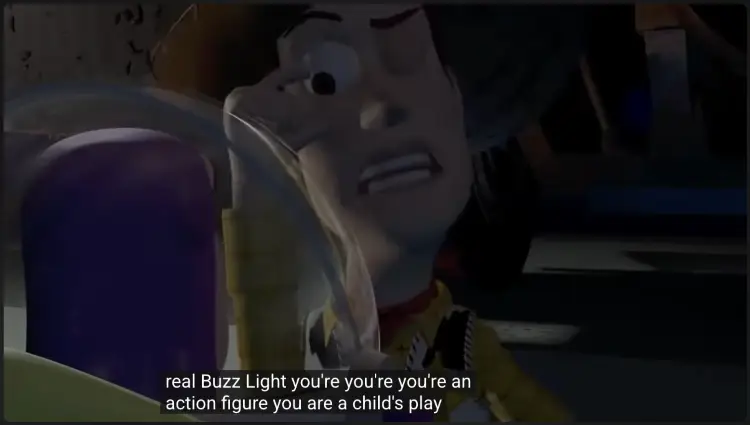
Woody is Andy’s favorite toy until Buzz Lightyear arrives and takes his place. Woody initially sees Buzz as a threat, but the two eventually become close friends and work together.
- Why it’s situational irony: Woody expects Buzz to replace him and become his enemy, but the rival he wants gone becomes one of his closest allies.
Situational irony examples in real life
Real life has a funny habit of producing outcomes nobody saw coming. The clearest examples happen when someone’s role, goal, or expectation clashes with what actually happens.
- A driving instructor fails their driving test: You’d expect someone who teaches people how to drive to have no trouble passing their own test. Their failure creates the unexpected contrast that makes the situation ironic.
- A professional chef orders takeout: Someone who spends their working life preparing food ends up ordering dinner instead of cooking it. The situation goes against what we’d naturally expect from their role.
- A fitness trainer misses a workout: A person whose job involves helping others stay active decides to skip their own exercise session. The irony comes from the contrast between their profession and their unexpected choice.
- A dentist gets a cavity: Dentists spend their days telling patients how to protect their teeth, so discovering a cavity in their own mouth creates an unexpected reversal.
- A fire station catches fire: A building dedicated to responding to fires becomes the place that needs rescuing. The outcome is surprising precisely because of what the building is designed to do.
Situational irony examples sentences
Short sentences make situational irony easy to spot because you can see the expectation and outcome side by side.
- “I was standing at the edge of the pool, ready to demonstrate the stroke,” the swimming instructor admitted, “and then I realized I had completely forgotten how to swim.”
- The locksmith sighed as he reached his front door. “Of course,” he muttered, “I’ve locked myself out of my own house again.”
- The weather reporter laughed while wringing out his jacket. “I told everyone to expect heavy rain,” he said, “and I still managed to get caught in it myself.”
- The police officer shook his head when he came back to his patrol car. “You’ve got to be kidding me,” he said, staring at the parking ticket on the windshield.
- The chef groaned as he opened the oven. “That’s the birthday cake ruined,” he said, seeing it burned beyond repair.
- The librarian winced at the email notification. “An overdue notice for my own book,” she said, shaking her head. “I can’t believe I forgot to return it.”
- The photographer blinked just as the shutter clicked. “No, no, no,” he said, checking the image afterward. “I missed the shot again.”
- The teacher paused mid-search through her bag. “I can’t believe this,” she said with a sigh. “I forgot to bring my own homework.”
Situational irony examples pictures
Situational irony can sometimes be explained in a short definition, but other times it is far easier to understand when you see it visually. In those cases, a single image can communicate the idea instantly.
“This Is Fine” dog
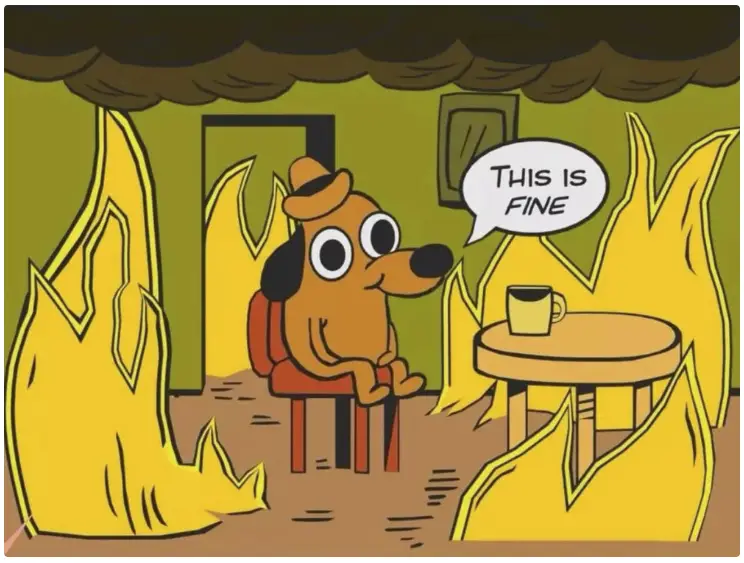
The classic image of the dog sitting calmly while everything around him is on fire is a perfect visual for a situation going wildly differently from what you’d expect.
The calm response against the chaos is what makes the image so memorable.
SpongeBob dries out at Sandy’s house
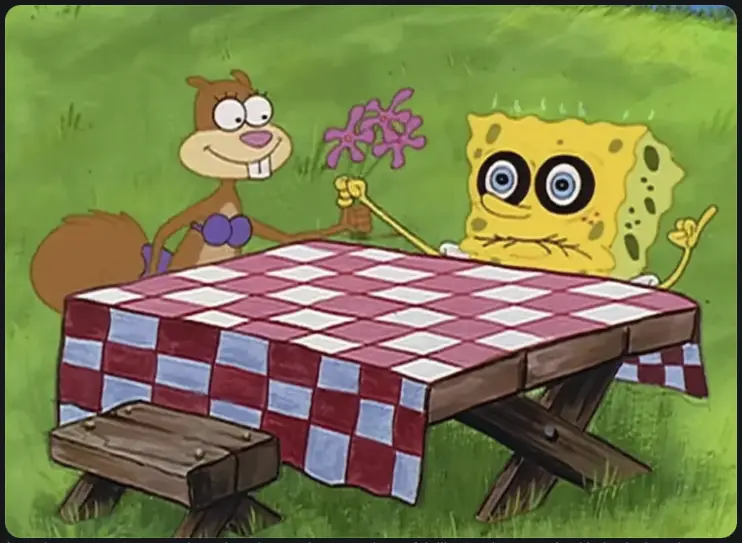
SpongeBob heads into Sandy’s treedome to spend time with her, only to end up desperately needing water as he dries out.
For a character who literally lives underwater, ending up in a situation where he’s begging for water is about as ironic as it gets.
10 Common Misconceptions about Situational Irony
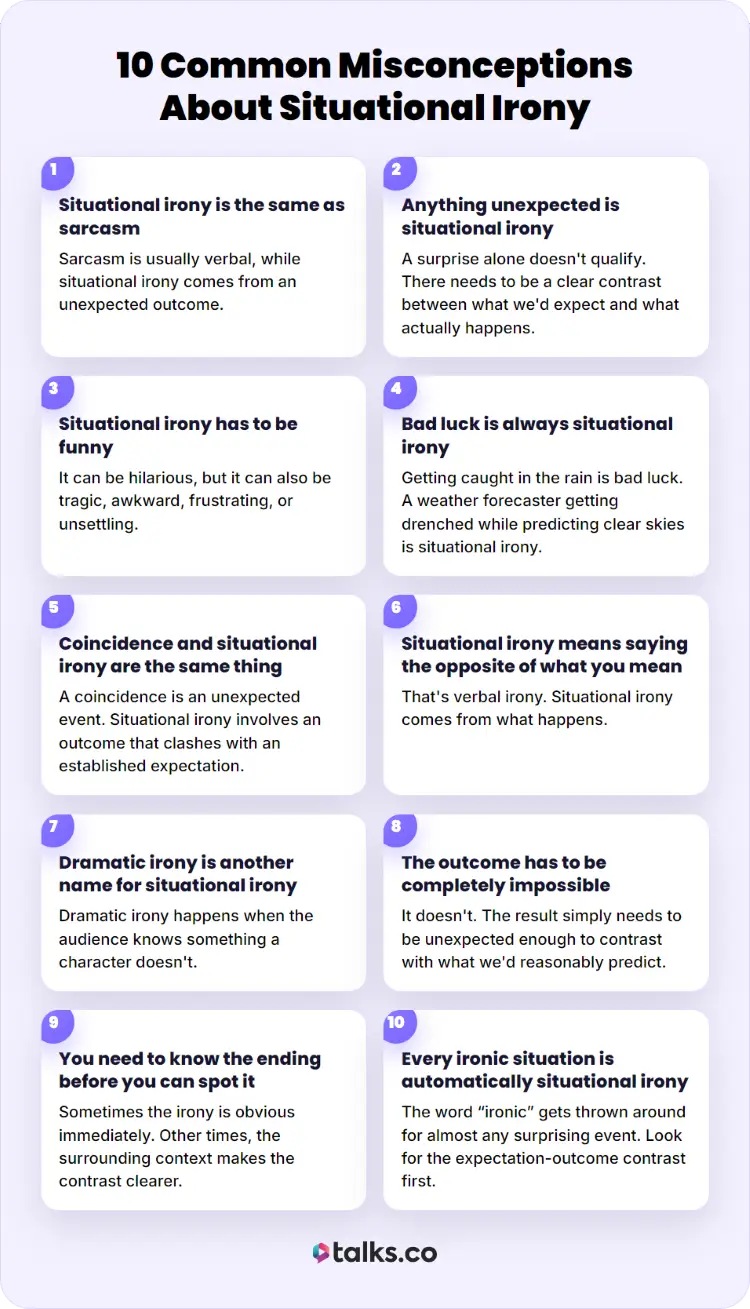
Situational irony gets confused with sarcasm, coincidence, bad luck, and a few other things pretty easily. Here are ten common misconceptions to help you spot the real thing.
- Situational irony is the same as sarcasm: Sarcasm is usually verbal, while situational irony comes from an unexpected outcome.
- Anything unexpected is situational irony: A surprise alone doesn’t qualify. There needs to be a clear contrast between what we’d expect and what actually happens.
- Situational irony has to be funny: It can be hilarious, but it can also be tragic, awkward, frustrating, or unsettling.
- Bad luck is always situational irony: Getting caught in the rain is bad luck. A weather forecaster getting drenched while predicting clear skies is situational irony.
- Coincidence and situational irony are the same thing: A coincidence is an unexpected event. Situational irony involves an outcome that clashes with an established expectation.
- Situational irony means someone says the opposite of what they mean: That’s verbal irony. Situational irony comes from what happens.
- Dramatic irony is another name for situational irony: Dramatic irony happens when the audience knows something a character doesn’t.
- The outcome has to be completely impossible: It doesn’t. The result simply needs to be unexpected enough to contrast with what we’d reasonably predict.
- You need to know the ending before you can spot situational irony: Sometimes the irony is obvious immediately. Other times, the surrounding context makes the contrast clearer.
- Every ironic situation is automatically situational irony: The word “ironic” gets thrown around for almost any surprising event. Look for the expectation-outcome contrast before calling something situational irony.
On your way to become a content creator but not sure how to do podcast interviews? Keep these to-don’ts to make sure you start your podcast on the right foot
Ironic, Isn’t It?
Good situational irony examples stick because the outcomes catch you completely off guard. Once you know what to look for, you’ll start spotting those expectation-meets-reality moments everywhere.
And if you’re an author, speaker, coach, or expert, there are plenty of places to put your own ideas in front of people who are already looking for them.
Want more podcast opportunities without spending hours hunting for the right shows?
Create your free Talks profile and start connecting with hosts in your niche.


