
I’ve done 400+ podcast interviews so naturally you’d assume I’d have figured out the whole “nerves thing” by now.
I haven’t.
Honestly, I still get that little jolt before a big conversation, a presentation, or a stage appearance and my first podcast guest appearance was the same.
I’d already hosted more than a dozen times, so I knew the other side of the mic, too. I’d prepared my talking points and done everything I could to get ready. Then we started talking.
The nerves faded into the background and the conversation became natural, authentic. And that experience taught me something I’ve seen play out hundreds of times since:
Being nervous doesn’t mean you’re bad at speaking.
So, if public speaking nerves are messing with your head before you step on stage, here’s what’s actually happening and what you can do about it.
What Is Public Speaking Anxiety vs Public Speaking Nerves?
Getting butterflies before speaking is pretty normal. The important bit is knowing when you’re dealing with regular nerves and when anxiety is starting to run the show.
| Public speaking anxiety | Public speaking nerves |
| Fear can build days or weeks beforehand. | Nervous before speaking, then settle once you start. |
| Intense physical symptoms that feel hard to control. | Racing heart, sweaty palms, dry mouth. |
| Persistent fear of judgment or embarrassment. | Worry about forgetting or stumbling. |
| Fear may lead you to avoid speaking altogether. | You can usually push through the presentation. |
| Anxiety can persist before, during, and after speaking. | Nerves usually fade once you get going. |
What causes public speaking anxiety?
Usually, there’s something underneath the nerves like that presentation you bombed in middle school, you’re speaking to people you really want to impress, or you’ve convinced yourself the whole room is waiting for you to mess up.
- Fear of looking stupid: You picture forgetting your opening while 500 people at a conference stare back.
- A bad experience: One rough presentation at work can stay in your head for years.
- High stakes: Pitching a $50,000 coaching package feels different from chatting on a small podcast.
- Too little preparation: Walking onto a stage with five half-finished talking points is asking your brain to panic.
- Trying to be perfect: You start chasing a polished TED Talk performance instead of having an actual conversation.
Why do I get nervous when speaking in public?
Your brain doesn’t always care that you’re standing in a perfectly safe and controlled stage. Put 100 eyes on you and it can still hit the alarm button.
- Your heart speeds up: Adrenaline can kick in before you’ve said a word.
- You become hyper-aware: Suddenly you’re thinking about your hands, voice, posture, and every facial expression.
- The audience feels intimidating: A keynote at Wembley Stadium carries a different psychological weight from a 20-person workshop.
- Your brain starts predicting disaster: You imagine blanking, stumbling, or forgetting your best point.
- You care about the result: Speaking to potential clients, partners, or a room full of industry leaders and emcees can raise the pressure fast.
15 Types of Public Speaking Anxiety
Sometimes public speaking anxiety looks like obsessively rewriting your opening, avoiding the Q&A or suddenly finding 47 reasons to decline that speaking invitation.
- Stage fright: Feeling intense fear as you approach or step onto a stage.
- Performance anxiety: Worrying that your delivery won’t live up to expectations.
- Fear of forgetting: Panicking about losing your place or forgetting key talking points.
- Fear of judgment: Worrying the audience will think you’re boring, stupid, or unqualified.
- Fear of making mistakes: Obsessing over mispronouncing a word or getting something wrong.
- Fear of rejection: Expecting people to dislike your ideas, story, or message.
- Fear of embarrassment: Imagining yourself stumbling over your words or having an awkward moment.
- Audience anxiety: Feeling uncomfortable with lots of people watching you.
- Social anxiety: Experiencing broader fear around social situations that also affects speaking.
- Imposter syndrome: Feeling like you don’t deserve to be the person at the front of the room.
- Anticipatory anxiety: Becoming nervous hours, days, or weeks before an event.
- Fear of Q&A: Dreading questions you can’t immediately answer after presenting.
- Fear of being recorded: Feeling extra pressure knowing your podcast, webinar, or keynote will live online.
- Microphone anxiety: Becoming unusually nervous about using a microphone or stage equipment.
- Fear of losing control: Worrying your nerves will become obvious through shaking, sweating, or a trembling voice.
How to Avoid Getting Nervous In Public Speaking Setups (Checklist)

A lot of speaking nerves start before you ever touch the microphone. Get the practical stuff sorted early and you’ve got fewer things competing for your attention when it’s time to speak.
How to speak in public without getting nervous
You can’t guarantee you’ll feel completely calm, but you can remove plenty of reasons for your brain to panic.
☐ Know your first 60 seconds: Rehearse your opening until you can deliver it without searching for the next sentence.
☐ Visit the room: Walk through the Hilton ballroom or workshop space before your session so the environment feels familiar.
☐ Test your setup: Check the clicker, microphone, slides, camera, and presentation file before people arrive.
☐ Bring water: Keep a glass or bottle within reach so a dry mouth doesn’t become another distraction.
How to not get nervous in public speaking
Trying to force yourself to “stop being nervous” can make you focus even harder on the nerves. Give your attention somewhere useful instead to overcome your fear of public speaking.
☐ Slow your first sentence: Speak deliberately instead of racing through your opening.
☐ Find 3 friendly faces: Look at people who appear engaged and rotate between them.
☐ Pause after key points: A 2-second pause feels much longer to you than it does to the audience.
☐ Think conversation: Imagine you’re explaining the idea to one person across a coffee table rather than performing for a crowd.
How to Overcome Public Speaking Nerves
Since you’re not going to wake up one day to discover your public speaking nerves have mysteriously packed their bags, the better goal is to make them smaller, more familiar, and easier to handle.
5 Tips on how to get over public speaking nerves
The fastest way to make any public speaking opportunity feel less scary is to get more reps doing it. Start somewhere the stakes are manageable, then gradually make the room bigger.
- Start with small rooms: Give a 10-minute presentation to your team before volunteering for a 300-person industry conference.
- Stack speaking reps: Try a local meetup, LinkedIn Live, guest podcast, then a conference session.
- Repeat the same talk: Delivering your 20-minute “How Coaches Can Build a Referral Engine” workshop five times will feel very different by the fifth run.
- Increase the stakes gradually: Move from a Zoom workshop with eight people to a 50-person webinar, then a stage at an event like Podcast Movement.
- Review the evidence: After every talk, write down what actually happened instead of replaying every awkward moment in your head.
5 Techniques on how to stop nervousness when public speaking
Those five minutes right before you get on stage comes with a ton of nerves begging to be wrestled so you need to give your body something steady to do and your mind something specific to focus on.
- Use controlled breathing: Take a slow breath in, then make your exhale longer before walking onto the stage.
- Ground your body: Plant both feet firmly on the floor instead of pacing backstage at the Marriott Marquis.
- Drop the adrenaline: Take a short walk before a keynote rather than sitting rigidly in the green room.
- Focus on your next point: If you’re halfway through a presentation on your $2,000 coaching program, think about the next useful idea instead of how you’re being perceived.
- Keep talking: A shaky first 30 seconds doesn’t mean the whole presentation is falling apart. Give yourself time to settle into the conversation.
How to Calm Public Speaking Nerves (Checklist)
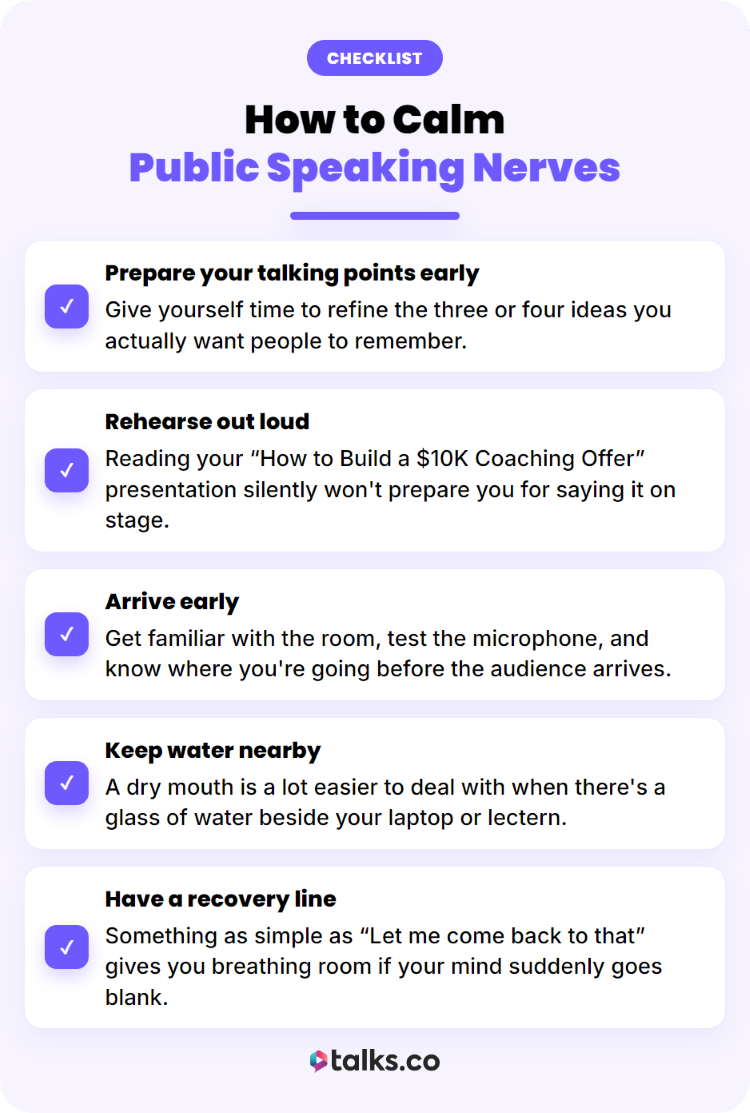
These are the things I’d focus on when you’ve got a presentation, podcast, workshop, or keynote coming up.
☐ Prepare your talking points early: Give yourself time to refine the three or four ideas you actually want people to remember.
☐ Rehearse out loud: Reading your “How to Build a $10K Coaching Offer” presentation silently won’t prepare you for saying it on stage.
☐ Arrive early: Get familiar with the room, test the microphone, and know where you’re going before the audience arrives.
☐ Keep water nearby: A dry mouth is a lot easier to deal with when there’s a glass of water beside your laptop or lectern.
☐ Have a recovery line: Something as simple as “Let me come back to that” gives you breathing room if your mind suddenly goes blank.
5 Nervous public speaking tips during your speech
Once you’re actually speaking, your job gets much simpler: slow yourself down and give your attention to the person in front of you.
☐ Slow your pace: Nervous speakers often speed through their best points without realizing it.
☐ Use deliberate pauses: Give an important idea a second to land before moving on.
☐ Look at individuals: During a 200-person keynote, talk to one person for a sentence or two before moving your attention elsewhere.
☐ Relax your shoulders: Tension in your neck and shoulders can make the rest of your body feel even more wound up.
☐ Stick to your structure: Know your next major point instead of memorizing every sentence.
5 Public speaking nerves tips after your speech
The talk is over, your heart rate is finally coming down, and your brain wants to replay every awkward second. Resist the urge to judge the whole performance from one shaky moment.
☐ Wait before reviewing: Give yourself an hour or two before picking apart your presentation.
☐ Separate facts from feelings: “I felt terrible” doesn’t automatically mean the audience thought you performed badly.
☐ Write down the wins: Maybe 47 people stayed for your workshop, 3 asked about your coaching program, and someone shared your presentation afterward.
☐ Review the recording: If you filmed your talk at a conference in Austin, watch for specific things to improve instead of judging yourself generally.
☐ Book another opportunity: Another podcast interview or 20-person workshop gives you a chance to use what you learned while the experience is still fresh.
5 Public Speaking Anxiety Tricks
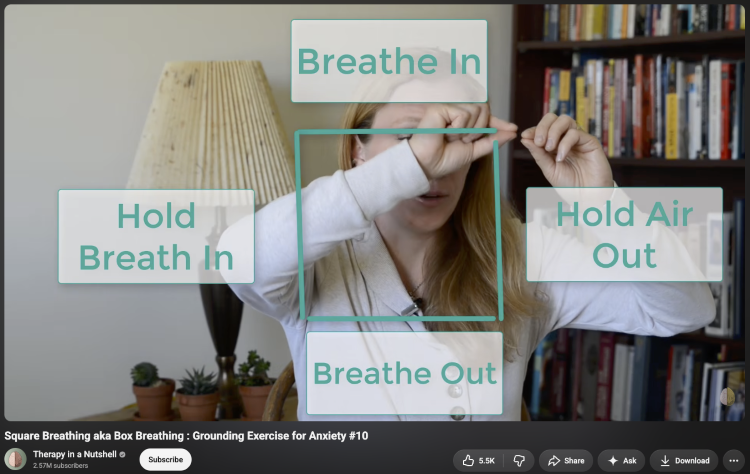
When anxiety starts climbing, give your brain something concrete to do. A few simple physical and mental cues can stop you from spiraling about what might happen next.
- Try box breathing: Breathe in for four seconds, hold for four, breathe out for four, then hold again.
- Ground your feet: Feel both feet against the floor and loosen your knees instead of locking them.
- Name 5 things you see: Use the room around you to pull your attention out of your head.
- Reframe the adrenaline: A racing heart can mean your body is preparing you to perform, not predicting disaster.
- Take one slow breath: Before answering a question at a podcast recording or conference Q&A, breathe before you speak.
Public speaking fear hypnosis
Hypnosis gets plenty of attention as a way to manage public speaking fear, but don’t treat it like a magic switch. Research on hypnosis as a public speaking anxiety treatment is mixed, so it’s worth approaching it as one possible tool rather than your entire strategy.
- Work with a qualified practitioner: Look for appropriate professional credentials and experience with anxiety.
- Set a specific goal: “Feel calmer before my keynote” gives you a clearer target than simply wanting to eliminate fear.
- Keep practicing: Pair any hypnosis work with actual meditation and deep breathing or speaking reps, from small Zoom sessions to larger stages.
- Watch the claims: Read the latest public speaking fear statistics and be cautious of anyone promising to permanently cure public speaking anxiety in one session.
How to Control Public Speaking Nerves
You can’t always choose when the nerves show up, but you can get better at handling your stress levels and control what triggers them so you remain standing tall and confident delivering a speech. The more familiar the process becomes, the less power those first few minutes have over you.
Check out how to become a public speaker and how to become a content creator to learn how you can connect with your audience, build public speaking confidence, and regulate your own public speaking skills so you stay composed on stage.
Ways to control public speaking nerves
Think about controlling the conditions around your nerves rather than trying to force yourself into feeling perfectly calm.
- Build a pre-talk routine: Use the same 10-minute routine before every podcast, workshop, or keynote so your brain knows what’s coming.
- Practice under pressure: Record your presentation while standing, use a timer, and answer unexpected questions out loud.
- Know your recovery points: Mark the three places in your presentation where you can pause, take a breath, and reset.
- Get comfortable with silence: Practice leaving two or three seconds after a question instead of filling every gap with “um.”
- Track your wins: After speaking at something like Podcast Movement, write down what went well and what you’d change next time to be an even more confident speaker in public.
How to control public speaking nerves
When the nerves hit halfway through your talk, you need something you can actually remember. Keep your attention on the job in front of you.
- Slow your breathing: Take one controlled breath before your next sentence instead of rushing to fill the silence.
- Return to your message: If you’re presenting a six-week business coaching program, focus on the transformation you’re explaining rather than how you look delivering it.
- Use your notes strategically: Keep a few keywords nearby instead of reading full paragraphs from a script.
- Pause after a mistake: Correct the error, smile, and continue. Most audiences forget small stumbles quickly.
- Finish the thought: Don’t abandon a good point because your voice shook or your heart started racing. Give yourself another sentence and keep going.
Nervous and Still Brilliant
Nervous and Still Brilliant
If your stomach still flips before a big presentation, you’re in good company. I’ve done 400+ interviews and I still get public speaking nerves sometimes. The difference is knowing I can feel that fight-or-flight response and still speak anyway.
The more you speak, the more familiar that feeling becomes. Podcast interviews are a great place to get those reps, meet new audiences, and sharpen your message as a presenter.
Talks can help you find the shows. Create your free Creator Profile, get matched with relevant hosts, and start putting yourself out there.
Your next conversation could be the one that opens another door.
Set Up My Talks Creator Profile Now!