

You’ve heard of a seller’s high. But have you ever felt a speaker’s rush?
You’re halfway through your talk. You look up. Someone in the audience has just had an Aha! moment.
I’ve hosted plenty of live events in my speaking career, and man… that moment NEVER gets old. You see an idea hit home in real time, watch someone’s perspective shift, and just know it in your gut your words mattered.
That’s the pull of keynote speaking.
You take what you know, turn it into a message people remember, and earn a room’s full attention.
But getting paid for public speaking engagements take more than being comfortable on stage.
You need a subject worth hearing, authority behind your name, a signature talk, and a way to get in front of the right organizers outside of LinkedIn.
Here’s how to become a keynote speaker.
What Is a Keynote Speaker?
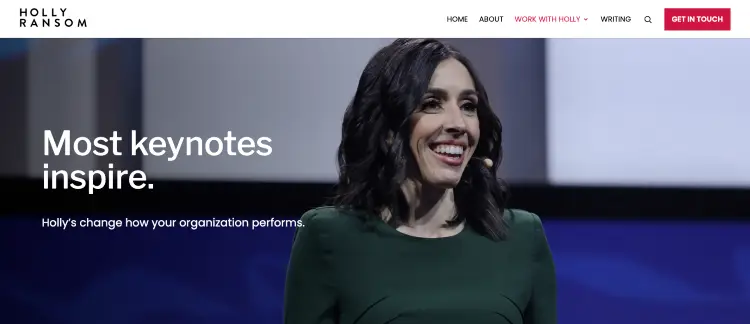
A keynote speaker is usually the person trusted to give an event its central idea.
At a leadership conference, that might mean challenging managers to rethink burnout. At a sales summit, it could mean showing reps how to handle rejection without losing momentum.
- Leads the event’s message: Opens up the big idea the audience came to hear.
- Shares real expertise: Turns experience and knowledge into lessons people can use.
- Keeps people engaged: Makes the audience care about the subject.
- Creates a memorable experience: Gives people stories, ideas, and moments worth remembering.
What does it mean to be a keynote speaker?
Being a keynote speaker means becoming known for a subject people associate with your name.
If you speak about leadership, for example, your talk might help new managers handle difficult conversations, delegate work, and earn trust during their first 90 days.
- Own a specific subject: Become known for one problem, audience, or area of expertise.
- Develop a point of view: Have something useful to say that goes beyond obvious advice.
- Create a signature talk: Build a presentation around your strongest stories, lessons, and ideas.
- Give people something useful: Leave attendees with actions they can take immediately.
What Does a Keynote Speaker Do?
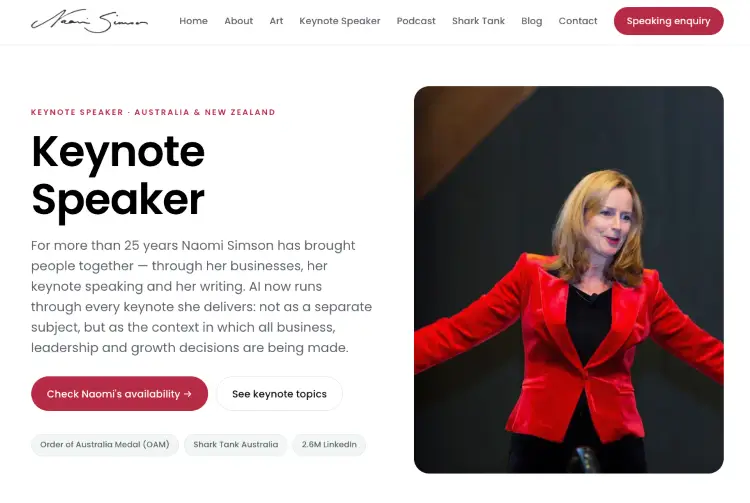
A great keynote speaker does plenty of work before stepping onto the stage. The goal is simple: understand the audience, deliver a strong message, and make those minutes count.
- Researches the audience: Learns what the people in the room care about.
- Builds the presentation: Turns expertise into a focused, engaging talk.
- Rehearses the delivery: Practices stories, timing, transitions, and key moments.
- Captures attention: Gives people a reason to keep listening.
- Tells great stories: Uses real experiences to make ideas stick.
- Reads the room: Pays attention to audience reactions and energy.
- Leaves people with something: Gives the audience a clear takeaway they can remember and use.
Who is a famous keynote speaker example?
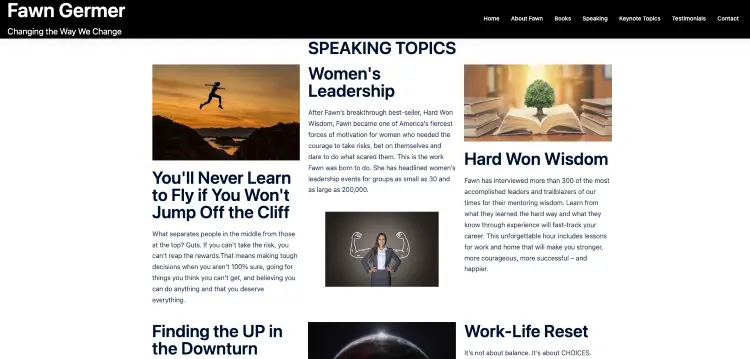
Fawn Germer shows what a clearly positioned keynote career can look like.
- Her niche: Leadership, resilience, career growth, relevance, and adapting to change.
- Her credibility: Bestselling author who interviewed 300+ accomplished leaders.
- Her reach: Has spoken at events ranging from intimate groups to audiences of 200,000.
- Her signature topics: Hard Won Wisdom, Be Relevant, and Work-Life Reset.
- Her lesson: Strong speakers give audiences a specific problem, perspective, and message to remember.
How To Become A Keynote Speaker
Becoming a public speaker is a progression: choose a subject you can own, build proof that you know it, turn that expertise into a strong talk, and get enough people seeing you speak to create paid opportunities. Here’s the path I’d follow.
1. Choose your keynote speaking niche
Your keynote niche gives event organizers a reason to remember you. “I speak about business” is forgettable. “I help first-time founders build sales systems before hiring their first salesperson” gives people something specific to associate with your name.
- Pick a problem you know deeply: Start with a subject you’ve spent years studying, practicing, teaching, or solving yourself.
- Name the audience: Founders, sales leaders, HR teams, healthcare executives, new managers, and other specific groups make your positioning easier to understand.
- Find your strongest angle: Look for the lesson, opinion, method, or experience that makes your perspective different from the usual advice.
- Check the demand: Search conferences, corporate events, podcasts, and speaker bureaus to see which topics organizers are already booking.
- Make it specific enough to remember: “Leadership” is broad. “Leading through rapid company growth without burning out your best people” gives you a sharper lane.
2. Build your expertise and authority
Event organizers need a reason to trust you with their audience. Your credentials can come from years in an industry, original research, business results, a book, media appearances, or experiences that taught you something worth sharing.
- Document your results: Track revenue growth, client outcomes, research findings, projects completed, teams led, or other measurable proof.
- Publish your ideas: Write articles, record podcasts, post videos, or share practical insights that demonstrate how you think.
- Collect third-party proof: Testimonials, media features, podcast interviews, awards, and client stories can strengthen your speaker profile.
- Build recognizable expertise: Talk consistently about the subject you want event organizers to associate with your name.
- Use Talks to build authority: Get featured on relevant podcasts and shows with other Toastmasters where you can demonstrate your expertise through real conversations.
3. Create your signature keynote talk
Your signature keynote is the presentation you can adapt for different audiences without rebuilding the entire thing from scratch. Give it a clear promise, memorable stories, and practical ideas people can use after the event.
- Start with one big idea: Decide what you want attendees to understand, reconsider, or do differently after hearing you speak.
- Build a simple structure: Open with a strong story or surprising observation, teach your core ideas, then finish with clear actions.
- Use stories from your experience: A failed launch, difficult client, major career decision, unexpected success, or lesson from a hard season can make an abstract idea concrete.
- Give the talk a memorable name: A specific title makes it easier for organizers to understand and promote your keynote.
- Create supporting materials: Build slides, worksheets, frameworks, examples, or a short takeaway document that reinforces the presentation.
4. Build your speaking experience and speaker reel
You don’t need a room of 10,000 people to start building speaking proof. Smaller conferences, workshops, panels, podcasts, webinars, business events, and community gatherings can give you footage and feedback you can use to win larger public speaking opportunities.
- Start with accessible stages: Speak at industry meetups, company events, associations, virtual conferences, and local business groups.
- Record every strong opportunity: Capture clean video and audio whenever possible so you can build a library of usable clips.
- Create a tight speaker reel: Show your delivery, audience reactions, strongest ideas, and different speaking environments in a short video.
- Collect speaking testimonials: Ask organizers to describe the specific value attendees got from your presentation.
- Improve after every talk: Review your pacing, stories, slides, audience questions, and sections where attention dropped.
5. Find speaking opportunities on Talks
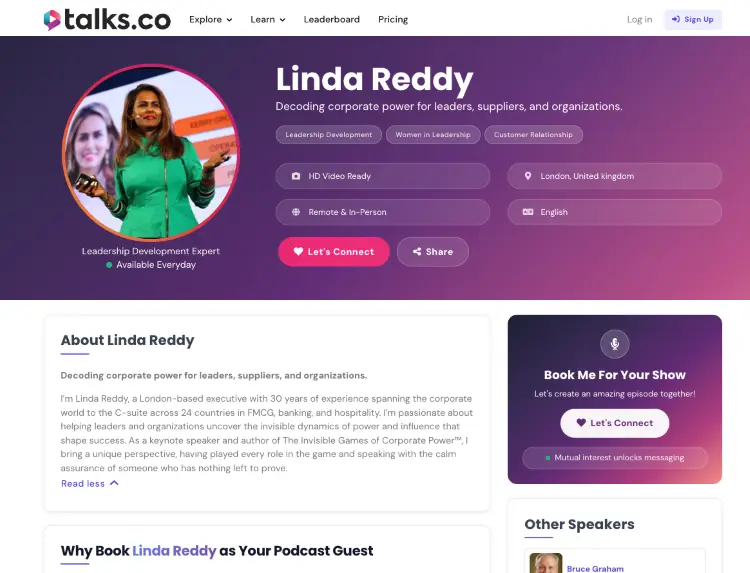
Talks gives you another way to build visibility while getting your ideas in front of hosts who are already looking for interesting experts. A strong Talks creator profile can help podcast hosts discover you, book you for podcasts, and give you more recorded conversations to use as credibility.
- Build a specific profile: Lead with your expertise, ideal audience, signature topics, and the problems you can speak about.
- List strong talking points: Give hosts several angles they could turn into a compelling episode.
- Use your podcast guest appearances as proof: Add your best interviews so organizers can hear how you communicate before booking you.
- Ask for reviews: Positive feedback from hosts gives future bookers another reason to take a closer look.
- Turn interviews into speaking assets: Use strong podcast clips, quotes, and discussions to strengthen your speaker reel and promotional material.
6. Pitch event organizers
Once you have a clear keynote and enough proof behind it, start putting your name in front of people who book speakers. Your pitch should make their job easier by showing exactly what you can deliver to their audience.
- Target relevant events: Look for conferences, corporate meetings, associations, summits, and industry events that attract the audience you serve.
- Find the actual decision-maker: Identify the conference producer, event director, speaker manager, HR leader, or executive responsible for booking speakers.
- Lead with the audience benefit: Explain the problem your keynote solves and what attendees will be able to do differently afterward.
- Use your Talks profile as a media kit: Send organizers one link with your bio, speaking topics, podcast appearances, reviews, and profile details instead of making them hunt for your credentials.
- Pitch specific talks: Give organizers two or three keynote topics with clear outcomes instead of sending a generic “I’d love to speak at your event” message.
7. Set your keynote speaking fees
Don’t feel pressured to hit or charge the $50,000 or $100,000 fees established speakers do. Start with a number that reflects your current experience, then increase it as your demand, proof, and track record grow.
- Research comparable speakers: Look at speakers with similar expertise, experience, audience, and event history.
- Set a starting fee: You might begin at $2,500-$5,000 for a keynote and increase your rate as your speaking portfolio develops.
- Create different packages: Charge separately for a keynote, keynote plus workshop, executive session, or additional event appearances.
- Account for extra costs: Clarify travel, accommodation, preparation, recording rights, and additional sessions before agreeing to a fee.
- Raise your rate with demand: If organizers keep booking you at your current price, that’s useful evidence that it’s time to test a higher fee.
How to Be a Keynote Speaker (Checklist)
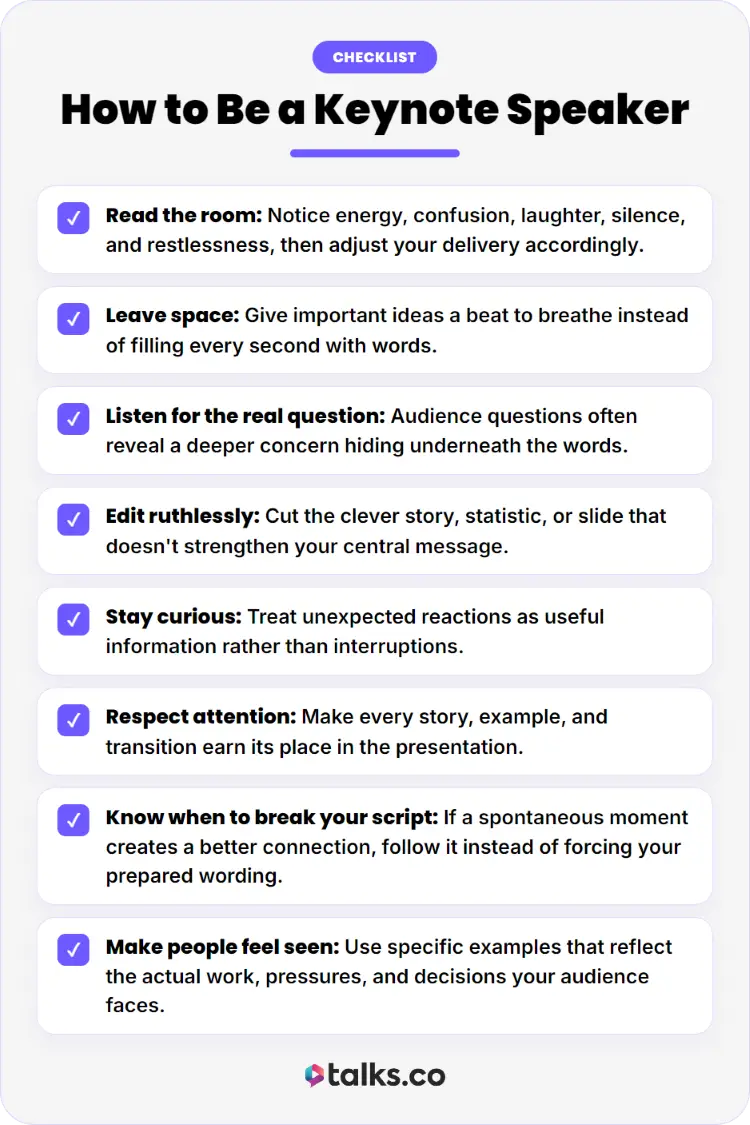
The mechanics of speaking matter, but the details people rarely train can make a bigger difference. Great keynote speakers pay attention to how they listen, observe, edit, react, and make an audience feel involved.
☐ Read the room: Notice energy, confusion, laughter, silence, and restlessness, then adjust your delivery accordingly.
☐ Leave space: Give important ideas a beat to breathe instead of filling every second with words.
☐ Listen for the real question: Audience questions often reveal a deeper concern hiding underneath the words.
☐ Edit ruthlessly: Cut the clever story, statistic, or slide that doesn’t strengthen your central message.
☐ Stay curious: Treat unexpected reactions as useful information rather than interruptions.
☐ Respect attention: Make every story, example, and transition earn its place in the presentation.
☐ Know when to break your script: If a spontaneous moment creates a better connection, follow it instead of forcing your prepared wording.
☐ Make people feel seen: Use specific examples that reflect the actual work, pressures, and decisions your audience faces.
What does it take to become a keynote speaker?
A killer keynote speaker has strong self-awareness. They know when to push an idea, when to pause, when an audience needs an example, and when their favorite story has already overstayed its welcome.
- Be observant: Notice what changes in the audience as you move through your talk.
- Be generous: Share useful knowledge freely instead of holding back your best insight for the final slide.
- Be comfortable with silence: A quiet room isn’t automatically a bad room.
- Be willing to change: Retire stories, examples, and jokes when they stop serving the audience.
- Be specific: Replace vague advice with situations, decisions, mistakes, numbers, and examples people recognize.
- Be emotionally disciplined: Don’t let a tough question, technical glitch, or nonreactive audience throw you off your message.
- Be a good listener: The best speakers often become better by paying close attention before they ever step on stage.
How long should a keynote speaker speak?
Most keynote speeches fall somewhere between 20 and 60 minutes, depending on the event format and audience.
- Short keynote: 20-30 minutes: Best for tight conference programs, opening remarks, and focused presentations built around one strong idea.
- Standard keynote: 30-45 minutes: Gives you enough time for stories, teaching, audience interaction, and a strong closing.
- Extended keynote: 45-60 minutes: Works for deeper presentations with multiple examples, exercises, demonstrations, or audience Q&A.
How Much Do Keynote Speakers Make?
Keynote speaking income can look very different depending on experience, reputation, audience, and the type of event you’re booking.
Salary data gives you one benchmark, while actual keynote fees show what established speakers can charge for a single engagement.
- Average U.S. salary: $50,890 per year
- 25th percentile: $40,000 per year
- 75th percentile: $57,500 per year
- Top 10%: $70,000 per year
- Highest reported annual salary: $78,500
Thinking about a different lane? Check out how to become a motivational speaker instead.
Do keynote speakers get paid?
Yes. Established keynote speakers can command five-figure fees for a single U.S. event, with the examples below showing fee ranges currently listed for established speakers.
- Low range: $5,000 – $10,000: Temple Grandin, Danielle Green, Jones Loflin, and Jason Young.
- Mid range: $30,000 – $50,000: Mike Eruzione, Carey Lohrenz, Inky Johnson, and Duncan Wardle.
- High range: $100,000+: Arthur C. Brooks, Fei-Fei Li, and Scott Galloway.
How much does a keynote speaker cost?
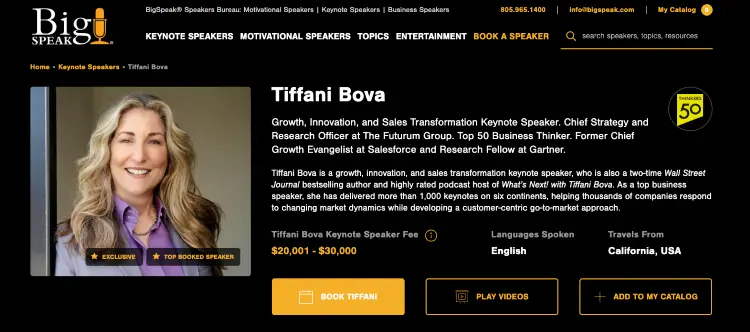
Keynote fees can vary from a few thousand dollars to $200,000 or more. All American Speakers Bureau currently lists seven speaking fee ranges showing how dramatically the market can vary.
- $5,000 – $10,000: Haydn Shaw, Kenneth Harris II, Erika Obando, Shoshana Johnson, and Josh Davis.
- $10,000 – $20,000: Rocky Bleier, Amelia Rose Earhart, Jim Morris, Gerry Brooks, and Oz Sanchez.
- $20,000 – $30,000: Andrew Busch, Shannon Miller, Robyn Benincasa, Sylvia Acevedo, and J.R. Martinez.
- $30,000 – $50,000: Eric Boles, Amy Jo Martin, Josh Linkner, Mike Massimino, and Bethany Hamilton.
- $50,000 – $100,000: Daymond John, Cassie Kozyrkov, Erik Qualman, Sol Rashidi, and Erica Dhawan.
- $100,000 – $200,000: Kevin O’Leary, Jocko Willink, and Erik Brynjolfsson.
- $200,000 and above: Michael Phelps and Simon Sinek.
Got Something Worth Saying?
Learning how to become a keynote speaker starts with expertise, but your next opportunity can come from simply getting your ideas in front of more people.
Your Talks profile gives you a place to showcase your bio, topics, interviews, reviews, and speaking experience, while connecting you with hosts and opportunities that can build your visibility.
Create your free Talks profile today and start putting your name in the places people go when they’re looking for someone worth hearing.
The speaker who gets booked is usually the one who makes themselves easy to find.


