

Walk onto a stage, a podcast, or a Zoom call with a cold voice and it will crack on your first word, and a 5-minute vocal warm up for speaking wakes your vocal tract up before that happens.
Those vocal warm-up exercises for speaking and warm-up techniques work like the warm up I swore by as a striker in Australia’s national soccer competition, and I still run vocal exercises inspired by it before I host a virtual summit with 20 to 30 expert speakers.
If you struggle to keep your voice, I’ll show you the exercises for vocal resonance, how long to warm up your voice, when to take deep breaths, and the warm-up routine mistakes that cause vocal fatigue, so your voice sounds as good in minute 40 as it did when you first spoke during your next speech and presentation.
What Is a Vocal Warm Up?
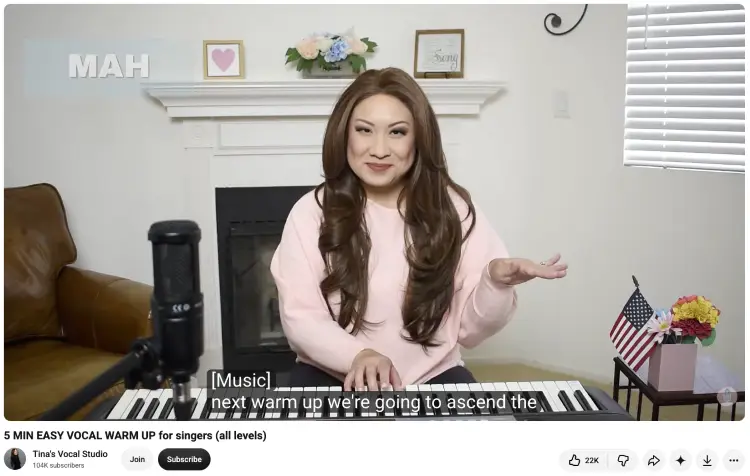
An effective vocal warm up is a short set of gentle exercises, like humming, lip trills, and slow breathing, that wakes up the muscles you use across your vocal range before you ask them to work. It helps your breath, voice, and mouth work together, so your first answer in a podcast interview, presentation or speech comes out clear when using your voice.
Singers made the habit of maintaining their vocal cords famous, and quick and effective vocal warm ups fit anyone who talks for a living: coaches on client calls, authors on book tours, keynote speakers giving speeches and presentations, and podcast guests on the shows that book them.
Why are vocal warm-ups necessary?
Vocal warm-ups are necessary because speaking asks more of your voice than it feels like it does. Your vocal folds vibrate about 115 times a second in a typical male speaking voice and about 200 times a second in a typical female one, according to the University of Minnesota’s Lions Voice Clinic, so a single minute of talking adds up to thousands of tiny vibrations.
A set of vocal warm ups helps prepare your voice and gives your muscles a gentle start when opening your mouth during a meeting or speech, and your audience hears the difference in the vocal projection and speech clarity of your chest voice.
- Smoother first words: Short vocal warm-ups and articulation exercises bring blood to your vocal muscles, so your opening line, which often carries your name and your main point, comes out clear and gives you a powerful voice.
- Less strain: Starting gently with basic vocal warm ups and building up on it like any other muscle gives your voice time to reach full volume, which matters on a virtual summit or in a 60-minute workshop.
- Longer stamina: Coaches running 5 client calls in a row and hosts moderating a 3-hour panel use their voices for hours, and an early warm up helps their voices hold up.
- Calmer nerves: A set workout for your voice to encourage vocal clarity or solid vocal warm-up for a more confident voice gives your mouth and breath something to do while the adrenaline settles before you go live.
What Are Good Vocal Warm Ups?
Good vocal warm ups loosen the parts you talk with and settle the breath and posture that power your voice, and together they take about 5 minutes.
Examples of voice warm ups for speaking publicly
Start with these specific parts that shape your words because they’re the first to feel stiff on a cold morning call.
1. Jaw release
A tight jaw holds your words back, and these warm-ups free them before you speak.
- How: Let your mouth hang open, massage the hinge in front of your ears with two fingers, and open and close slowly like a yawn you’re easing into.
- Feel for: A loose, heavy jaw that drops open easily.
- Time: Keep it going for about 20 seconds.
2. Lip trills
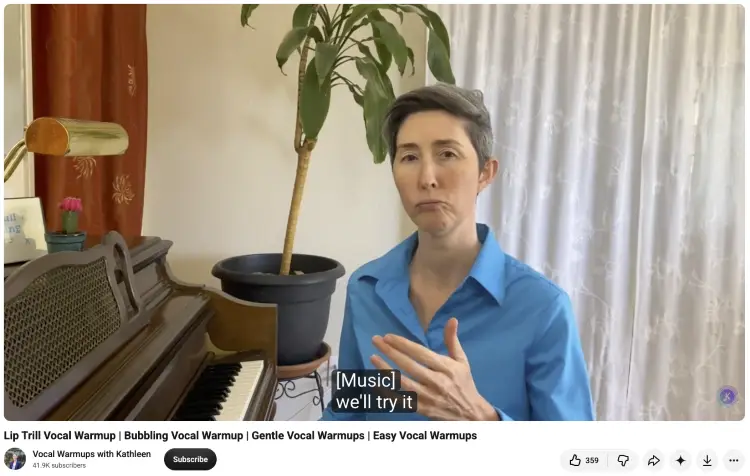
Lip trills warm up your breath and pitch together and they feel a little silly in the best way.
- How: Blow air through loose lips so they flutter like a kid revving a toy car, and glide from a low pitch to a high one and back down.
- Feel for: A light tickle on your lips with air flowing evenly.
- Time: Run it for about 40 seconds.
3. Humming
Humming brings your voice online at a low volume, which gives it a ramp up to full power.
- How: Hum “mmm” from low to high with your lips lightly closed.
- Feel for: A buzz around your lips and nose, which is your voice resonating forward.
- Time: Hum for about 40 seconds.
4. Tongue stretches
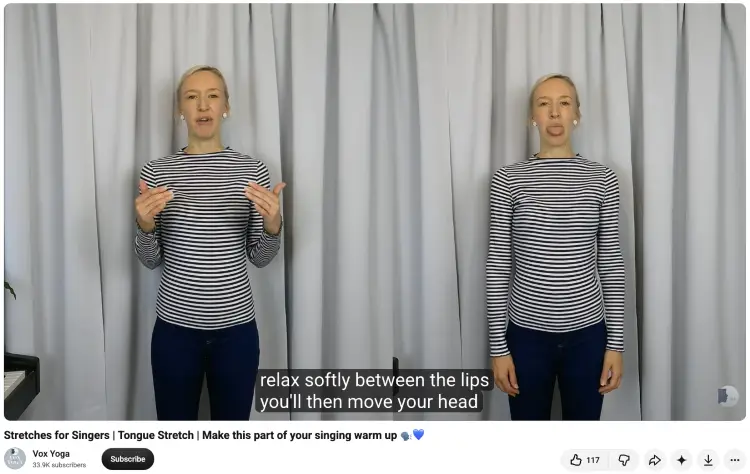
Your tongue does most of the work shaping words so a stretch helps your consonants come out crisp.
- How: Stick your tongue out as far as it goes, sweep it side to side, and circle it behind your lips once in each direction.
- Feel for: A stretch under your chin and a relaxed throat.
- Time: Spend about 20 seconds.
5. Tongue twisters
Tongue twisters put everything you just loosened to work on fast, tricky sounds.
- How: Say “six sharp strikers sprint past the stunned keeper” 5 times in a row, slowly at first and then at your normal speaking speed.
- Feel for: Every consonant staying crisp as you speed up.
- Time: Take about 40 seconds.
Breathing and posture vocal warm up exercises for speaking
Finish with your breath and posture, since a collapsed chest and shallow breaths leave your voice running on fumes halfway through a talk.
6. Posture reset
Your ribs can only expand as far as your posture allows, so standing tall opens up room for a full breath.
- How: Stand with your feet hip-width apart, ears over shoulders, and chin level, and imagine the crown of your head reaching toward the ceiling.
- Feel for: Your ribs opening as your chest lifts slightly.
- Time: Hold it for about 20 seconds.
7. Belly breathing
Slow belly breaths fill your lungs fully, so your voice has a full tank to draw air from. Take them right before you start and again before your opening line.
- How: Rest a hand on your belly, breathe in through your nose for 4 counts, and breathe out for 6.
- Feel for: Your hand moving out as your belly expands.
- Time: Repeat for about 40 seconds.
8. Sustained “sss”
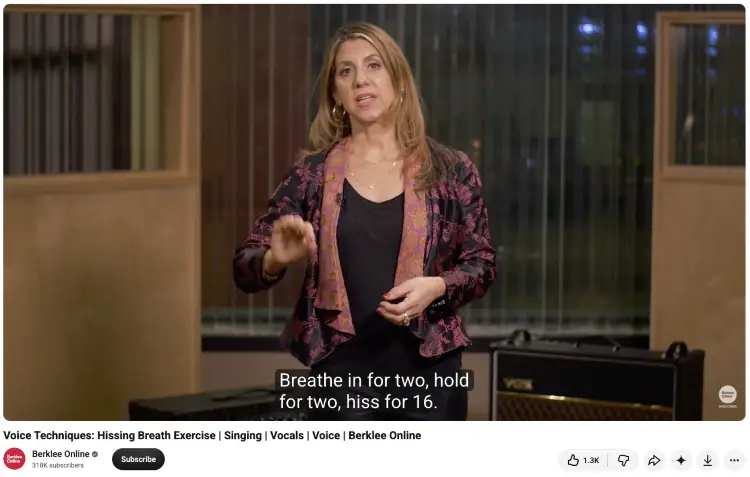
A steady “sss” teaches you to let air out at an even pace, which keeps your sentences from fading at the end.
- How: Breathe in low, then hold a steady “sss” like air easing out of a pool float.
- Feel for: An even stream of air, and stop when it feels comfortable.
- Time: Do 2 rounds for about 30 seconds in total.
9. Shoulder and neck rolls
Tension in your shoulders and neck squeezes your voice, so this releases it before you start.
- How: Roll your shoulders back 5 times, then tilt your ear toward each shoulder slowly.
- Feel for: Your shoulders dropping away from your ears.
- Time: Take about 20 seconds.
How to Do a Vocal Warm Up for Speaking
Do a vocal warm up for speaking in the order the exercises appear above, then adjust the mix for where you’re speaking.
Vocal warm up for talking on podcasts and Zoom calls
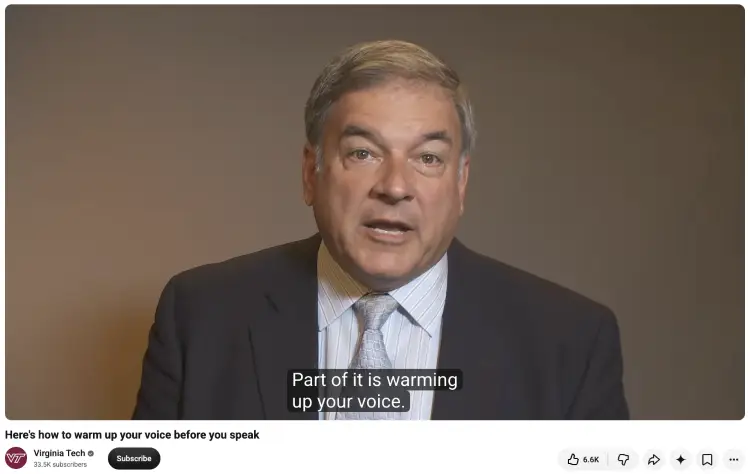
A vocal warm up for talking on podcasts and Zoom calls works best about 10 minutes before you join, with your mic muted, so your first live sentence is your best one.
- Guests: Podcast guesting rewards the guest who sounds clear from minute one, so pair the routine with your checklist for how to prepare for a podcast interview.
- Gear: Whichever best podcast microphone you plug in will pick up the clarity you just built, so say your opening line out loud once before you hit record.
- Hosts: If you’re learning how to start a podcast, make the routine part of every recording day.
Vocal warm up for speech on stage
A vocal warm up for a speech on stage runs bigger, so find a hallway or green room about 15 minutes before you go on.
- Projection: Add an extra round of the “sss” and the posture reset so your voice reaches the back row.
- Opportunities: Every public speaking opportunity, from a meetup panel to a conference keynote, asks for volume, and a warm voice gives you room to spare.
- Delivery: Pair the routine with public speaking tips on pacing and pauses, so your voice has a plan from the first line.
Vocal warm up for public speaking and hosting events
A vocal warm up for public speaking and hosting events leans on breath control, since you’ll be talking for hours.
- Timing: Finish with belly breathing right before the doors open, so your breath is fresh for the opening line.
- Role: Wondering what is an emcee? It’s the host who keeps an event moving, and that job means long stretches of speaking.
- Nerves: If public speaking nerves show up while you wait backstage, run through the shoulder and neck rolls until your name is called.
How Long Does a Vocal Warm Up Last?
A vocal warm up for speaking lasts 2 to 10 minutes, and about 5 minutes covers most podcasts, calls, and talks. The longer and louder you’ll speak, the more of the routine you’ll want.
Quick warm up vs longer routine
Pick the length by how long and how loud you’ll be speaking, and the two-minute version fits days when your calendar is packed.
- Jaw release: Spend 20 seconds on the hinge massage and slow open-and-close.
- Lip trills: Run them for 40 seconds, gliding from low to high.
- Humming: Hum for 40 seconds until you feel the buzz.
- Belly breathing: Finish with 20 seconds of slow breaths, 4 counts in and 6 out.
| Length | Best for |
|---|---|
| 2 minutes | Back-to-back Zoom calls or a short podcast interview |
| 5 minutes | Podcasts, workshops, and most talks |
| 10 minutes | Keynotes, all-day events, and long hosting days |
Longer vocal warm-up routine for big talks
A longer routine for big talks runs about 10 minutes, which is your 5-minute base plus extra work on volume, range, and movement.
- Read-through: Read the first page of your talk out loud at the volume you’ll use in the room for about 2 minutes, so your voice has already done it before you walk on.
- Pitch glides: Repeat lip trills and humming at higher and lower pitches for about 2 minutes to stretch your range.
- Walk and breathe: Pace the room while doing belly breathing for about 1 minute, since you’ll be moving when you speak.
- After the talk: Hum gently for a few minutes to bring your voice back to its everyday range.
7 Vocal Warm Up Mistakes to Avoid
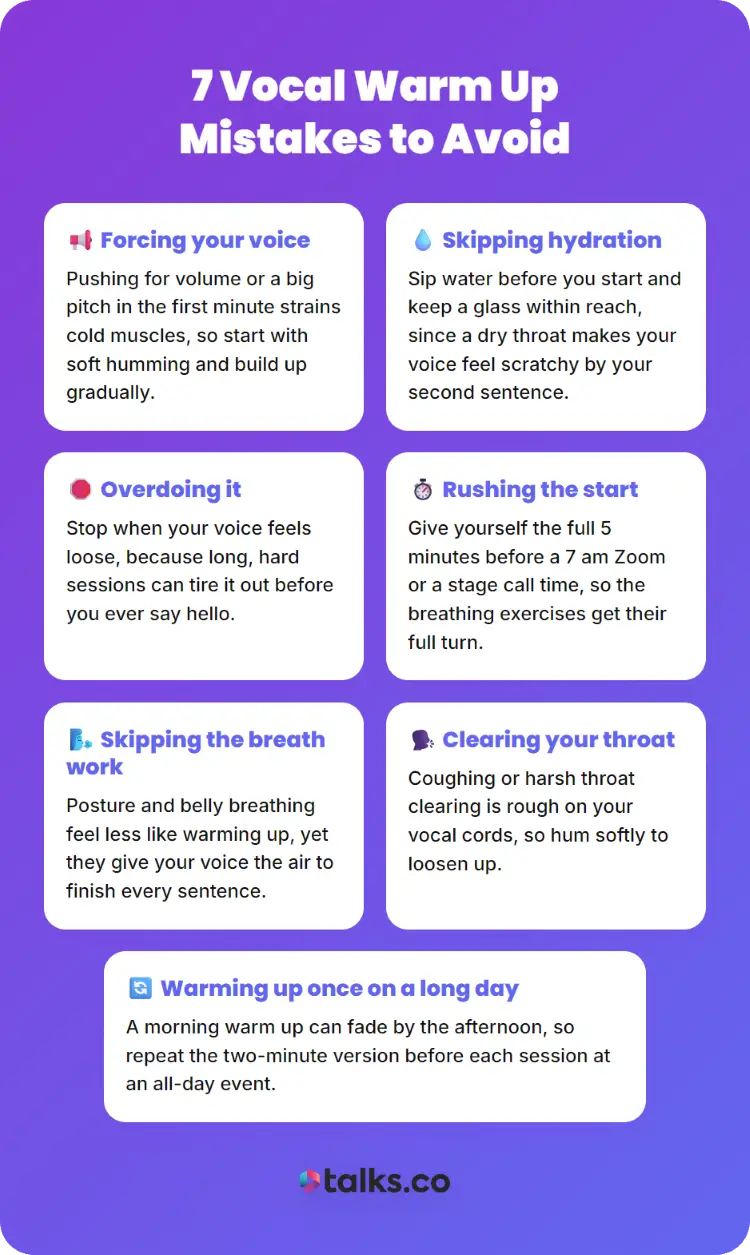
The biggest vocal warm up mistakes are forcing your voice and skipping water, and a few small habits make them easy to dodge before your next podcast, Zoom call, or stage talk.
- Forcing your voice: Pushing for volume or a big pitch in the first minute strains cold muscles, so start with soft humming and build up gradually.
- Skipping hydration: Sip water before you start and keep a glass within reach, since a dry throat makes your voice feel scratchy by your second sentence.
- Overdoing it: Stop when your voice feels loose, because long, hard sessions can tire it out before you ever say hello.
- Rushing the start: Give yourself the full 5 minutes before a 7 am Zoom or a stage call time, so the breathing exercises get their full turn.
- Skipping the breath work: Posture and belly breathing feel less like warming up, yet they give your voice the air to finish every sentence.
- Clearing your throat: Coughing or harsh throat clearing is rough on your vocal cords, so hum softly to loosen up.
- Warming up once on a long day: A morning warm up can fade by the afternoon, so repeat the two-minute version before each session at an all-day event.
Your Voice Is Ready Before You Speak
Next time you open a Zoom call, a stage talk, or a recording, give your voice a few minutes first. Start with the 2-minute version when your day is packed, and build up to the full 5 or 10 minutes as the stakes climb.
A vocal warm up for speaking costs a few minutes and gives you a steady first sentence, a voice that lasts through the Q&A, and nerves that settle faster, plus a warm voice gives hosts and audiences a reason to stay with you.
Ready to put that voice in front of new audiences?
Sign up for Talks to get featured as a guest on shows, or to find the right guests for yours.


