

Confidence gets weird when other people are watching.
You can know your stuff inside out and still hear yourself speak differently the moment a microphone is in front of you. I’ve seen it in sales, coaching, interviews, and live events. I’ve felt it myself.
The mistake is thinking confident people were simply born that way. Most of the time, they’ve had more reps.
When I was learning sales, I’d shadow people who were better than me, practice the calls, review what worked, then do it again. That same principle applies to confidence.
You build it by giving yourself chances to practice being the person you want to become.
These confidence building exercises will give you plenty of those chances, from everyday conversations to networking, podcast interviews, and public speaking.
What Is Self-Confidence?

Self-confidence is your belief that you can handle a situation, make a decision, communicate your ideas, and recover when things don’t go perfectly.
It’s battling negative thoughts with positive affirmations to boost your self-esteem, using confidence-building science-based exercises to increase your sense of self-worth, and learning to stay in the present moment when negative thought patterns try to hijack you with negative-self talk.
Being self-confident can change from one setting to another, which explains why someone can confidently coach a client in a private Zoom call all about going out of their comfort zone, increasing their mindfulness and resilience with a power pose or two yet freeze when asked to speak on stage.
Why confidence matters
Confidence affects how you communicate, make decisions, handle setbacks, and put your expertise in front of people.
Having confidence allows you to:
- Speak with conviction: A career coach pitching a workshop to a Chicago HR team can explain the offer without “maybe” and “I think.”
- Take more opportunities: An author invited onto The Mel Robbins Podcast as a podcast guest can prepare, say yes, and show up ready.
- Handle mistakes: Forgetting a statistic during a keynote at Sydney’s International Convention Centre doesn’t have to derail the presentation.
- Communicate expertise: A health coach can explain her six-week program without apologizing for the price.
- Become more visible: An entrepreneur can gradually get comfortable posting LinkedIn videos.
Why building confidence is important

Developing self-confidence happens through experience. Each time you practice something uncomfortable like blocking out negative self-talk and handle it, you give yourself evidence that you can do it again.
- Reduce avoidance: A consultant can practice on smaller podcasts before pitching larger shows.
- Build self-trust: Five weekly presentations can give a new Melbourne manager proof they can lead a room and become a confident speaker in public.
- Handle discomfort: Repeated speaking practice can make overcoming the fear of public speaking and pre-keynote nerves in San Francisco feel manageable.
- Improve communication: Practicing a sales pitch exposes rambling and awkward pauses before the call.
- Support bigger goals: Aspiring keynote speakers need higher confidence levels to pitch organizers and face large audiences.
Why confidence is important in coaching
Your confidence affects how you show up with clients. You need enough self-belief to ask difficult questions, challenge assumptions, and stand behind your professional judgment.
- Establish credibility: A New Orleans leadership coach can confidently advise a VP with decades of experience.
- Ask better questions: Confidence helps you probe when a client’s polished answer doesn’t match reality.
- Hold boundaries: A coach can clearly explain that 11:30 pm WhatsApp messages aren’t included.
- Challenge respectfully: You can question a client’s fixation on reaching 50,000 Instagram followers.
- Handle resistance: Client pushback becomes an opportunity to stay curious and explain your reasoning.
- Model confidence: A confidence coach should demonstrate the same willingness to speak up they teach clients.
How Does Exercise Build Your Confidence?
Exercise gives your brain repeated proof that you can do hard things. Each rep, awkward attempt, and small improvement builds self-efficacy, making unfamiliar situations feel more manageable over time.
For example, practicing a two-minute presentation alone can make speaking to 20 people feel less intimidating. The same principle applies to social confidence, networking, sales calls, and getting booked on podcast interviews.
You’re teaching yourself, through experience, “I can handle this.”
That’s also why affirmation reps to build and boost self-esteem matter so much.
When I was learning sales, I shadowed stronger teammates, practiced calls, reviewed what worked, and kept going. My confidence came from doing the work repeatedly rather than waiting to somehow magically feel ready.
Best Daily Confidence Building Exercises
Confidence gets stronger when you give yourself regular opportunities to practice it and enhance your self-esteem.
These confidence-building exercises are simple enough to use every day, but each one targets a different part of confidence, from self-talk and body language for low self-esteem to communication, growth mindset, and taking action.
Self confidence building activities
These exercises help you build confidence by giving your brain repeated evidence that you can handle uncomfortable situations. Start with one or two and use them consistently before adding more.
1. Keep a wins log
Your brain naturally gives more attention to mistakes, so deliberately recording wins gives you concrete evidence of progress.
- Log three wins: Write “answered a tough client question,” “pitched two podcasts,” and “spoke first in the team meeting.”
- Track the date: Add the date beside each win so you can see progress over several weeks.
- Review before pressure: Read five recent wins before a keynote, sales call, or podcast interview.
2. Practice positive self-talk

Useful self-talk should feel believable and specific, helping you focus on what you can control instead of predicting failure.
- Replace absolutes: Change “I always freeze” to “I sometimes need a second to think, and I can pause.”
- Prepare a cue: Write “Slow down and finish the thought” on a note beside your laptop.
- Use it before speaking: Repeat your cue immediately before joining a podcast recording or client call.
3. Keep small promises
Following through on small commitments builds self-trust because you repeatedly prove that you can rely on yourself.
- Choose one daily rep: Commit to five minutes of speaking practice every morning for seven days.
- Make it measurable: Record one 60-second explanation of your expertise instead of vaguely planning to “practice more.”
- Increase gradually: Move from one-minute recordings to three-minute talks once the first week feels manageable.
4. Visualize the situation
Mental rehearsal can make an unfamiliar situation feel more predictable by giving you a chance to mentally practice your response.
- Picture the opening: Before a keynote, visualize walking onstage, smiling, pausing, and delivering your first sentence.
- Rehearse pressure: Imagine a podcast host asking a question you don’t immediately know how to answer, then picture yourself pausing before responding.
- Focus on behavior: Visualize speaking slowly and clearly rather than imagining the audience applauding.
Self confidence building exercises
Confidence becomes easier to build when you can see and hear yourself improving. These exercises put confidence into practice instead of keeping it inside your head.
5. Record yourself speaking
Watching yourself back can reveal habits you don’t notice while speaking, giving you something specific to improve instead of relying on how confident you feel.
- Record a two-minute answer: Explain your coaching offer, book topic, or area of expertise without notes.
- Review one habit: Watch once and identify a single issue, such as rushing, looking away, or saying “um” repeatedly.
- Record again: Re-answer the same question immediately and focus only on fixing that one habit.
6. Practice eye contact
Comfortable eye contact can make conversations feel more confident and engaged, while practicing gradually helps reduce the urge to look away when you feel nervous.
- Use the three-second rule: Hold eye contact for roughly three seconds before naturally looking elsewhere.
- Practice on low-pressure calls: Maintain eye contact with your webcam when explaining an idea on Zoom.
- Test it in person: During your next networking conversation, focus on the other person’s eyes while they finish their thought.
7. Use a stronger voice
Your voice affects how clearly your expertise comes across. Practicing volume, pacing, and sentence endings can make your delivery sound more assured.
- Read aloud for two minutes: Use a page from your book, website, or presentation each morning.
- Finish every sentence: Avoid letting your voice trail off at the end of important points.
- Record one take: Listen for rushed sections, weak volume, or filler words and repeat the passage with one improvement.
8. Do one uncomfortable thing

Small, deliberate challenges teach your brain that discomfort is manageable and help expand the situations where you feel comfortable taking action.
- Ask one question: Speak up during your next team meeting, webinar, or industry event.
- Make one introduction: Walk up to someone at a conference and introduce yourself before you feel completely ready.
- Send the pitch: Choose one podcast that reaches your ideal audience and send a guest pitch you’ve been putting off.
Confidence building exercises for adults
Adults often know exactly what they want to say but hesitate when the moment arrives. These exercises create small, repeatable opportunities to practice speaking up, meeting people, setting boundaries, and receiving useful feedback.
9. Speak up once
Speaking early can make it easier to contribute before you spend the whole meeting second-guessing your idea.
- Set one target: Decide before the meeting that you’ll contribute at least once, even if it’s a 20-second observation.
- Prepare one point: Write down one opinion or question before joining the call.
- Go early: Aim to speak within the first 10 minutes instead of waiting for the “perfect” opening.
10. Start a conversation
Initiating conversations gives you repeated practice with social uncertainty, making networking feel less intimidating over time.
- Use a simple opener: Ask, “What brought you to this event?” instead of trying to invent a clever introduction.
- Prepare your 15-second intro: State your name, what you do, and the problem you help solve.
- Set a daily rep: Start one conversation with a stranger at your next conference, coworking space, or industry meetup.
11. Practice saying no
Clear boundaries build self-trust because you practice protecting your time instead of automatically agreeing to requests.
- Use a direct script: “I can’t take this on this week, but I can look at it Monday.”
- Remove the essay: Give your answer without listing five reasons to justify it.
- Practice somewhere small: Decline one low-stakes request this week before tackling a bigger client or workplace boundary.
12. Ask for feedback
Specific feedback gives you useful evidence about your communication and creates a clear target for your next practice session.
- Ask two questions: “What worked?” and “What should I improve next time?”
- Choose one reviewer: Ask a colleague who watched your presentation rather than collecting opinions from everyone.
- Apply one change: If they say you rushed through your opening, rehearse that section slowly before your next talk.
Daily confidence building exercises
The best confidence routine is one you can repeat without turning it into another big task on your calendar. Use these four exercises as a simple daily practice for stronger communication, greater visibility, and more self-trust.
13. Morning statement
A specific statement gives you a behavioral cue for the day, helping you focus on how you want to act instead of waiting to feel confident first.
- Write one sentence: Try “I’ll speak clearly, pause before answering, and trust what I know.”
- Match it to your goal: Before a speaking day, write “I’ll slow down and make eye contact.”
- Read it before work: Put the statement beside your monitor and read it before your first call.
14. Two-minute speaking drill
Speaking without notes forces you to organize your thoughts quickly, which builds comfort with spontaneous communication.
- Pick one topic: Explain your coaching method, book, or latest client lesson for two minutes.
- Remove the script: Use three keywords as prompts instead of writing complete sentences.
- Review one metric: Count filler words, long pauses, or unnecessary tangents, then repeat the drill.
15. One visibility action
Small visibility actions create regular practice with putting your ideas in front of other people, which can make bigger opportunities feel easier to pursue.
- Pitch one podcast: Send one personalized guest pitch to a show your ideal clients already listen to.
- Share one idea: Post a useful lesson from a recent client conversation on LinkedIn without turning it into a sales pitch.
- Start with five minutes: Set a timer and complete one visibility action before checking your inbox.
17. Evening review
Reviewing your progress helps your brain notice improvement that might otherwise get lost in the day’s mistakes and frustrations.
- Write one win: Record one moment you handled better than you would have six months ago.
- Name the behavior: Write “I answered the unexpected question without rushing” instead of “I felt confident.”
- Track it weekly: Review seven entries every Sunday and look for situations that are becoming easier.
Confidence Building Exercises For Specific Situations
Confidence can change depending on the situation. Speaking onstage, answering a podcast host, meeting strangers at a conference, or communicating with your boss all create different pressures, so your practice should reflect the situations you actually face.
Confidence building speaking exercises
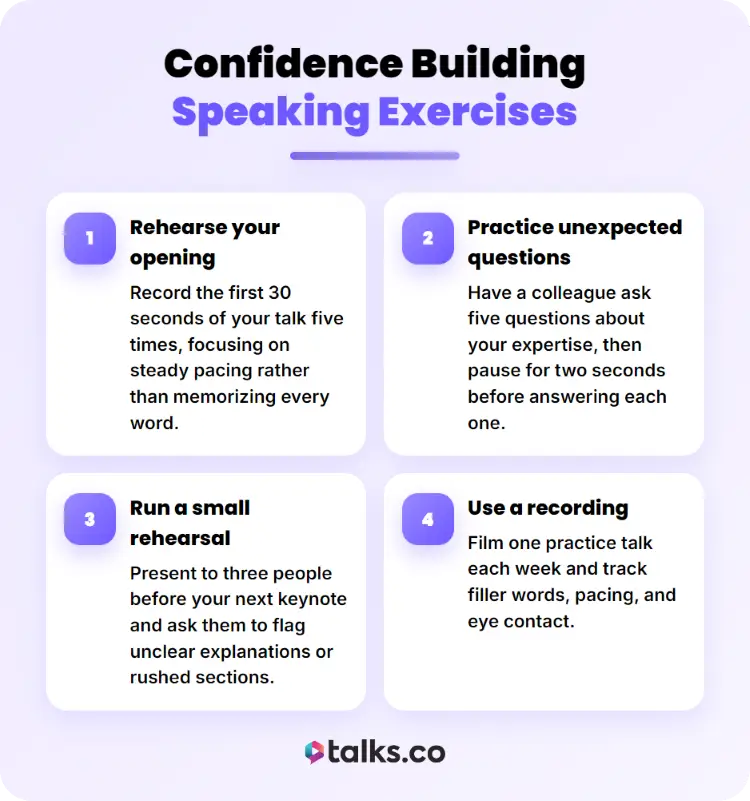
Speaking confidence improves through repeated exposure to the exact situations that make you nervous. Practice the mechanics of clear delivery before adding bigger audiences or higher-stakes opportunities.
- Rehearse your opening: Record the first 30 seconds of your talk five times, focusing on steady pacing rather than memorizing every word.
- Practice unexpected questions: Have a colleague ask five questions about your expertise, then pause for two seconds before answering each one.
- Run a small rehearsal: Present to three people before your next keynote and ask them to flag unclear explanations or rushed sections.
- Use a recording: Film one practice talk each week and track filler words, pacing, and eye contact.
Exercises to build social confidence
Social confidence comes from getting comfortable initiating interactions and staying engaged when you don’t know exactly what to say next.
- Start one conversation: At your next networking event, introduce yourself to someone standing alone before checking your phone.
- Ask open questions: Try “What are you working on right now?” instead of relying on small talk.
- Practice your introduction: Prepare a 15-second explanation of who you help and what you do.
- Stay present: Put your phone away for the first 20 minutes of an event and focus entirely on the conversations around you.
Confidence building exercises for men
Confidence can improve when you practice being direct, taking responsibility for your ideas, and staying composed when someone disagrees with you.
- State your position: In your next meeting, give your recommendation first, then explain the reasoning behind it.
- Make one direct request: Ask clearly for a deadline, resource, introduction, or fee without padding the request with unnecessary apologies.
- Practice disagreement: Tell a colleague, “I see it differently because…” and explain your reasoning without becoming defensive.
- Pause before responding: Take one full breath after a challenging question instead of rushing to fill the silence.
Confidence building exercises for women
Practicing clear communication, boundaries, and ownership of your expertise can help build confidence in professional and social situations.
- Claim your contribution: During a project recap, clearly state what you delivered instead of describing your work vaguely.
- Practice a boundary: Say, “I can have that ready Friday,” when Thursday’s deadline isn’t realistic.
- Speak early: Make one contribution during the first 10 minutes of your next meeting rather than waiting for the perfect moment.
- Accept the compliment: Respond with “Thank you, I appreciate that” when someone praises your work instead of immediately minimizing it.
Tips to Build Self Confidence & Mistakes to Avoid
A simple routine also makes it easier to keep going when your confidence hasn’t caught up with your effort yet.
Start with 10 to 15 minutes a day and focus on one skill at a time. After two weeks, you can increase the difficulty or add a second practice block.
- Monday: Record a two-minute explanation of your expertise and review one communication habit.
- Tuesday: Start one conversation with someone you don’t know at work, a meetup, or a networking event.
- Wednesday: Practice answering five unexpected questions about your business without notes.
- Thursday: Take one visibility action, such as pitching a podcast or sharing an expert tip on LinkedIn.
- Friday: Speak once during a meeting and record what happened afterward.
- Weekend: Review your wins, identify one improvement, and choose next week’s confidence target.
6 Common confidence mistakes to avoid
Even the latest public speaking fear statistics agrees that confidence practice can backfire when you set unrealistic expectations or focus too heavily on how you feel in the moment.
- Waiting to feel ready: Use small, manageable reps instead of waiting for nerves to disappear before taking action.
- Trying everything at once: Pick one exercise and repeat it for a week before adding another.
- Over-rehearsing: Practice your key points, then leave room to respond naturally during conversations and interviews.
- Comparing your beginning to someone else’s peak: Track your own speaking time, pitches, conversations, or presentations instead.
- Ignoring specific feedback: Turn “you need more confidence” into something measurable, such as slowing your speaking pace.
- Only practicing alone: Gradually move from mirror work to recordings, one-on-one conversations, small groups, and larger audiences.
You Need to Take Up More Space
Now’s no longer the time to keep doubting yourself and believing you’re just “not good enough.”
Confidence building exercises give you the reps. The next step is using that confidence where people can actually see your expertise.
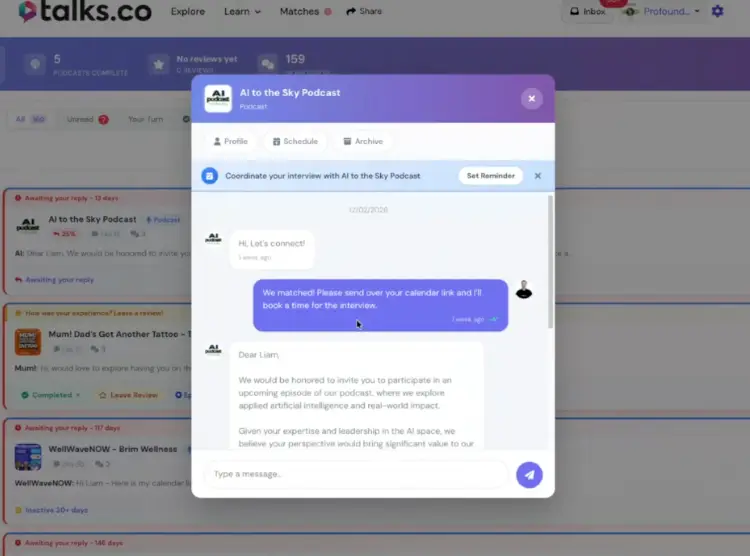
If podcast guesting has been sitting on your “someday” list, create your free Talks profile and start connecting with relevant hosts.
Talks can match you with podcasts in your niche, so you can start getting your ideas in front of audiences already interested in what you know.
The people getting booked are taking action now.
Create your free Talks profile and start finding podcast opportunities in as fast as 5 minutes.


