

What would you say if someone handed you a topic, started the clock, and told you to begin a speech and debate that is informative and well-developed?
Your mind probably goes blank, your mouth suddenly feels extremely dry, and suddenly, every intelligent thought you’ve ever had has left the building.
That’s the pressure of an extemporaneous speech. You’ve got limited time to think, organize your ideas, and sound confident while your brain is doing its best impression of a crashed laptop.
But the good in all of it? You can prepare for this.
Once you know how to break down a topic, form a clear position, organize your key points, and speak from brief notes, you can handle the pressure without memorizing an effective persuasive speech script word for word.
And that’s exactly what we’re going to cover.
What Is Extemporaneous Speech?
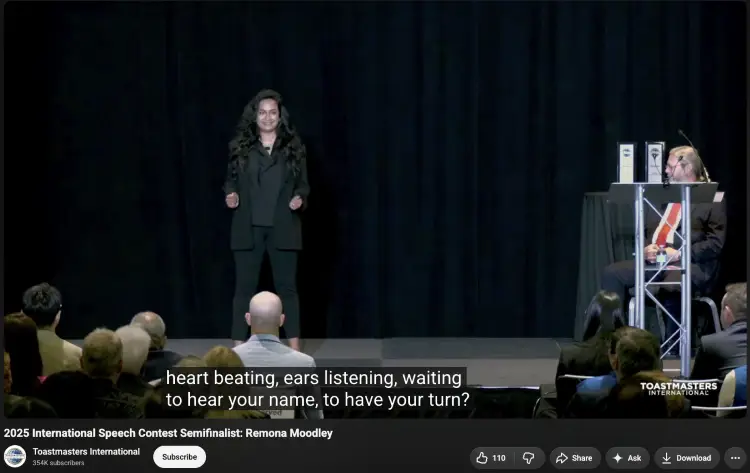
An extemporaneous speech is a prepared speech delivered conversationally, usually from brief notes rather than a fully written script. You’ve done the thinking beforehand, but you leave enough room to adapt your wording as you speak.
What is extemporaneous speech delivery?
Extemporaneous speech delivery gives you a clear plan without forcing you to recite every sentence. You prepare your ideas, then deliver them naturally.
- Prepared: You research your topic and decide what you want to say.
- Brief notes: You use keywords or prompts instead of full paragraphs.
- Conversational: You speak naturally rather than sounding rehearsed.
- Flexible: You can adjust your wording, examples, or emphasis as you go.
Is extemporaneous speech memorized?
You’ll usually memorize the structure and key ideas, not every word. That keeps your delivery natural and gives you room to respond to the audience.
- Know your message: Remember your main argument and supporting points.
- Know your structure: Keep the order of your ideas clear.
- Use prompts: Let short notes jog your memory.
- Practice aloud: Rehearse enough to build familiarity without sounding scripted.
How long is extemporaneous speech?
There’s no universal time limit for extemporaneous speech. The length depends on the setting, purpose, and rules of the event or competition.
- Short speeches: Often run for a few minutes.
- Competitions: Follow the specific time limit set by the organizers.
- Presentations: Can run longer when the topic needs more explanation.
- Practice: Time yourself so you know how much material you can comfortably deliver.
Where Do We Use Extemporaneous Speech?
Extemporaneous speaking gives you enough preparation to know where you’re going while leaving room to sound like yourself. Here are six situations where that flexibility pays off:
- Podcast interviews: Before appearing on The Diary Of A CEO, a leadership coach can prepare 3 stories about managing burnout without memorizing every answer.
- Conference talks: A speaker at SXSW can outline a 20-minute session on creator economics, then adapt examples based on audience reactions.
- Client presentations: A business consultant presenting to Shopify’s marketing team can prepare key recommendations while answering follow-up questions naturally.
- Panel discussions: An author on an SXSW panel can prepare positions on AI and publishing, then respond directly to what the other panelists say.
- Media interviews: A health expert speaking with BBC News can prepare statistics and talking points before handling unexpected questions from the host.
- Networking events: A career coach at Web Summit can prepare a concise explanation of their specialty, then adjust the conversation around each person’s questions.
During an extemporaneous speech competition

Competitive extemporaneous speaking often gives you a short window to prepare before delivering a timed response. For example, a competition might ask, “Should Australia introduce a four-day workweek?”
- Preparation: You may get 30 minutes to research and outline your response.
- Topics: Questions can cover elections, AI, climate policy, or international trade.
- Delivery: Judges assess organization, evidence, delivery, and time management.
- Timing: A round might require a 7-minute speech with strict time limits.
Within extemporaneous speaking questions
A strong question gives you enough material to build an argument quickly. “Should universities ban ChatGPT?” gives you a clear issue, opposing viewpoints, and plenty of room for evidence.
- Policy: “Should Australia lower the voting age to 16?”
- Business: “Should companies keep remote work permanently?”
- Technology: “Should schools restrict generative AI?”
- Society: “Has social media improved public conversation?”
What Is the Difference Between Impromptu and Extemporaneous Speech?
The biggest difference comes down to preparation. An impromptu speech gives you little or no warning, while an extemporaneous speech gives you time to research, organize your thoughts, and prepare brief notes before you speak.
What is impromptu speech vs extemporaneous speech?
Imagine a networking event where someone asks you to explain your coaching business on the spot. That’s impromptu. Preparing a 5-minute talk about your coaching method from three bullet points is extemporaneous.
- Preparation: Impromptu gives you seconds; extemporaneous gives you preparation time.
- Notes: Impromptu rarely uses notes; extemporaneous commonly uses brief prompts.
- Research: Impromptu relies on existing knowledge; extemporaneous allows research.
- Delivery: Both should sound conversational and natural.
Extemporaneous speech and impromptu speech difference
Both formats test your ability to communicate clearly, but they create different pressures.
An impromptu answer rewards quick thinking, while an extemporaneous speech example rewards preparation without sounding rehearsed.
| Aspect | Impromptu speech | Extemporaneous speech |
|---|---|---|
| Example | Answer an emcee or podcast host’s surprise follow-up. | Prepare three talking points before your guest interview. |
| Structure | Forms while speaking. | Planned beforehand. |
| Flexibility | Adapt on the fly as you speak. | Adapt while speaking, but within a prepared framework. |
Why Use Extemporaneous Speech?
Extemporaneous speaking gives you enough preparation to sound sharp without turning your delivery into a recital. That matters when you’re pitching an idea, answering questions on a podcast, or speaking to a room full of potential clients.
Extemporaneous speech examples
Picture a health coach speaking at a wellness conference about building sustainable exercise habits. She has three key points prepared, but explains each one in her own words.
- Conference talk: Present a prepared argument from brief notes.
- Podcast interview: Prepare key ideas before answering the host’s questions.
- Business presentation: Explain quarterly results using a structured outline.
- Panel discussion: Prepare talking points while adapting to other speakers.
Extemporaneous speech script sample outline
An extemporaneous speech script works best as a speaking guide rather than something you memorize word for word. Use short prompts to keep your argument moving.
- Opening: “Most people quit their fitness routine within 3 months.”
- Point 1: Why motivation fades.
- Point 2: What makes habits easier to maintain.
- Example: A client who replaced 6 weekly workouts with 3.
- Close: “Consistency beats intensity when you’re building a habit.”
What Is a Good Topic for an Extemporaneous Speech?

You want a topic that’ll give you enough room to take a position, tell a story, throw in a solid example, and keep the conversation moving.
Here are 20 topics that give you plenty to work with:
- Should schools limit students’ use of generative AI?
- Should employers move to a four-day workweek?
- Has social media made political discussion better or worse?
- Should universities make public speaking opportunities a required course?
- Should companies be required to disclose their use of AI?
- Is remote work actually better for productivity?
- Should governments regulate social media algorithms?
- Should teenagers have stricter limits on social media use?
- Does influencer marketing still build trust with consumers?
- Should businesses put employee wellbeing ahead of productivity targets?
- Should professional athletes speak publicly about politics?
- Has streaming made entertainment better?
- Should companies publish salary ranges on every job listing?
- Is entrepreneurship a better career path than traditional employment?
- Should schools teach financial literacy from an early age?
- Does working from home actually improve work-life balance?
- Should governments give businesses incentives to use renewable energy?
- Has artificial intelligence made education better?
- Should podcasts be treated as a form of journalism?
- Does public speaking deserve more attention in professional education?
How to Prepare for Extemporaneous Speech
Still learning how to become a public speaker? Give yourself a repeatable process, then practice it until you can use it under pressure.
- Read the question twice: On the second read, underline the exact action being asked, such as “Should Australia introduce a four-day workweek?”
- Take a position: Write your answer in one sentence: “Yes, Australian employers should trial a four-day week because productivity, retention, and wellbeing can improve.”
- Pick three reasons: Choose 3 points that directly support your position rather than three interesting facts about the topic.
- Add one concrete example: Attach a specific case to each point, such as Microsoft Japan’s 2019 four-day workweek experiment.
- Build your opening: Start with a fact, question, short story, or strong opinion that gets people listening immediately.
- Write cue words: Put “productivity > Microsoft > trial results” on your notes instead of writing the entire paragraph.
- Plan your close: Return to your original position and give the audience one clear takeaway they can remember.
- Practice with a timer: Give yourself 10 minutes to prepare, then record a 5-minute response on your phone.
- Review the recording: Check where you ramble, repeat yourself, rush, or lose your point, then tighten those sections.
- Repeat with a new topic: Try the same process with “Should Australian universities restrict generative AI?” until the structure feels automatic.
How to do an extemporaneous speech
Once the preparation clock starts, your job is to turn a messy question into a simple argument you can actually speak. Use this quick sequence to keep your thoughts organized.
- Identify the question: Circle words such as “should,” “why,” “how,” or “what” so you know exactly what you’re being asked.
- Choose your answer: Write “YES,” “NO,” or a qualified position at the top of your notes.
- Use the PREP framework: Make your Point, give a Reason, provide an Example, then Point back to your argument.
- Create three headings: For a question about remote work, write “productivity,” “culture,” and “flexibility” as your three talking points.
- Attach evidence: Add one memorable detail under each heading, such as a company example, statistic, study, or personal observation.
- Write your first sentence: Try something direct like, “Imagine cutting your commute from 90 minutes to zero every morning.”
- Mark your transitions: Use simple prompts such as “First,” “Next,” and “Finally” so you always know where you’re going.
- Leave breathing room: Put a slash between major points in your notes to remind yourself to pause before moving on.
- Deliver from keywords: Look down, grab the next idea, then look back up before speaking rather than reading from your page.
- Finish on your answer: End by stating your position again in fresh language so the audience knows exactly what you believe.
6 Types of extemporaneous speech format examples
Once you understand the basic structure, you can shape an extemporaneous speech around different subformats depending on the question and audience.
Pick the type of speech format that makes your argument easiest to follow.
- Problem-solution: Explain the problem, show why it matters, then recommend a practical solution.
- Cause-effect: Explore what caused an issue, then explain the consequences, such as how fake followers can weaken trust in influencer marketing.
- Compare-contrast: Put two approaches side by side, such as remote work versus office-based work, then argue which works better.
- Question-answer: Build the speech around three questions your audience is likely to ask, answering each with evidence and examples.
- Persuasive: Take a clear position, support it with your strongest arguments, address the opposing view, then reinforce your conclusion.
- Topical: Break a broad subject into three distinct areas, such as authenticity, transparency, and relevance when discussing influencer marketing.
How to make extemporaneous speech
Writing an extemporaneous speech means preparing your notes that help you remember the argument while leaving your actual wording flexible.
- Write the opening: Draft your first two sentences so you know exactly how you’ll begin.
- Build the body: Give each main point a short heading and one supporting detail.
- Add examples: Use specific references, such as a Harvard Business Review study or a real company case.
- Write the close: Prepare one sentence that reinforces your central argument.
- Convert to prompts: Replace paragraphs with keywords, numbers, names, and short phrases.
How to write extemporaneous speech
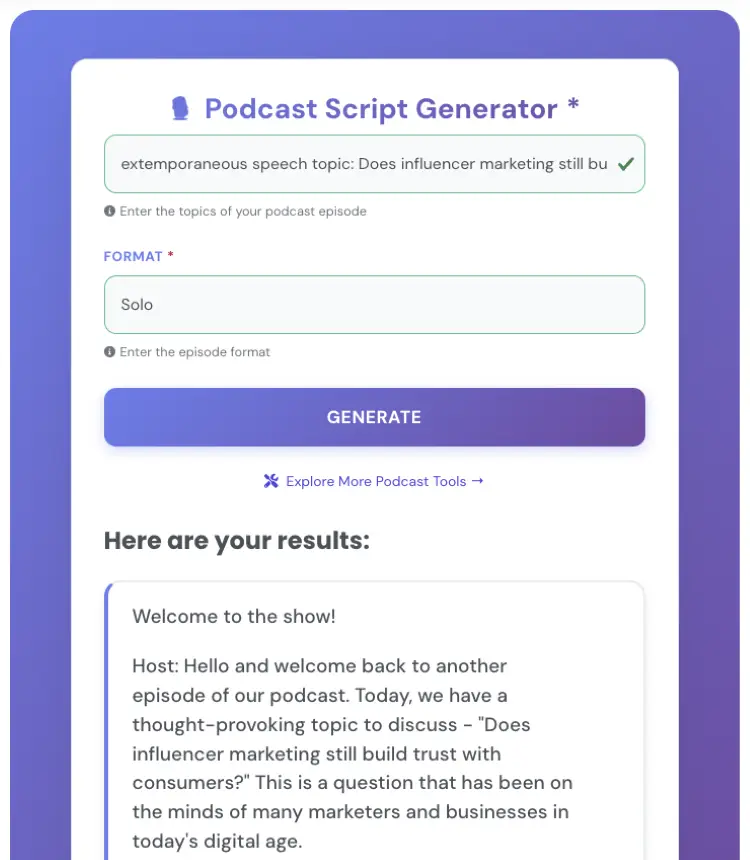
You can also use a free Talks Podcast Script Generator to get your first draft moving, then turn that draft into speaking notes you can actually use.
For example, enter “Does influencer marketing still build trust with consumers?” into the Talks Podcast Script Generator, select Solo, and you’ll get a complete starting script.
- Pull out the argument: Use the generated answer to identify the position and strongest supporting points.
- Keep useful examples: Save specific ideas around fake followers, sponsored content, transparency, and authenticity.
- Turn paragraphs into prompts: Convert the longer script into keywords you can glance at while speaking.
- Make it yours: Add your own opinion, stories, client experiences, or examples before practicing aloud.
How to start extemporaneous speech
The first few seconds can feel brutal because you’re still settling your nerves while everyone is watching. Have your opening ready, then use it to get your rhythm before moving into the main argument.
- Ask a question: “What would happen if every Australian company moved to a four-day workweek tomorrow?”
- Use a surprising fact: Lead with one relevant statistic you can explain clearly.
- Tell a quick story: Give the audience a specific moment, such as missing a train because of a 90-minute commute.
- Take a position: Start with “I believe Australian employers should…” and explain why.
- Connect to the audience: Open with a situation they recognize, then move directly into your argument.
Extemporaneous speech outline example
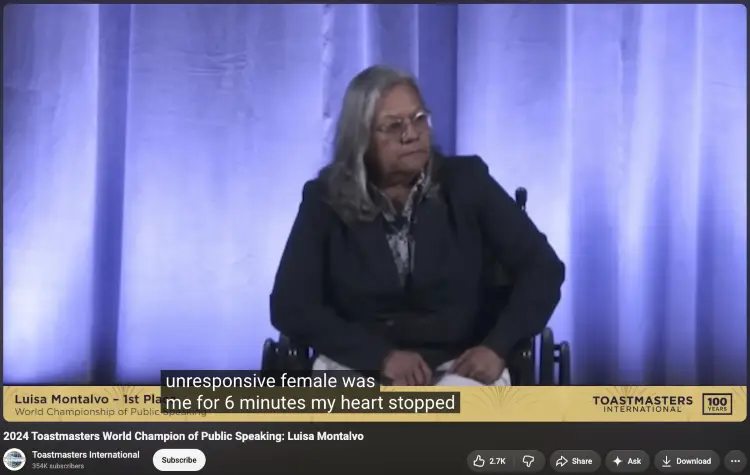
Luisa Montalvo’s 2024 Toastmasters World Championship speech 37 Strangers is a great example of how a personal story can carry a clear argument. You can borrow its structure for your own extemporaneous speech, then speak from short prompts.
- Hook: Start with the life-or-death moment: “For six minutes, my heart stopped beating.”
- Set the scene: Explain that Montalvo was returning from New Jersey after delivering 88 homeless shelter dogs to a rescue.
- Introduce the central idea: Bring in the 37 people who helped save her: firefighters, EMTs, helicopter pilots, surgeons, and nurses.
- Add personality: Use a lighter imagined scene with St. Peter and his iPad to give the audience a laugh after the heavier opening.
- Show the turning point: Move to her 90 days in trauma care and rehab, where she questioned her own value.
- Give the audience a human example: Tell the story of the young man in the gym who had recently lost both legs but was excited about getting married.
- Land the message: Connect the 37 strangers to the audience and challenge them to treat other people with dignity and worth.
- Create a memorable close: Return to the “reset button” idea and invite the audience to hit their own reset button.
How to Deliver an Extemporaneous Speech Confidently
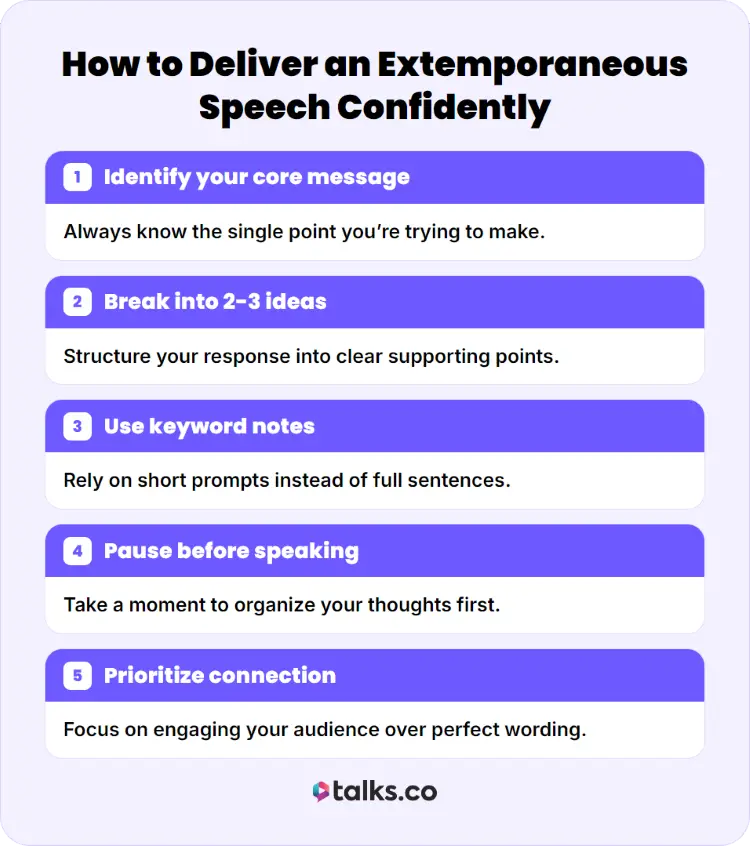
Confidence comes from knowing what to do when your brain inevitably throws you a curveball. Follow these steps to structure your approach before and during the speech:
- Identify your core message: Always know the single point you’re trying to make.
- Break into 2-3 ideas: Structure your response into clear supporting points.
- Use keyword notes: Rely on short prompts instead of full sentences.
- Pause before speaking: Take a moment to organize your thoughts first.
- Prioritize connection: Focus on engaging your audience over perfect wording.
Practice these five public speaking tips together with the ones below until they feel familiar, then you can focus on connecting with the room.
6 Tips for extemporaneous speech
You need to sound like you know where you’re going, even when you pause, rethink a sentence, or change direction.
- Pause before answering: Give yourself two seconds to think instead of filling silence with “um” or “you know.”
- Look at one person: Hold eye contact for a full sentence, then move naturally to someone else.
- Slow down after your opening: Nerves often make the first 30 seconds ridiculously fast.
- Signpost your argument: Say “My first point…” so the audience always knows where you are.
- Practice random topics: Pick a headline from The Guardian and give yourself 60 seconds to form a three-point response.
- Finish cleanly: Stop after your final point instead of weakening your ending with “so, yeah, that’s basically it.”
7 Examples of extemporaneous speech questions to never ask
Some questions make an extemporaneous speech unnecessarily difficult because they’re vague, enormous, or impossible to answer meaningfully in a few minutes.
If you’re creating prompts for others, tighten them first.
- “Is the world getting better?” Define the area you’re actually asking about.
- “Tell us about politics.” Pick a policy, election, or current issue.
- “What makes someone successful?” Give the speaker a specific context, such as entrepreneurship.
- “What is the meaning of life?” Save the existential crisis for another day.
- “How can we fix climate change?” Focus on one industry, policy, or action.
- “What is the future of business?” Ask about a specific trend, market, or technology.
- “What should governments do?” Name the government, problem, and decision you want addressed.
Does Your Brain Thrive Under Pressure?
An extemporaneous speech gets a whole lot easier when you know how to think, organize, and speak under pressure. Practice with real questions, keep your notes lean, and get comfortable leaving a little space between your thoughts.
And once you’re ready to put those speaking skills in front of a bigger audience, create your free Talks profile. You could be one good conversation away from your next podcast interview, speaking opportunity, or client.
Want more people hearing what you have to say?
Create your free Talks profile and start connecting with podcast hosts today.


