

Give a group of 13-year-old middle schoolers a controversial debate topic they care about and suddenly everyone has something to say.
My nephew once overheard me and my fiancee, Sarah, having a pretty heated debate about whether we should send Vegemite to our team in the Philippines together with the rest of their care packages. He jumped straight into the conversation with his own solution: let the team decide if they like it.
And you know what? Fair enough, kid.
That’s the magic of a middle school debate topic with some bite.
For junior high school students, the right question can make public speaking and research feel relevant and turn a classroom exercise into a middle school debate they actually want to win. Pick the wrong one and you’ll be met with blank stares from a bunch of middle school students.
Below, you’ll find 100 persuasive junior high debate topics covering school, technology, friendships, social media, entertainment, everyday life, and social issues, with options for different communication skill levels and kids of all ages.
What Are Debate Topics?

Debate topics are questions or statements that give students two or more positions to argue. For junior high students, the best topics are easy enough to understand but open enough to support different opinions, evidence, and rebuttals.
Think about the Vegemite debate from earlier. My nephew didn’t need a university-level understanding of food science to have an opinion. He heard the question, picked a position, and explained his reasoning.
That’s a useful test for any junior high debate topic: can a student understand the interesting debate topic for kids, take a side, and give a reason for it?
What makes a good debate topic?
A good debate topic for middle school students gives them something worth arguing about, builds confidence, and encourages them to use their critical thinking skills to present their sides of the argument.
Look for fun and engaging topics that:
- Have reasonable arguments on both sides: Students should be able to make a case without reaching for extreme or unrealistic points.
- Are easy to understand: Skip complicated wording or specialist knowledge that gets in the way of the actual debate.
- Have reliable evidence available: Students should be able to find facts, research, examples, and expert opinions to support their arguments.
- Match the students’ age and experience: Familiar subjects often give younger students a stronger starting point.
- Leave room for rebuttals: The opposing side should have enough substance to challenge the argument and keep the discussion moving.
- Fit the assignment: Consider the available research time, debate format, and speaking time before settling on a topic.
Top 100 Junior High Debate Topics
A good debate topic can change the whole energy of a classroom. Give students something they already have an opinion about, then add enough room for evidence, disagreement, and a solid rebuttal, and suddenly you’ve got a debate worth having.
These 100 junior high debate topics cover school, technology, friendships, entertainment, everyday life, social issues, and a few trickier questions for students ready for a bigger challenge.
Use them as written or tweak the wording to suit your class, debate format, and students’ skill levels.
Best junior debate topics for school

School debates are an easy place to start because students already have plenty of opinions about homework, uniforms, lunch, grades, and school rules.
These should feel familiar enough to get a student talking, while still giving them something they can argue from both sides.
- Should students have homework every night?
- Should school uniforms be required?
- Should students be allowed to use phones during lunch?
- Should the school day start later?
- Should grades be replaced with written feedback?
- Should students get a longer lunch break?
- Should schools offer four-day school weeks?
- Should students choose their own seats?
- Should schools ban junk food?
- Should students have more choice over their classes?
- Should group projects count toward individual grades?
- Should schools have mandatory physical education?
- Should students be allowed to listen to music while working?
- Should schools offer more life-skills classes?
- Should students have a say in school rules?
Fun debate topics for high school students about technology

Technology gives junior students plenty to argue about, from AI and smartphones to video games and online learning.
Some of these are easy to jump into, while others will push students to do a little more research before they pick a side.
- Should students be allowed to use AI for schoolwork?
- Should schools teach AI literacy?
- Should students have screen-time limits?
- Should every student have a school-issued laptop or tablet?
- Are video games good for students?
- Should schools ban smartphones during class?
- Should children under 14 have social media accounts?
- Should parents monitor their children’s internet use?
- Should schools teach coding to every student?
- Is technology making students less independent?
- Should students be allowed to use calculators for all math work?
- Should schools replace textbooks with tablets?
- Should students be allowed to use search engines during tests?
- Is online learning as effective as learning in a classroom?
- Should robots be used to help teach students?
Junior high debate topics about social media
Friendships can get surprisingly interesting once you start asking students what makes someone a good friend. These topics give them room to talk about trust, honesty, loyalty, and the way friendships work online and in person.
- Is it better to have a few close friends than many friends?
- Should friends always tell each other the truth?
- Should you forgive a friend who breaks your trust?
- Is it okay to end a friendship over an argument?
- Should friends have to share the same interests?
- Is competition between friends healthy?
- Should you defend a friend who is being bullied?
- Can people be close friends without seeing each other often?
- Should friends always support each other’s decisions?
- Is it better to make friends in person than online?
Junior high debate topics about entertainment
Students already have plenty to say about the movies they watch, games they play, books they read, and music they listen to. These topics turn those everyday opinions into questions they can actually build an argument around.
- Are books better than movies?
- Should movie theaters ban phones during films?
- Should celebrities be role models for young people?
- Are reality TV shows good entertainment for teenagers?
- Should violent video games have age restrictions?
- Is watching sports better than playing sports?
- Should schools offer more arts and music programs?
- Are streaming services better than traditional television?
- Should students be allowed to choose the music played at school events?
- Is it better to watch a movie at home than in a theater?
- Should famous people be held responsible for their influence on young fans?
- Are animated movies as valuable as live-action movies?
- Should schools have talent shows?
- Is reading for fun better than watching TV for fun?
- Should students be allowed to review movies, games, or books for class assignments?
Junior high debate topics about everyday life
Some of the best debate topics are hiding in the stuff students deal with every day. Chores, bedtimes, part-time jobs, free time, and family rules can all lead to strong arguments when there’s a reasonable case to make on both sides.
- Should teenagers have regular household chores?
- Should students earn an allowance for doing chores?
- Should kids be allowed to choose their own bedtime?
- Should teenagers be allowed to have part-time jobs?
- Should students be allowed to walk or bike to school alone?
- Should children get more freedom as they get older?
- Should parents limit how much junk food their children eat?
- Should teenagers be responsible for buying some of their own clothes?
- Should students be allowed to bring pets to school?
- Is it better to spend free time indoors or outdoors?
- Should schools have longer summer breaks?
- Should teenagers be allowed to stay up later on weekends?
- Should students learn how to cook before finishing junior high?
- Should children have a say in family decisions?
- Should students be required to volunteer in their communities?
Junior high school debate topics on social issues
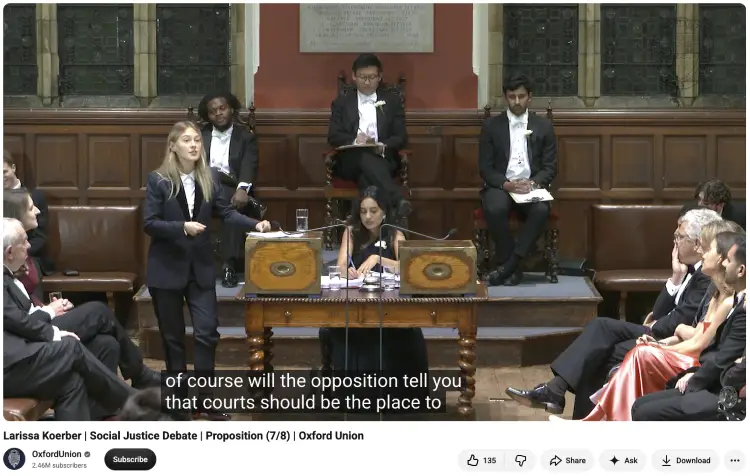
These controversial debate topics go beyond a student’s immediate school or home life and get students to consider new debate topics relevant to their community and the wider world.
They’re a little more demanding, so students may need to spend extra time researching facts and understanding different points of view when you use these topics.
- Should schools have mandatory anti-bullying programs?
- Should students be punished for bullying someone online?
- Should schools provide free meals to every student?
- Should communities have more public spaces for teenagers?
- Should students be required to participate in community service?
- Should schools teach students about climate change?
- Should recycling be mandatory in schools?
- Should stores stop giving customers plastic bags?
- Should animals be kept in zoos?
- Should students learn about different cultures in school?
- Should schools provide free mental health resources for students?
- Should everyone be required to help keep public spaces clean?
- Should schools have stricter rules against discrimination?
- Should students be allowed to organize campaigns for causes they care about?
- Should communities create more programs for young people?
Fun and challenging junior high debate topics
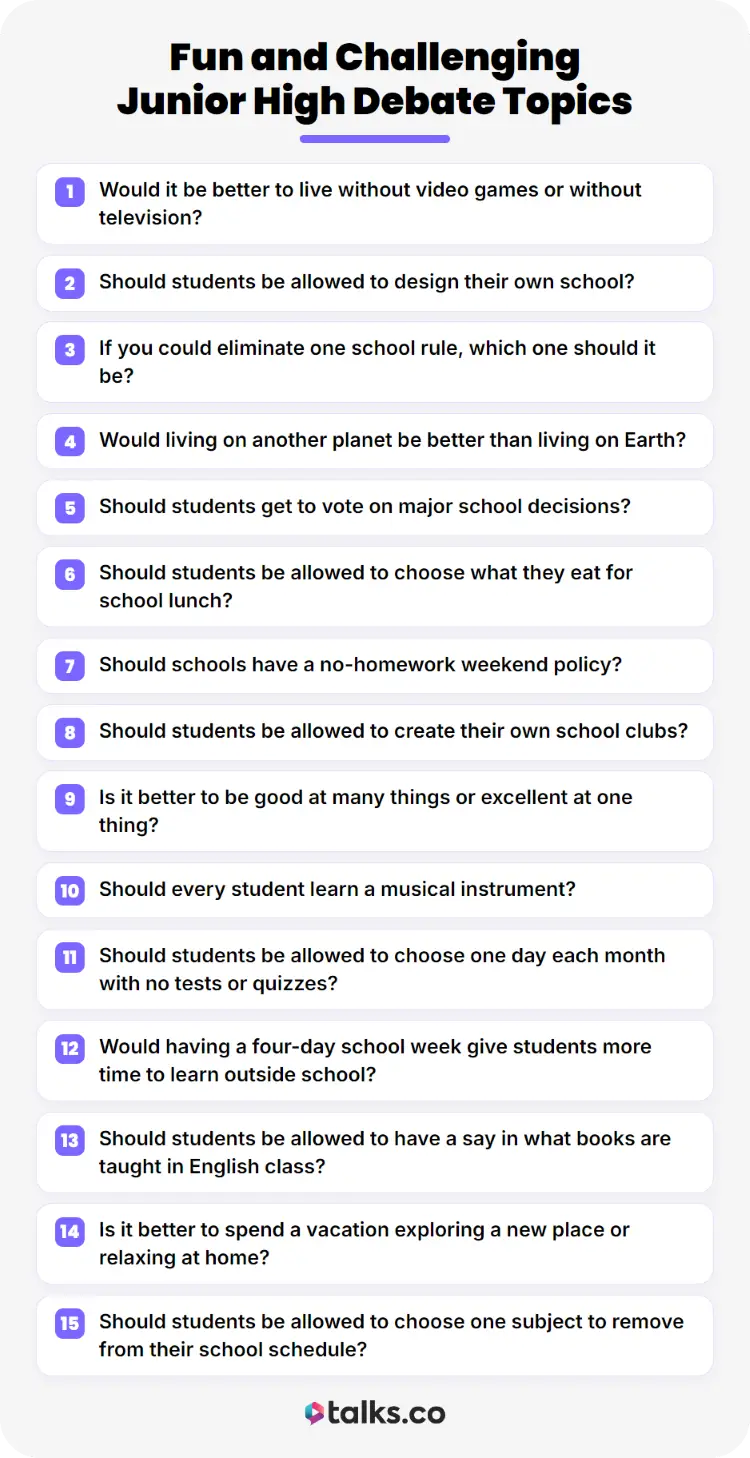
Once students have tackled a few familiar questions, it’s good to throw in some fun debate topics that make them stop and think. These are a mix of lighthearted and more challenging prompts that can test how well a student builds an argument when the answer isn’t obvious.
- Would it be better to live without video games or without television?
- Should students be allowed to design their own school?
- If you could eliminate one school rule, which one should it be?
- Would living on another planet be better than living on Earth?
- Should students get to vote on major school decisions?
- Should students be allowed to choose what they eat for school lunch?
- Should schools have a no-homework weekend policy?
- Should students be allowed to create their own school clubs?
- Is it better to be good at many things or excellent at one thing?
- Should every student learn a musical instrument?
- Should students be allowed to choose one day each month with no tests or quizzes?
- Would having a four-day school week give students more time to learn outside school?
- Should students be allowed to have a say in what books are taught in English class?
- Is it better to spend a vacation exploring a new place or relaxing at home?
- Should students be allowed to choose one subject to remove from their school schedule?
How to Choose the Right Debate Topic (Checklist)

Got a few possible topics for your students? Run each one through this checklist before assigning it. A strong student debate topic should suit their age and skill level while giving them enough room to research, argue, and respond to the other side.
☐ Can students form a clear opinion? They should be able to choose a side and explain why without extensive research.
☐ Do students know enough to get started? Familiar subjects can give beginners a useful starting point.
☐ Can students argue either side? If students can find reasonable points for both positions, the topic has debate potential.
☐ Is the question specific enough? “Should schools ban phones during class?” gives students a clear issue to argue.
☐ Can students find reliable evidence? Look for topics with accessible research, statistics, expert opinions, or official information.
☐ Does the topic fit their age and assignment? Students should understand the subject without specialist knowledge.
☐ Will students have enough time to research it? Avoid topics that require more preparation than the assignment allows.
☐ Does it fit the debate format? Consider the time limit, number of speakers, and debate rules.
☐ Can students make more than one strong point? Look for topics that support several distinct arguments.
☐ Can students predict what the other side will say? Strong topics give students clear counterarguments to prepare for.
10 Tips to Help Students Prepare for a Debate
Once you’ve chosen the topic, help students turn their research into a clear argument. They need solid evidence, a few strong points, and practice responding to the opposing side.
- Research both sides: Have students explore evidence supporting their position and the main arguments against it.
- Use trustworthy sources: Start with school district websites, government agencies, universities, and established research organizations.
- Write down the main argument: Help students turn their research into one clear position they can explain.
- Find evidence for each point: Match statistics, research, examples, or expert opinions to each major argument.
- Prepare for the other side: Ask students to identify two or three arguments their opponents might make.
- Practice short rebuttals: Have students practice answering likely challenges in one or two clear sentences.
- Keep notes easy to scan: Use short bullet points, key facts, and source names instead of full paragraphs.
- Practice out loud: Have students practice with a classmate, teacher, parent, or teammate.
- Watch the time: Make sure students can deliver their main points within the assigned time limit.
- Listen before responding: Encourage students to focus on the opposing team’s claim before preparing their response.
These tips apply even for the most popular podcasts, people learning how to become a content creator preparing for their next public speaking opportunity, or emcees struggling to get booked on podcasts.
Change Can Happen Within Four Walls
Strong junior high debate topics for students can do more than fill a class period. Give students a question they care about and they start thinking harder, defending their ideas, and finding their voice.
That ability to speak up on great debate topics for high schoolers tends to stick with you.
And if you’re building a career around your ideas, expertise, or story, getting in front of the right audience matters too. Talks helps you connect with podcast hosts looking for guests like you, so you can spend less time hunting for opportunities and more time having conversations that put your ideas in front of new people.
Ready to get your voice out there? Create your free Talks profile and start finding podcast opportunities.
Create your free Talks profile today!


