

Want to start a podcast, but you’re not the type to ramble all alone?
Starting a podcast interview might be the format for you. You get to bring out unique perspectives from different guests, putting your hosting and listening skills to the test.
But to actually turn your conversations into professional episodes people will listen to, you need structure and planning that seems effortless.
To guide you, I listed 9 podcast interview template options to help you write a script for solo shows, group discussions, and more. Think of them as your roadmap to knowing exactly what to ask and when to ask it.
I also listed practical tips for finding guests, writing your questions, and conducting interviews like a seasoned pro.
What Is a Podcast Interview?
A podcast interview is a recorded conversation between a podcast host and a guest. It allows you to share the guest’s expertise with your audience.
You’re not just casually chatting. You follow a structured format to keep the discussion focused, engaging, and valuable for podcast listeners.
Interviews can range from deep-dive explorations of a single topic to quick conversations touching on multiple subjects.
What are the most popular interview podcasts out there?
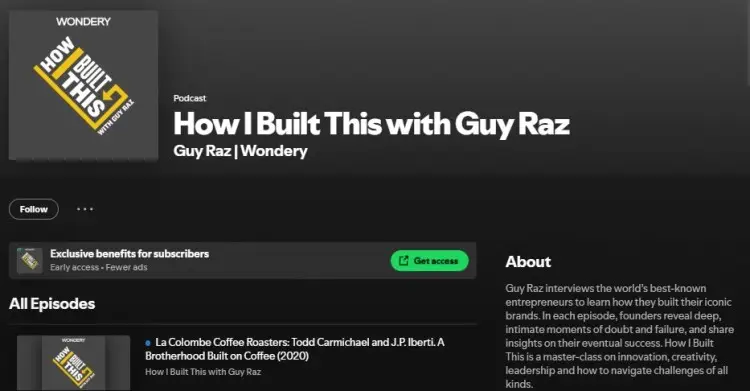
Many shows have mastered this format and grown massive followings. Here are a few examples of successful and crowd favorite podcast interview-style shows:
- The Joe Rogan Experience: Known for long-form conversations with diverse guests ranging from scientists to comedians.
- How I Built This: Features founders and entrepreneurs discussing how they created their companies, focusing on origin stories, challenges, and important moments that defined their journey.
- The Tim Ferriss Show: Explores high-performers across industries through conversations about habits, mindsets, and breakthroughs.
- Lex Fridman Podcast: Brings on researchers, entrepreneurs, and thought leaders for philosophical and technical deep-dives that explore ideas from multiple angles.
- On Being with Krista Tippett: Centers on meaningful conversations about life’s biggest questions, featuring artists, scientists, and spiritual leaders.
- The Indicator from Planet Money: Short-form interviews that break down economic concepts and how they affect daily life.
- Masters of Scale: Explores how to scale a business through interviews with founders and lessons applicable to any organization.
If you want to reach their level of success, you need to be strategic with the guests you interview. Find experts in your niche who add depth and energy to your show by joining top podcast guest-matching platforms like Talks.
9 Free Podcast Interview Template Options
Creating a perfect podcast script depends on the type of podcast format and podcast topic you’re doing.
Every podcast template below represents a different approach to structuring your podcast segments and episode scripts. Pick from any of these free templates that match your style, or adapt these to create your own version.
Let’s look at free podcast script templates for solo podcasts, panel discussions, and more to help you write a podcast script of your own.
1. One host template
A one-host interview setup lets you control the pace, ask the questions, and manage the flow. This common podcast script example works well if you host a solo podcast and want to guide listeners through a narrative journey with your guest.
One host interview script template:
[Opening music and host introduction]
Welcome to [podcast name], I’m [host name]. Today we’re talking about [topic] with [guest name].
[Guest name] is [one to two sentence bio highlighting their credentials and relevance to today’s topic].
II. Questions
- First question: [Ask an opening or background question that helps listeners understand who your guest is]
- Follow-up and transition: [Based on their answer, ask a follow-up or move to your next prepared question]
- Other questions: [Continue with prepared questions, but remain flexible to explore interesting tangents]
III. Sponsor message (if applicable):
[Host-read ad about a product or service relevant to your audience]
IV. Closing
- Final questions and recap: [Wind down with reflective questions and summarize key takeaways]
- Call to action: Follow [guest name] on [social platform] or visit [website]. Subscribe to this show by visiting [link].
[Closing music]
2. Two hosts template
A two-host format adds dynamic energy to interviews with banter and complementary questioning styles.
Use a podcast script for duos like this when both hosts bring different perspectives or when one host is more interviewer-focused while the other manages technical elements or time.
Two host interview script template:
I. Introduction
- Host 1: [Opening greeting and podcast name]
- Host 2: [Co-host introduction and guest preview]
- Host 1: Today, we’re diving into [topic] with [guest name].
- Guest Introduction (shared between hosts): [Host 1 or 2 provides guest bio while the other chimes in with enthusiasm or context]
II. Questions
- Host 1: [Asks Question 1]
- Guest: [Responds]
- Host 2: [Asks follow-up or transitions to Question 2]
- Guest: [Responds]
- Sponsor message: [Ad break if needed]
- Continuation: [Pattern repeats with hosts alternating questions and following up on answers]
III. Closing
- Host 2: [Wraps up with final thoughts]
- Host 1: [Delivers call to action]
3. Panel discussion template
Panel discussions bring three or more voices to explore a single topic from multiple angles. This free panel discussion template considers careful moderation to make the format of your show balanced.
Panel discussion script template:
I. Introduction
- Host opening: [Assign a main facilitator to introduce the topic and each panelist briefly.]
- First question: [Ask a broad question that any panelist can answer to warm up.]
II. Discussion
- Taking turns: [Ask a more in-depth question to each panelist in turn, giving each 60-90 seconds to respond.]
- Open discussion: [Let panelists respond to each other’s points and build on ideas in this section of your script.]
- Audience questions (if recorded live): [If applicable, take questions from your listeners.]
III. Closing remarks
- Final thoughts: Each panelist gets a final 30-second spiel.
- Call to action: Thank everyone and direct listeners to resources, websites, or social accounts.
4. Q&A template
A question-and-answer podcast interview directly responds to audience queries. This strong script is a key strategy to building a podcast community where listeners feel heard with every podcast episode.
Q&A interview script template:
I. Introduction
- Opening: [Welcome listeners, mention how you selected the questions, and preview what’s coming.]
II. Discussion
- Question 1: [Read the listener’s question (or paraphrase it briefly).]
- Answer: [Provide a thorough but conversational response. If you have a guest, let them answer too.]
- Follow-up insight: Add a personal observation or related story.
- Continuation: [Repeat for five to eight questions depending on your podcast episode length]
III. Closing
- Final thoughts: [Recap the most common theme among questions and thank listeners for asking.]
- Call to action: [Invite listeners to submit questions for future episodes.]
5. How-to template
A how-to podcast format is perfect for tutorials. This detailed script keeps it easy for listeners to follow along and also learn from your guest’s insights.
How-to interview script template:
I. Introduction:
- Topic: [Explain what listeners will learn and why it matters.]
- Requirements: [List tools, resources, and what other things listeners will need.]
II. Tutorial
- Step-by-step: [Introduce each step. Ask your guest how they approach it.]
- Guest insight: [The guest shares their method, shortcuts, or personal experience with completing the task.]
- Common mistakes: [Ask your guest what people get wrong and how to fix it.]
III. Closing
- Quick recap: [Summarize the steps and key takeaways.]
- Call to action: [Direct listeners to a downloadable checklist or resource page.]
6. Storytelling template
A narrative podcast structure frames the interview as a story with a beginning, middle, and end. This storytelling template works beautifully for entrepreneurs, authors, or anyone with a moving personal journey.
Storytelling interview script template:
I. Introduction:
- Hook: [Start with an intriguing moment from the guest’s journey.]
II. The story
- Beginning: [Ask the guest to take you back to the start. Where were they before the big change?]
- Turning point: [Explore the moment when everything shifted.]
- Struggle: [Dig into challenges they faced and how they overcame them.]
- Breakthrough: [What changed? What did they learn?]
- Present: [Where are they now and what’s next?]
III. Closing
- Reflection: [Ask a final thoughtful question that lets the guest share wisdom gained from their journey.]
- Call to action: [Encourage listeners to follow the guest’s work or take action inspired by the story.]
7. Resound interview podcast script template
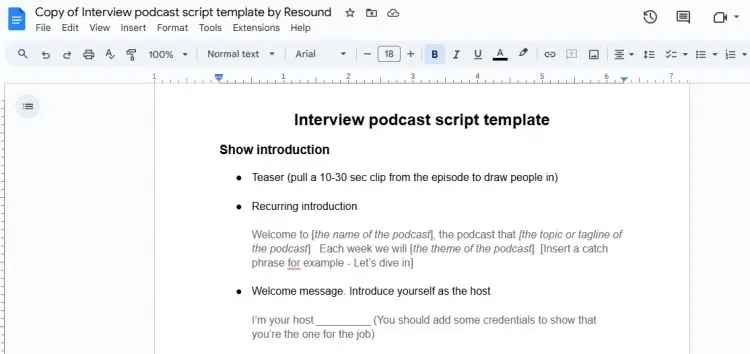
Aside from the podcast script templates above, you can also look at other formats like this one from Resound. Their solid podcast script can help with guest introductions, themed questions, and transitions.
This resource emphasizes preparation and provides space for notes between questions so you can stay flexible. You can make your own copy via Google Docs or download it.
8. Podcast interview format template (Captivate.fm)
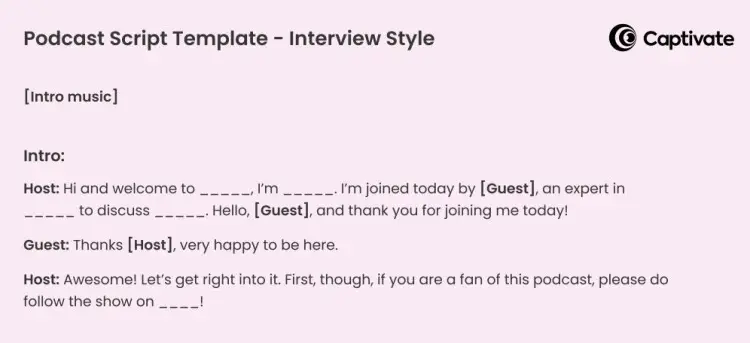
Captivate’s template provides a clean layout for organizing your questions, sponsor messages, and podcast intro and outro script all in one place. It’s useful if you’re still building confidence in your interviewing skills and want every element spelled out.
The template emphasizes the importance of segues (those connective phrases that guide listeners from one question to the next naturally) when writing a great podcast script before you record.
9. Columbia podcast interview consent form
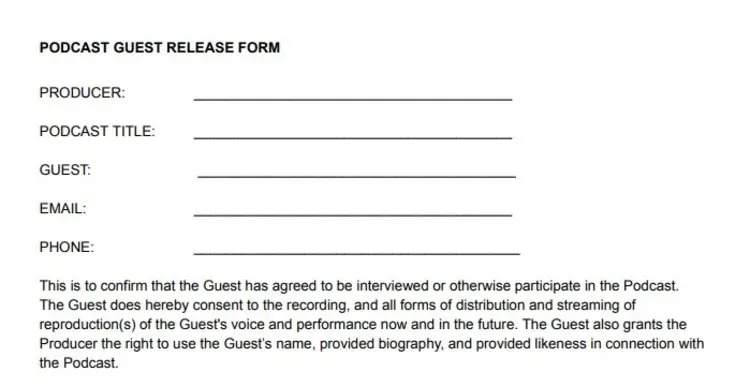
Before publishing interviews, you should have a consent form protecting both you and your guest. Columbia University’s template provides standard language around permissions, privacy, and usage rights.
Having this document in place can support the podcast by legally covering you and making sure guests understand how their interview will be used.
How to Start a Podcast Interview Strong
Starting your interview podcast goes more than just pressing record. You need to set up your technical environment, recruit the right guests, and prepare a good podcast script or podcast outline.
Below are all the practical steps to prepare for a podcast recording and find the right people to keep your podcast interesting.
How to start an interview podcast
Before you record, invest time in getting your podcast interview setup right. Here’s how you get good quality recordings every time:
- Equipment: Invest in a decent podcast microphone (e.g., RODE podcast mic, Blue Yeti) and headphones so you can monitor while recording a podcast.
- Set up: Choose a quiet space with soft furnishings like curtains or carpets that absorb sound and reduce echo.
- Software: Choose the best recording software based on your setup (e.g., Zoom for, Riverside and Squadcast for better quality and features, Podcastle for an all-in-one platform).
- Audio settings: Check levels, test your microphone placement, and confirm that everyone can hear each other clearly.
How to do a podcast interview

Your studio might be ready, but without the right guests, you still can’t get started. Here’s how you can find the perfect experts and personalities to interview:
- Leverage your network: Start with people you know, like friends, colleagues, mentors, or past clients. Your personal connection will show and make everything feel natural and comfortable.
- Use guest platforms: Think of matching platforms like Talks as a shortcut. You can get instantly connected with entrepreneurs, coaches, consultants, and fellow podcasters and invite them on your show.
- Do your online research: Go the traditional scouting route and look for speakers on social media, read recent articles and books, and listen to other podcast interviews.
- Pitch thoughtfully: Keep your pitch short (two to three paragraphs), explain who your audience is, mention your typical download numbers, and suggest a few potential topics.
- Allow enough lead time: Ask guests three to four weeks in advance. Also, give them your interview questions ahead of time so they can prepare answers.
- Confirm details: Once someone agrees, confirm the recording date a week before and then again 48 hours before. Send your technical requirements, a list of questions, and any guidelines about topics you want to avoid.
Free Podcast Interview Template (Customizable)
Use this free and customizable podcast interview template as your plug-and-play script. Copy it, tweak it, make it yours.
Episode overview
- Podcast name: [Insert podcast name]
- Episode title: [Working title]
- Guest name: [Full name]
- Topic/theme: [What this episode is about]
- Core outcome: [What the listener walks away with]
I. Pre-interview prep (behind the scenes)
- Guest research notes: [Key achievements, recent work, talking points]
- Audience angle: [Why your audience should care about this guest]
- 3 key takeaways you want:
- [Takeaway #1]
- [Takeaway #2]
- [Takeaway #3]
II. Opening (on record)
- Hook: [Short, punchy opening line to grab attention]
- Intro: “Welcome to [podcast name]. Today we’re diving into [topic] with [guest name].”
- Guest positioning: “[Guest name] is [credibility + relevance in one sentence].”
III. Warm-up questions (build comfort)
- “Take us back. How did you get into [topic]?”
- “What were you doing before this?”
IV. Core interview section (main value)
- Question 1: [Big idea or belief]
- Follow-up: [Clarify or go deeper]
- Question 2: [Process, framework, or method]
- Follow-up: [Ask for steps or example]
- Question 3: [Mistakes or misconceptions]
- Follow-up: [What should people do instead?]
- Question 4: [Real-world application]
- Follow-up: [Specific story, case, or result]
V. Depth + differentiation
- “What’s something most people get wrong about [topic]?”
- “What changed everything for you?”
- “If someone is stuck right now, where should they start?”
VI. Rapid-fire (optional)
- One belief you’ve changed your mind on: [Answer]
- One tool/resource you swear by: [Answer]
- One piece of advice for beginners: [Answer]
VII. Closing
- Final question: “If you had to leave listeners with one takeaway, what would it be?”
- Call to action: “Where can people find you?” [Website] + [Social links]
- Outro: “If you enjoyed this, subscribe and share it with someone who needs to hear this.”
VIII. Post-interview notes (for you)
- Best quotes: [Pull 2-3 strong soundbites]
- Clip ideas: [Moments worth turning into short-form content]
- Follow-up actions: [Thank-you email, promo plan, future collab]
How to Write an Interview Podcast Script
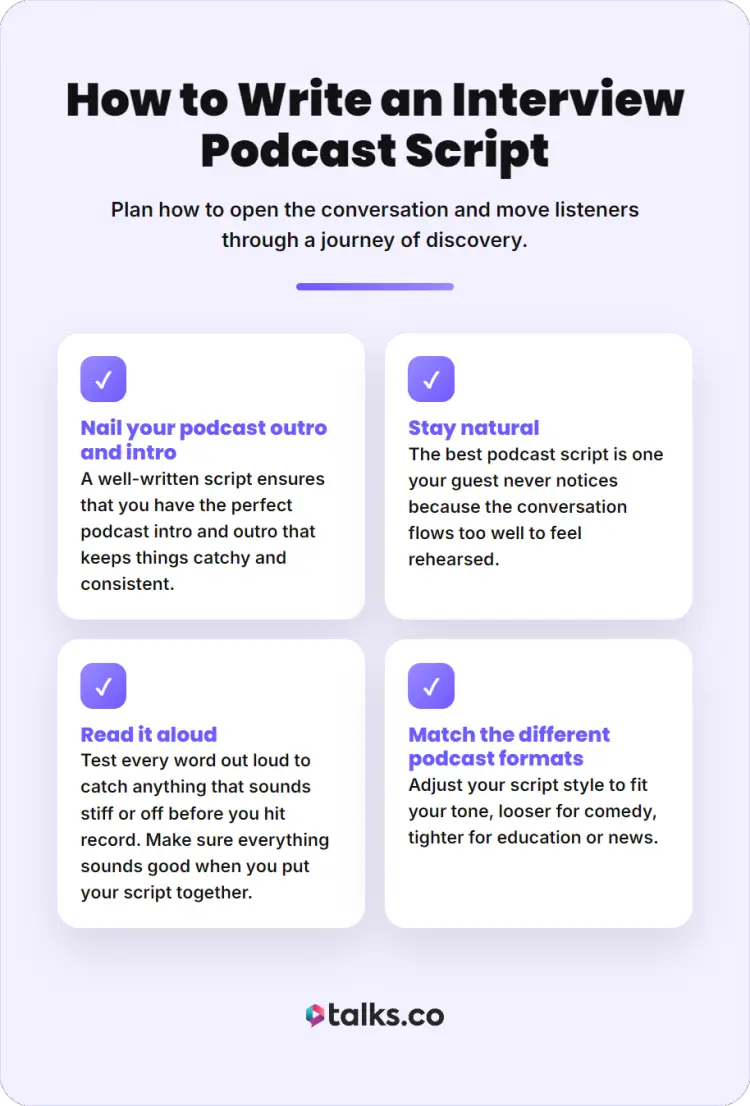
Podcasts sound like rambling without a good script or outline. Whether you plan to read your script out loud or just jump off bullet points, you need to plan how to open up the conversation and move listeners through a journey of discovery.
Keep these in mind when you create a script for a podcast:
- Nail your podcast outro and intro: A well-written script ensures that you have the perfect podcast intro and outro that keeps things catchy and consistent.
- Stay natural: The best podcast script is one your guest never notices because the conversation flows too well to feel rehearsed.
- Read it aloud: Test every word out loud to catch anything that sounds stiff or off before you hit record. Make sure everything sounds good when you put your script together.
- Match the different podcast formats: Adjust your script style to fit your tone, looser for comedy, tighter for education or news.
Podcast interview script example
Having a full script for each episode can make your podcast production process smoother and easier.
You don’t have to create your own podcast script with a blank page. Use this podcast script generator to script out your podcast and ensure your script has everything you want to include in your podcast.
For example, when you type “life coach” as a topic and select the format “guest interview”, you get the example script below (shortened version):
Host: Today, we have a special guest joining us, a renowned life coach who has helped countless individuals unlock their full potential and achieve their goals. Welcome!
Guest: Thank you for having me. I’m excited to be here and share some insights on how life coaching can truly transform lives.
Host: That’s fantastic! Let’s start by exploring what inspired you to become a life coach and how your journey began.
Guest: Well, my own personal experiences navigating challenges and setbacks in life led me to seek guidance and support from a life coach. I knew I wanted to pay it forward and help others in a similar way.
Host: Thank you so much for sharing your wisdom and expertise with us today. It’s been a pleasure having you on the show.
Guest: Thank you for having me. It’s been a pleasure. Remember, your best life awaits!
Host: And that’s a wrap for today’s episode. Thank you for tuning in, and we’ll see you next time on the podcast!
How to craft podcast interview questions
Great podcasts know how to drive great conversations with questions. Here are some best practices to remember when crafting interview questions for podcasts:
- Use open-ended questions: Avoid asking yes or no questions. “What was your biggest challenge and how did you overcome it?” is better than “Did you face any challenges?”
- Dive into the specifics: Generic questions get generic answers. Say, “Walk us through the decision to leave your corporate job and start your company.”
- Progress as you go: Start with easier, personal questions that help guests relax. Then gradually move toward deeper, more challenging questions once they’re comfortable.
- Avoid leading questions: Don’t steer guests toward answers. “You obviously built your business by focusing on customer service, right?” forces agreement.
- Prepare follow-ups: Write notes under each main question with possible prompts like “Ask about the turning point” or “Explore what they learned.”
Podcast interview questions for entrepreneurs
Interviewing business founders can be intimidating. Borrow these podcast interview questions to pull out their success stories and get to know the people behind the legends:
- “What’s the idea that started everything, and where did it come from?”
- “What’s the hardest part of those first months or years?”
- “Was there a moment when you almost gave up, or when you realized you might actually pull this off?”
- “What’s something that didn’t work that you thought would?”
- “What surprised you most about scaling?”
- “What are you working on now that excites you?”
- “If you could go back and tell your younger self one thing, what would it be?”
How to Conduct a Podcast Interview
Conducting an interview is part hosting, part journalism, and part friendly chat. Your role is to make your guest comfortable, ask good questions, listen actively, and guide the conversation toward moments that matter to your audience.
This advice for first-time interviewers or those who’ll conduct remote interviews gives you insight into how to build rapport with guests, no matter the situation.
How to interview someone for a podcast
Even when you use your podcast script to guide the flow, your first few podcast interviews can feel awkward. But remember: Your guest is also nervous. Follow these tips to ease the tension and capture authentic conversations:
- Start with a greeting: Before you hit record, chat for two minutes about something personal, like how their day’s been.
- Expect pauses: Don’t rush to fill silence or jump into reading a script. Let your guest take time to formulate good answers.
- Follow the energy: If a topic opens up something fascinating, stay with it even if it means skipping a planned question. The best podcast moments come from genuine exploration, not word-for-word scripts.
- Take light notes: Jot down follow-up ideas as your guest talks, but don’t get so focused on notes that you stop listening.
- End gracefully: Give your guest a heads-up when you’re wrapping up (“We’ve got about five more minutes”). Also, ask if there’s anything they wanted to mention that you didn’t cover.
How to conduct a podcast interview online
Remote interviews have become the norm. Here’s how you can successfully record online:
- Have a tech check-in: Call your guest 15 minutes before the actual recording. Test audio, video, and connection strength.
- Minimize distractions: Close unnecessary browser tabs, silence your phone, and let people around you know you’ll be recording. Likewise, ask your guests to make their space distraction-free.
- Use headphones: Both you and your guest should wear headphones to improve audio quality and prevent feedback.
- Manage your energy: Even on remote calls, smile when you speak and react to what you’re hearing. Your guest will respond to your energy, and the conversation will feel more alive.
- Have a backup communication channel: If you’re using Zoom or Riverside, have their phone number handy in case the connection drops. A quick text or call can get you reconnected without losing momentum.
- Record locally: Use your recording software’s backup feature to record on your computer. If the internet connection drops, you’ll still have the audio file.
Additional podcast interview tips to nail your next episode
Guest connections shouldn’t end after recording. A lot of the best professional relationships I have now come from interviews I did long ago. Even now, we cheer each other on and keep in touch when opportunities come up.
Here are podcast interview tips for nurturing your connections with guests:
- Promote together: After your interview airs, stay in touch. Many guests will promote episodes to their audience, which expands your reach.
- Repurpose interview content: A single 45-minute interview can become a blog post, five social media clips, an email newsletter, and a LinkedIn article. This multiplies your and your guest’s impact.
- Thank your guests publicly: Share clips of their episode on social media, tag them, and let your audience know why this person mattered. This costs you nothing but builds loyalty with guests.
- Ask guests for referrals: People love helping when you ask them directly. Some time after publishing, ask them for guest recommendations. Better yet, ask them to hop on over again.
From Conversations to Conversions
A single viral podcast interview can bring you a flood of downloads and new audiences.
To make that happen, you need the right guest and podcast interview template to keep things engaging.
Got your script template already? Great! Let’s talk about your dream interviewee next.
If it’s meaningful conversations you’re after, Talks is the place you can find relevant experts. All on your terms. All inside one AI-powered platform.
No tiring back-and-forths. Use advanced search or AI recos to find exactly who you need. Then book them directly on Talks.
Yes! I want to find my dream guests quickly and start recording with top industry experts today!


