

You know that moment when your name gets called and suddenly you forget how sentences work?
Your palms sweat. Your heart picks up speed. You look at the room and think, “Why did I ever agree to this?”
Then you start talking too fast.
Maybe you lose your place. Maybe your voice gets quieter. Maybe your brain serves up the one thought you desperately needed approximately 30 seconds after you sit back down.
Many of the best public speakers started out feeling exactly like this.
The difference comes from learning what to do with your voice, body, nerves, preparation, and attention.
So if you want to become the person who can walk into a room, grab the mic, and actually enjoy having everyone look at you, these public speaking tips will help you get there.
What Is Public Speaking?

Public speaking is any situation where you communicate an idea, story, message, or argument to an audience. That could mean delivering a keynote, presenting at work, teaching a workshop, giving a speech, or speaking on a podcast or video.
Why are public speaking skills important?
Strong public speaking skills can change how people experience you. They help you communicate more clearly and confidently when the room is paying attention.
- Build credibility: People are more likely to trust someone who can explain their ideas clearly and confidently.
- Create opportunities: When you speak in public, you put yourself in front of potential clients, employers, partners, media, and other valuable connections.
- Make your ideas memorable: A strong speaker can turn their speech or presentation into something people actually remember.
- Lead with confidence: Speaking well helps you communicate your point when the stakes are high.
- Grow your influence: The more you improve your public speaking skills, the less public speaking anxiety you’ll have and the more you can grab your audience’s attention with your ideas.
- Reduce speaking anxiety: Practice gives you greater control over your nerves before and during a presentation.
Effective Public Speaking Tips
Great public speaking gets easier when you know what to practice. Start with the basics, work on one weakness at a time, and give yourself plenty of chances to speak before the stakes get high.
How to improve public speaking skills (Checklist)
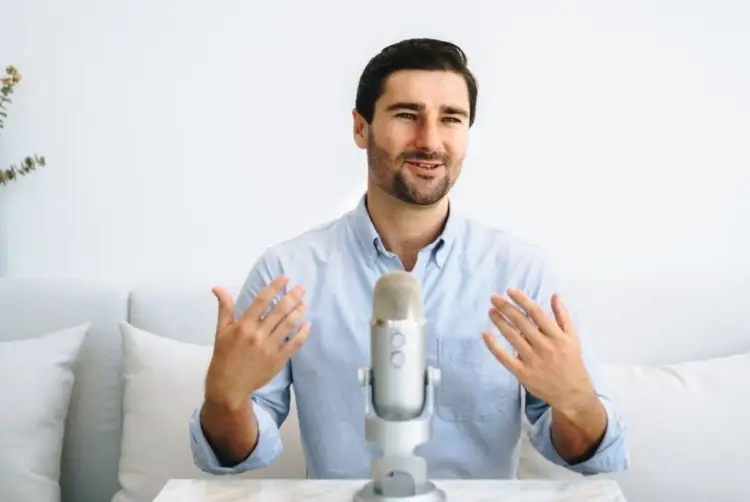
Use this checklist before your next speech or presentation, workshop, or interview to increase your confidence:
☐ Know your main point: Decide what you want people to remember.
☐ Practice out loud: Hearing yourself reveals gaps you won’t catch while you prepare a good impromptu speech.
☐ Record nonverbal communication: Watch your pace, posture, gestures, and filler words when delivering a speech.
☐ Slow down: When delivering the speech, make sure you give important ideas room to connect with your audience.
☐ Use pauses: Silence can make your delivery stronger and communicate more effectively.
☐ Study great speakers: Notice how they open, explain, move, and finish.
☐ Ask for feedback: Get specific notes you can apply to your next talk.
3 Public speaking skills training courses and programs
You can build the skills to be a good podcast guest through structured courses, guided practice, or both. Here are three online options worth considering:
- Toastmasters International: A respected option for building public speaking skills through structured practice, prepared speeches, evaluations, and supportive feedback.
- LinkedIn Learning (Public Speaking Foundations): A practical course covering speech organization, audience engagement, delivery, and presentation confidence.
- Dale Carnegie Training: A well-established program focused on communication, confidence, audience connection, and persuasive speaking.
Public Speaking Tips And Tricks
Good public speaking has less to do with having a naturally commanding voice and more to do with knowing what to do when people are watching.
The small choices you make before and during a talk can change how confident, clear, and memorable you sound.
Good public speaking tips
Use these habits to make you a better public speaker and your next talk easier to follow and more engaging:
- Open with something worth hearing: Start with a surprising fact, sharp observation, or specific story that gives people a reason to pay attention.
- Talk to one person at a time: Move your attention around the room instead of scanning every face at once.
- Change your vocal pace: Speed up during an exciting story and slow down when delivering an important takeaway.
- Give ideas concrete images: Instead of saying a business owner was busy, describe them answering 47 emails from a coffee shop at 6:15 am.
- Use stories strategically: A short personal story can make an abstract lesson easier for your audience to remember.
- Make transitions obvious: Tell people when you’re moving from the problem to the solution so they always know where you’re taking them.
- Finish with purpose: End by giving the audience one clear idea, action, or question to carry with them.
Quick tips for public speaking
Need a few things to remember five minutes before you go on stage? Start here:
- Check your first sentence: Know exactly how you’ll begin so you aren’t searching for words while everyone is watching.
- Plant both feet: A stable stance can stop nervous shifting before it starts.
- Look up between thoughts: Let your eyes connect with the room instead of spending the entire talk looking at your notes.
- Keep water nearby: A dry mouth can make your delivery feel more difficult than it needs to be.
- Mark your key moments: Circle the two or three lines you want to land hardest during your final rehearsal.
- Leave room for laughter: If the audience laughs, let them finish before continuing.
- Expect a little adrenaline: A racing heart before speaking is a normal physical response, so don’t treat it as proof that you’re going to fail.
Do and don’ts of public speaking
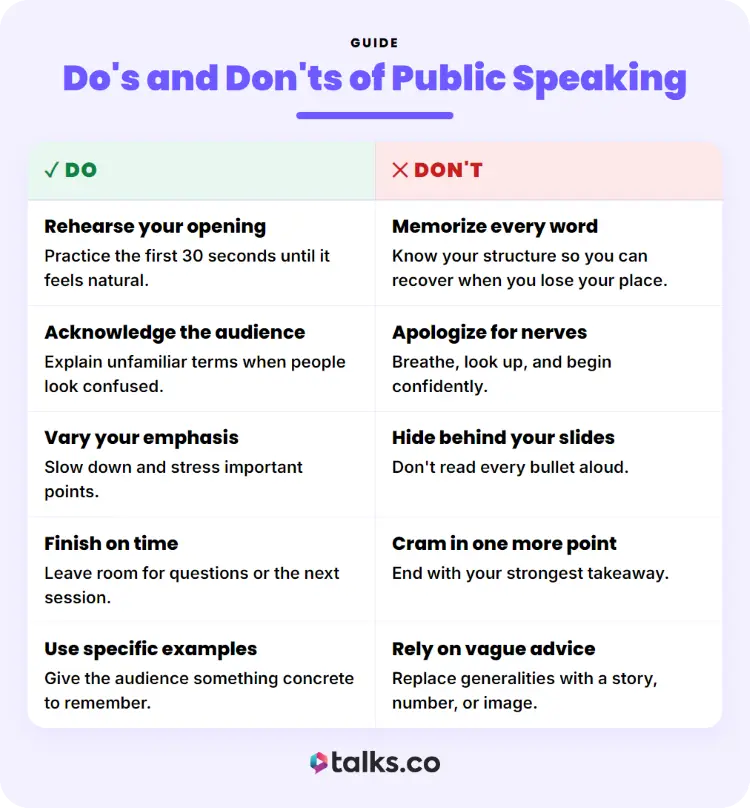
Strong public speaking depends on small choices that shape what the audience sees, hears, and remembers. Use these practical dos and don’ts to make your delivery clearer, more confident, and easier to follow.
| Do | Don’t |
|---|---|
| Rehearse your opening. Practice the first 30 seconds until it feels natural. | Memorize every word. Know your structure so you can recover when you lose your place. |
| Acknowledge the audience. Explain unfamiliar terms when people look confused. | Apologize for nerves. Breathe, look up, and begin confidently. |
| Vary your emphasis. Slow down and stress important points. | Hide behind your slides. Don’t read every bullet aloud. |
| Finish on time. Leave room for questions or the next session. | Cram in one more point. End with your strongest takeaway. |
| Use specific examples. Give the audience something concrete to remember. | Rely on vague advice. Replace generalities with a story, number, or image. |
Public speaking breathing tips
Your breathing can change your entire delivery. Practice these techniques before the audience arrives, then use them naturally while you speak.
- Breathe into your lower ribs: Before walking onto a stage at the Hyatt Regency Chicago, take several slow breaths and feel your ribs expand instead of repeatedly lifting your shoulders.
- Exhale before your first sentence: If your heart is pounding before introducing yourself to a room of 80 entrepreneurs, breathe out slowly before saying, “Good morning, everyone.”
- Breathe at punctuation: During a story about losing your first client, use the period after “Then he called me” as a natural pause before revealing what happened next.
- Avoid tiny emergency breaths: If you’re explaining how a three-year-old startup went from $400,000 to $2.7 million in revenue, don’t squeeze six rushed breaths into one long sentence.
- Take one slow breath before answering: When a conference attendee asks, “So what would you do if you had only $500 to start?”, pause, breathe, and then give the answer.
- Practice with longer sentences: If your keynote includes the line, “The problem started when we hired five people before we knew how to sell the product,” rehearse exactly where you’ll breathe.
- Keep your breathing quiet: On a popular close-mic podcast like The Diary of a CEO, exaggerated inhalations can become surprisingly noticeable in the final recording.
Public speaking tips body language

Your audience reads your physical cues while they listen to your words. Small changes in how you stand, move, and respond can make you appear more composed.
- Keep your chest open: Avoid folding inward or pulling your shoulders toward your ears.
- Use purposeful gestures: Let your hands reinforce an idea instead of moving constantly out of nervousness.
- Turn toward the audience: Face the people you’re speaking to instead of keeping your body angled toward the screen.
- Move with a reason: Walk to a new spot when you’re changing topics rather than pacing throughout the presentation.
- Let your face react: Genuine expressions help your delivery match the emotion behind your words.
- Avoid gripping the podium: A tight grip can make your shoulders and arms look tense.
- Match your energy to the message: A serious story calls for different physical energy than an upbeat announcement.
Public Speaking Tips For Beginners
Your first few talks probably won’t feel polished. That’s fine. Focus on getting comfortable speaking in front of people, then improve one skill at a time.
Public speaking tips for students
School gives you plenty of low-stakes public speaking opportunities to practice before presentations become part of your career.
- Know what your teacher is grading: If your history rubric awards points for evidence, practice explaining your strongest source instead of spending all your time designing slides.
- Practice with your actual slides: Run through your 7-minute biology presentation while standing beside the desk where you’ll present it.
- Use cue cards wisely: Write “Causes > turning point > aftermath” instead of cramming an entire paragraph onto an index card.
- Make eye contact: During a five-minute book report on The Great Gatsby, look at three classmates instead of staring at your teacher.
- Practice answering questions: Ask a classmate to challenge your argument so you’re prepared when someone asks about your weakest point.
- Record one rehearsal: A phone recording can reveal that your “confident” delivery sounds much quieter than you expected.
Public speaking tips for teens
Teenagers already speak in front of people constantly. The goal is learning to control that skill when the setting becomes more formal.
- Start with familiar subjects: Give a three-minute talk about your favorite Roblox game, soccer club, band, or Netflix series to practice organizing ideas.
- Cut the filler words: Ask a friend to hold up a finger every time you say “like,” “um,” or “literally” during a two-minute practice speech.
- Own your opinion: If you’re arguing that your school should start later, lead with your strongest reason instead of spending two minutes apologizing for the idea.
- Practice without hiding behind humor: A joke can loosen the room, but your argument still needs to carry the presentation.
- Use your phone as a rehearsal tool: Record yourself answering five questions about a topic you’re passionate about, then watch the playback with the sound turned off to study your physical delivery.
- Ask someone your age for feedback: A sibling or teammate may notice awkward habits that adults overlook because they know you too well.
Public speaking tips for introverts
Being introverted doesn’t prevent you from becoming an excellent speaker. You may simply need a preparation style that gives you enough time to organize your thoughts.
- Prepare your first answer: If you’re joining a panel about entrepreneurship, write down the first question you’re likely to receive and rehearse your response.
- Arrive early: Getting familiar with the room before 300 people enter can make the environment feel far less unfamiliar.
- Use pauses: Take two seconds to think before answering instead of rushing to fill every moment of silence.
- Build recovery phrases: Keep lines such as “Let me think about that for a second” ready for moments when a question catches you off guard.
- Practice in smaller rooms: Try a five-person mastermind before volunteering for a 500-person conference session.
- Protect your preparation time: Give yourself time before a presentation instead of filling the hour beforehand with back-to-back conversations.
Impromptu public speaking tips
Impromptu speaking gets easier when you have a simple way to organize your thoughts under pressure.
- Use the past-present-future structure: Explain what happened, where things stand now, and what you expect next.
- Answer the actual question: If someone asks what you’d change about your business, don’t spend four minutes describing how you started it.
- Take a moment: A two-second pause can feel enormous to you and completely normal to everyone listening.
- Use a personal example: If asked about resilience, tell the story of the client who canceled your biggest contract three days before launch.
- State your answer first: Giving the audience your position before explaining the experience or reasoning behind it is how to be a better public speaker.
- Give yourself an ending: Once you’ve answered the question, stop instead of adding three increasingly unrelated thoughts.
Public Speaking Tips For Anxiety
Even the latest public speaking fear statistics agree that anxiety can make a five-minute presentation feel like a five-hour ordeal.
The goal is to give yourself practical tools that help you manage the physical symptoms, stay focused, and keep speaking even when your public speaking fears and nerves show up as a way to overcome your anxiety about public speaking.
Public speaking confidence tips

Confidence and effective speaking tends to grow after you collect enough evidence that you can handle the situation. Give yourself those public speaking engagement wins deliberately.
- Start with familiar rooms: Practice your presentation for three coworkers before delivering it to 200 people at an industry conference.
- Know your strongest material: Be able to explain your best case study, statistic, or story without checking your notes.
- Practice recovering: Deliberately stop halfway through a rehearsal, lose your place, and practice finding your way back.
- Track small wins: Write down moments such as answering a difficult question clearly or finishing a presentation without rushing.
- Rehearse standing up: Practicing from your desk can create false confidence when the real presentation requires you to stand under bright lights.
- Give yourself realistic reps: Volunteer to introduce an ideal podcast guest at a local networking event before signing up to deliver a 60-minute keynote.
Fear of public speaking tips
Fear can make your mind predict disaster before you’ve said a single word. Shrink the unknown by exposing yourself to the parts of speaking that trigger you.
- Practice the feared moment: If questions scare you most, spend 10 minutes having someone fire unexpected questions at you.
- Visit the room early: Walk onto the actual stage at a conference venue and test the microphone before your audience arrives.
- Stop rehearsing catastrophe: Replace “I’m going to forget everything” with a specific recovery plan for losing your place.
- Speak before the stakes rise: Give a two-minute update during a team meeting instead of waiting until you’re asked to deliver a 30-minute presentation.
- Separate discomfort from danger: A pounding heart can feel alarming, but the sensation itself doesn’t mean your presentation is going badly.
- Consider professional support: If fear consistently prevents you from speaking, a qualified mental health professional can help you work through severe anxiety.
Public speaking tips for nerves
Nerves often show up physically before you consciously feel anxious. Prepare for those sensations instead of being surprised by them.
- Arrive with time to spare: Give yourself 20 minutes to settle in before speaking rather than running through the door as your name is announced.
- Warm up your voice: Read your opening aloud at a comfortable volume so your first spoken words aren’t delivered cold.
- Release physical tension: Roll your shoulders, unclench your jaw, and shake out your hands before stepping onto the stage.
- Keep your preparation simple: On the morning of a sales presentation in Boston, review your opening, key points, and close instead of rewriting every slide.
- Expect your voice to change: Your first few sentences may sound slightly different when adrenaline kicks in, so don’t panic and start forcing your voice lower.
- Focus on the next sentence: If your brain starts racing halfway through a talk, concentrate on delivering the one sentence you’re saying now.
Public Speaking Tips for Video Content
If you’re learning how to become a content creator, know that speaking to a camera changes the job. There’s no room full of faces to read, so your voice, expressions, pacing, and words have to carry more of the connection.
Public speaking tips for a TED Talk
A TED-style talk needs a clear idea that can hold an audience’s attention from the first sentence to the final takeaway before the next presentation.
- Build around one idea: If your talk is about burnout, focus on the specific idea that helped you rethink it rather than trying to solve every workplace problem.
- Open with a human moment: A speaker discussing perfectionism could begin with the morning she deleted a 47-slide presentation because the title slide “wasn’t good enough.”
- Make the abstract concrete: Instead of saying social media affects attention, describe checking Instagram 11 times before finishing your first cup of coffee.
- Rehearse the emotional turns: Know where the audience should laugh, pause, reflect, or feel the weight of what you’re saying.
- Keep slides visually simple: A single photograph of an empty hospital waiting room can carry more emotional weight than six bullet points about healthcare.
- Earn the final line: Don’t tack on “Thank you” after your conclusion. Finish with the thought you want people repeating on the walk home.
Public speaking tips for YouTube
YouTube viewers can leave instantly, so your delivery needs to feel personal, focused, and worth sticking around for.
- Start with the payoff: If you’re teaching people how to negotiate salary, open with the exact mistake that cost you a $12,000 raise.
- Speak to the lens: Look directly into the camera when delivering your main point instead of watching yourself on the monitor.
- Cut the throat-clearing: Replace “Hey guys, welcome back to another video” with the specific reason someone should keep watching.
- Change your visual rhythm: Move from talking-head footage to a screen recording when you’re explaining how to build a presentation in Canva.
- Use conversational language: Imagine you’re explaining the topic to one mate sitting across the table rather than addressing thousands of anonymous viewers.
- Keep your energy consistent: Don’t start a video at full volume and gradually become quieter as you reach the final section.
- Edit for attention: Remove long pauses, repeated phrases, and detours that sounded fine during filming but slow down the finished video.
Your Voice Is Worth Hearing
Public speaking tips can help you calm the nerves, sharpen your delivery, and sound like yourself when the room gets quiet.
Now put those skills to work.
If you’re ready to get your voice in front of bigger audiences, set up your free Talks profile and start connecting with podcast hosts who want experts like you on their shows.
Create your free Talks Creator profile and start getting booked.


