

You can have a great podcast and still be invisible.
Not because your episodes aren’t good. Not because your mic setup is wrong. But because your podcast description is doing absolutely nothing for you.
Think about it.
When someone stumbles across your show on Apple Podcasts or Spotify, they’re not hitting play out of loyalty.
They’re skimming. Judging. Deciding fast if your podcast is worth their time.
And that decision almost always comes down to one thing: your description.
They either say a lot without saying anything, or they turn into a personal backstory no one came for. Neither makes someone think, “This sounds like my kind of show.”
In this guide, I’ll show you how to write a podcasting description that earns attention, makes it obvious who the podcast is for, and gives the right listener a real reason to hit play.
(Plus a few podcast description examples you can run with or make your own.)
By the end, you’ll have a description that attracts the potential listeners you actually want and gets them curious enough to press play.
What Is a Podcast Description?
Your well-crafted podcast description is the short block of text people see when they land on your show in Apple Podcasts, Spotify, or Google Podcasts.
It’s a positioning statement that summarizes to the right listener, very quickly, “This podcast was made for you.”
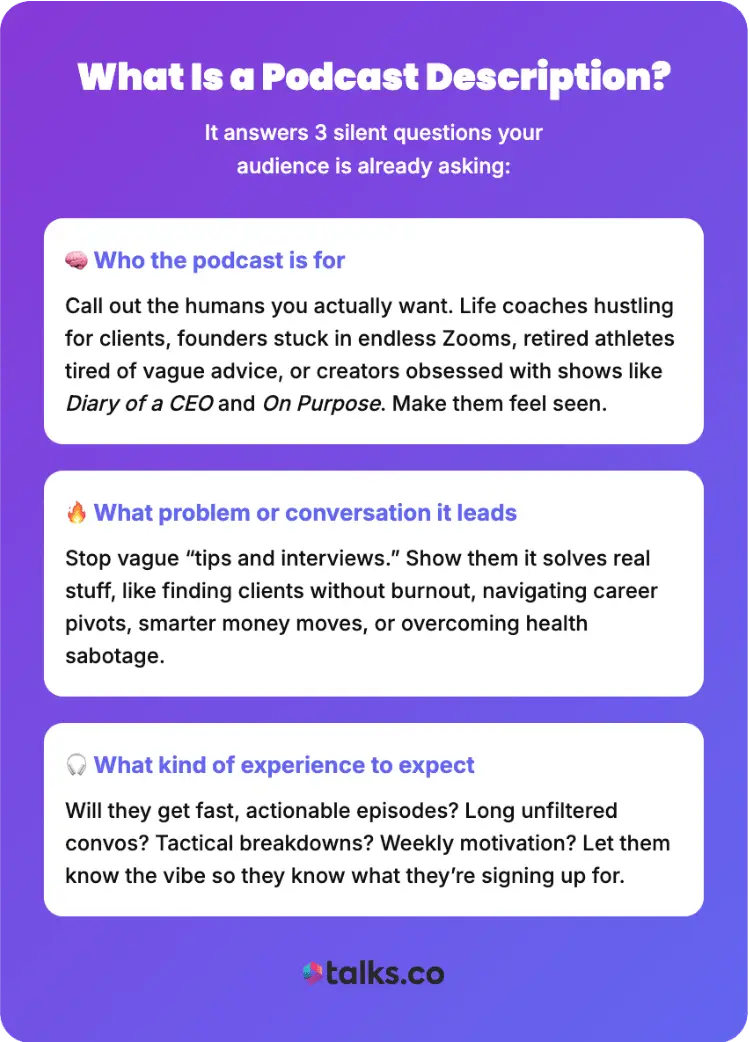
A compelling podcast description answers three questions people are silently asking while they skim.
- Who the podcast is for: Call out the humans you actually want. Life coaches hustling for clients, founders stuck in endless Zooms, retired athletes tired of vague advice, or creators obsessed with shows like Diary of a CEO and On Purpose. Make them feel seen.
- What problem or conversation it leads: Stop vague “tips and interviews.” Show them it solves real stuff, e.g., finding clients without burning out, getting clarity on career pivots, making smarter financial choices, or getting past self-sabotaging health habits.
- What kind of experience to expect: Will they get fast, actionable episodes? Long unfiltered conversations? Tactical step-by-step breakdowns? Weekly motivation or deep-dive strategy? Give the vibe so they know what they’re signing up for.
Why is a great podcast description important?
Podcast descriptions are important because they help with attracting new listeners and showing them immediately what makes your podcast unique.
- Filters the right listeners in: Attract people who actually care. Your audience should match your vibe, not just any passerby.
- It boosts SEO discoverability: Podcast apps and search engines use your description to understand what your show is about, so the right keywords in the right places actually matter.
- It sets expectations early: Listeners know what they’re signing up for, how often you publish, and what kind of value they’ll get, which leads to better retention.
- It positions your authority: A confident description signals a confident host. Vague? You look unsure. Clear? You look like someone worth listening to.
Podcast description vs. show notes
Your podcast description and show notes serve different jobs. Mixing them up is a common mistake.
| Podcast description | Podcast show notes |
|---|---|
| Sells the podcast as a whole | Supports a single episode |
| Written for new listeners | Written for current listeners |
| Focuses on positioning and value | Focuses on episode details |
| Rarely changes | Updated every episode |
Your podcast description gets people in the door. Your podcast show notes help them stay, learn, and engage once they’re inside.
How long should a podcast description be?
One of the first things your description should do is grab attention fast and tell the right people exactly why they should lean in.
- 250-300 words: Enough of an elevator pitch length to call out your ideal listener with phrases like “Founders juggling 12-hour days, sleepless nights, and endless Zooms. This show is for you.”
- Lead with the hook: When writing your podcast description, start with the promise. “Want to grow your business without burning out? Every week, we break down exactly how successful founders do it.”
- Use keywords naturally: Make sure to include and drop them into the content of your podcast description where they make sense, e.g., “Nutrition tips, mental wellness hacks, and fitness strategies for busy professionals.”
- Be specific, not clever: Focus on the payoff and expectations about your show instead like “Quick, actionable marketing tactics you can implement by Friday” or “Honest advice to land your first client.”
14 Best Podcast Description Examples
Great podcast descriptions don’t explain the show. They make the right person stop scrolling.
The ones below work because they do one thing well: they speak directly to someone who already feels the problem and wants help fixing it.
Read these great podcast description examples to see how the best and most successful podcast shows do it and exactly what to copy.
Example of podcast descriptions for coaches
Coach-led podcast descriptions work when they do three things fast:
- Call out the internal problem
- Show credibility without overexplaining
- Promise a clear shift the listener wants
Here’s how that looks in practice.
1. The Contemplative Science Podcast
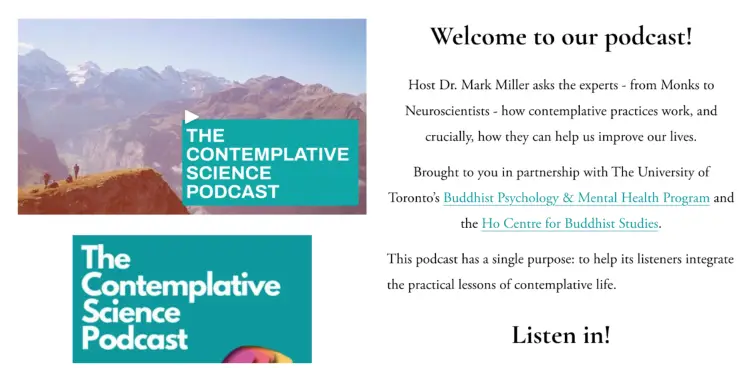
The Contemplative Science Podcast’s description doesn’t try to sound impressive. It sounds intentional.
It’s clear who the show is for, what kind of conversations happen, and why those conversations matter in real life. Bringing monks and neuroscientists into the same sentence instantly signals depth without overexplaining it.
You know exactly what you’re signing up for and you trust it before the first episode even loads.
How to make it your own:
“[Podcast name] explores [specific practice or way of thinking] and how it actually shows up in [real-life situations your audience cares about].
Each episode features [type of guest or perspective], breaking down [what people usually overcomplicate] into something you can use.
This show is for [who it’s really for] who want [practical change, not random advice].”
2. The Fertility Podcast
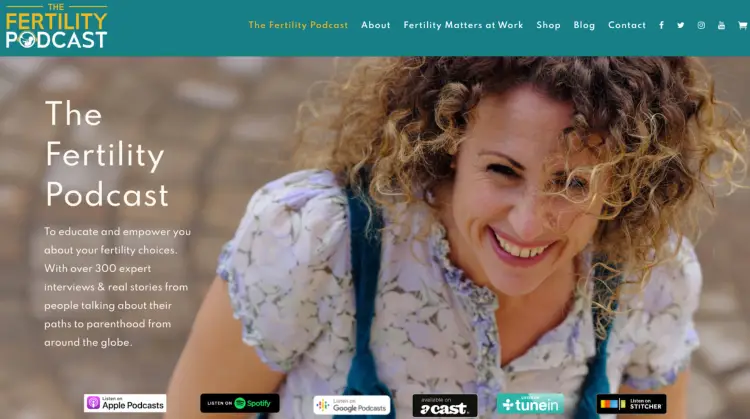
This one gets out of the way and lets the listener feel seen.
The Fertility Podcast doesn’t lead with credentials. It leads with the emotional reality of making hard, personal decisions. Then it quietly backs that up with “300+ expert interviews” so trust is handled without making a big deal of it.
It feels supportive, not salesy. That’s why it works.
How to make it your own:
“[Podcast name] is for [specific person] navigating [high-stakes or emotional situation] and wanting clearer next steps.
You’ll hear [expert conversations] alongside [real stories] from people who are figuring it out in real time.
The point isn’t perfection. It’s helping you make [better, calmer, more confident choices].”
3. Healing Is Hot
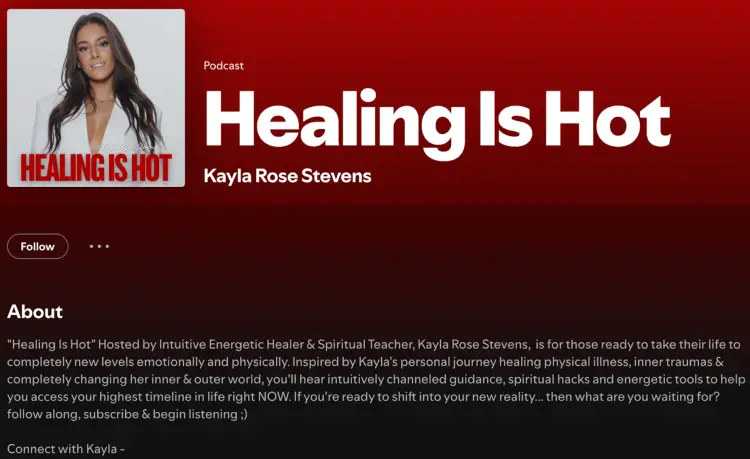
This description knows exactly who it’s for and doesn’t apologize for it.
Healing Is Hot’s story is the anchor. The language is bold. The invitation is clear. If you resonate, you’re in. If you don’t, you move on.
That filtering is the feature.
How to make it your own:
“[Podcast name] is hosted by [who you are in plain language] and created for [people ready for a specific kind of change].
Shaped by [your personal experience or turning point], each episode shares [tools, insights, or conversations] to help you [shift they want to make].
If you’re done with [old pattern] and ready for [new way of being], you’ll feel at home here.”
4. The Mel Robbins Podcast
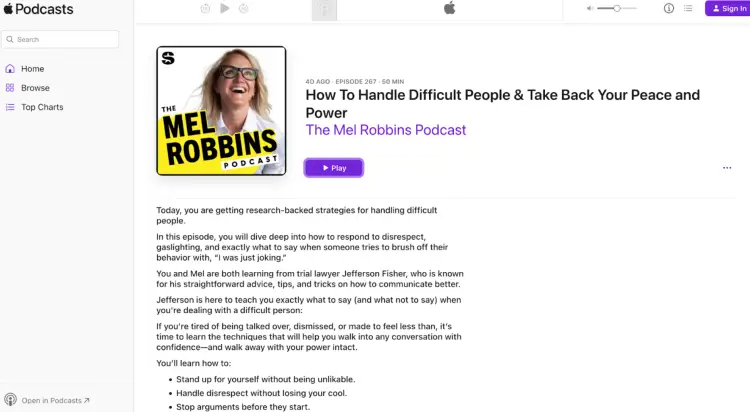
This description meets the listener exactly where they’re already frustrated. It doesn’t diagnose them or promise a personality overhaul. It names a real, everyday tension: dealing with people who drain you.
“Take back your peace and power” is the quiet hook. You can tell this episode will leave you calmer, clearer, and better equipped the next time a hard conversation shows up.
How to make it your own:
“[Podcast name] helps you navigate [specific frustrating situation] without [common emotional cost].
In this episode, we break down [practical skill or boundary] so you can [emotional or relational payoff].
Listen if you’re tired of [current pattern] and want to respond with more control.”
5. The Happier Hour with Cassie Holmes
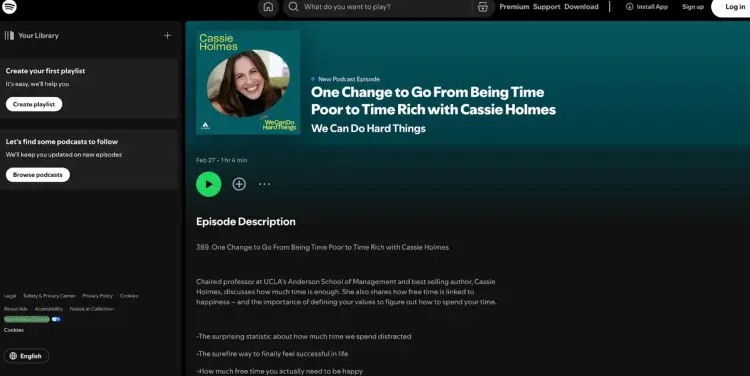
This description works because it doesn’t overwhelm.
“One change” feels doable. “Time poor” feels painfully familiar. “Time rich” feels aspirational without sounding unrealistic.
It frames the episode as a mindset shift with immediate application, not a productivity system you’ll never keep up with. That makes the promise feel trustworthy before you even press play.
How to make it your own:
“[Podcast name] explores small shifts that make a real difference in [area of life].
In this episode, we focus on one change that helps you move from [current pain point] to [desired feeling].
Perfect for [specific listener] who wants improvement without burning out.”
6. The Daily Stoic
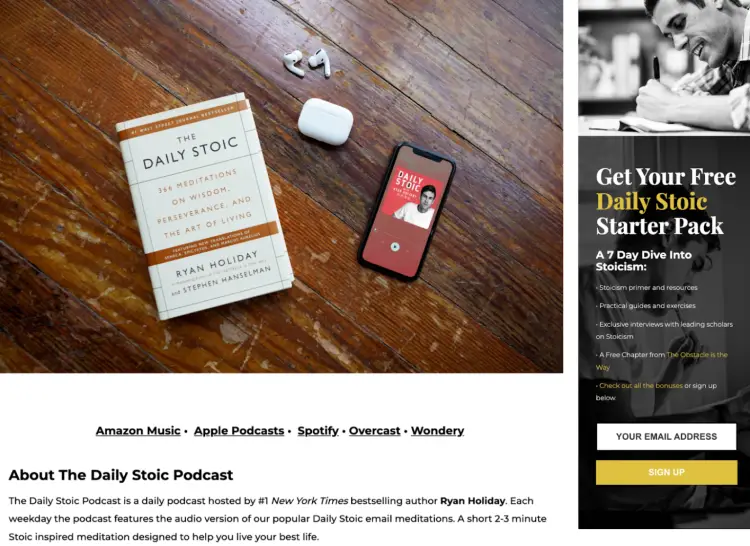
This description wins by removing uncertainty. You know how long it is. You know how often it drops. You know exactly what it’s for.
Short daily meditations position the show as a habit, not a commitment. The authority is there, but it’s understated. It feels less like content and more like a ritual you can actually keep.
How to make it your own:
“[Podcast name] is a [short, repeatable format] designed to fit into your [daily routine].
Each episode offers [type of insight or reflection] to help you [specific mindset or behavior shift].
Created for people who want [personal growth outcome] without spending hours consuming content.”
Example description of podcast shows for entrepreneurs
Entrepreneurial podcasts hook because they promise insight without any catch. They signal that every episode is a shortcut to smarter decisions, faster growth, or the mental hacks that most founders figure out the hard way.
Here’s how the best do it:
7. The Tim Ferris Show
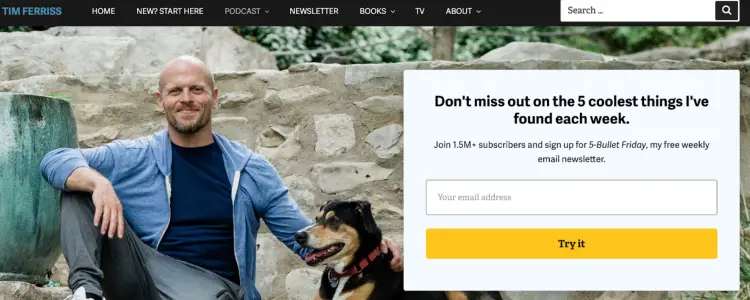
Authority meets curiosity. Tim Ferris leads with his track record but immediately hints at practical takeaways from world-class performers. Listeners know they’ll walk away with actionable strategies and stories worth their time.
How to make it your own:
“[Podcast name] uncovers [habits, tools, or stories] from [top performers in your niche].
Each episode breaks down [complex strategies] into [practical takeaways] for [specific audience].
This show is for [who it’s really for] looking to [improve, scale, or level up].”
8. Smart Passive Income
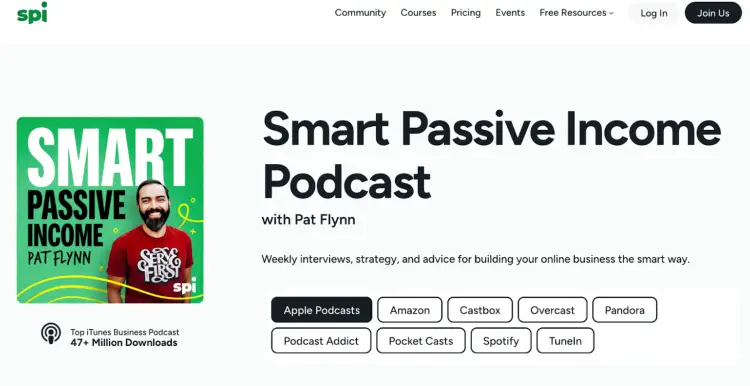
Smart Passive Income’s podcast description nails it. Straight to the point. Clear audience. Direct value. You know exactly what you’ll get: interviews, strategies, and actionable advice without vague promises.
How to make it your own:
“[Podcast name] is for [entrepreneurs or creators] wanting [specific outcome].
Each week features [podcast interview tips or step-by-step guides] so you can [achieve outcome faster].
Tune in if you want [real results, not just ideas].”
9. We Study Billionaires
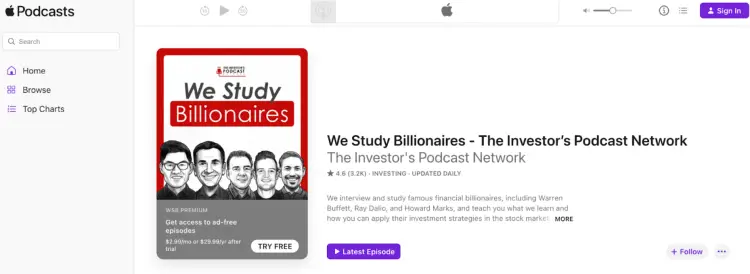
We Study Billionaire’s podcast description tells you exactly who the guests are (billionaires), what you’ll learn (investment strategies), and why it matters (apply it yourself). Authority + clarity + practical hook.
How to make it your own:
“[Podcast name] studies [experts, leaders, or top performers] to extract [strategies or lessons].
Each episode explains [real-world applications] for [audience with similar goals].
Ideal for [ambitious professionals] ready to [apply elite strategies to their own life or business].”
Podcast bio example for speakers
The right description hooks listeners with a clear benefit, shows why the host actually knows their stuff, and gives a taste of the stories or insights they’ll get.
Think of it as your first handshake: confident, friendly, and memorable.
10. STRATA Originals – The Podcast
This description tells you everything in one glance: who the guests are (CEOs, executives, entrepreneurs), what’s discussed (lessons from leadership journeys), and why it matters (real insights you can use). It signals authority without sounding stiff.
How to make it your own:
“[Podcast name] talks to [leaders, creators, or experts] about [lessons or experiences your audience cares about].
Each episode breaks down [big concepts] into [practical insights, tools, or ideas].
If you’re [specific audience] looking to [achieve outcome or skill], this show is for you.”
11. Behind the Art Inspiration
Caroline’s description gives listeners a backstage pass into artists’ studios, instantly showing the niche (artists, collectors) and the vibe (curious, casual, visual). You know exactly what to expect.
How to make it your own:
“[Podcast name] goes behind the scenes with [creative professionals, experts, or enthusiasts].
Episodes explore [practices, inspirations, or processes] to give [specific audience] a clear view of [insights, stories, or lessons].
Perfect for [niche audience] who want [benefit or experience].”
12. Thinking Out Loud w/Friends of SoundBroker
Fun, social, and informative. This podcast’s description immediately sets the tone: knowledgeable conversation with laughs included. Fans of live sound or concert production know they’re in the right place.
How to make it your own:
“[Podcast name] combines [topic expertise] with [fun, casual banter].
Listeners hear [real-world stories, lessons, or insights] while connecting with [community or industry].
Ideal for [audience] who want [knowledge + personality] in each episode.”
13. Huberman Lab
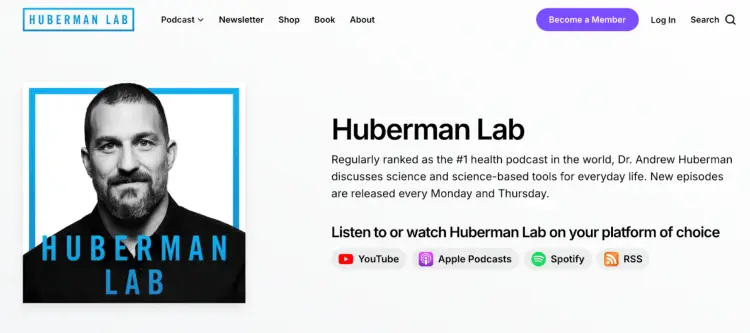
This description earns trust fast by being specific and restrained.
No grand claims or overly emotional hype. It’s all science-backed tools, explained clearly, on a consistent schedule.
You know exactly what kind of listener Huberman Lab respects: someone who wants evidence and application, not noise.
How to make it your own:
“[Podcast name] explores [topic area] through [research, experience, or expert insight].
Each episode offers practical tools you can use to improve [specific part of life or performance].
Ideal for listeners who want clarity, not opinions.”
14. Lewis Hamilton On: Why You Should Stop Chasing Society’s Definition of Success & How to Be More Intentional With Your Goals
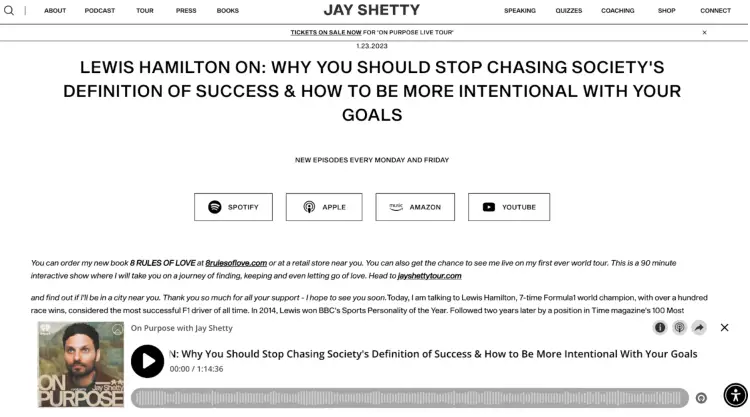
This description works because it reframes success before you even listen.
It uses contrast (public achievement versus personal intention) to create instant curiosity. You’re not promised motivation. You’re promised a rethink.
Coming from someone with nothing left to prove, that hits hard.
How to make it your own:
“[Podcast name] challenges the way we usually think about [success, growth, or identity].
In this episode, [speaker or guest] shares how redefining [common goal] changed the way they [work, live, or decide].
Listen if you’re questioning the path you’re on and want a more intentional one.”
Talks Podcast Description Generator
Most podcast description tools spit out something that sounds polite, safe, and instantly forgettable.
The Talks podcast description generator doesn’t try to be clever. It gives you a clean, usable starting point that already sounds like a real show. Something you could publish, tweak, and move on from without rewriting the whole thing.
You enter:
- Your podcast topic
- Your show name
- Your host name
That’s it.
What comes out is a clear description that names the real problem your listener is dealing with, positions the host as credible without flexing, and focuses on practical outcomes.
(Super useful tool to craft your description for when you’re still learning how to start a podcast and figuring out how to help listeners find your podcast on podcast listening platforms .)
Podcast descriptions fresh from the Talks generator
Here are the results I got using these inputs:
- Topic: Managing difficult clients without losing authority
- Podcast name: Coaching After Hours
- Host: Liam Austin
Talks generated these example descriptions:
- Join host Liam Austin on Coaching After Hours as he delves into the intricacies of managing difficult clients without losing authority. Through in-depth discussions and real-life examples, Liam shares proven strategies and techniques for maintaining control and professionalism in challenging situations. Whether you’re a seasoned coach or just starting out, this podcast offers valuable insights and practical advice to help you navigate client relationships effectively.
- Welcome to Coaching After Hours with your host Liam Austin, where we explore the art of managing difficult clients while upholding your authority. In each episode, Liam draws from his extensive experience in coaching to provide valuable tips and insights on handling tough client interactions with confidence and grace. From setting boundaries to effective communication strategies, this podcast equips you with the tools you need to maintain control and build strong client relationships.
- Discover the secrets to successfully managing difficult clients without compromising your authority with Coaching After Hours. Hosted by Liam Austin, this podcast offers a deep dive into the world of client coaching, focusing on practical strategies for handling challenging situations with poise and professionalism. Tune in to learn how to navigate tough client conversations, set clear expectations, and establish boundaries that support both you and your clients in achieving their goals.
Looking for something extra to help you attract and retain listeners plus make a good first impression? We’ve got the Talks podcast name generator to give you extra ideas for your new show.
How to Write a Podcast Description
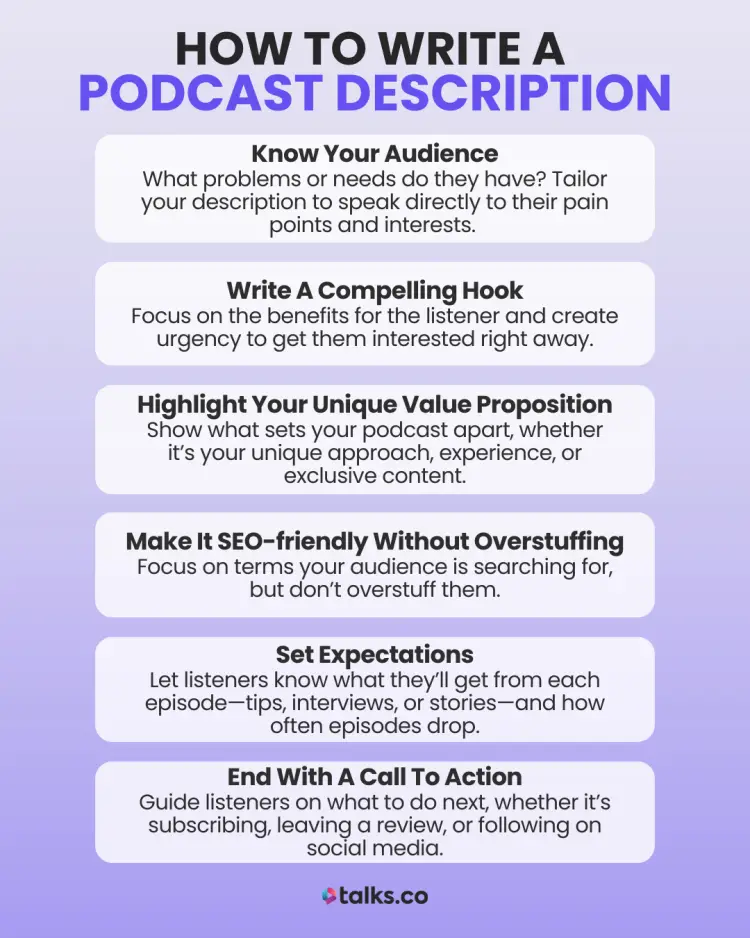
Your podcast description is your one chance to seduce, surprise, and convince someone in under 30 seconds that your show is worth their precious ears.
Here’s how to nail writing your description that’ll get listeners to click and give your show a try:
- Know your audience: Picture the humans you want. A baker launching an online cookie brand needing wholesale clients. A yoga teacher balancing parenthood and side gigs. A comic artist growing a webtoon following. Speak to their goals and struggles so they instantly feel seen.
- Write a compelling hook: Grab attention fast and let listeners know your unique selling point immediately. Example: “Tired of social media advice that wastes hours? Here’s how indie creators get results in a weekend.”
- Highlight your unique value proposition: Show why your show is one-of-a-kind. Behind-the-scenes startup fails, micro-strategy guides for side hustles, or mental health hacks parents actually have time for. Make them feel they can’t get this anywhere else.
- Make it SEO-friendly without overstuffing: Use natural keywords: “side hustle growth,” “small business marketing tips,” “stress relief routines.” Flowing, helpful, not robotic.
- Set expectations: Tell listeners what they’ll get. Quick 15-minute guides, long interviews with founders, or interactive Q&As. Example: “Every Wednesday, 20 actionable tips to grow your creative side hustle.”
- End with a call to action (CTA): Be explicit. “Subscribe for every episode,” “Leave a review if this helped you take action,” “Follow on Instagram for bonus content.”
Podcast description tips
Your description should work as hard as your podcast. Here’s how to make it irresistible:
- Focus on pain points: Call out real struggles. A yoga instructor juggling online classes and toddler naps, a freelance copywriter stuck chasing clients, or a food blogger trying to grow their email list. Make them feel seen.
- Use simple language: You don’t need to prove you’re smart. Saying “Step-by-step strategies to land clients” beats “holistic approaches to professional leverage optimization.”
- Be concise but descriptive: Nail the core value in a few sharp sentences. A career coach could say: “Get clear on your next move in 20 minutes a week.”
- Highlight key takeaways: Tell listeners what they’ll walk away with: podcast script templates for better interviews, daily productivity hacks, or meal-planning strategies that actually work.
- Show your personality: Infuse voice. Funny, candid, or slightly sassy like a personal note: “Coffee-fueled marketing tips for humans who actually have lives.”
- Include social proof subtly: Mention guests, credentials, or notable achievements. “Featuring interviews with indie authors who hit bestseller lists in under a year.”
- Create urgency: Give them a reason to listen now. “Every Monday, actionable tips so you can launch your side hustle before Friday.”
- Test different hooks: Play with curiosity, humor, or controversy. Example: “Why most productivity advice is garbage and what actually works.”
- Hint at transformation: Show what changes after listening. “Turn ADHD timeblindness into a manageable schedule in just 15 minutes a week.”
- Invite engagement: Encourage them to act. “Subscribe now to never miss a tip that could save your sanity.”
Where to add your podcast description
To make sure your podcast description gets maximum exposure, put it where people will actually see it:
- Podcast directories: Your Talks creator profile, Apple, Spotify, Google Podcasts, Stitcher, Overcast, and niche platforms. The more eyes, the better (and the more podcast monetization opportunities).
- Social media bios: Promote your podcast on social media like Instagram, LinkedIn, and TikTok. Make sure new followers instantly know what your show offers.
- Your website: Add it to the homepage or a dedicated podcast page to give visitors context and subscription links.
- Show notes: Reinforce the episode’s value for listeners who dig deeper.
- Email newsletters: Include a snippet in weekly updates or onboarding sequences to draw subscribers back to the show.
- Guest promotions: Ask guests to share your description when they promote their episode to help reach their audience.
- Podcast trailers: Embed the description in your promo episodes or teasers.
- Online communities: Forums, Facebook groups, and Discord servers. Use your description to hook members searching for solutions.
- Event pages or speaking engagements: If you’re on a panel or hosting a webinar, include a short description to entice attendees.
- Cross-promotions: Partner with other podcasters and swap descriptions or blurbs to attract like-minded listeners.
How to make sure your description shows up on all platforms
Your podcast description doesn’t live in one place. It gets pulled, cached, shortened, and reused across podcast hosting platforms, apps, and discovery tools. If you don’t control it at the source, you lose consistency everywhere else.
Here’s where to focus:
- Talks: Add your podcast description to your Talks show profile and it becomes your visibility layer. Other hosts trying to find podcast guests see it, Google and AI pick it up, plus it doubles as a one-sheet when guests are deciding if your show is a fit.
- Spotify for Podcasters: This is now the control center for a huge chunk of podcasts. Update your show description here and make sure it matches where your show is now. Your positioning should evolve as the podcast grows. (Here’s a full guide on how to upload a podcast to Spotify.)
- Apple Podcasts (via your host): Apple still drives discovery and credibility. Your description here should be readable in the first two lines, since many apps truncate the rest.
- Buzzsprout: Edit the show description inside your Buzzsprout dashboard. This version feeds Apple Podcasts, Pocket Casts, and dozens of smaller directories.
- Captivate: Captivate pushes your description to every connected platform through your RSS feed. Use short paragraphs and plain language so it survives truncation.
- Libsyn: Libsyn’s show description is often reused verbatim across apps. Avoid formatting tricks. Write it so it still makes sense as raw text.
- Transistor: Your description is tied to your RSS feed. Change it once here and it updates across platforms, which makes this a great place to test sharper positioning without re-uploading episodes.
- Podbean: Podbean surfaces your description inside its own app and pulls from your RSS. Make sure the first sentence clearly states the topic and audience.
- Castos: Your show description sits inside the podcast settings and syncs to listening apps and your WordPress site. Keep it scannable so it works in both places.
- RSS.com: RSS.com uses your show description exactly as written. If it’s vague here, it will be vague everywhere it appears.
- Acast: Acast distributes globally. Keep it simple and spell things out for your target audience. This podcast description often shows up in international apps.
- Podcast websites: This is your long-form version. Same positioning, more context. Many platforms crawl this page, so inconsistencies here can dilute what shows up elsewhere.
FREE Podcast Description Template
Here’s a simple, customizable template to help you craft the best possible podcast description that’ll convince them to hit play on your show. Just plug in your details and make it your own:
Podcast episode title: [Your podcast name]
Description:
“[Podcast name] is a podcast for [who the show is for] who want [clear outcome or result] without [common frustration or waste of time].
Each episode features [type of guests or format] covering [2-4 good podcast topics]. The kind of conversations that help you [specific takeaway listeners can expect after listening].
You’ll hear from [examples of guest types or experience level], sharing [what they actually talk about: strategies, mistakes, behind-the-scenes, real stories], not surface-level advice.
Hosted by [host name], the show is [tone: direct, conversational, tactical, relaxed, etc.] and built for [how and when people listen: busy professionals, founders on walks, creators between calls].
New episodes drop [frequency].
If you’re [restate ideal listener], hit follow and start listening.
Write It Right
A strong podcast description doesn’t explain your show. It does the filtering for you.
The right listener reads it and thinks, “This is for me.” Everyone else scrolls on.
When your description is clear, specific, and honest, it works everywhere it shows up. Podcast apps. Search results. Guest profiles. First impressions you don’t get to redo.
The 14 podcast description examples show you how to set expectations before a listener commits their time, which is why they convert casual browsers into subscribers.
If you want your podcast description working for you everywhere it appears (and to connect with better-fit guests without cold outreach), create your free Talks creator profile and put it to work.
Yes! Sign Me Up to Talks For Free


