

Think about this. The stage is empty. The mic is within your reach.
As an emcee, you know you aren’t the main event, but as the starter, the first words you say decide whether the event warms up or flops.
Whether you’re hosting a podcast or a conference, it’s up to your speaker introduction to connect with a cold, disengaged audience. You’ll either build trust and set the tone or drain the room of its energy.
Let me show you how it’s done. I listed six speaker introduction examples you can apply immediately.
From podcast guestings to seminars and corporate events, I’ll give you scripts, templates, and practical tips that just work.
6 Speaker Introduction Examples

A speaker introduction is a short spiel that connects the speaker and the audience even before they speak. It’s not a biography with a list of qualifications or a full-length speech. It’s a tight, purposeful preview that tells people why they should listen.
When you introduce a speaker well, you create trust in seconds. You also protect your own reputation as a host, organizer, or fellow public speaker who respects the craft.
- Podcasting intros: A sharp intro during your podcast episode can turn a casual listener into an engaged follower before the mic even warms up.
- Goal of introductions: You want to set the stage, highlight the credibility of the speaker, and get the audience ready to lean in.
- Impact of a great intro: You do more than just list credentials. You create anticipation and make the guest feel respected before they say hello.
That said, let’s look at six examples of guest speaker introductions you can copy and use today.
1. Podcast speaker introduction example
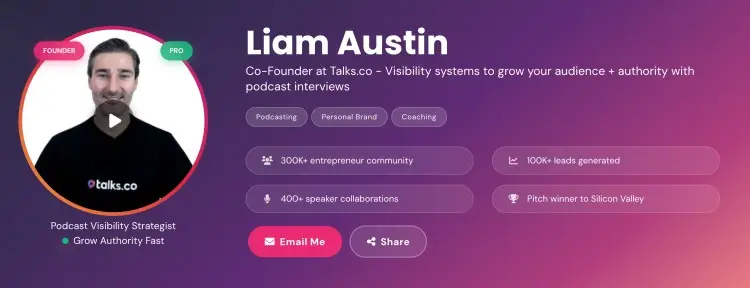
As a podcast host, you should be ready to introduce yourself whenever you launch a new episode or become a guest on another show. Use Talks podcast tools to come up with creative variations of your speaker bio.
Podcast Speaker Bio Generator Example
Just input your topics of expertise and your name, and generate a short but impactful speaker bio. You can use this to introduce yourself during speaking engagements and even add it to your speaker one-sheet.
For example, this is what I got when I inputted “Liam Austin” and “digital marketing, virtual events, and podcast visibility”.
“Liam Austin is a digital marketing guru with a knack for driving online success. As a trailblazer in virtual events, he’s redefining the landscape of online engagement. With his expert insights on podcast visibility, Liam helps hosts and guests shine in the crowded audio space. Tune in to hear his tips on leveraging digital strategies for maximum impact.”
Customization tip: Personalize by rewriting this in the first person point of view and by adding a relevant anecdote.
When you also need to introduce your show, the Talks podcast intro generator can produce a natural show opener that helps you give the audience a reason to stay for the full episode.
2. Guest speaker introduction examples
Here’s a reliable introduction for a guest speaker that balances warmth and authority. You can use this whether you’re recording remotely or introducing someone on a live stream.
“I am thrilled to introduce our guest speaker today. She’s a marketing strategist who turned a tiny budget into a seven-figure brand in under three years. Her work has been featured in major publications, and she regularly teaches public speaking to founders who want to share their message with clarity.
Today, we’re going to talk about how to stand out in this competitive market without adding to the noise. Grab your notes because this conversation is packed with value. Please join me in welcoming [Name].”
Customization tip: Add one detail about how you first discovered their work, so the connection with the speaker feels genuine.
3. Keynote speaker introduction example

A keynote speaker sets the tone for the entire day, so your energy should match the weight of the moment. Your goal for this introduction is to build anticipation, either by a thought-provoking idea or a shocking fact.
“Ladies and gentlemen, we’re about to explore a groundbreaking idea that’s already shifting how teams collaborate across the globe.
Our keynote presenter comes to us after leading a transformation project for a Fortune 500 company that saved millions and restored morale. He believes that leadership is a practice, not a title, and his stories stick with you long after the applause fades.
Today, he will share the exact key points that helped his team move from friction to flow. So get ready to take notes and learn from a true expert. Let’s welcome the speaker who’s here to challenge our thinking and expand our possibilities, [Name].”
Customization tip: Confirm the speech topic or title the night before, so your introduction isn’t vague and doesn’t cover promises that won’t actually happen.
4. Conference speaker introduction example
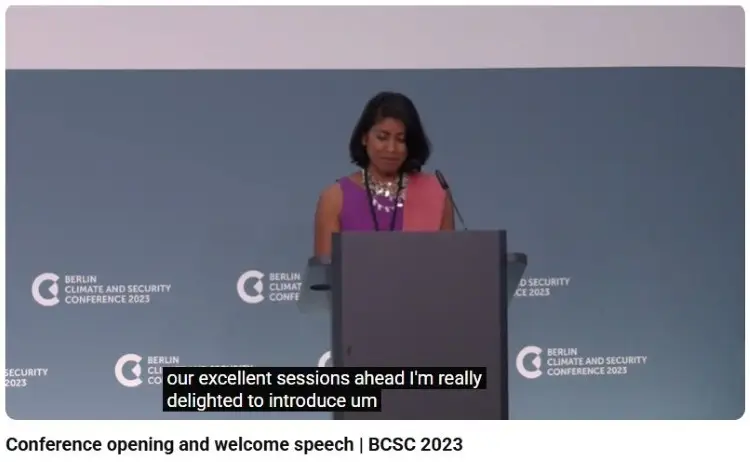
Conferences move fast, so your job is to stop the hallway chatter and pull people into the room. A strong opener boosts speaker credibility and keeps the schedule on track.
“Good morning, everyone. I hope you’re enjoying the sessions so far. Right now, I want to introduce a guest speaker who’s traveled across the country to be with us.
She’s the author of three bestsellers and the creator of a coaching program that has served over 10,000 students. Her latest research on decision fatigue answers a thought-provoking question that many of us wrestle with every Monday morning.
Here to change our minds and touch our hearts is [speaker’s name]. Let’s all give her a round of applause.”
Customization tip: Mention one credential that connects directly to the conference theme, so the room understands why this session matters to them.
5. Formal and corporate speaker introduction example
In boardrooms and annual meetings, professionalism wins over hype. A great introduction here is quiet, confident, and brief. Executives appreciate it when you respect the clock and get to the point.
“It’s my privilege to introduce speakers who bring both expertise and integrity to our organization.
Our presenter this afternoon holds an advanced degree in organizational psychology and has advised leadership teams across three continents. His credibility is built on two decades of measurable results and client renewals.
We asked him here because we believe his insights will create value for the audience and support our goals for the next quarter. Let’s offer a warm welcome to [speaker’s name].”
Customization tip: Keep the entire introduction under 60 seconds because corporate schedules rarely forgive long windups.
6. Casual and energetic speaker introduction example
Not every room needs a suit-and-tie vibe. Sometimes the best way to energize a crowd is to keep it human and fun. When the mood is light, your intro can be too.
“Alright, everybody, I need you on your feet for this one. The person I am about to bring up is the reason I stopped sleeping through my morning routine.
She runs a community of 10,000 creatives, and her weekly newsletter is the only one I read start to finish. Today, she’s going to teach us how to pitch anything without feeling salesy or weird.
I’ve seen her work in action, and she can get the audience hyped within seconds. So let us give a loud round of applause and bring up [speaker’s name].”
Customization tip: Use your own voice here because a good speaker introduction sounds like it came from a friend, not a press release.
How to Write an Introduction for a Speaker
Whether you’re hosting a podcast interview or looking to get booked on a podcast as an expert, learning to write your speaker introduction is a handy skill. Here are some quick reminders to keep your setup sharp.
- Be concise: A good introduction shouldn’t exceed one minute to consider short attention spans and the program schedule.
- Know the speaker: If you have little knowledge of the speaker, spend at least five minutes reviewing their work, so you don’t sound detached.
- Check pronunciation: Nothing breaks trust faster than mispronouncing the speaker’s name in front of a crowd, so verify the correct pronunciation beforehand.
- Match the tone: The best way to introduce a comedian differs from the way to introduce a speaker at a board meeting or on a podcast.
- Build an emotional bridge: Your role is to connect the audience with the speaker, so choose details that matter to the people in the seats.
- Avoid spoilers: Never give away the ending of a story or the core punchline that the speaker’s presentation depends on.
- Set the stage: Use your opening line to get the audience curious, so they’re already leaning forward when the guest steps up.
- Meet beforehand: Chat with the speaker before the event, so you understand their energy and can introduce them with authenticity, even if you’ve just met.
- Practice: The best way to introduce any speaker effectively is to rehearse out loud until the words feel natural.
If you’re new to podcasting, check these guides on how to find a podcast guest and how to prepare for a podcast interview.
What do you say when you introduce a speaker? (Checklist)
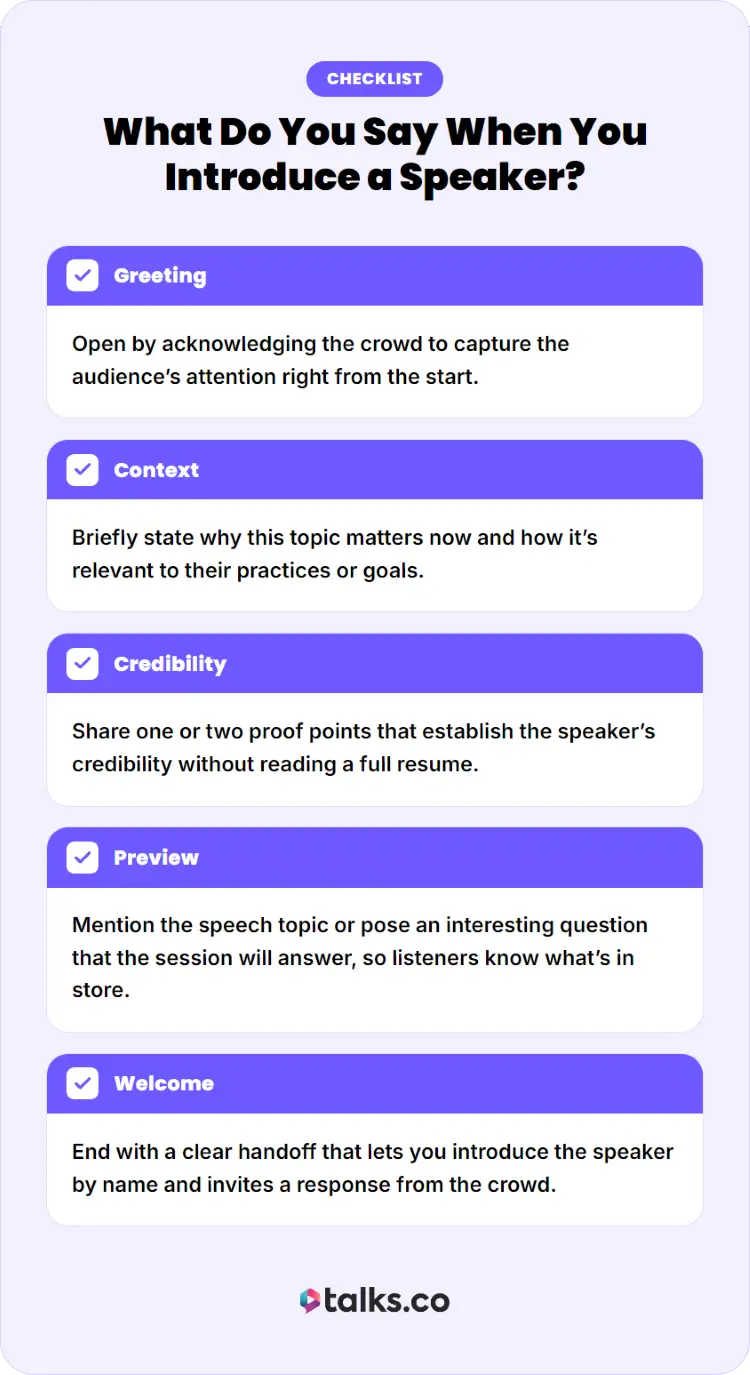
Every well-crafted introduction follows a simple structure. Think of it as a recipe with five main ingredients that you can adapt for any setting. Once you learn the pattern, you’ll never need to stress about what comes next.
☐ Greeting: Open by acknowledging the crowd to capture the audience’s attention right from the start.
☐ Context: Briefly state why this topic matters now and how it’s relevant to their practices or goals.
☐ Credibility: Share one or two proof points that establish the speaker’s credibility without reading a full resume.
☐ Preview: Mention the speech topic or pose an interesting question that the session will answer, so listeners know what’s in store.
☐ Welcome: End with a clear handoff that lets you introduce the speaker by name and invites a response from the crowd.
If you’re new to guest speaking, pay attention to how hosts set you up because the same rules apply when it’s your turn to host. And if you’re building your own platform, explore podcast hosting platforms to get your show online without tech headaches.
How to introduce speakers in a seminar
Seminars are intimate and interactive, which allows you to approach audiences more warmly. Still, it follows a lot of the same principles used by emcees and peer facilitators.
Here’s a quick rundown of do’s and don’ts:
Do’s:
- Prepare early: Start preparing at least a day ahead to introduce a speaker, so you aren’t scrambling through notes at the last minute.
- Ask first: It’s polite to ask the speaker if there are any topics they prefer you avoid mentioning. Also, confirm the speaker’s preferred title and pronunciation to show respect.
- Stay visible: A good guest speaker introduction sets the tone, so maintain eye contact with the room instead of reading off your phone.
- Ask preferences: Many speakers like to be introduced with a specific story or title, so verify what matters to them.
Don’ts:
- Don’t wing it: Even if you know the speaker personally, avoid inside jokes that exclude the crowd.
- Don’t read a full bio: Long lists of dates and degrees drain energy faster than you can say guest speaker’s credentials.
- Don’t vanish: Once the speaker arrives on stage, stay nearby until they have the mic and the crowd is settled.
- Don’t steal focus: Your job is to warm the room, not deliver your own speech.
How to introduce a speaker example

Writing a good speaker introduction script is only half the battle. Delivery is what transforms a decent setup into a moment the crowd remembers.
- Pause first: Walk to the mic, breathe, and let the room settle down first. This makes you appear confident, even in a room full of new faces.
- Make eye contact: Build rapport even before you speak. Listeners can feel grounded and more present with your attention on them.
- Speak clearly: Articulate your words, so the guest hears their own name correctly as they approach the lectern.
- Step aside: Once the final line is said, move away quickly so the crowd shifts its focus to the speaker.
- Lead applause: Start the clapping yourself to signal the rest of the room. Make the speaker feel welcomed.
The dynamic changes if you’re just introducing yourself on your own show or on your digital speaker profile. If you’re looking for an example of that, check out my video speaker introduction for Talks.
Speaker Introduction Template (Copy & Use)
You don’t always have to build your speaker introduction from scratch. These sample scripts will help you create an introduction in under two minutes.
Podcast template
“Welcome to [Show name], [Show tagline]. This is episode [Number] entitled [Episode title]. Today we are talking about [Theme].
Our guest speaker is an expert in [Topic] and has [Credential]. I discovered their work through [Story], and I’ve been following them ever since.
We’re going to explore [Speech topic] together so you can leave with [Benefit]. Let’s jump in and welcome [Name].”
Speaking event template
“Good [morning/afternoon/evening]. It’s an honor to stand here as your host today.
Our first speaker comes to us with a background in [Industry] and a reputation for [Result]. I had the chance to read their latest [Article or book], and it’s exactly the kind of insight we need right now. Let’s offer a warm welcome to [Name].”
You can also use these podcast script templates and a solid podcast introduction script to keep every episode smooth.
Get Introduced to Your Next Guest
Speaker introduction examples show you what it takes to sound like a seasoned host. It takes intention and authenticity to actually capture a crowd.
Put your speaker intro scripts to use. Book podcast guests using Talks and start recording podcast interviews for your show.
All it takes is a free Talks Creators profile. It modernizes podcast matching, making it the easiest way to connect with industry experts actively looking for speaking opportunities.
No time to connect? No problem. The AI mutual matching system got rid of the need to pitch or send emails back and forth.
Deborah already got 10 bookings. Sanjai completely filled up his calendar.
Yes! I Want to Set up my Talks Creators Profile Now!


