

Need to hire a keynote speaker? Start with the audience, not the speaker’s fame.
I’ve organized enough virtual summits, workshops with motivational speakers, corporate events for inspirational thought leaders, and interviews to see what happens when the wrong person gets the microphone. People check their phones, conversations drift, and 45 minutes suddenly feels like a very long time.
So, how do you hire keynote speakers worth putting in front of your audience to deliver, inspire, and motivate?
If you hire a speaker, could their expertise solve a real problem for the people in the room? Can they tell a story that sticks? Do their experience and personality fit the event? And what should you expect to pay?
Grab your coffee and let’s break down what keynote speakers do, how they differ from guest and resource speakers, how much they make, the tricks to finding the perfect professional speakers, and how to hire the right one.
What Are Keynote Speakers?
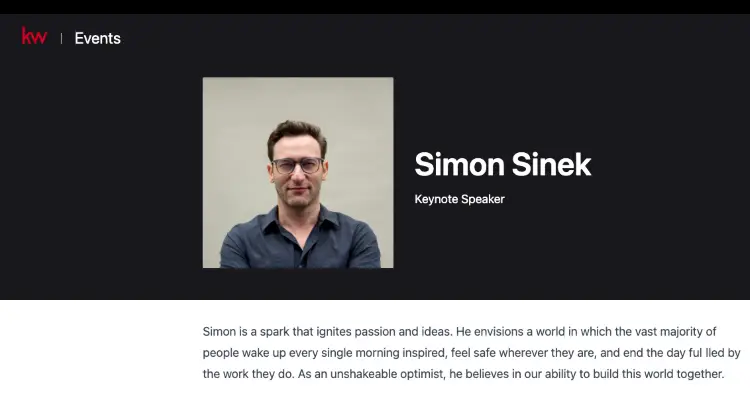
A keynote speaker gives the audience a big idea or vision to organize and promote the rest of the event around.
At Mega Camp 2026 in San Antonio, Keller Williams put Simon Sinek in that role as a business keynote speaker after the organization realized more than 4,000 KW-affiliated agents and industry leaders attended the 2025 event.
- Event anchor: The keynote can give separate workshops and sessions a common thread.
- Memorable takeaway: The speech should leave attendees with an idea they can repeat and discuss afterward.
- Right-sized message: The subject needs enough breadth to resonate across the wider audience.
- Main-stage presence: The speaker typically addresses the largest audience during a high-profile slot.
Keynote speaker meaning
“Keynote” comes from the idea of setting the tone or central theme for what follows. When you’re hiring a corporate speaker or a celebrity, look beyond the speaker’s job title and ask what their talk will give the audience that fits the occasion.
- Theme setter: The speech gives the event a recognizable point of view.
- Big-picture thinking: The subject usually reaches beyond one narrow skill or technical task.
- Story or perspective: Strong keynote speeches often give people an entertaining way to think about the topic.
- Event connection: The speaker’s message should make sense for the occasion, audience, and wider program.
What Does a Keynote Speaker Do?
A keynote speaker can teach a new approach, challenge an assumption, or give the audience and event planners a new technique they can immediately use or apply afterward.
At a leadership summit, the focus could be workplace culture; at a marketing conference, the keynote might center on AI planning and how to educate the team on governance, how to ensure customer engagement and how to budget ad spend, or brand experiences.
- Set the theme: Frame the event around an idea that fits the audience and occasion.
- Teach: Turn research, expertise, talent, or experience into useful takeaways.
- Tell stories: Bring a wide range of personal experiences and specific examples into the subject.
- Shift perspective: Encourage attendees to reconsider familiar ideas about leadership, marketing, or performance.
- Prompt action: Give the audience practical tips and ideas they could apply and explore after the event.
Keynote speaker example
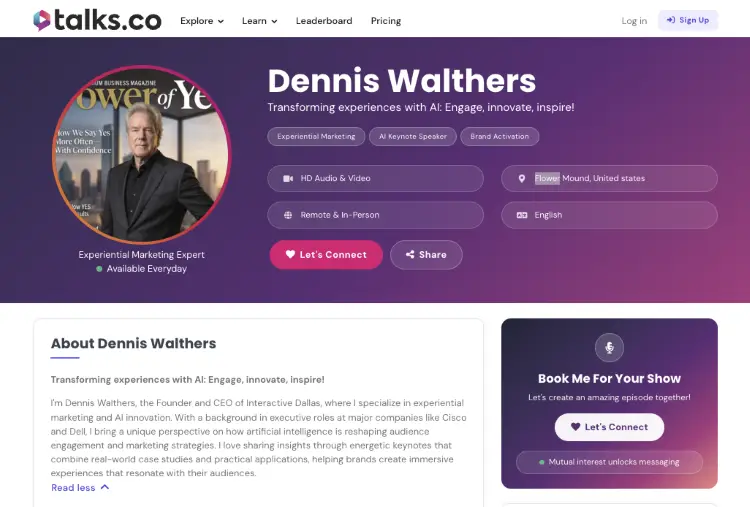
These Talks profiles show that the right keynote speaker depends on the audience, subject, and outcome the event needs.
- Dennis Walthers: Founder and CEO of Interactive Dallas, bringing AI innovation, experiential marketing, and brand activation together through real-world case studies.
- Stella James: Draws on building Gooseberry Planet across 14 countries, raising £1 million, surviving cancer treatment, and rebuilding after major personal loss.
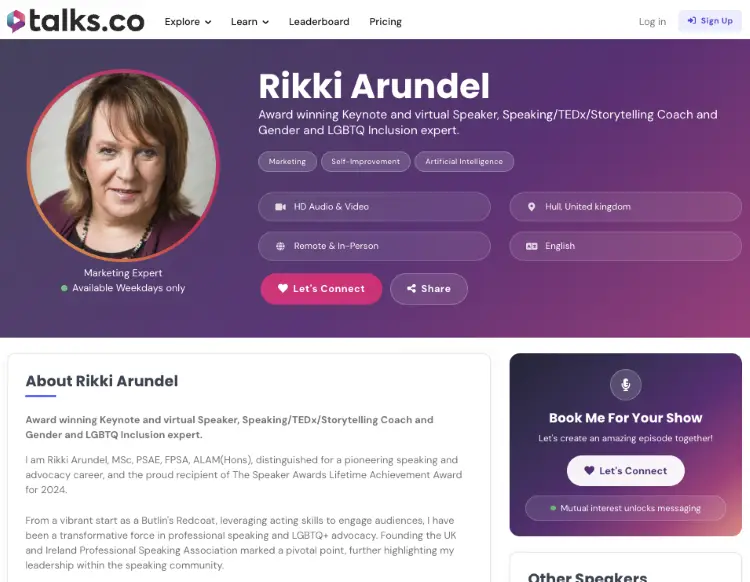
- Rikki Arundel: Brings award-winning speaking experience, TEDx storytelling, transgender awareness, LGBTQ+ inclusion, and workplace advocacy to the stage.
- Jeff Brandeis: Uses his ENGAGE Method and 25+ years of corporate leadership experience to help presenters create more interactive webinars and presentations.
- Maya Madkour: Combines her work as a professor, author, PhD candidate, and international keynote speaker with science-backed perspectives on wellbeing and peak performance.
How to Hire Keynote Speakers (Checklist)
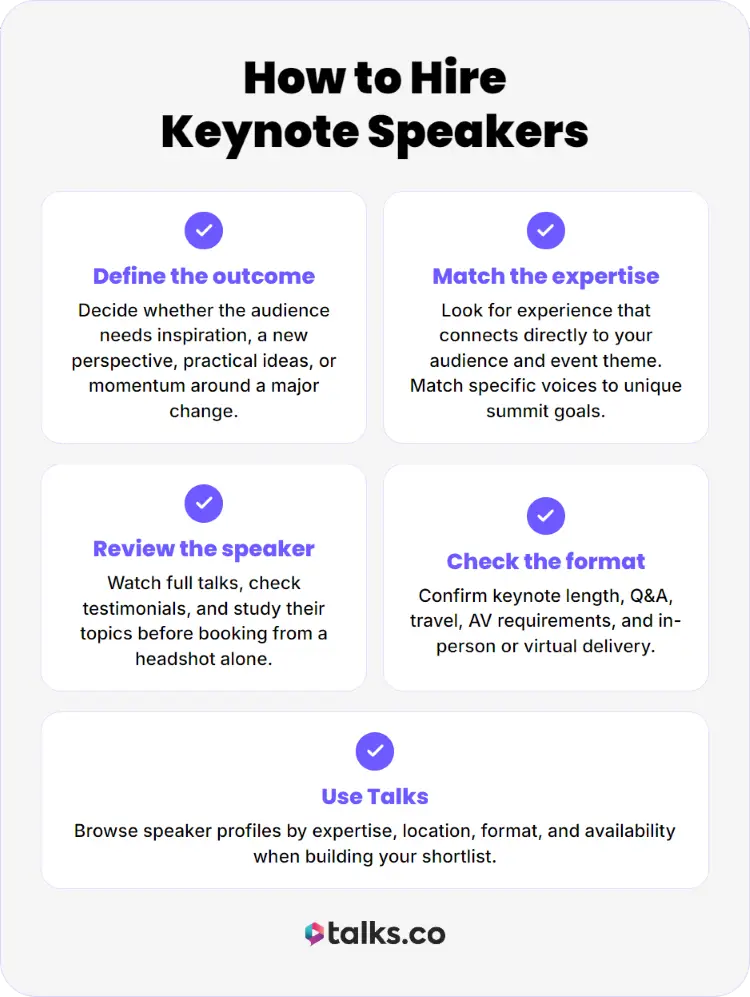
To hire the perfect keynote speaker, you need to start with the event you’re trying to create, the audience sitting in the room, and the message you want them discussing afterward.
☐ Define the outcome: Decide whether the audience needs inspiration, a new perspective, practical ideas, or momentum around a major change.
☐ Match the expertise: Look for experience that connects directly to your audience and event theme. A San Antonio real estate conference needs a different voice from a London fintech summit or a company-wide sales kickoff in Chicago.
☐ Review the speaker: Watch full talks, check testimonials, and study their topics before booking from a headshot alone.
☐ Check the format: Confirm keynote length, Q&A, travel, AV requirements, and in-person or virtual delivery.
☐ Use Talks: Browse speaker profiles by expertise, location, format, and availability when building your shortlist.
Why Hiring a Keynote Speaker Matters
The right keynote can give hundreds or thousands of attendees a shared reference point for the rest of an event.
Dennis Walthers, Founder and CEO of Interactive Dallas, could bring AI, experiential marketing, and brand activation to the center of a marketing conference, giving attendees a common theme to carry into the sessions that follow.
- Creates a shared focus: Gives a large audience one central idea to carry into later sessions.
- Sets the energy: An opening keynote can get a room ready for a full day of workshops and presentations.
- Adds credibility: A recognized expert can strengthen the perceived value of the event.
- Creates memorable moments: A strong story or insight can become the line attendees repeat afterward.
- Extends the event: Keynote clips, quotes, and ideas can fuel social posts, newsletters, and follow-up content.
Keynote speaker vs resource speaker
Trying to decide who belongs on the main stage and who belongs in the breakout room? Start with the job you need the speaker to do, then use the table below to see which role fits your event.
| Keynote speaker | Resource speaker | |
|---|---|---|
| Main purpose | Sets the event’s central message | Teaches a specific subject |
| Content | Big ideas, stories, and perspectives | Skills, processes, research, or technical knowledge |
| Typical format | Main-stage keynote | Workshop, breakout, or training |
| Audience | Usually the full event audience | Often a specific group or learning track |
| Example | Rikki Arundel on LGBTQ+ inclusion and authentic leadership | HR specialist teaching inclusive workplace practices |
Keynote speaker vs guest speaker
Choosing between a keynote and a guest speaker? Look at how important their contribution is to the event’s main message, then consider where they fit into the schedule.
| Keynote speaker | Guest speaker | |
|---|---|---|
| Main role | Carries a central event message | Adds expertise or perspective to a session |
| Schedule | Often opens or closes the main program | Can appear anywhere on the agenda |
| Audience | Usually speaks to the full audience | May speak to a specific group |
| Topic | Connects closely to the event theme | Can focus on a narrower subject |
| Example | Rikki Arundel addressing LGBTQ+ inclusion at a leadership conference | A local HR director sharing practical inclusion policies in a breakout |
Difference between keynote and guest speaker
Still unsure which one you need? Ask yourself how much weight the speaker needs to carry within the event, then match the role to that responsibility.
| Keynote | Guest speaker | |
|---|---|---|
| Event impact | Shapes the wider conversation | Strengthens one part of the program |
| Message | Broad enough for the entire audience | Focused on a particular topic |
| Placement | Usually gets a headline time slot | Fits around the wider agenda |
| Preparation | Built around the event’s core objective | Built around the assigned session |
| Quick test | “Could this person represent the main idea of the event?” | “Would this person add value to one session?” |
How Much Do Keynote Speakers Make?
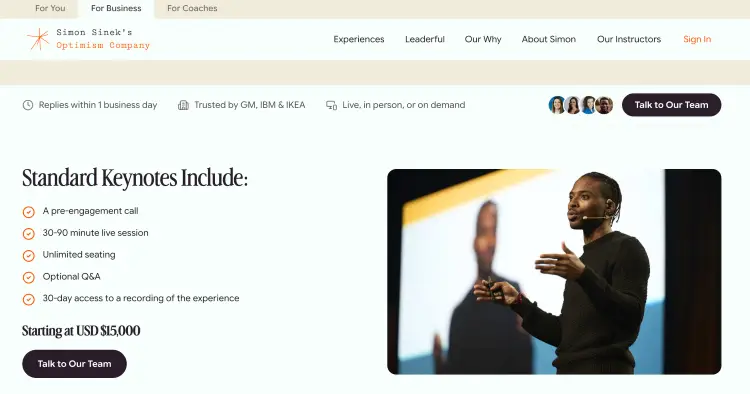
Keynote speaker pay can look very different depending on how the speaker earns their money. A salaried speaker role averages $50,890 per year, while independent speakers can charge several thousand dollars for a single keynote.
- Salary benchmark: $50,890 average annual pay for keynote speaker jobs in the U.S.
- Typical range: Salaries run from roughly $40,000 at the 25th percentile to $57,500 at the 75th percentile.
- Pricing variables: Experience, specialization, audience size, event type, travel, and demand can all affect the booking fee.
Do keynote speakers get paid?
Yes, keynote speakers can charge for a single appearance, and the number can vary dramatically from one speaker to another.
- Entry-level booking: Jeff Ponders II starts at $350 for a 30-90 minute engagement.
- Developing speaker: The Burnout Breakthrough prices keynotes and workshops from $650 to $5,500 per event.
- Specialist: Rhonda Petit charges $1,500 to $5,000 for leadership and healthcare speaking.
- Established speaker: Marina Morgan and Michael Forman charge $3,000 to $10,000 per event.
- Premium booking: Mark Fabian charges $7,800 to $22,000 per event.
Check out how to become a keynote speaker and read up on podcast booking agencies if you’re looking for your next public speaking opportunity.
Most expensive keynote speakers
At the upper end of the market, keynote fees can reach tens of thousands of dollars for a single appearance. Those prices tend to reflect a speaker’s reputation, specialized expertise, demand, and the value an event expects from putting them on its main stage.
- $22,000: Mark Fabian’s published range reaches $22,000 for an event.
- $10,000: Tony Bradshaw’s upper published rate reaches $10,000.
- $7,800: Mark Fabian’s lower published rate already sits well above many entry-level speaking fees.
- $7,500: Dr. Dennis Cummins starts at $7,500 per event.
Where to Find Keynote Speakers for Hire
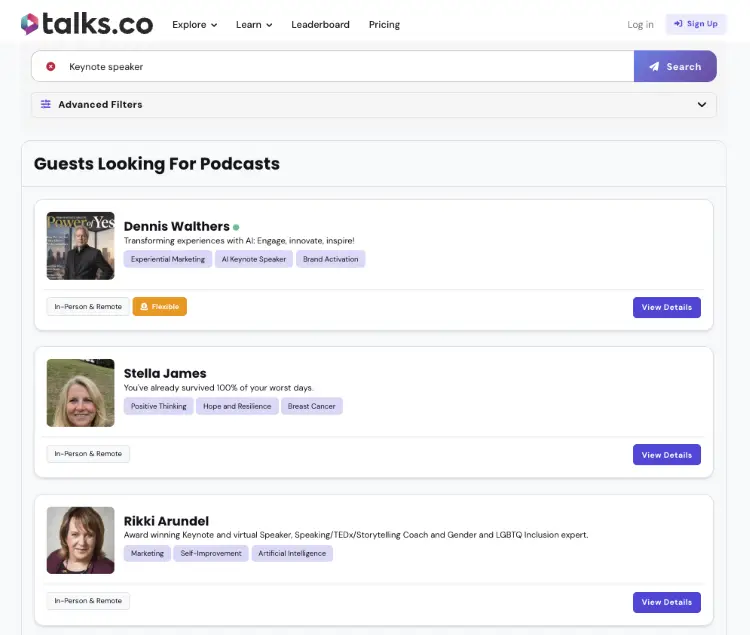
Finding a keynote speaker gets easier once you know where to look. You can search speaker bureaus, professional networks, conference lineups, and expert marketplaces, or head straight to Talks to hire motivational speakers when you want to browse speaker profiles and match your event with someone who fits the brief.
- Talks: Browse expert profiles by topic, location, speaking format, and availability, then connect with speakers who match your event.
- Speaker bureaus: Agencies can recommend established speakers and handle booking logistics, contracts, and travel arrangements.
- Professional associations: Industry groups can point you toward respected experts already speaking on your subject and expose you to other public speaking platforms.
- Conference agendas: Check events like SXSW, Dreamforce, or INBOUND to find speakers with relevant stage experience.
- LinkedIn: Search for experts by specific topics, industries, publications, and previous speaking appearances.
- Your network: Ask clients, partners, podcast hosts, and other event organizers who they’ve brought onto their stages.
If you want to start with Talks, browse keynote speakers on Talks and create your free Talks profile as your public speaker website to connect with speakers and experts.
Who Do You Want Up Onstage?
Your event has a stage. You have a room full of people. Now comes the part that can make or break the whole thing: deciding who deserves the microphone.
A famous name might fill the room, but when you hire a keynote speaker based on reputation alone, that decision can get expensive fast. The better question is who has the expertise, story, and point of view your audience will actually remember.
So, when you’re ready to hire keynote speakers, start looking where the experts already are.
Talks lets you create a free profile and connect with experts based on what your event actually needs. Your next standout keynote could be a few clicks away.
Create your free Talks profile and get matched as quickly as 5 minutes!


