

What’s the trick for how to be a confident speaker in public is to treat every talk like a match?
Rehearse your opening, steady your breathing, and rehearse your speech to one person at a time until you’re comfortable speaking in public and feel confident enough to make eye contact to keep your audience’s attention.
I played striker in Australia’s national soccer competition, and I still run that routine before I host a virtual summit in front of a crowd with 20 to 30 expert speakers and communicators or open my weekly group coaching call on Zoom to feel less anxious.
So take a deep breath, grab your coffee and borrow the public speaking skills a lot of public speaking experts like toastmasters and I use to tell stories that resonate and be a confident public speaker online and offline.
This public speaking confidence article lays out what I do before, during, and after every speech, plus a 4-week practice plan, PowerPoint tips, so you can walk into your next stage, Zoom call, or podcast calm and ready.
What Is Confidence in Public Speaking?
Confidence in public speaking is the steady belief that you can deliver your point, recover from a slip, and keep the room with you while your heart races.
About 95% of successful speakers have felt daunting public speaking anxiety at some point, according to Ambitions ABA, so nerves can sit right beside self-confidence. Build that belief one talk at a time, and you’ll speak confidently in public in any room with and without a script you memorize.
What confident and nervous delivery look like
Confident delivery sounds specific, steady, and unhurried, and nervous delivery shows up in hedging words, fast pacing, and busy hands.
- Opening: A nervous opener sounds like “Um, so, I guess I’ll start with podcasts,” and a confident opener sounds like “In the next 5 minutes, you’ll learn how to book your first podcast interview.”
- Pace: A nervous speaker rushes a 5-minute story into 3 minutes while a confident speaker takes a full breath after each key point so the room can take it in.
- Eye contact: A nervous speaker watches the floor or the slides. A confident speaker finishes each sentence looking at one person.
- Hands: Nervous hands fiddle with a pen or a lanyard, and confident hands rest at waist height and move on your key points.
- Ending: A nervous close trails off with “So, yeah, that’s it, thanks,” and a confident close ends with a clear ask like “Book your first guest spot this week.”
How to Be a Confident Speaker in Public
A confident speaker in public prepares before the talk, steadies their eyes and voice during it, and reviews it afterward, because confidence grows with every loop. Use these tips to boost your confidence and improve your public speaking skills and body language.
Before you speak: Build a rehearsal routine and a strong opening
Build a rehearsal routine and a strong opening for your key messages by giving your first 60 seconds more practice than any other part of the talk, since a deep breath before you start and a settled opener will help you overcome the fear of giving a speech publicly.
- Spaced rehearsals: Book three rehearsals of 20 minutes on three different days, so your brain gets a night between runs.
- Strong opening: Open with one specific number or story from your own work, like “Last month, a client booked four podcasts in 10 days,” and rehearse it until you can say it looking away from your notes.
- Confidence exercises: Pair the rehearsals with confidence building exercises, like saying your opening to your bathroom mirror and then to a friend over FaceTime.
- Day-of ritual: Arrive or log in 15 minutes early, sip water, and read your opening line twice.
- Last minute: In your final 60 seconds, stand tall, press your feet into the floor, breathe out slowly, and say your opening line silently once.
While you speak: Eye contact and vocal delivery to connect with your audience

Eye contact and vocal delivery carry your confidence while you speak, so hold gazes for a full thought and aim your voice at the back of the room.
- Friendly face: Pick one smiling person for your first sentence, and your voice settles before you widen your gaze.
- Eye contact: Hold each person’s gaze for one full thought, about 3 to 5 seconds, then move to someone in a different part of the room.
- Volume: Aim your voice at the person farthest from you, and your volume rises without feeling like shouting.
- Fillers: Swap “um” and “like” for a one-second silence, and your sentences sound certain.
After you speak: Review and reset to get better at public speaking
Review and reset within an hour of finishing by writing down one win and one fix while the talk is still fresh.
Roughly 80% of people with public speaking anxiety feel immense relief once the speech is over, according to Supportive Care ABA, so that rush is the best moment to capture constructive feedback so you can continue building confidence as a successful public speaker.
- Win: Write one thing that went well, like the laugh at your opening or the question you answered smoothly to improve your confidence, because confidence grows from evidence.
- Fix: Pick one change for the next time you speak publicly and don’t be afraid to write it as an action for the next public speaking event like “pause after the price.”
- Feedback: Ask one trusted listener, “Which moment was clearest?” so you know what to repeat, what the areas for improvement are to enhance your presentation, and you can learn from the best to boost your confidence in public speaking.
- Reset: Take a 10-minute walk and answer messages later, so your next talk starts fresh and you become a more confident public speaker in a room full of people waiting for you to get your message across.
- Proof file: Keep a phone note titled “Proof,” add one line after every talk from your personal experiences, and read it before your next one to overcome your fear and become more comfortable speaking in front of a big crowd.
How to Be a Good Speaker in Public
Giving each setting its own first minute makes you a good speaker in public: a planted stance on stage, a warm hello to the lens on Zoom, and a ready story for the host on a podcast.
Tips for speaking on stage
On stage, confidence comes from knowing your cue, your spot, and your first 30 seconds.
- Time cue: Agree on a signal with the emcee, like a raised hand at two minutes left, so you never glance at a clock.
- Mic check: Say your opening sentence into the mic during setup, so your amplified voice sounds familiar when it counts.
- First breath: Walk to your spot, plant your feet, and breathe in for three seconds before you say hello.
- First stage: Start with a 15-minute slot at a local meetup or a coworking event, since each public speaking opportunity gives you stage time to build on.
Tips for speaking on Zoom
On Zoom, confidence comes from a clean screen and the first 30 seconds you control.
- Tab cleanup: Close every tab and silence notifications 10 minutes early, so a pop-up never rattles you.
- Self-view: Check your framing, then hide your own video, since watching your face makes you self-conscious.
- Early hello: Join five minutes before start time and chat with the host, so your first words on the call are a conversation and not your talk.
- Standing talk: Stand if you can, because your breath and voice open up.
Tips for speaking on podcasts
On podcasts, confidence comes from knowing the show and having your first answer ready.
- Show study: Listen to two episodes and note how the host opens and how long guests talk.
- First answer: Write your answer to “Tell us about yourself” in three sentences and say it aloud five times, since it’s a common first question.
- Warm-up shows: Learn how to get booked on podcasts with a short pitch, and treat each smaller show as a rep before you pitch one of the most popular podcasts.
- Headphones: Wear them so the host’s voice stays in your ear and the interview feels like a chat.
How to Become Confident in Public Speaking
You become confident in public speaking by practicing a little every week, since each talk, big or small, hands your brain proof that you can do it.
A 4-week confidence practice plan
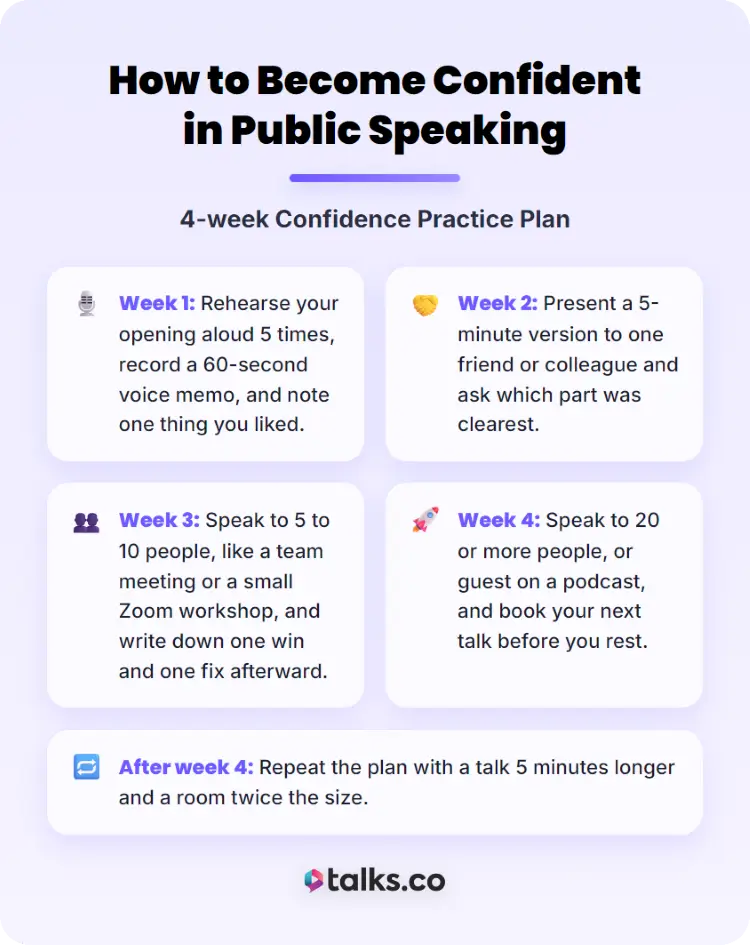
A 4-week confidence practice plan builds from rehearsing alone to speaking for a real audience, with one small win each week.
- Week 1: Rehearse your opening aloud 5 times, record a 60-second voice memo, and note one thing you liked.
- Week 2: Present a 5-minute version to one friend or colleague and ask which part was clearest.
- Week 3: Speak to 5 to 10 people, like a team meeting or a small Zoom workshop, and write down one win and one fix afterward.
- Week 4: Speak to 20 or more people, or guest on a podcast, and book your next talk before you rest.
- After week 4: Repeat the plan with a talk 5 minutes longer and a room twice the size.
Where to find rooms to practice in

Find rooms to practice in by joining a club, booking a coach, and saying yes to small invitations.
- Talks: Create a free profile on Talks, browse podcast shows that fit your topic, and book one interview a month, so each guest spot becomes a real room to practice in.
- Clubs: Visit three of the public speaking groups in your area during your first month and join the one where you feel welcome.
- Coach: Book one session of speaker coaching to run your 5-minute talk and leave with three notes.
- Ideas: Browse resources for public speaking when you need a new talk topic, and pick one to try this week.
- Big picture: Read how to become a public speaker to see where each talk can lead.
- Virtual summits: Pitch yourself to a virtual summit host, since summits line up 20 to 30 expert speakers and each one records from their own desk.
How to Be More Confident in Public Speaking
Calm your body before you go on and recover fast from slips, and you’ll feel more confident in public speaking. About 90% of the anxiety people feel before a presentation comes from a lack of preparation, according to Cross River Therapy, so the plan above is already working on it.
Breathing exercises for nerves
Breathing exercises for nerves calm your body fast, so pick one and run it before every talk.
- Box breath: Breathe in for four counts, hold for four, breathe out for four, hold for four, and repeat four times.
- Finger trace: Trace your hand with a finger, breathing in as you climb each finger and out as you slide down.
- Humming exhale: Hum on each exhale for five breaths, and your throat loosens before you speak.
- Go deeper: Read how to overcome fear of public speaking when nerves keep you from saying yes.
What to do after a mistake
The fear of making mistakes is a primary driver of public speaking anxiety, according to Ambitions ABA, so plan your reset before you need it.
- Pause: Take one breath and give yourself a full second before the next sentence.
- Name it once: Say “Let me restart that sentence” once and keep going, and skip the extra apologies.
- Light line: Keep “Well, that part got away from me” ready, and move on with a smile.
- Fix list: Add the slip to the one-fix list from your review, so the same mistake shows up less.
You Know Your Worth
Knowing how to be a confident speaker in public comes down to a loop you can start this week: rehearse your opening, steady your breath and your eyes while you speak, and write down one win and one fix afterward. Run it through the four-week plan, and your nerves start to feel like a warm-up.
You already know your worth, so give it a real room.
Create your free Talks profile, and Auto-Match will find podcasts that fit your topic while Auto-Message sends a personalized reply the moment you connect.
Then say yes to your first invitation and take the plan with you.
Get Your Free Talks Profile ASAP


